NEET Zoology Syllabus (Latest)– Chapter-wise Topics, Weightage & Expert Tips
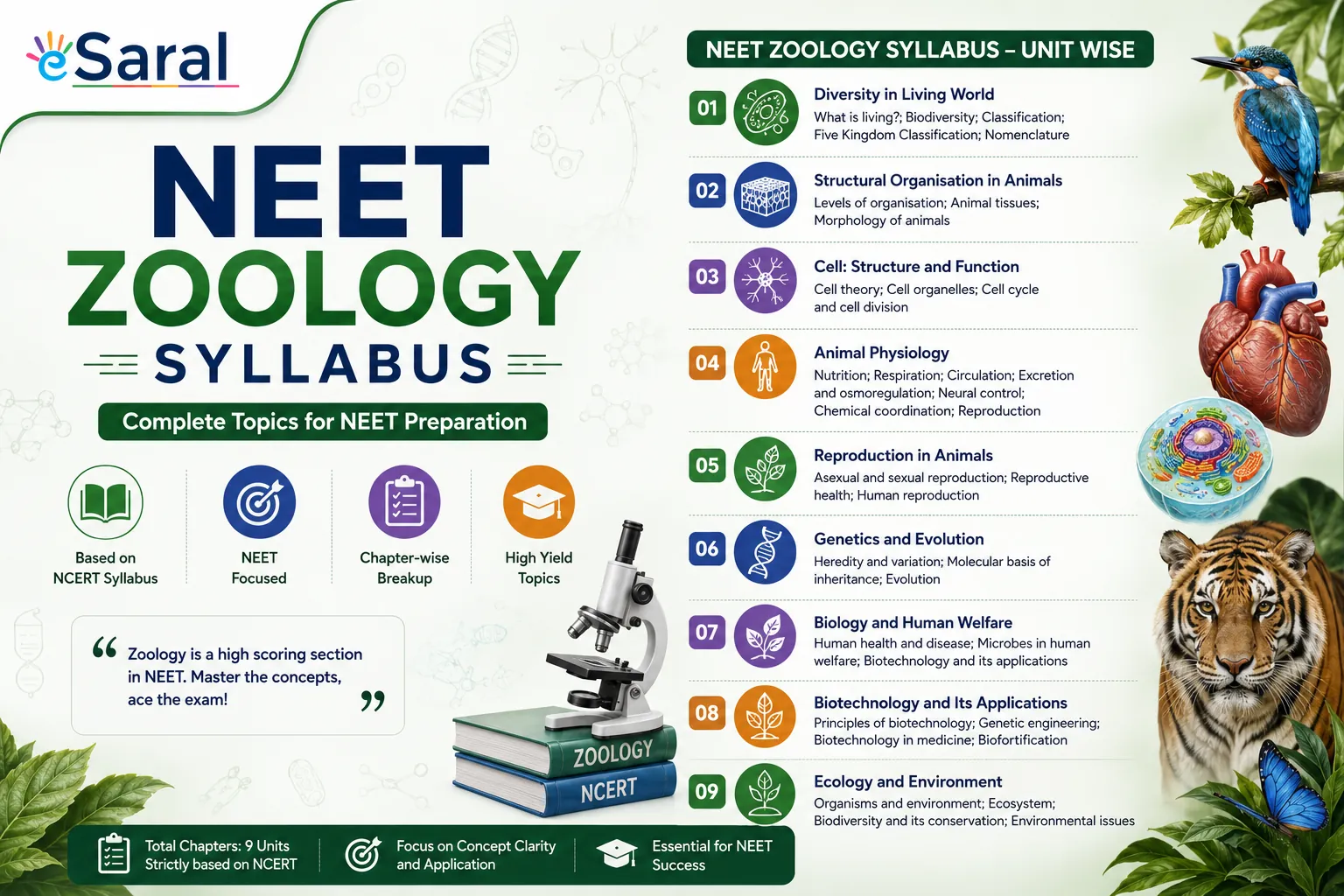
Table of Contents

Home > NEET > NEET Zoology Syllabus 2025

The NEET UG exam focuses on the Biology syllabus for NEET from both classes 11th and 12th. Biology carries the highest weightage among all subjects in the NEET syllabus, making it crucial for you to prioritize your studies.
Understanding the chapter-wise weightage of the biology NEET syllabus can help you focus on important topics first. This section consists of 90 questions covering both Botany and Zoology. It’s important to note that the zoology chapter for NEET covers to NCERT books, so you are advised to thoroughly study them.
The National Testing Agency (NTA) has released the syllabus for the NEET UG exam, which consist of undergraduate medical admissions. The official website, neet.nta.nic.in, will act as the main hub for all exam-related activities, through this portal, candidates can complete their registration, submit applications, and access important documents such as the information bulletin, exam city intimation slips, admit cards, answer keys, results, and other essential updates.
NEET Biology Syllabus Overview
The NEET biology syllabus comprises two branches which are Botany and Zoology. Botany mainly focuses on studying plant life, while Zoology deals with animal biology. The NEET biology syllabus is designed to assess you on the topics covered in Class 11 and Class 12 of their school curriculum. The biology syllabus for NEET is extensive, covering a wide range of topics which is given by the NCERT. Therefore, you need to understand and go through the biology Class 12th zoology NEET syllabus thoroughly.
|
Biology NEET Syllabus Overview |
|
|
Parameter |
Details |
|
Official Release |
|
|
Authority |
National Testing Agency (NTA) |
|
Syllabus Availability |
Available on NTA’s official website |
|
Document Format |
|
|
Key Sections |
Physics, Chemistry, Biology |
|
Changes from the Previous Year |
Yes (Specified in the revised sections) |
|
Accessibility |
NEET syllabus PDF by NTA is Available |
|
Applicability |
Mandatory for NEET aspirants |
NEET Biology Syllabus For Class 11
The Class 11th zoology NEET syllabus for biology for Class 11 plays a vital role in the preparation for the National Eligibility cum Entrance Test (NEET). It gives the specific topics and subtopics that Class 11 candidates should prioritize to succeed in the Biology section of the NEET exam. Below is an outline of the NEET syllabus for biology for Class 11, emphasizing the important areas you should concentrate on based on the updated guidelines provided by NTA.
|
NEET Biology Syllabus for Class 11 |
|
|
Unit Name |
Unit Topics |
|
Unit 1 – Diversity of Living Organisms Change |
|
|
Unit 2 – Structural Organization in Plants & Animals Change |
|
|
Unit 3 – Cell Structure and Function No Change |
|
|
Unit 4 – Plant Physiology |
|
|
Unit 5 – Human Physiology |
|
NEET Biology Syllabus For Class 12
As per the updated guidelines from NTA, the Class 12th zoology NEET syllabus for Class 12 emphasizes building upon the fundamental concepts introduced in Class 11 while also exploring more advanced topics and principles in Biology. It consists of a range of subjects such as human reproduction, evolution, ecology, biotechnology, genetics, and others. The updated Class 12th Zoology NEET syllabus outlines the key topics and subtopics that you should concentrate on as you prepare for the exam.
|
NEET Biology Syllabus for Class 12 |
|
|
Unit Name |
Unit Topics |
|
Unit 6 – Reproduction |
|
|
Unit 7 – Genetics & Evolution |
|
|
Unit 8 – Biology and Human Welfare |
|
|
Unit 9 – Biotechnology and its Applications |
|
|
Unit 10 – Ecology and Environment |
|
NEET Biology Syllabus For Zoology
The NEET zoology syllabus is designed to assess your comprehension of diverse zoological aspects, encompassing animal classification, structural organization, cell biology, and human physiology. Through these core areas, the zoology syllabus for NEET offers a thorough structure for evaluating your proficiency and understanding within the realm of zoology.
NEET Biology Syllabus For Zoology |
|
|
S. No |
Chapter Name |
|
1 |
Structural Organization in Animals (including Frog) |
|
2 |
Biomolecules |
|
3 |
Breathing and Exchange of Gases |
|
4 |
Body Fluids and Circulation |
|
5 |
Excretory Products & their Elimination |
|
6 |
Locomotion & Movement |
|
7 |
Neural Control & Coordination |
|
8 |
Chemical Coordination & Integration |
|
9 |
Animal Kingdom |
|
10 |
Human Reproduction |
|
11 |
Reproductive Health |
|
12 |
Evolution |
|
13 |
Human Health and Diseases |
|
14 |
Biotechnology: Principles & Processes |
NEET Biology Syllabus Weightage
Before starting the preparation, you should familiarize yourself with the zoology syllabus for NEET distribution of marks for NEET Syllabus . Understanding the weightage helps in prioritizing topics that carry more marks. The table summarizing the marks assigned to each chapter in NEET zoology chapter wise weightage , which is essential for effective study planning.
|
NEET Biology Syllabus Weightage |
||
|
Chapters/Topics |
Average No. of Questions Based on 5 Years Analysis |
Weightage (%) |
|
NEET Chapter Wise Weightage for Zoology |
||
|
Structural Organisation in Animals (Animal Tissues) |
4 |
8% |
|
Locomotion and Movement |
3 |
6% |
|
Body Fluids and Circulation |
2 |
5% |
|
Evolution |
3 |
6% |
|
Biomolecules |
5 |
10% |
|
Human Reproduction |
3 |
6% |
|
Breathing and Exchange of Gases |
2 |
4% |
|
Excretory Products and Their Elimination |
2 |
5% |
|
Reproductive Health |
4 |
8% |
|
Biotechnology – Principles and Processes |
6 |
12% |
|
Human Health and Disease |
3 |
6% |
|
Biotechnology and Its Applications |
4 |
7% |
|
Animal Kingdom |
7 |
13% |
|
Neural Control and Coordination |
1 |
2% |
|
Chemical Coordination and Integration |
2 |
4% |
Frequently Asked Questions
Find answers to common questions.
Which is the most important chapter in NEET Zoology from Class 12?
Genetics and Molecular Basis of Inheritance is consistently the most high-yield chapter in Class 12 zoology. It regularly contributes 7–9 questions in NEET, covering Mendelian genetics, DNA structure, replication, transcription, translation, Lac Operon, and chromosomal disorders. Human Reproduction is the second most important chapter from Class 12.
Is NEET Zoology syllabus the same as NCERT Biology?
Yes, the NEET 2025 zoology syllabus is based entirely on NCERT Class 11 and Class 12 Biology textbooks. NTA designs questions directly from NCERT content — including in-text questions, diagrams, and examples. Thorough NCERT study, line by line, is the most reliable preparation strategy for zoology
How many questions come from zoology in NEET 2025?
Out of 90 biology questions in NEET 2025, approximately 45 are from zoology and 45 from botany. Each question carries 4 marks, making the zoology section worth up to 180 marks. The exact split can vary slightly, but NTA has historically maintained near-equal distribution between the two branches.
How is the NEET 2027 zoology syllabus different from the last year's syllabus?
NTA revised the NEET syllabus last year, and those changes carry forward to NEET 2027. Some chapters that were removed in the 2024 revision remain excluded. Candidates should always verify against the official NTA notification on neet.nta.nic.in rather than relying on older PDFs or third-party sources. The syllabus tables on this page reflect the current NTA-released version
Can I skip Ecology for NEET Zoology 2025?
Skipping Ecology entirely is not advisable. While it has lower weightage than Human Physiology or Genetics, Ecology (Unit 10) still contributes 4–6 questions in most NEET papers. The topics are also relatively straightforward — biodiversity, ecosystem structure, and environmental issues can be covered efficiently in 5–7 days, giving a solid return.
Which zoology unit from Class 11 has the highest weightage?
Human Physiology (Unit 5) carries the highest weightage from Class 11 zoology. Topics like the cardiac cycle, nephron structure and function, neural coordination, and endocrine glands are frequently tested. This single unit can account for 8–10 marks, making it the most important Class 11 zoology unit to master.