NEET 2026 Paper Analysis: Chapter-Wise Weightage and Difficulty
NEET 2026 paper analysis shows Modern Physics, Electrostatics, Thermodynamics-KTG, EMI, and Semiconductor as the top Physics chapters, while Coordination Compounds led Chemistry and Cell led Biology. Class 11 and Class 12 content were split almost 50-50 across subjects, and Biology stayed the easiest section while Physics decided this year's rank.
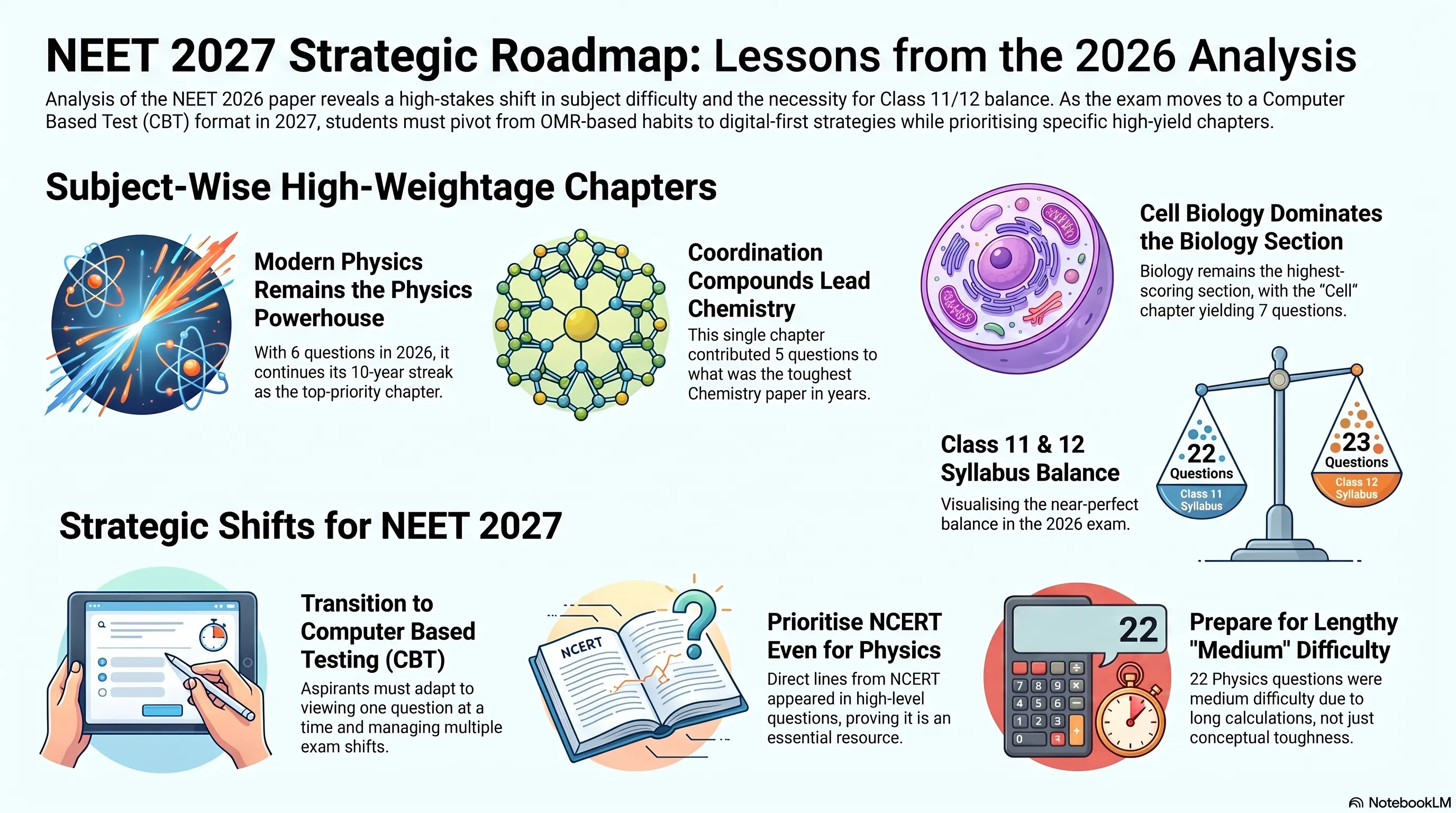
- Physics top chapters: Modern Physics (6 Qs), Electrostatics, EMI, KTG & Thermodynamics (4 Qs each)
- Chemistry top chapter: Coordination Compounds (5 Qs), followed by Oxidation-Reduction, Hydrocarbon, Electrochemistry, Carboxylic Acid & Amines (3 Qs each)
- Biology top chapter: Cell (7 Qs), followed by Evolution (6), Biological Classification (5)
- Class 11 vs Class 12 weightage: almost 50-50 (22 vs 23 questions)
- NEET shifting to CBT mode for 2027 — one question per screen, Mark for Review option
- ~70% of NEET selections come from droppers; dedicated Warrior batch available for 2027 droppers
Table of Contents
- Why This NEET 2026 Analysis Matters for NEET 2027
- NEET 2026 Physics: Chapter-Wise Weightage and Difficulty
- NEET 2026 Chemistry: Chapter-Wise Weightage
- NEET 2026 Biology: Chapter-Wise Weightage
- Class 11 vs Class 12: What Was the Real Weightage?
- How to Shift to CBT Mode Before NEET 2027
- Test Strategy: Using Rank Predictors and 20-Page Analysis Reports
- What Should NEET 2027 Droppers Do Now?

eSaral › NEET › NEET 2027 Warrior 2.0: A Fresh Start After a Tough RE-NEET 2026 Paper

Why This NEET 2026 Analysis Matters for NEET 2027
NEET is expected to shift to CBT mode for 2027, and there is discussion of the exam being held more than once. Regardless of how many attempts there are, the actual Physics, Chemistry, and Biology content tested in NEET 2026 is the most direct guide available for what to prioritise next.
This analysis also covers how to read a test analysis report, because that habit matters just as much as knowing the chapter weightage.
NEET 2026 Physics: Chapter-Wise Weightage and Difficulty
The Physics paper had 45 questions. Overall, the paper was lengthy, with longer calculations and bigger questions, even though the concept-level toughness was somewhat lower than NEET 2025. One question was dropped as a bonus because its answer did not match any option (a misprint), and every student was awarded 4 marks for it.
Top chapters in NEET 2026 Physics:
| Rank | Chapter | Questions |
|---|---|---|
| 1 | Modern Physics (Atomic Structure, Photoelectric Effect, de Broglie, Nuclear Physics) | 6 |
| 2 | Electrostatics | 4 |
| 2 | KTG and Thermodynamics (combined) | 4 |
| 3 | EMI (Electromagnetic Induction) | 4 |
Modern Physics has topped the chapter-wise list on average over the last 10 years, and it stayed on top again in 2026.
Current Electricity, which used to be one of NEET's favourite chapters and had slightly more weightage in NEET 2025, fell behind this time with just 1 question. Distribution across the rest of the paper was fairly even — 12 chapters had exactly 2 questions each.
💡 Expert Tip from the eSaral Faculty: To score 150+ in Physics, you have to study everything, and you have to study good-level content — not shortcut or "halwa" content. Reading only the easy version will not get you there.
Beyond the top 4 (Modern Physics, Electrostatics, EMI, Thermodynamics & KTG), these chapters need special attention for NEET 2027:
- Semiconductors — 2 questions this time, though the average over the years is closer to 3.
- Ray Optics — only 2 questions this time, weaker than its usual average of around 3 over the last 10 years.
- EM Waves — a small chapter (4–5 lectures, 4 formulas) that consistently gives questions; 2 questions this time, including one question with an option-matching issue.
- Rotation — 2 questions (Circular Motion can be grouped with Rotation, which also had 2 questions).
- Gravitation — 2 questions.
- Unit & Dimension — 1 question, at a fairly high difficulty level.
- Waves — generally low weightage; SHM appeared as expected, Sound Wave appeared less this time, and Wave on String did not appear at all.
So the 5 chapters to make "super strong" for NEET 2027 Physics are: Modern Physics, Electrostatics, KTG & Thermodynamics, Semiconductors, and EM Waves.
Difficulty-level breakdown (out of 45 questions):
| Difficulty | Number of Questions | What This Means |
|---|---|---|
| Easy | 15 | Formula-based with light calculation — 60 marks should be scored here comfortably |
| Medium | 22 | The concept was not too tricky, but the calculations were long |
| Tough | 8 | Required extra thinking; included unconventional or rarely asked topics |
A score of 120–130 out of 180 in Physics is considered a good result for this paper. From NEET 2027 onward, the exam is expected to move to CBT mode, which changes the entire test-taking strategy — more on that below.
NEET 2026 Chemistry: Chapter-Wise Weightage
Chemistry topped the difficulty conversation this year — teachers noted it was the toughest Chemistry paper in the last 5–7 years, and it was also lengthy, which left students less time for Physics.
Top 5 chapters in NEET 2026 Chemistry:
| Rank | Chapter | Questions |
|---|---|---|
| 1 | Coordination Compounds | 5 |
| 2 | Oxidation-Reduction | 3 |
| 2 | Hydrocarbon | 3 |
| 2 | Electrochemistry | 3 |
| 2 | Carboxylic Acid & Amines | 3 |
Coordination Compounds alone gave 5 questions from a single chapter, making it the clear topper. Mole Concept, Periodic Table, and Chemical Bonding followed with 2 questions each, rounding out a fairly balanced paper.
Chapters that gave fewer questions than usual:
- Atomic Structure — lower this time (the shortfall was made up for by Physics's own Atomic Structure-related questions).
- Thermochemistry — lower this time.
- POC, IUPAC, and GOC — behind their usual share; GOC normally contributes more questions, so this was an exception.
- Liquid Solution — only 1 question.
- Biomolecules — 2 questions.
One Modern Physics question on Scattering had been taught by eSaral faculty, but it was picked directly from an NCERT line — a reminder that NCERT needs to stay a priority even for topics that feel adequately covered in class.
NEET 2026 Biology: Chapter-Wise Weightage
Biology was comparatively easier this year — many students finished this section in 35–45 minutes.
Top 5 chapters in NEET 2026 Biology:
| Rank | Chapter | Questions |
|---|---|---|
| 1 | Cell | 7 |
| 2 | Evolution | 6 |
| 3 | Biological Classification | 5 |
| 4 | Photosynthesis | 4–5 |
| 5 | Locomotion & Movement | 2–5 |
This chapter pattern reflects NEET 2026 specifically — it does not mean the same chapters will repeat with the same weightage every year. Even so, the broader point stands: Biology is the easiest section and traditionally decides selection, while Physics decides the rank this time around in NEET 2026.
Class 11 vs Class 12: What Was the Real Weightage?
A common question among NEET 2027 aspirants is whether Class 12 content matters more than Class 11. Based on NEET 2026, the answer is: almost equally.
| Subject | Class 11 Questions | Class 12 Questions |
|---|---|---|
| Overall (NCERT basis, 45 Qs sampled) | 22 | 23 |
| Chemistry | 22 | 23 |
This is close to a 50-50% split, and it is described as a genuinely good, balanced break-up for NEET. The takeaway is direct: do not assume Class 12 chapters carry more weight — Class 11 chapters need equally strong preparation.
For Biology specifically, a different historical pattern that varies year to year: roughly 57.8% of Biology questions have come from the Class 11 book in past trends (around 52 questions from Class 11 content versus 38 from Class 12), though this ratio is described as something that keeps varying rather than staying fixed.
For chapter-by-chapter syllabus weightage going into 2027, the official NEET syllabus is worth keeping alongside this analysis, along with the detailed NEET Physics weightage and NEET Chemistry weightage breakdowns.
How to Shift to CBT Mode Before NEET 2027
NEET is moving toward a computer-based test (CBT) format, and this changes the exam experience completely compared to OMR-based papers. On a CBT screen, only one question is shown at a time, a "Mark for Review" option is available, and a summary of attempted/unattempted questions is shown together, all of which change the test strategy significantly.
Since the country does not yet have enough infrastructure to run every student's paper on a single day, multiple shifts are expected if NEET goes fully CBT. Any given shift — easy, medium, or tough — could fall to any student, so preparation now has to cover all three difficulty levels rather than betting on one type of paper.
Students should start practising in CBT mode as early as possible rather than waiting until close to the exam. Reviewing the NEET exam pattern is a useful starting point for understanding how the test structure is expected to change.
Test Strategy: Using Rank Predictors and 20-Page Analysis Reports
Two specific tools are useful right after any test, including NEET 2026 itself:
- Rank Predictor: a tool that was reportedly quite accurate in 2025 — students search "eSaral Rank Predictor," enter their marks, and get a predicted rank to help with decision-making for the year ahead.
- 20-page analysis report: after every test, students should go through this report properly — for example, checking exactly how many Rotation questions were attempted correctly, and within that, how many Rolling Motion sub-topic questions were right. Mentors then use this to drive improvement.
For direct practice with the actual exam pattern, the NEET question paper archive — including NEET 2023, NEET 2022, NEET 2021, NEET 2020, and NEET 2019 papers — is a direct way to see how chapter-wise weightage has shifted year to year. Given how much NCERT mattered to this year's Chemistry and Physics papers, the NCERT Solutions for Class 11 Physics, Class 12 Physics, Class 11 Chemistry, and Class 12 Chemistry are also worth revisiting line by line.
What Should NEET 2027 Droppers Do Now?
If NEET 2026 did not go as planned, do not be disheartened. Data shows that around 70% of NEET selections come from droppers, partly because the number of droppers appearing for the exam is also higher, but droppers do make their mark.
For students taking a drop year for NEET 2027, the following is available, based on the latest CBT pattern:
- 250 tests built specifically around the latest CBT pattern, for full computer-based, topic-wise practice.
- An offline option at the Kota Gurukul, positioned as highly affordable, with one-to-one personalised mentorship.
- For online students, the first 200 registrants get study material delivered to their homes, with 100% scholarships available there as well.
This is described as the Warrior course. Within it, students get computer-based tests, an early identification of weak chapters and sub-topics, and mentors who work through "Agar Analysis" — an assessment and goal-setting process done one-on-one with each student to set their preparation goals.
Frequently Asked Questions
Find answers to common questions.
Which chapters had the highest weightage in NEET 2026 Physics?
Modern Physics topped NEET 2026 Physics weightage with 6 questions, followed by Electrostatics, EMI, and KTG & Thermodynamics with 4 questions each. Twelve other chapters had 2 questions each, making the rest of the paper fairly evenly spread.
Which chapters had the highest weightage in NEET 2026 Chemistry?
Coordination Compounds topped NEET 2026 Chemistry with 5 questions from a single chapter. Oxidation-Reduction, Hydrocarbon, Electrochemistry, and Carboxylic Acid & Amines followed with 3 questions each.
Which chapters had the highest weightage in NEET 2026 Biology?
Cell-led NEET 2026 Biology with 7 questions, followed by Evolution with 6, Biological Classification with 5, and Photosynthesis with 4–5 questions. Biology overall was considered easier than Physics and Chemistry this year.
What was the Class 11 vs Class 12 weightage in NEET 2026?
Class 11 and Class 12 content were split almost 50-50, with 22 questions from Class 11 and 23 from Class 12 on an NCERT basis. This pattern held for both the overall paper and specifically for Chemistry.
How should NEET 2027 aspirants prepare for the CBT mode?
Students should start practising in Computer Based Test mode as early as possible, since it shows one question at a time, includes a "Mark for Review" option, and gives an attempt summary — all different from OMR-based papers. Preparing for all difficulty levels matters too, since multiple exam shifts may be used and any shift could be easy, medium, or tough.