Paper Chromatography Experiment Class 11: Procedure & Plant Pigment Separation
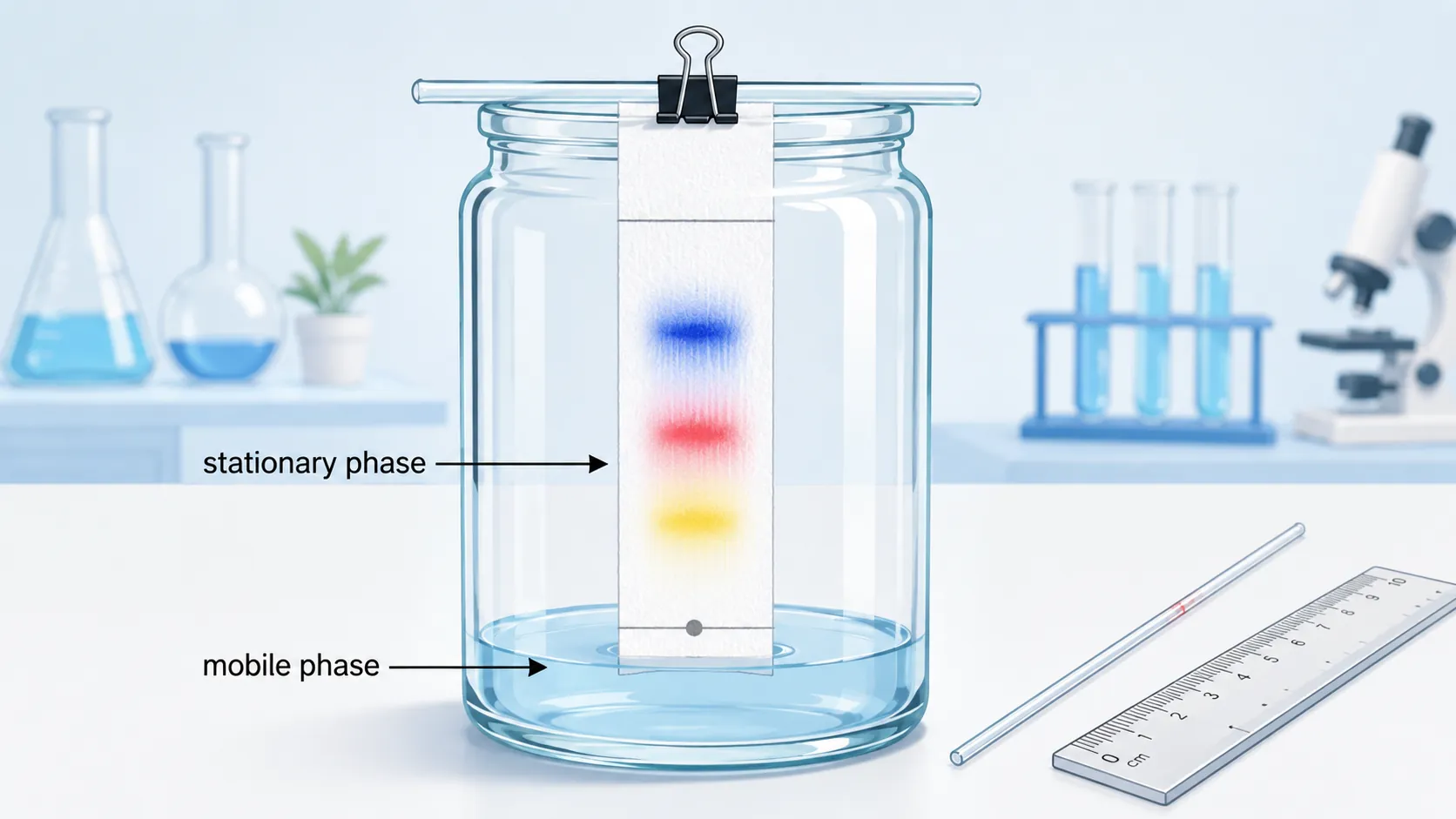
Table of Contents
- What Is the Paper Chromatography Experiment in Class 11 Chemistry?
- Types of Paper Chromatography
- Separation of Plant Pigments by Paper Chromatography — Class 11 Practical
- Materials and Apparatus Required for Paper Chromatography Class 11 Practical
- Procedure for Paper Chromatography Experiment Class 11 (Ascending Method)
- Rf Value Formula in Paper Chromatography Class 11
- Precautions for Paper Chromatography Class 11 Practical
- Common Sources of Error in the Paper Chromatography Experiment
- Difference Between Paper Chromatography and Column Chromatography (Class 11)
- Viva Questions for Paper Chromatography Class 11 Practical

eSaral › Class 11 Chemistry › paper chromatography experiment class 11

What Is the Paper Chromatography Experiment in Class 11 Chemistry?
The paper chromatography experiment class 11 is a qualitative analytical technique taught under the chapter Organic Chemistry — Some Basic Principles and Techniques. It is used to separate and identify the individual coloured components present in a mixture — most commonly ink, plant pigments, or food dyes — by allowing a solvent to travel up a strip of chromatography paper.
In this paper chromatography class 11 practical, chromatography (or filter) paper acts as the stationary phase, because the paper's cellulose fibres hold a thin layer of water within them. A suitable liquid, called the mobile phase, moves through the paper by capillary action, carrying the dissolved components of the mixture along with it at different speeds.
Aim of Paper Chromatography Experiment Class 11
Aim: To separate the coloured components (dyes/pigments) present in a given mixture, such as black ink or a mixture of red and blue dyes, by the method of ascending paper chromatography and to calculate the Rf value of each separated component.
Principle of Paper Chromatography Class 11 Practical
The principle of paper chromatography class 11 is based on the differential rate of migration of the components of a mixture between two phases:
- Stationary phase: Water molecules trapped in the cellulose fibres of the chromatography paper.
- Mobile phase: A solvent (or solvent mixture) that moves up the paper by capillary action.
Each component of the mixture has a different degree of solubility in the mobile phase and a different affinity for the stationary phase. Components that are more soluble in the solvent and less strongly adsorbed on the paper travel faster and cover a greater distance, while components that are more strongly held by the stationary phase move slower. This differential movement causes the components to separate into distinct, visible spots along the length of the paper.
Result and Report Format for Paper Chromatography Experiment Class 11
Practical file marks depend heavily on correct reporting format, so getting this right matters. The paper chromatography experiment class 11 report should follow this order: Aim, Apparatus, Principle, Procedure, Observation Table (with Rf values), Result, and Precautions.
Result statement (sample): "The paper chromatography experiment class 11 successfully separated the given mixture into [number] components, with Rf values of [X], [Y], and [Z] respectively."
This clean, examiner-expected format should be followed in every CBSE Class 11 chemistry practical file — it also helps you give structured answers during the viva.
Types of Paper Chromatography
| Type | How It Works | Common Use in Class 11 Lab |
|---|---|---|
| Ascending paper chromatography | Solvent rises up the paper from the bottom | Standard method used in most CBSE class 11 chemistry practicals |
| Descending paper chromatography | Solvent flows downward from a reservoir at the top | Used for components with very high Rf values |
| Two-dimensional (2-D) chromatography | Paper is developed in two solvents at right angles | Used for complex mixtures with overlapping spots (not usually required at class 11 level) |
Separation of Plant Pigments by Paper Chromatography — Class 11 Practical
The separation of plant pigments by paper chromatography is a variant of this practical that uses a leaf extract instead of ink, and separates the natural pigments responsible for photosynthesis. It follows the same principle — differential movement of components between a stationary and mobile phase — but uses a different solvent system and produces four distinct, identifiable pigment bands.
Aim
To separate and identify the photosynthetic pigments present in a leaf extract using paper chromatography, and to calculate the Rf value of each separated pigment.
Materials Required
- Fresh green leaves (spinach works well and is commonly used)
- Mortar and pestle (for crushing the leaves)
- Petroleum ether–acetone solvent mixture (mobile phase)
- Whatman No. 1 filter paper strips
- A capillary tube for spotting
- A wide-mouthed chromatography jar with a lid
- Watch glass, pencil, and scale
Procedure
- Extract the pigment: Crush a few fresh leaves with a pinch of sand using a mortar and pestle, adding a small amount of the petroleum ether–acetone mixture to extract the pigments into solution.
- Prepare the paper strip: Draw a pencil line about 2–3 cm from one end of the filter paper strip to mark the origin.
- Spot the extract: Using a capillary tube, apply a small, concentrated spot of the leaf extract on the origin line. Let it dry and repeat 2–3 times.
- Run the chromatogram: Suspend the strip in the jar containing a shallow layer of the petroleum ether–acetone solvent, keeping the spot above the solvent level. Seal the jar.
- Develop and mark: Once the solvent nears the top of the strip, remove it and immediately mark the solvent front.
- Observe the pigment bands: Air-dry the strip. Four distinct bands should appear, separated by colour and position.
Pigments Separated and Their Order
| Pigment | Colour | Position on Paper (Rf) |
|---|---|---|
| Carotene | Yellow-orange | Highest Rf — travels farthest |
| Xanthophyll | Yellow | Second-highest Rf |
| Chlorophyll a | Blue-green | Lower Rf |
| Chlorophyll b | Yellow-green | Lowest Rf — travels least |
(This order reflects typical relative polarity and solubility in the petroleum ether–acetone system; exact Rf values will vary slightly by solvent ratio and should be measured during the actual practical.)
Result
Result statement (sample): "The leaf extract was separated into four pigments — carotene, xanthophyll, chlorophyll a, and chlorophyll b — with Rf values of [W], [X], [Y], and [Z] respectively.
Materials and Apparatus Required for Paper Chromatography Class 11 Practical
- Whatman chromatography paper (or good-quality filter paper), cut into a rectangular strip
- A wide-mouthed glass jar or chromatography chamber with a lid
- A capillary tube or fine dropper for spotting the sample
- The test mixture (commonly water-soluble black/blue ink or plant leaf extract)
- Solvent system (mobile phase) — e.g., a mixture of n-butanol, acetic acid, and water
- A pencil (never a pen) to mark the point of origin
- A scale/ruler to measure distances
- A pin or thread to suspend the paper strip
Procedure for Paper Chromatography Experiment Class 11 (Ascending Method)
- Prepare the paper strip: Take a strip of chromatography paper and, with a pencil, draw a fine horizontal line about 2–3 cm from one end. This is called the origin or baseline.
- Spot the sample: Using a fine capillary tube, place a small, concentrated spot of the ink/dye mixture exactly on the pencil line. Allow the spot to dry, and repeat 2–3 times to concentrate it.
- Prepare the solvent chamber: Pour a shallow layer of the chosen solvent (mobile phase) into the chromatography jar, ensuring the level stays below where the sample spot will sit.
- Suspend the paper: Hang the paper strip in the jar so that only the bottom edge (below the spot) dips into the solvent — the spot itself must remain above the solvent level.
- Seal and develop: Close the jar with a lid to maintain a saturated atmosphere and prevent uneven solvent evaporation. Allow the solvent to rise up the paper by capillary action.
- Mark the solvent front: Once the solvent has travelled close to the top of the paper, remove the strip and immediately mark the solvent front with a pencil before it evaporates further.
- Dry and observe: Allow the chromatogram to air-dry. You will now see separated coloured spots at different heights on the paper.
- Measure distances: Measure the distance moved by each component from the origin and the distance moved by the solvent front from the origin.
- Calculate Rf values: Use the Rf formula (below) for each spot to identify and record the components.
Rf Value Formula in Paper Chromatography Class 11
The retention factor (Rf) is the key quantitative result of the paper chromatography class 11 practical. It is defined as:
Rf = Distance travelled by the component ÷ Distance travelled by the solvent front
Both distances are measured from the same point — the origin. The Rf value is always a number between 0 and 1 (or expressed as a ratio/decimal) and is characteristic of a substance for a given solvent system and temperature, which is why it is used for identification. Rf value–based numericals are a recurring question type in NEET Chapterwise PYQ, especially under the Organic Chemistry basics unit.
Sample Observation Table for Paper Chromatography (Rf Values)
| S. No. | Component/Spot | Distance travelled by component (cm) | Distance travelled by solvent front (cm) | Rf value |
|---|---|---|---|---|
| 1 | Spot A (e.g., blue dye) | 4.2 | 8.0 | 0.52 |
| 2 | Spot B (e.g., red dye) | 6.4 | 8.0 | 0.80 |
| 3 | Spot C (e.g., yellow pigment) | 2.8 | 8.0 | 0.35 |
(Values above are illustrative sample readings for practice — record your own measured distances during the actual practical.)
Precautions for Paper Chromatography Class 11 Practical
- Always use a pencil, never a pen, to mark the origin and solvent front — ink from a pen will run and contaminate the chromatogram.
- Handle the chromatography paper only by its edges to avoid contaminating it with oil or sweat from your fingers.
- Keep the sample spot small and concentrated; a large, diffuse spot gives poor separation.
- Ensure the sample spot stays above the solvent level when the paper is suspended.
- Keep the chromatography jar covered throughout to maintain a saturated solvent atmosphere.
- Mark the solvent front immediately after removing the paper, before it evaporates.
Common Sources of Error in the Paper Chromatography Experiment
- Using impure or low-quality filter paper instead of proper chromatography paper
- Letting the sample spot touch or dip into the solvent directly
- Uneven or tilted suspension of the paper strip in the jar
- Delayed marking of the solvent front, leading to inaccurate Rf calculations
- Using a wet or dirty capillary tube, which contaminates the sample spot
Difference Between Paper Chromatography and Column Chromatography (Class 11)
| Basis | Paper Chromatography | Column Chromatography |
|---|---|---|
| Stationary phase | Water held in cellulose fibres of paper | Adsorbent (e.g., alumina, silica) packed in a column |
| Scale of separation | Small-scale, qualitative | Can be scaled up; often used for purification |
| Apparatus | Chromatography paper + jar | Glass column packed with adsorbent |
| Common Class 11 use | Practical file experiment (ink/dye separation) | Explained theoretically in GOC chapter |
This comparison is a favourite one-mark and assertion-reason question — practice how it's tested with JEE Main Chapterwise PYQ.
Viva Questions for Paper Chromatography Class 11 Practical
Q1. What is chromatography?
A. Chromatography is a technique used to separate the components of a mixture based on their differing rates of movement between a stationary and a mobile phase.
Q2. Why do we use a pencil and not a pen to mark the paper?
A. A pen's ink is itself a mixture of dyes and will dissolve and run in the solvent, contaminating the chromatogram; pencil marks (graphite) do not dissolve.
Q3. What does the Rf value depend on?
A. The Rf value depends on the nature of the solvent, the nature of the substance, temperature, and the quality of the chromatography paper used.
Q4. Why must the sample spot remain above the solvent level?
A. If the spot is submerged in the solvent, the sample dissolves directly into the liquid instead of migrating up the paper, and no separation occurs.
Q5. What is the stationary phase in paper chromatography?
A. The stationary phase is the water trapped within the cellulose fibres of the chromatography paper.
Once confident with these viva answers, check the NEET Syllabus to see how much weight Organic Chemistry basics carries in the overall NEET Chemistry section.
Explore More on eSaral (Related Class 11 Chemistry Resources)
- Learn the complete chapter this experiment comes from: Organic Chemistry – Some Basic Principles and Techniques Class 11 Notes →
- Practice exam-style questions from this unit: Important Questions of Organic Chemistry Class 11 (with Solutions) →
- Revise every chapter before your practicals: NCERT Solutions for Class 11 Chemistry – All Chapters →
- Need the full syllabus at one place? NCERT Class 11 Chemistry Book – Free PDF →
- Browse chapter-wise concept notes for boards, JEE & NEET: Complete Chemistry Notes for Class 11 →
- Test your practical-based concepts under exam conditions: NEET Test Series →
Struggling to connect practicals like paper chromatography with your board and JEE/NEET prep? eSaral's Class 11 Chemistry course, taught by IIT Bombay faculty, links every NCERT practical and concept directly to board, JEE & NEET-level questions — with a 5-layer doubt-solving system to clear your queries the same day. Start your free eSaral Class 11 Chemistry demo class today →
Frequently Asked Questions
Find answers to common questions.
Which paper is used in the paper chromatography experiment?
What is the Rf value formula in paper chromatography?
What is the principle of paper chromatography class 11 practical?
What is the aim of the paper chromatography experiment in class 11?
Is paper chromatography important for the class 11 practical exam?
Can paper chromatography separate colourless substances?
What mistakes should be avoided in the paper chromatography class 11 practical?
Why is ascending paper chromatography preferred over descending in the class 11 lab?
How do you write the paper chromatography experiment class 11 in a practical file
The paper chromatography experiment class 11 is written in the standard format — Aim, Principle, Materials Required, Procedure, Observation Table, Result, and Precautions with the Rf value calculation shown under the Result section for each separated component.
What is the expected result of the paper chromatography experiment class 11?
The expected result of the paper chromatography experiment class 11 is a set of separated, visible spots on the paper, each with a distinct Rf value that identifies a component of the mixture (such as individual dyes in ink).
What pigments are separated in the plant pigment paper chromatography experiment?
Four pigments are separated: carotene (yellow-orange, highest Rf), xanthophyll (yellow), chlorophyll a (blue-green), and chlorophyll b (yellow-green, lowest Rf).
What is the separation of plant pigments by paper chromatography practical for Class 11?
It's a variant of the paper chromatography experiment that uses a leaf extract instead of ink, separating it into four visible pigment bands using a petroleum ether–acetone solvent system.