What is the nature of cell-walls in diatoms?

Home > NCERT Class 11 Biology Q&A > Nature of Cell Walls in Diatoms

What is the nature of cell-walls in diatoms?
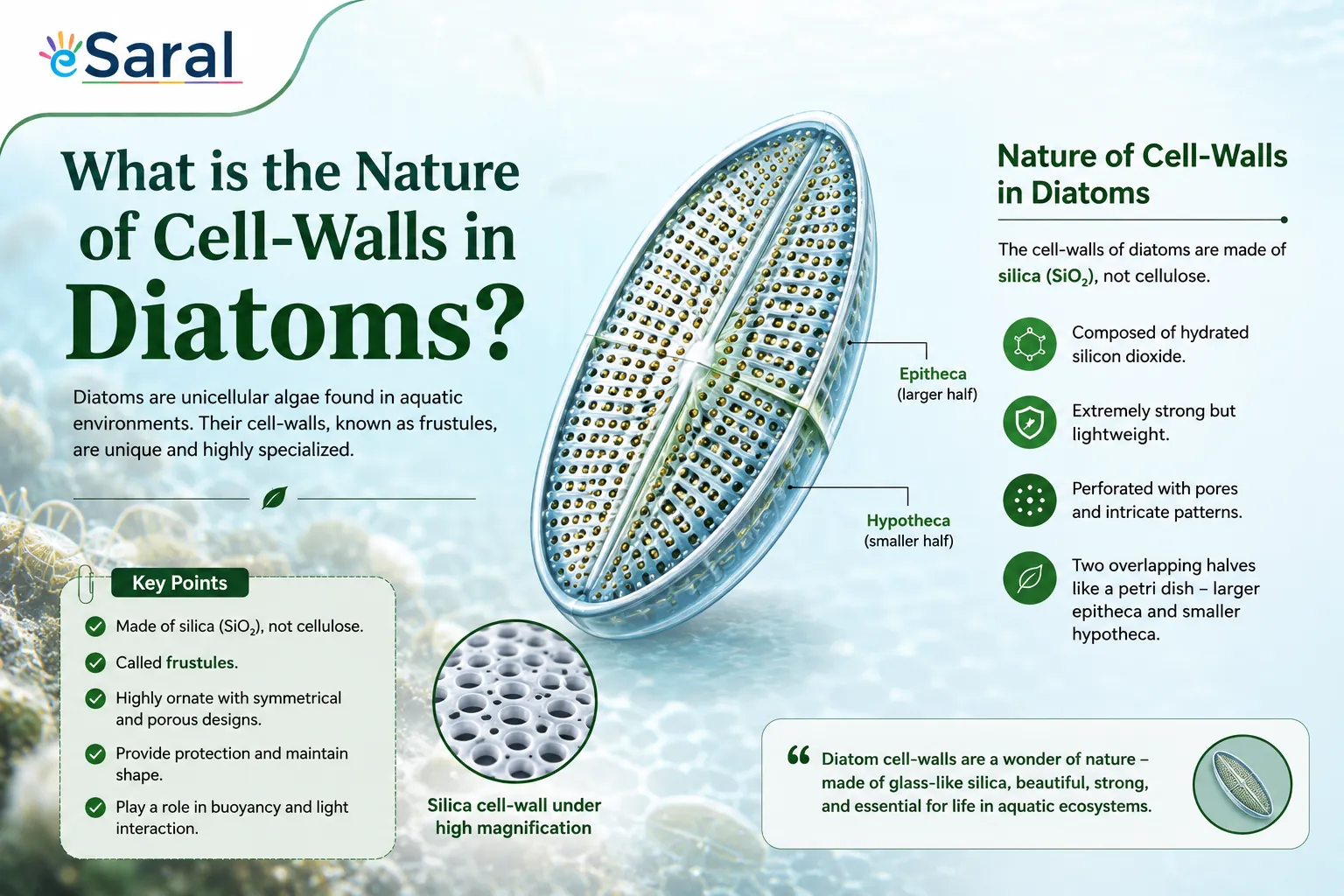
The cell walls of diatoms are made of silica. Their cell wall construction is known as frustule. It consists of two thin overlapping shells that fit into each other such as a soap box. When the diatoms die, the silica in their cell walls gets deposited in the form of diatomaceous earth. This diatomaceous earth is very soft and quite inert. It is used in filtration of oils, sugars, and for other industrial purposes.
What Are Diatoms? A Quick Overview
Diatoms are microscopic, photosynthetic protists belonging to the division Chrysophyta (or placed under Kingdom Protista in the NCERT classification). They are found in fresh water, marine water, and even moist soil — making them one of the most widespread groups of microorganisms on Earth.
They are the primary producers of aquatic ecosystems and contribute roughly 20–25% of the total oxygen on Earth through photosynthesis. Despite their microscopic size, diatoms are extraordinarily diverse — over 100,000 species have been described so far.
For Class 11 and NEET students, diatoms are most significant because of one defining feature: their uniquely constructed silica cell wall. This forms the core of NCERT Chapter 2 questions and frequently appears in NEET Biology MCQs.
In NEET Biology, diatoms are a high-frequency topic in the Biological Classification chapter. Pay close attention to the two-word answer: silica frustule. Students often confuse diatomaceous earth (formed from dead diatoms) with the living frustule — they are related but different concepts. Write them as separate bullet points in your notes.
Nature of Cell Walls in Diatoms
The Cell Walls Are Made of Silica
The cell walls of diatoms are inorganic and siliceous — meaning they are composed of hydrated silicon dioxide (SiO₂·nH₂O), commonly referred to as silica. This is highly unusual in biology, where most cell walls are made of organic polymers like cellulose, chitin, or peptidoglycan.
The silica is deposited within an organic matrix of proteins and polysaccharides during cell wall formation. The result is an extraordinarily rigid yet intricately patterned wall that persists long after the organism dies.
Key Characteristics of Diatom Cell Walls
| Property | Detail |
|---|---|
| Chemical composition | Hydrated silica (SiO₂·nH₂O) |
| Organic component | Proteins + polysaccharides (pectin-like) |
| Texture | Hard, glassy, insoluble in most acids |
| Preservation | Persists after death — does not decompose |
| Pattern | Intricate pores (punctae) in species-specific arrangements |
This siliceous nature means diatom cell walls fossilise easily, giving us a rich fossil record dating back 185 million years. This is also why diatomaceous earth deposits can be metres thick in certain geological formations.
Frustule: Structure and Components
Defining the Frustule
The silica cell wall of a diatom is specifically called a frustule. The word comes from the Latin frustulum, meaning "a small piece." Every diatom cell is enclosed within this two-part silica case.
Epitheca and Hypotheca — The Two Halves
The frustule is made of two overlapping halves, each called a theca (plural: thecae):
- Epitheca — the larger, upper half (like the lid of a box)
- Hypotheca — the smaller, lower half (like the base of a box)
The hypotheca fits inside the epitheca, much like the two halves of a soap box or a Petri dish. This overlapping arrangement is a defining structural feature of diatoms.
Each theca consists of:
- Valve — the flat or domed top/bottom face
- Girdle (cingulum) — the band connecting the valve to the other theca
Pores and Patterns on the Frustule
The silica wall is not solid — it is perforated by tiny pores called punctae or areolae. These pores allow exchange of gases, nutrients, and waste between the cell and its environment. The arrangement of these pores is so species-specific that it is used in taxonomy to identify diatom species.
A common NEET MCQ asks: "The cell wall of diatoms resembles a ___." The answer is a soap box (or sometimes phrased as a Petri dish). Both comparisons appear in NCERT. Learn both analogies — some question papers use one, some use the other. Never leave this as a vague memory.
Formation of the Silica Cell Wall
Biomineralisation in Diatoms
The process by which diatoms build their silica wall is called biomineralisation or silicification. It occurs within a specialised membrane-bound compartment inside the cell called the silica deposition vesicle (SDV).
Steps of Formation
- The cell absorbs silicic acid (H₄SiO₄) from the surrounding water.
- Silicic acid is transported into the SDV.
- Inside the SDV, silicic acid polymerises into amorphous silica.
- The silica is deposited in species-specific patterns determined by an organic template.
- The new theca is extruded to the cell surface after cell division.
Cell Division and the Frustule
During cell division, each daughter cell inherits one theca from the parent and must build a new, smaller hypotheca. This means that after repeated divisions, one line of daughter cells becomes progressively smaller — a phenomenon called the MacDonald-Pfitzer rule or size reduction in diatoms. Sexual reproduction restores the original size.
Diatomaceous Earth and Its Formation
Formation of Diatomaceous Earth
When diatoms die, their organic cell contents decompose, but the silica frustule does not break down. These empty frustules sink to the ocean or lake floor and accumulate over millions of years, forming thick sedimentary deposits known as diatomaceous earth (also called diatomite or kieselguhr).
Diatomaceous earth is:
- Soft and chalky in texture
- Chemically inert — it does not react with most substances
- Highly porous — due to the millions of microscopic pores in each frustule
- Lightweight — mostly air by volume
Major deposits of diatomaceous earth are found in the USA (Nevada, Oregon), Denmark, and parts of India. Some deposits are over 900 metres thick.
Industrial and Scientific Uses of Diatomaceous Earth
The unique properties of diatomaceous earth make it commercially valuable across many industries:
| Industry | Use |
|---|---|
| Filtration | Filtering beer, wine, fruit juices, swimming pool water |
| Food processing | Purifying sugar and edible oils |
| Agriculture | Natural insecticide (damages the exoskeletons of insects) |
| Construction | Lightweight insulating material, soundproofing |
| Cosmetics | Mild abrasive in toothpaste and facial scrubs |
| Forensics & Geology | Dating sediment layers; palaeoclimate research |
| Lab Science | Filter medium and stabiliser in explosives (e.g., dynamite) |
Note: Alfred Nobel used diatomaceous earth as the stabilising carrier for nitroglycerin when he invented dynamite in 1867.
For NCERT purposes, the key uses to remember are filtration of oils and sugars and use in other industrial processes, as stated directly in your textbook.
You can cross-check this topic against the official NCERT Class 11 Biology textbook. The eSaral NCERT Solutions for Class 11 cover all such short-answer questions from Chapter 2 with detailed explanations prepared by the eSaral faculty.
How Do Diatom Cell Walls Compare to Other Algae?
Understanding how diatom cell walls differ from other algal groups helps in NEET MCQs that test comparative biology.
| Organism / Group | Cell Wall Material | Special Feature |
|---|---|---|
| Diatoms (Chrysophyta) | Silica (SiO₂) | Frustule: two overlapping halves |
| Green Algae (Chlorophyta) | Cellulose | Similar to higher plant cell walls |
| Red Algae (Rhodophyta) | Cellulose + agar/carrageenan | Agar is used in culture media |
| Brown Algae (Phaeophyta) | Cellulose + alginic acid | Alginates used in the food industry |
| Dinoflagellates | Cellulose plates (thecal plates) | Armoured appearance |
| Euglenoids | No cell wall; protein pellicle | Flexible; not a true wall |
This table is a useful quick-revision tool. Students who have used eSaral's NCERT Books for Class 11 alongside structured notes from IIT faculty have found comparative tables like this one especially useful during last-minute NEET revision.
Frequently Asked Questions
Find answers to common questions.
Why is the diatom cell wall compared to a soap box?
The diatom cell wall is compared to a soap box because two thin silica shells overlap each other, with the larger shell (epitheca) fitting over the smaller shell (hypotheca), exactly like the lid and base of a soap box. This analogy is used in the NCERT Class 11 Biology textbook and is a frequently tested fact in NEET.
What is a frustule in diatoms?
A frustule is the silicified cell wall of a diatom, made entirely of silica. It is composed of two overlapping halves — the larger epitheca (upper half) and the smaller hypotheca (lower half) — fitted together like the two halves of a soap box. The frustule is perforated with species-specific patterns of tiny pores called punctae.
What are diatom cell walls made of?
Diatom cell walls are made of silica (hydrated silicon dioxide, SiO₂·nH₂O). This makes them unique among algae, as most other photosynthetic organisms use organic compounds like cellulose for their cell walls. The silica wall is called a frustule and consists of two interlocking halves called epitheca and hypothecal
Do diatoms have a cell wall or a cell membrane?
Diatoms have both. Like all cells, they have a cell membrane (plasma membrane) on the inside. Outside that, they have a rigid silica cell wall called the frustule. The frustule is the defining structural feature of diatoms and is what distinguishes their cell wall from virtually every other group of photosynthetic organisms.
What are the uses of diatomaceous earth?
Diatomaceous earth is used in filtration of oils, beers, wines, and sugars; as a natural insecticide in agriculture; in construction as lightweight insulation; in cosmetics as a mild abrasive; and historically as a stabilising carrier in dynamite. Its usefulness comes from its chemical inertness and highly porous, lightweight structure.
What is diatomaceous earth and how does it form?
Diatomaceous earth is a soft, chalky sedimentary deposit formed by the accumulation of silica frustules from dead diatoms over millions of years. Since the organic matter decomposes but the silica does not, the empty frustules pile up on the beds of oceans and lakes, eventually forming thick deposits of diatomaceous earth (also called diatomite).