Class 11 Biology NCERT PDF – Free Chapter Wise Book Download
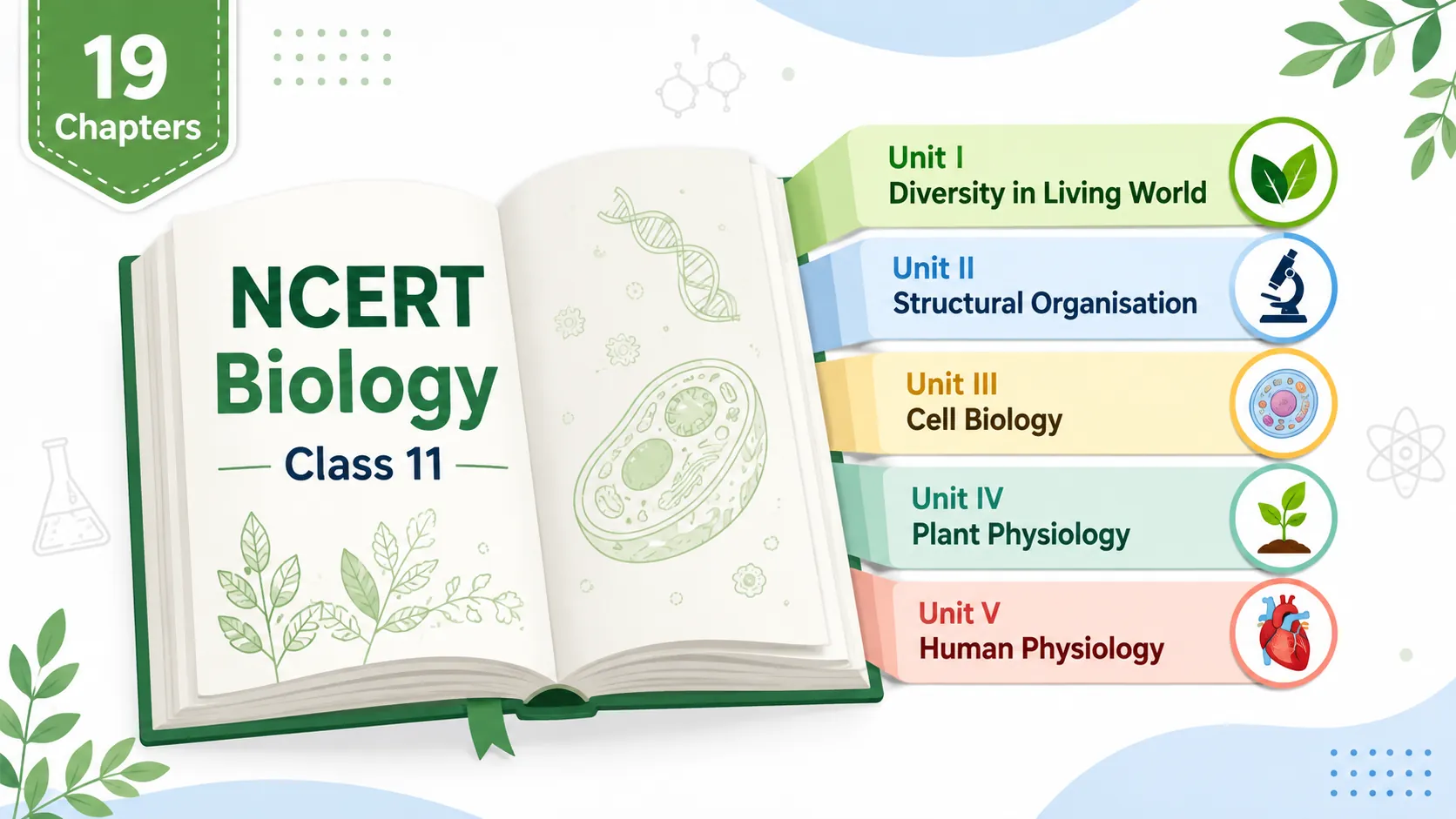
Table of Contents
- What Is NCERT Biology Class 11?
- NCERT Biology Class 11 PDF Chapter Wise (All 19 Chapters)
- NCERT Biology Class 11 Syllabus (Updated)
- Class 11th Biology NCERT Book PDF – Hindi Medium
- NCERT Biology Class 11: Chapters Removed in the Revised Syllabus
- NCERT Solutions Class 11 Biology — Chapter-wise Access
- Key Concepts and Formulas in NCERT Biology Class 11
- Why Is NCERT Biology Class 11 Important for NEET?
- How to Study NCERT Class 11 Biology Effectively

eSaral › Class 11 › Biology › NCERT Biology Class 11: Complete Book & Solutions Guide

What Is NCERT Biology Class 11?
NCERT Biology Class 11 is the official CBSE textbook published by NCERT, covering cell biology, plant physiology, and human physiology. If you're looking for the class 11 biology NCERT PDF, this guide gives you the complete book, chapter-wise access, and current syllabus in one place.
This class 11th biology NCERT book PDF forms the foundation for CBSE boards and NEET alike, since NEET draws a large share of its Biology questions directly from NCERT content. To see how this fits into a complete NEET preparation plan, explore eSaral's NEET Course.
NCERT Biology Class 11 PDF Chapter Wise (All 19 Chapters)
The NCERT Biology Class 11 syllabus, as per the current rationalized CBSE structure, is organised into 5 major units covering 19 chapters. This class 11th biology NCERT book PDF is updated as per the latest syllabus, so students can safely use it for both board exam and NEET preparation. Here is the complete ncert biology class 11 pdf chapter wise list, organized unit by unit:
NCERT Biology Class 11 — Unit-wise Chapter List (Current Syllabus)
| Unit | Unit Name | Chapters Included |
|---|---|---|
| I | Diversity in the Living World | 1. The Living World, 2. Biological Classification, 3. Plant Kingdom, 4. Animal Kingdom |
| II | Structural Organisation in Plants and Animals | 5. Morphology of Flowering Plants, 6. Anatomy of Flowering Plants, 7. Structural Organisation in Animals |
| III | Cell: Structure and Function | 8. Cell: The Unit of Life, 9. Biomolecules, 10. Cell Cycle and Cell Division |
| IV | Plant Physiology | 11. Photosynthesis in Higher Plants, 12. Respiration in Plants, 13. Plant Growth and Development |
| V | Human Physiology |
14. Breathing and Exchange of Gases, 15. Body Fluids and Circulation, 16. Excretory Products and their Elimination, 17. Locomotion and Movement, 18. Neural Control and Coordination, 19. Chemical Coordination and Integration |
NCERT Biology Class 11 —Chapter List (Current Syllabus)
|
Chapter No. |
Chapter Name | Download PDF |
|---|---|---|
| Chapter 1 | The Living World | Download PDF |
| Chapter 2 | Biological Classification | Download PDF |
| Chapter 3 | Plant Kingdom | Download PDF |
| Chapter 4 | Animal Kingdom | Download PDF |
| Chapter 5 | Morphology of Flowering Plants | Download PDF |
| Chapter 6 | Anatomy of Flowering Plants | Download PDF |
| Chapter 7 | Structural Organisation in Animals | Download PDF |
| Chapter 8 | Cell: The Unit of Life | Download PDF |
| Chapter 9 | Biomolecules | Download PDF |
| Chapter 10 | Cell Cycle and Cell Division | Download PDF |
| Chapter 11 | Photosynthesis in Higher Plants | Download PDF |
| Chapter 12 | Respiration in Plants | Download PDF |
| Chapter 13 | Plant Growth and Development | Download PDF |
| Chapter 14 | Breathing and Exchange of Gases | Download PDF |
| Chapter 15 | Body Fluids and Circulation | Download PDF |
| Chapter 16 | Excretory Products and their Elimination | Download PDF |
| Chapter 17 | Locomotion and Movement | Download PDF |
| Chapter 18 | Neural Control and Coordination | Download PDF |
| Chapter 19 | Chemical Coordination and Integration | Download PDF |
NCERT Biology Class 11 Syllabus (Updated)
The NCERT Biology Class 11 syllabus is divided into 5 units and 19 chapters, covering Diversity in the Living World, Structural Organisation in Plants and Animals, Cell: Structure and Function, Plant Physiology, and Human Physiology. Refer to the unit-wise table above for the complete chapter breakdown, or check the chapters removed in the revised syllabus below.
Class 11th Biology NCERT Book PDF – Hindi Medium
The NCERT Biology Class 11 book is also available in Hindi medium, known as "Jeev Vigyan" (जीव विज्ञान). Students studying in Hindi-medium schools can download the complete chapter-wise PDF here:
Download NCERT Biology Class 11 PDF in Hindi →
This covers the same 19-chapter, 5-unit syllabus as the English medium book above.
NCERT Biology Class 11: Chapters Removed in the Revised Syllabus
A large number of students still search for NCERT Biology Class 11 chapters that no longer exist in the current syllabus, simply because older PDFs and reference materials haven't been updated. As part of NCERT's content rationalisation, the following chapters were removed from the main Class 11 Biology index:
- Transport in Plants
- Mineral Nutrition
- Digestion and Absorption
If your study material, an old friend's notes, or a downloaded PDF still lists these three chapters, it is based on the pre-rationalisation syllabus. Always cross-check against the current 19-chapter, 5-unit structure above before building your revision plan for NCERT Biology Class 11.
NCERT Solutions Class 11 Biology — Chapter-wise Access
NCERT Solutions Class 11 Biology gives detailed, step-by-step answers to every in-text and exercise question in the NCERT textbook, framed according to CBSE marking guidelines. This is especially useful for Human Physiology and Plant Physiology chapters, where diagram-based and reasoning-type questions are common in both boards and NEET.
Some of the key chapters covered include:
- The Living World – Taxonomy, binomial nomenclature, biodiversity
- Biological Classification – Kingdom Monera, Protista, Fungi, Plantae, viruses
- Biomolecules – Metabolism, enzymes, proteins, nucleic acids
- Excretory Products and their Elimination – Nephron structure, urine formation, osmoregulation
- Chemical Coordination and Integration – Endocrine glands, hormones, feedback mechanisms
Get Chapter-wise NCERT Solutions for Class 11 Biology →
Key Concepts and Formulas in NCERT Biology Class 11
While NCERT Biology Class 11 is largely concept-based, a few quantitative relationships recur across chapters and are frequently tested:
- Water Potential (Chapter 11, Plant Physiology): $\Psi_w = \Psi_s + \Psi_p$, where $\Psi_s$ is the solute potential, and $\Psi_p$ is the pressure potential.
- Respiratory Quotient (Chapter 12, Respiration in Plants): $RQ = \frac{\text{Volume of } CO_2 \text{ evolved}}{\text{Volume of } O_2 \text{ consumed}}$.
- Cardiac Output (Chapter 18, Body Fluids and Circulation): $CO = SV \times HR$, where $SV$ is the stroke volume and $HR$ is the heart rate.
Why Is NCERT Biology Class 11 Important for NEET?
- Direct question overlap: A significant share of NEET Biology MCQs are adapted directly from NCERT Class 11 lines, diagrams, and in-text examples, especially from Cell Biology, Plant Physiology, and Human Physiology units. Test how well you've retained these concepts with NEET Chapterwise PYQ.
- Foundation for Class 12: Concepts from NCERT Biology Class 11 — cell structure, biomolecules, physiology — are prerequisites for Class 12 topics like Genetics, Biotechnology, and Human Reproduction. Check the NEET Syllabus to see exactly how Class 11 and 12 Biology topics are weighted together.
- NCERT Solutions Class 11 Biology as a self-check tool: Attempting NCERT questions independently first, then verifying against solutions, builds the exact answer-writing precision NEET and boards reward.
How to Study NCERT Class 11 Biology Effectively
- Confirm you're using the current 19-chapter list before starting revision — discard notes based on the older 22-chapter structure that still included the three removed chapters.
- Read Human Physiology chapters (14–19) with diagrams — labelled diagrams of the nephron, heart, and neuron are frequently asked directly in exams.
- Use NCERT Solutions Class 11 Biology to self-check, not to copy — attempt each exercise question first, then compare your answer's structure and terminology. Structured revision for these chapters is part of eSaral's NEET Test Series, which tracks your accuracy chapter by chapter.
- Make short tables for classification chapters (Biological Classification, Plant Kingdom, Animal Kingdom) — these are naturally table-friendly and easy to revise quickly.
- Revisit Cell: The Unit of Life and Biomolecules repeatedly — both are foundational for nearly every Class 12 Biology chapter and carry high NEET weightage. Once confident, move to NEET Previous Year Question Papers to apply this understanding under exam-style conditions.
Explore More on eSaral (Related NCERT Class 11 Biology Resources)
- Download the complete chapter-wise NCERT Class 11 Biology Book PDF: Class 11 Biology NCERT PDF Book – Download All Chapters Free →
- Get step-by-step chapter-wise answers to every textbook question: NCERT Solutions for Class 11 Biology – Free PDF →
- Start with Chapter 1 solutions: NCERT Solutions Class 11 Biology Chapter 1 – The Living World →
- Continue with Chapter 2 solutions: NCERT Solutions Class 11 Biology Chapter 2 – Biological Classification →
- Compare with the parallel Class 11 Chemistry structure: NCERT Class 11 Chemistry Book – Free PDF Download →
- Practice NEET-style questions from previous years: NEET Chapterwise PYQ with Solutions →
- Check the complete NEET syllabus breakdown: NEET Syllabus 2026 PDF →
Still revising from an outdated NCERT Biology Class 11 chapter list, or unsure which topics matter most for NEET? eSaral's Class 11 Biology course, taught by Kota's top doctor faculty, is built strictly around the current 19-chapter syllabus, with chapter-wise NCERT Solutions and a structured NEET-focused study plan. Start your free eSaral Class 11 Biology demo class today →
Frequently Asked Questions
Find answers to common questions.
Is the Class 11 Biology NCERT PDF available for free download?
Yes. The NCERT Class 11 Biology PDF is freely available for download. eSaral provides chapterwise access through its app and website. You can also access the official PDF from the NCERT website. The eSaral version includes additional notes and links to video explanations by top NEET faculty.
How many chapters are in the Class 11 Biology NCERT book?
The Class 11 Biology NCERT book has 19 chapters spread across 5 units — Diversity of Living Organisms, Structural Organisation in Plants and Animals, Cell Structure and Functions, Plant Physiology, and Human Physiology. Each chapter is equally important for CBSE boards and carries significant weight in NEET.
How should I use the Class 11 Biology NCERT book for NEET preparation?
Read each chapter at least three times — first for conceptual understanding, second for memorisation of facts and diagrams, and third for identifying potential MCQ areas. Pay close attention to bold text, boxed content, tables, and diagram labels. Follow up each chapter with NEET-style MCQ practice. eSaral's 5-layer doubt solving system ensures you never get stuck on a difficult concept.
Can I download Class 11 Biology NCERT PDF in Hindi?
Yes. NCERT publishes the Class 11 Biology book in Hindi under the title "Jeev Vigyan". The official Hindi medium PDF is available on the NCERT website and through eSaral's resources section.
Is Class 11 Biology NCERT enough for CBSE board exams?
Yes, Class 11 Biology NCERT is completely sufficient for CBSE board exams. All board questions — including short answer, long answer, and diagram-based questions — are based entirely on NCERT content. No additional reference book is required for board preparation.
Is NCERT Biology Class 11 different from the older syllabus version?
Yes, the current NCERT Biology Class 11 syllabus has 19 chapters after rationalisation, compared to the earlier version which included additional chapters like Transport in Plants and Mineral Nutrition.
Which is the most important unit in NCERT Biology Class 11 for NEET?
Cell: Structure and Function and Human Physiology are widely considered the highest-weightage units for NEET, given their direct overlap with Class 12 topics and consistent question frequency.
Which chapters were removed from NCERT Biology Class 11?
Transport in Plants, Mineral Nutrition, and Digestion and Absorption were removed from the main NCERT Class 11 Biology index as part of the syllabus rationalisation.
What is the NCERT Biology Class 11 syllabus?
The NCERT Biology Class 11 syllabus covers 19 chapters across 5 units — Diversity in the Living World, Structural Organisation in Plants and Animals, Cell: Structure and Function, Plant Physiology, and Human Physiology. The full unit-wise breakdown is available in the table above, and eSaral's NEET course covers all five units in the same structure.