Cell Membrane Structure and Function
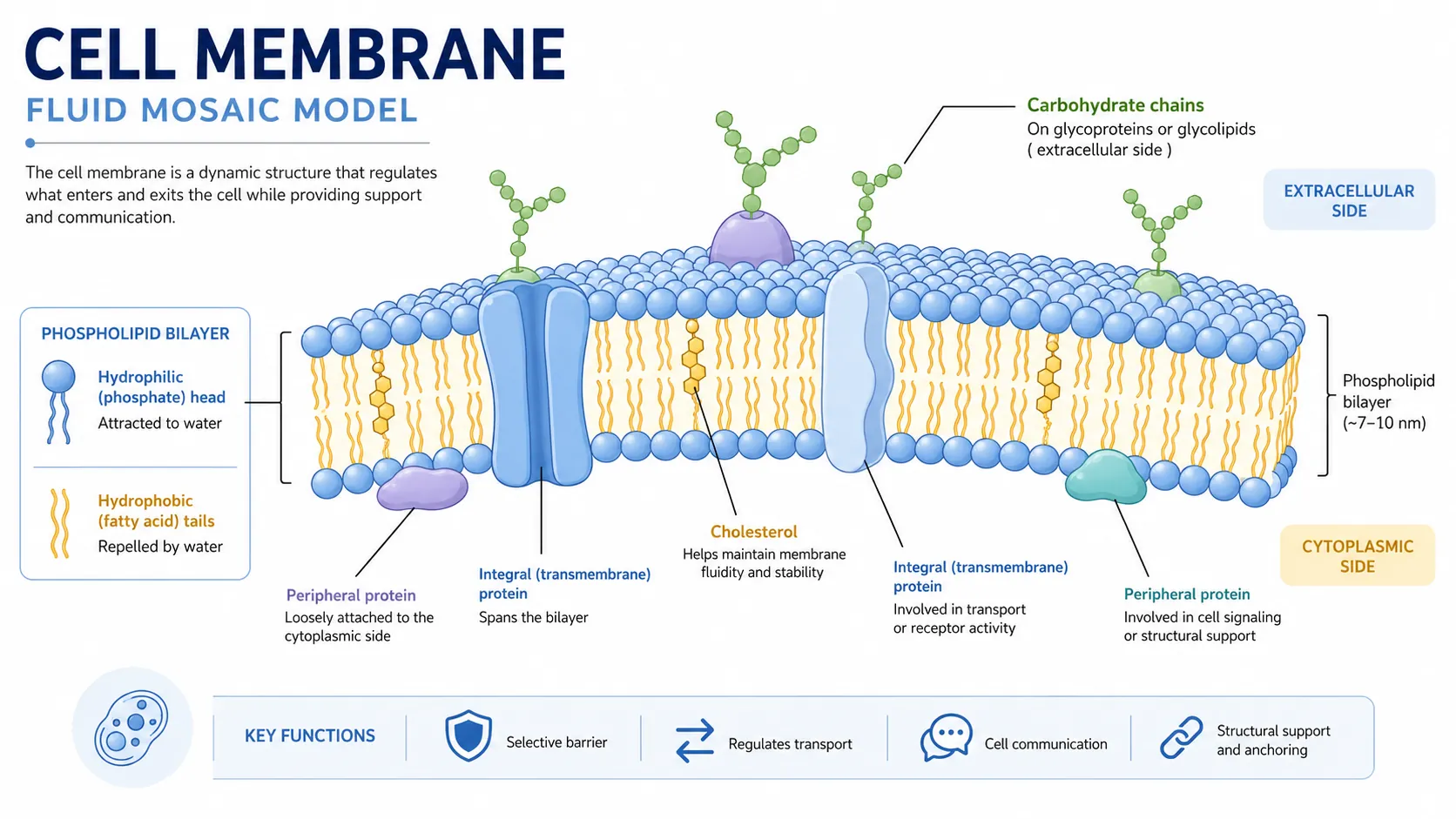
Table of Contents

eSaral › Class 11 › Biology › Cell Membrane in Cell Biology

Cell Membrane in Cell Biology: Structure, Functions & Diagram
In cell biology, the cell membrane is the thin, selectively permeable boundary that encloses every living cell, separating its internal contents from the external environment while controlling the movement of substances in and out. Also called the plasma membrane or plasmalemma, it is built primarily of a phospholipid bilayer embedded with proteins, cholesterol, and carbohydrates — a structure described by the fluid mosaic model. Every cell, whether prokaryotic or part of eukaryotic cells, has a cell membrane as one of its two universal features, alongside cytoplasm.
This topic forms the base of the Cell: The Unit of Life chapter for Class 11 Biology, and cell membrane structure is one of the most frequently tested areas in board exams and NEET Biology, contributing multiple questions almost every year. Test how frequently this exact topic appears with NEET Chapterwise PYQ.
What Is the Cell Membrane?
The cell membrane, in cell biology, is defined as the outermost living boundary of the cell that separates the protoplasm from the surrounding environment. It is present in every cell — from the simplest bacterium to the most complex human neuron — and is one of the two basic features shared by both prokaryotic and eukaryotic cells (the other being cytoplasm).
- The cell membrane is selectively permeable, allowing some substances to pass while blocking others.
- It is roughly 5–10 nanometres thick and appears trilaminar (three-layered) under an electron microscope.
- The cell membrane is not a rigid wall — it is fluid, dynamic, and constantly in motion.
- Unlike the rigid cell wall found in plant cells and bacteria, the cell membrane itself is flexible and present in all cell types.
Cell Membrane – Structure & Functions (Cell Biology)
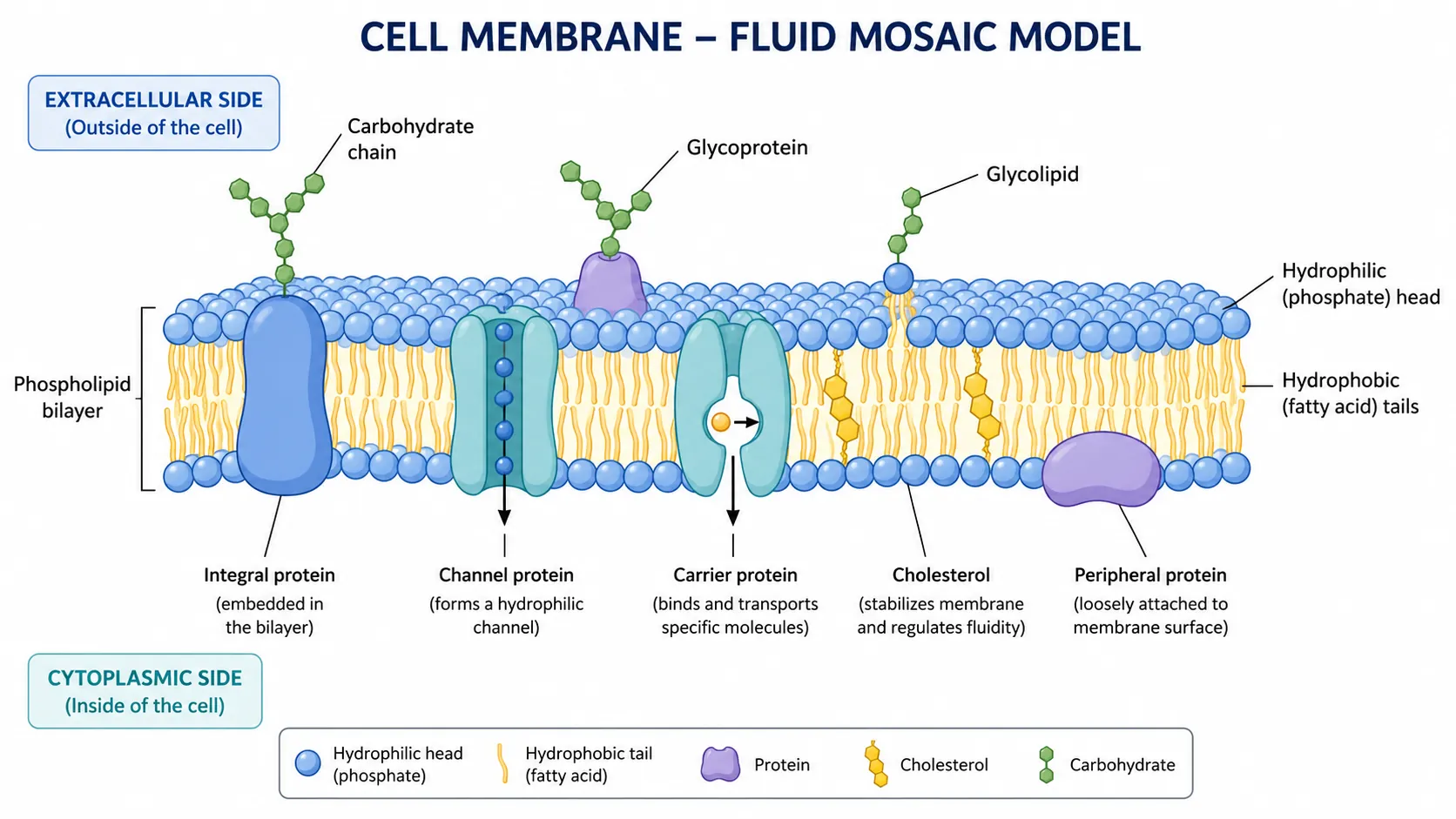
The structure of the cell membrane in cell biology is best explained by the fluid mosaic model, proposed by S.J. Singer and G.L. Nicolson in 1972. This model describes the membrane as a mosaic of different components — phospholipids, proteins, cholesterol, and carbohydrates — that gives it a fluid, constantly shifting character rather than a fixed, rigid one.
What Are the Components of Cell Membrane Structure?
| Component | Role in Cell Membrane Structure |
|---|---|
| Phospholipid bilayer | Forms the basic two-layered framework, with hydrophilic heads facing outward and hydrophobic tails facing inward |
| Integral (intrinsic) proteins | Embedded fully within the membrane; often form channels or carriers for transport |
| Peripheral (extrinsic) proteins | Loosely attached to the inner or outer membrane surface; involved in signalling and support |
| Cholesterol | Present between phospholipids; regulates membrane fluidity and stability |
| Carbohydrates (glycoproteins/glycolipids) | Extend from the outer surface; involved in cell recognition and cell-to-cell communication |
Why Is the Cell Membrane Called "Fluid Mosaic"?
The term fluid mosaic describes two properties of cell membrane structure at once:
- Fluid — phospholipids and many proteins can move laterally within the layer, giving the membrane a flexible, liquid-like consistency.
- Mosaic — proteins are scattered irregularly throughout the phospholipid bilayer, like tiles in a mosaic pattern, rather than being arranged in a fixed order.
What Are the Main Functions of the Cell Membrane?
The functions of the cell membrane in cell biology go far beyond simply enclosing the cell:
- Selective permeability — regulates which substances enter and exit the cell, maintaining internal stability.
- Transport of materials — moves ions, nutrients, and waste products across the membrane through passive and active transport.
- Cell protection — shields the internal organelles and cytoplasm from the external environment.
- Cell signalling — membrane receptors detect external signals and trigger internal responses.
- Cell recognition — surface carbohydrates help the immune system distinguish "self" cells from foreign ones.
- Maintaining cell shape — works with the cytoskeleton to support the overall structure of the cell.
Check the NEET Syllabus to see how Cell Biology's weightage compares to other high-scoring units.
How Does the Cell Membrane Transport Substances Across It?
Movement of substances across the cell membrane happens through two broad mechanisms — passive transport (no energy required) and active transport (requires ATP).
| Type of Transport | Example | Energy Required |
|---|---|---|
| Diffusion | Movement of oxygen and carbon dioxide across the membrane | No |
| Osmosis | Movement of water molecules across a selectively permeable membrane | No |
| Facilitated diffusion | Glucose transport through carrier proteins | No |
| Active transport | Sodium-potassium (Na⁺/K⁺) pump | Yes (ATP) |
| Endocytosis | Engulfing large particles or fluid into the cell | Yes (ATP) |
| Exocytosis | Releasing substances out of the cell | Yes (ATP) |
Transport mechanisms — especially active vs passive transport — are a favourite assertion-reason format in NEET Previous Year Question Papers
How Is the Cell Membrane Different in Prokaryotic and Eukaryotic Cells?
The basic fluid mosaic structure of the cell membrane is common to both prokaryotic and eukaryotic cells, but a few differences exist:
| Basis | Prokaryotic Cell Membrane | Eukaryotic Cell Membrane |
|---|---|---|
| Sterols | Generally absent (except in a few groups) | Cholesterol commonly present |
| Associated structures | Mesosomes (infoldings) may be present | Connected to an extensive endomembrane system |
| Cell wall outside membrane | Present in most bacteria (peptidoglycan) | Present only in plant cells (cellulose), absent in animal cells |
| Complexity of transport proteins | Simpler | More diverse and specialised |
Continue Your Cell: The Unit of Life Preparation
- Practise exam-pattern questions with Cell: The Unit of Life NEET previous year questions, complete with detailed solutions.
- Cross-check every textbook answer using NCERT Solutions for Class 11 Biology Chapter 8 — Cell: The Unit of Life.
- Go beyond the textbook with NCERT Exemplar Class 11 Biology for higher-order, application-based questions.
- Download the complete Class 11 Biology NCERT PDF Book chapter-wise for free.
- Explore the full NCERT Solutions for Class 11 Biology hub to plan your complete syllabus.
- Test your recall speed with topic-wise mock sections: NEET Test Series →
Want a structured revision plan for the complete Cell Biology chapter? Explore eSaral's NEET Course, taught by Kota's top Doctor faculty.
Frequently Asked Questions
Find answers to common questions.
What is the cell membrane made of?
What are the main functions of the cell membrane?
What is the fluid mosaic model of the cell membrane?
Why is the cell membrane called selectively permeable?
How do substances move across the cell membrane?
What is the difference between the cell membrane and the cell wall?
Is the cell membrane present in both prokaryotic and eukaryotic cells?
Is the cell membrane found in both plant and animal cells?
Yes, the cell membrane is present in both plant and animal cells; in plant cells, it lies just inside the additional rigid cell wall.
What is the definition and function of the cell membrane?
The cell membrane is defined as the selectively permeable boundary enclosing a cell, and its core function is regulating the movement of substances in and out while providing protection, structural support, and a site for cell signaling.