Cell: The Unit of Life - NEET Previous Year Questions with Complete Solutions

Table of Contents

eSaral › NEET Biology › Cell: The Unit of Life Previous Year Questions with Complete Solutions

Here you will get Complete Cell The Unit of Life NEET Previous Year Questions with complete and detailed solutions.
Get complete NEET previous year questions for Physics, Chemistry, and Biology.
You will find all the solutions at the end of this page:
How Many Questions Come From This Chapter in NEET?
On average, NEET includes 3 to 5 questions from "Cell: The Unit of Life" every year. In some years (2016, 2019, 2022), the chapter contributed 5 questions. The chapter's consistent appearance in NEET papers over the last 10 years makes it a reliable scoring opportunity for well-prepared students.
NEET Year-Wise Question Count from This Chapter
| NEET Year | Questions from Chapter | Difficulty Level |
|---|---|---|
| 2024 | 3 | Moderate |
| 2023 | 4 | Moderate–High |
| 2022 | 5 | Moderate |
| 2021 | 3 | Moderate |
| 2020 | 4 | Moderate |
| 2019 | 5 | High |
| 2018 | 3 | Low–Moderate |
| 2017 | 4 | Moderate |
In my experience teaching hundreds of NEET qualifiers, students who solve at least 8–10 years of PYQs from this chapter stop losing marks on it entirely. The question patterns repeat more predictably here than in almost any other biology chapter. Prioritise the topics with the highest PYQ frequency — especially cell organelles and prokaryote-eukaryote comparisons.
Topic-Wise NEET Question Frequency Table
Use this table to prioritise your revision. Topics marked High have appeared in 6 or more of the last 10 NEET papers.
| Topic | NEET Frequency | Priority |
|---|---|---|
| Prokaryote vs Eukaryote differences | High (8/10 years) | Must Do |
| Cell organelle structure & function | High (9/10 years) | Must Do |
| Cell theory and scientists | Moderate (5/10 years) | Important |
| Plant cell vs animal cell | Moderate (6/10 years) | Must Do |
| Plasma membrane structure | Moderate (4/10 years) | Important |
| Nucleus structure | Moderate (5/10 years) | Important |
| Cytoskeleton | Low (2/10 years) | Revise Once |
| Endomembrane system | Moderate (4/10 years) | Importan |
How to Use These PYQs Effectively
Step 1: Solve Without Looking at Solutions
Attempt each question independently before checking the answer. This builds exam-like focus and reveals your actual gaps — not the gaps you think you have.
Step 2: Analyse Every Wrong Answer
For each incorrect answer, go back to your NCERT textbook (Class 11, Chapter 8) and find the exact line that the question is testing. NEET Biology is almost entirely NCERT-based. If you cannot find the source in NCERT, look at the diagram captions and boxed notes — NTA routinely picks from these.
You can find chapter-aligned NCERT Solutions here to cross-check your understanding of every concept after solving a PYQ.
Step 3: Track Your Accuracy by Topic
After solving 2–3 years of PYQs, make a simple tally of which topics you get wrong most often. Focus your next revision session on those topics specifically rather than re-reading the entire chapter.
eSaral students who used our structured PYQ practice module alongside the 5-layer doubt-solving system consistently outperformed their self-study peers in mock tests. If a concept from this chapter isn't clicking after two reads, raise it as a doubt immediately — organelle functions especially need visual reinforcement, not just text revision. Our IIT Bombay-trained faculty resolve such doubts with diagram-based explanations that make the concept stick.
Step 4: Revisit 48 Hours Later
Spaced repetition is essential for Biology. Revisit every PYQ you solved two days after your initial session. Research on memory retention shows that recall after a gap solidifies long-term memory far better than repeated same-day reading.
NEET Previous Year Questions – Cell: The Unit of Life
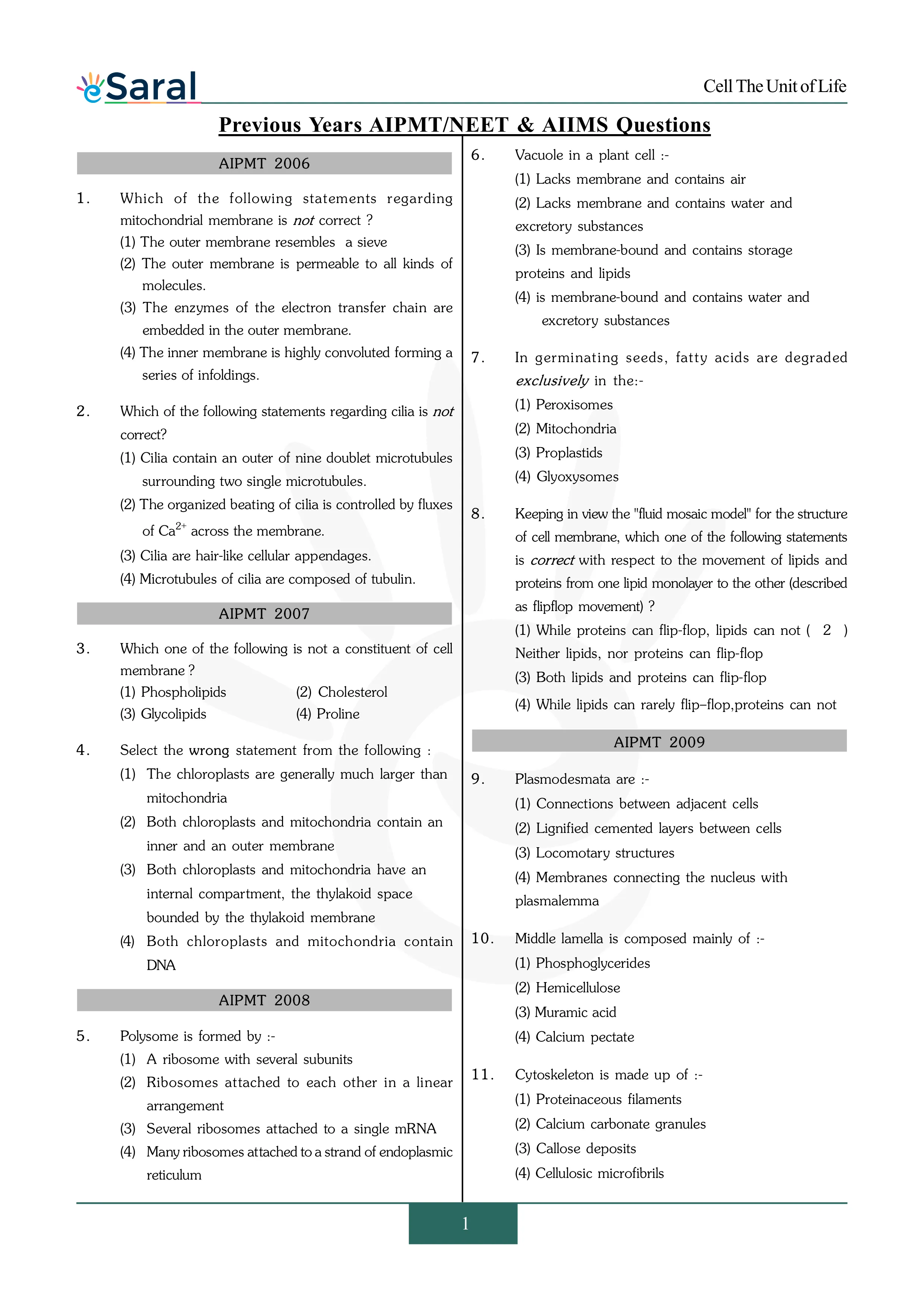
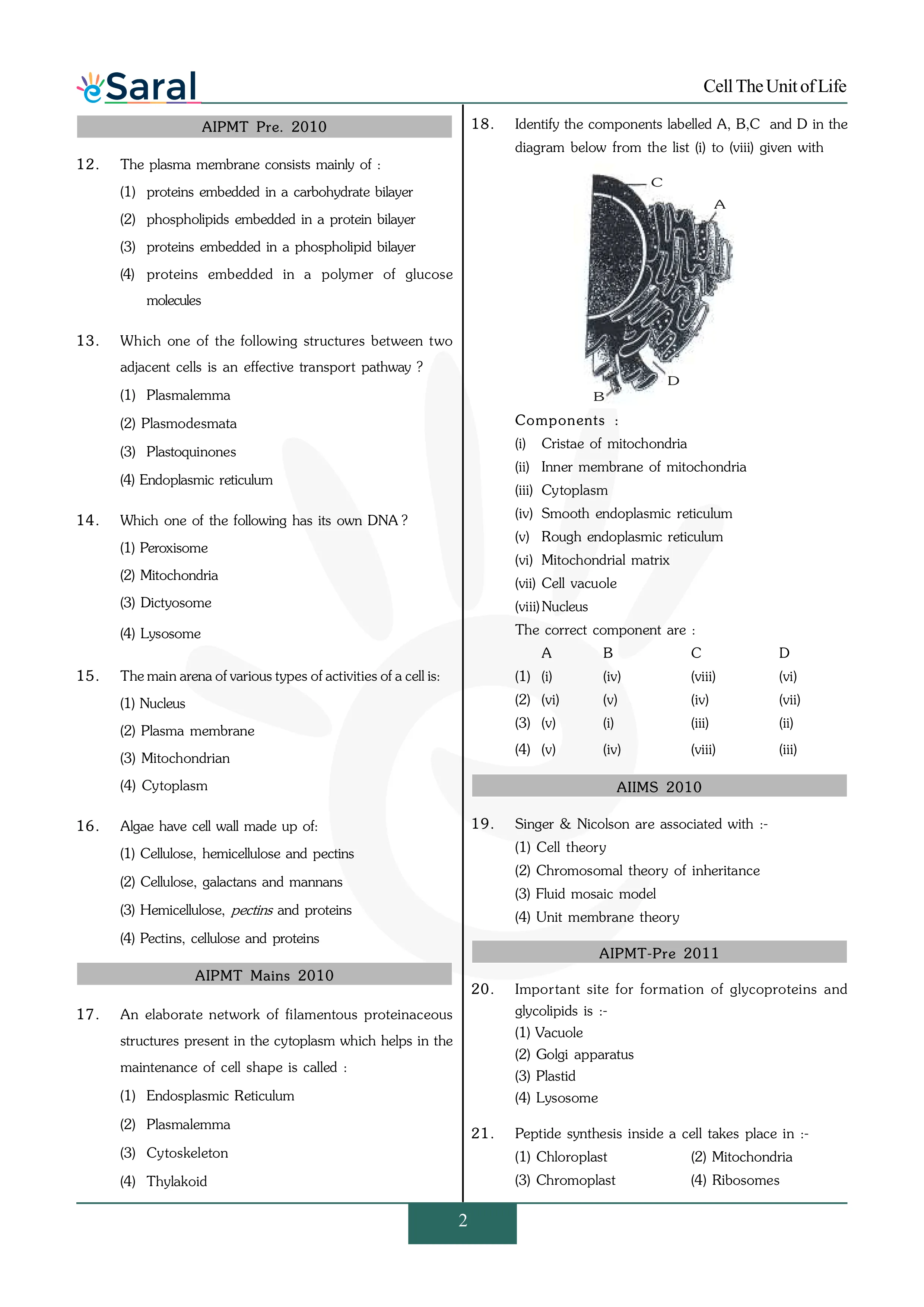
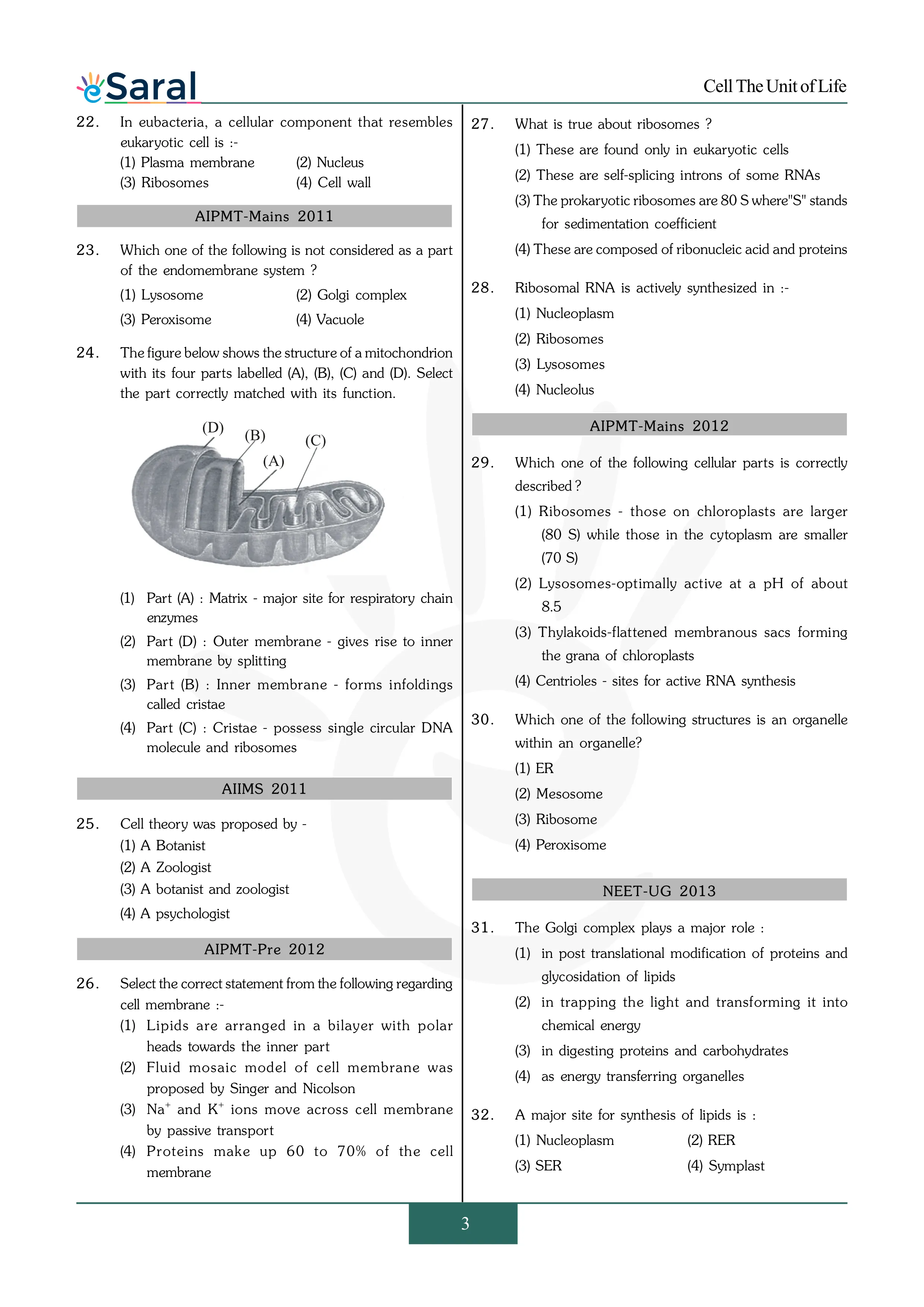
The complete set of NEET previous year questions with step-by-step solutions for this chapter is available in the interactive module below. Each question includes:
- The correct answer with explanation
- The NCERT source line or diagram reference
- The year and question number from the official NTA paper
- Common traps and why wrong options seem correct
For students who also want to strengthen their Physics and Chemistry PYQ practice alongside Biology, explore NCERT Solutions for Class 12 Chemistry and NCERT Books for Class 12 to keep all three subjects aligned.
Frequently Asked Questions
Find answers to common questions.
Which year's NEET paper had the toughest questions from this chapter?
NEET 2019 is widely considered to have had the most challenging questions from this chapter, with 5 questions that included application-based and diagram-interpretation items. Students who had practised PYQs from 2014 onwards were significantly better prepared, as several 2019 questions involved concepts that had appeared in different forms in earlier years
How should I revise this chapter one week before NEET?
One week before NEET, do not re-read the entire chapter. Instead, solve 2–3 years of PYQs in timed conditions, review only those concepts where you made errors, make a one-page list of all organelle distinguishing features, and revise the prokaryote vs eukaryote comparison table. Avoid introducing new sources at this stage
What is the difference between 70S and 80S ribosomes, and why does NEET ask about it?
70S ribosomes (made of 50S + 30S subunits) are found in prokaryotes, mitochondria, and chloroplasts. 80S ribosomes (made of 60S + 40S subunits) are found in eukaryotic cytoplasm. NTA asks this because it tests whether students understand the endosymbiotic origin of mitochondria and chloroplasts — a high-yield conceptual link between chapters.
What are the most important organelles to study for NEET from this chapter?
Mitochondria, chloroplasts, Golgi apparatus, lysosomes, endoplasmic reticulum, and the nucleus are tested most frequently. Each carries unique structural features — such as mitochondria having 70S ribosomes and their own circular DNA — that NTA uses to set tricky options. Learn the distinguishing structural feature of each organelle, not just its function.
Is NCERT enough for Cell: The Unit of Life in NEET?
Yes, NCERT Class 11 Biology Chapter 8 is sufficient for this chapter in NEET. NTA designs questions directly from NCERT text, diagrams, tables, and even diagram captions. However, solving 8–10 years of PYQs alongside NCERT reading is essential to understand exactly how NTA phrases questions and which lines it tests most frequently.
How many questions come from "Cell: The Unit of Life" in NEET every year?
NEET typically includes 3 to 5 questions from this chapter each year. Based on the last 10 years of NTA question papers, the chapter has appeared in every single NEET exam without exception. Cell organelles and prokaryote vs eukaryote differences are the two most consistently tested sub-topics, making them the highest priority for revision.