Cells in Plants and Animals – Plant Cell and Animal Cell Diagram
.webp)
Table of Contents
- What Are Cells in Plants and Animals?
- Plant Cell and Animal Cell Diagram (Labelled)
- How to Draw a Plant Cell and Animal Cell Diagram in Exams (Step-by-Step)
- Plant Cell and Animal Cell Difference (Comparison Table)
- Common Features of Cells in Plants and Animals (Similarities)
- Parts of Plant and Animal Cells and Their Functions
- Why Are Cells in Plants and Animals Different?
- Exceptions and Trap Questions (NEET and Olympiad Level Plant and Animal Cell Question)
- Common Mistakes Students Make
- Practice Questions on Plant Cell and Animal Cell

eSaral › Class 11 › Biology › Cells in Plants and Animals – Plant Cell and Animal Cell Diagram

What Are Cells in Plants and Animals?
Cells in plants and animals are eukaryotic cells. This means each one has a true nucleus enclosed by a nuclear membrane, plus membrane-bound organelles that divide up the cell's work. Every plant and every animal, from a moss to a human being, is built from these cells, which is why the cell is called the structural and functional unit of life.
Two findings in the 1830s tied cells in plants and animals together:
- Matthias Schleiden (1838) showed that all plants are made of cells.
- Theodor Schwann (1839) showed the same for animals.
Together they proposed the cell theory. Rudolf Virchow (1855) later added that new cells arise only from pre-existing cells (omnis cellula e cellula).
Plant and animal cells share the same basic machinery. They differ because plants are producers that make their own food and stand upright without a skeleton, while animals are consumers that move, hunt and change shape.
Quick facts about cells in plants and animals:
| Feature | Plant Cell | Animal Cell |
|---|---|---|
| Cell type | Eukaryotic | Eukaryotic |
| Typical size | 10–100 µm | 10–30 µm |
| Shape | Fixed, rectangular or box-like | Irregular, round or variable |
| Nutrition | Autotrophic (photosynthesis) | Heterotrophic |
| Discovered as cellular by | Schleiden (1838) | Schwann (1839) |
Plant Cell and Animal Cell Diagram (Labelled)
A labelled plant cell and animal cell diagram shows both cells side by side. The shared organelles are labelled on both cells so the differences stand out:
- On the plant cell diagram: a thick outer cell wall, green chloroplasts, and one large central vacuole that pushes the nucleus to one side.
- On the animal cell diagram: a thin cell membrane only, centrioles near the nucleus, and scattered lysosomes.
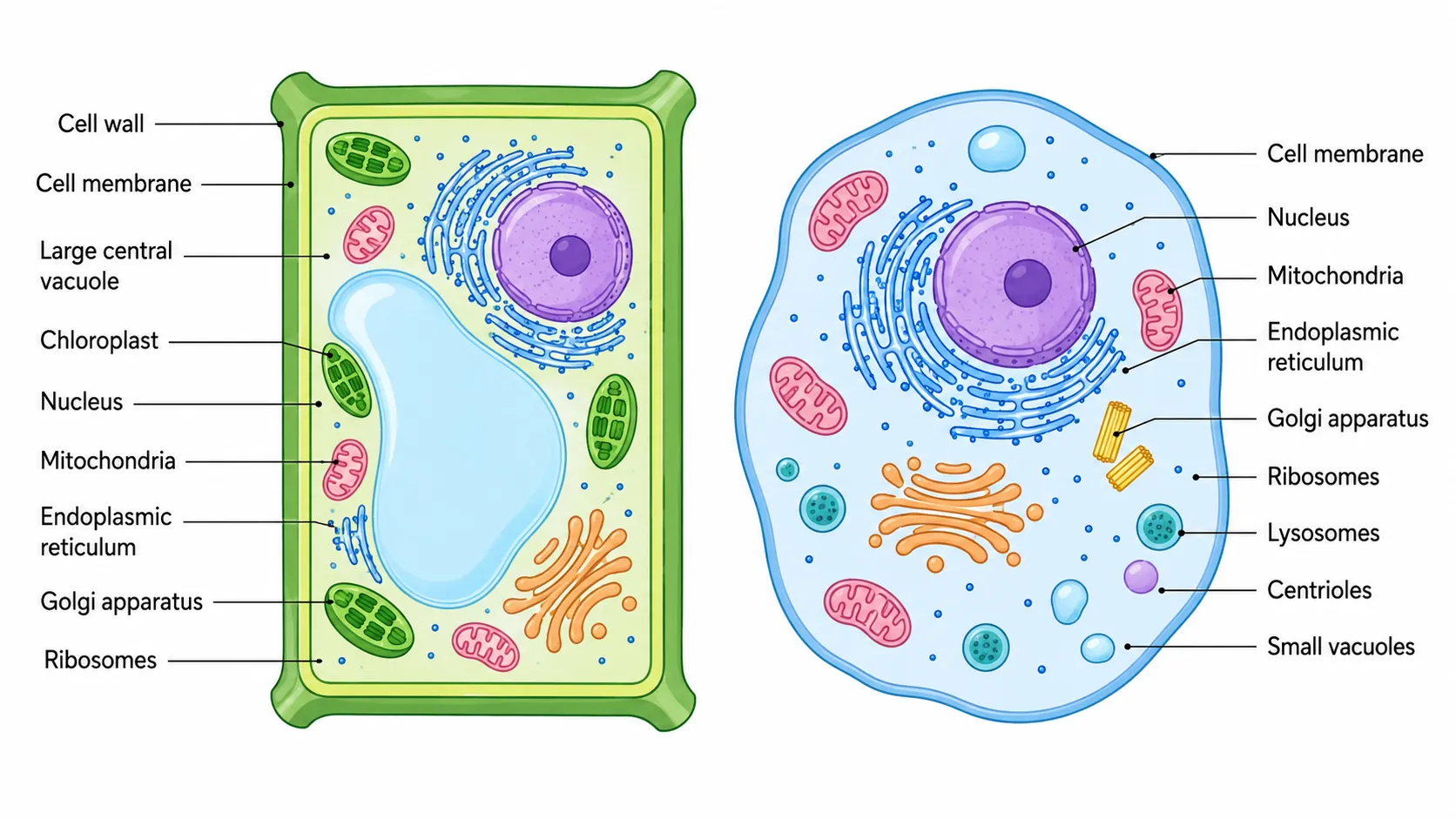
Labelled plant cell and animal cell diagram – cells in plants and animals compared
Labelled Plant Cell Diagram – Parts to Mark
A complete labelled plant cell diagram has 12 parts:
- Cell wall
- Cell membrane (plasma membrane)
- Cytoplasm
- Nucleus
- Nucleolus
- Chloroplast
- Large central vacuole
- Tonoplast (the membrane around the vacuole)
- Mitochondria
- Endoplasmic reticulum (rough and smooth)
- Golgi apparatus
- Ribosomes
Curious how all these components actually fit together in a real plant cell diagram? Understanding the diagram alongside the theory makes the concept stick far better than memorising labels alone — you'll see exactly how the cell wall, vacuole, and organelles work together to keep the cell functioning.
Labelled Animal Cell Diagram – Parts to Mark
A complete labelled animal cell diagram has 11 parts:
- Cell membrane
- Cytoplasm
- Nucleus
- Nucleolus
- Mitochondria
- Rough ER
- Smooth ER
- Golgi apparatus
- Lysosomes
- Centrosome with centrioles
- Ribosomes
Small vacuoles can be drawn but are optional.
How to Draw a Plant Cell and Animal Cell Diagram in Exams (Step-by-Step)
To draw a plant cell diagram, start with the rectangular cell wall. For an animal cell diagram, start with an irregular oval membrane. Then add organelles from largest to smallest.
Plant cell diagram steps:
- Draw a rectangle with a double outline. The outer line is the cell wall and the inner line is the cell membrane.
- Draw a large central vacuole covering 50–90% of the cell.
- Place the nucleus with its nucleolus near one edge, pushed there by the vacuole.
- Add 4–5 oval chloroplasts in the cytoplasm around the edges.
- Add mitochondria, Golgi apparatus, ER and ribosome dots.
- Label with straight horizontal lines, all ending on one side. Never cross label lines.
Animal cell diagram steps:
- Draw an irregular oval with a single thin outline, which is the cell membrane.
- Place the nucleus with its nucleolus in the centre.
- Draw two small cylinders at right angles near the nucleus. These are the centrioles.
- Add lysosomes (small circles), mitochondria, Golgi apparatus, ER and ribosomes.
- Label neatly and title the diagram "Animal Cell".
| Board exam tip: CBSE awards marks for the correct shape, at least 5–6 correct labels, and a title. A single-outline plant cell loses the "cell wall" mark, which is one of the most common errors in plant cell diagram questions.s. |
Plant Cell and Animal Cell Difference (Comparison Table)
The main plant cell vs. animal cell difference is that plant cells have a cell wall, chloroplasts, and a large central vacuole, while animal cells have centrioles and lysosomes instead. Every other difference in the table below follows from these structural ones.
| Basis | Plant Cell | Animal Cell |
|---|---|---|
| Cell wall | Present (cellulose) | Absent |
| Shape | Fixed, rectangular | Irregular or round |
| Chloroplasts | Present | Absent |
| Vacuole | One large central vacuole | Small, temporary vacuoles or none |
| Centrioles | Absent in higher plants | Present |
| Lysosomes | Rare; lytic vacuoles do this job | Present |
| Nucleus position | Pushed to the side | Usually central |
| Stored food | Starch | Glycogen |
| Nutrition | Autotrophic | Heterotrophic |
| Cytokinesis | Cell plate formation | Cleavage furrow |
| Cell connections | Plasmodesmata | Gap junctions, tight junctions, desmosomes |
| In water (hypotonic) | Becomes turgid, does not burst | Swells, may burst (lysis) |
| Glyoxysomes | Present in fat-storing seeds | Absent |
| Size | Larger (10–100 µm) | Smaller (10–30 µm) |
10 Differences Between Plant and Animal Cells (Quick Revision List)
- Cell wall: plant cells have one; animal cells do not.
- Chloroplasts: plant cells have them; animal cells do not.
- Central vacuole: plant cells have a large central vacuole; animal cells have small vacuoles or none.
- Centrioles: animal cells have them; higher plant cells do not.
- Lysosomes: common in animal cells, rare in plant cells.
- Shape: plant cells are rectangular; animal cells are irregular.
- Stored food: plant cells store starch; animal cells store glycogen.
- Cytokinesis: plant cells form a cell plate; animal cells form a furrow.
- Nutrition: plant cells are autotrophic; animal cells are heterotrophic.
- Nucleus position: peripheral in plant cells, central in animal cells.
| Memory trick: plants have the 3 C's, which are Cell wall, Chloroplast and Central vacuole. Animals have C + L, which is Centrioles and Lysosomes. |
Common Features of Cells in Plants and Animals (Similarities)
Before looking at the differences, it helps to identify what stays the same in cells in Plants and Animals. Both cell types contain:
- Cell membrane – a thin, selectively permeable boundary controlling what enters and exits the cell
- Cytoplasm – the jelly-like matrix where most cellular activities happen
- Nucleus – contains DNA and controls all cell activities
- Mitochondria – the "powerhouse," generating ATP through respiration
- Endoplasmic reticulum (ER) – rough ER for protein synthesis, smooth ER for lipid synthesis
- Golgi apparatus – packages and dispatches proteins and lipids
- Ribosomes – sites of protein synthesis, either free-floating or attached to rough ER
Because both cell types need to release energy from food, both perform cellular respiration and release $\ce{CO2}$ and water as byproducts while consuming $\ce{O2}$.
Parts of Plant and Animal Cells and Their Functions
Each organelle in cells in plants and animals performs one specialised job:
- The nucleus controls the cell.
- Mitochondria release energy.
- Chloroplasts make food, in plant cells only.
Cell Wall (Plant Cell Only)
The cell wall is a rigid, non-living layer made mainly of cellulose. It gives the plant cell its shape, strength and protection. It has three layers:
- a middle lamella of calcium pectate, which cements neighbouring cells together
- a primary wall
- a secondary wall in mature cells
It is freely permeable, unlike the cell membrane.
Cell Membrane (Both)
The cell membrane is a selectively permeable lipid–protein layer that controls what enters and leaves the cell. In animal cells it is the outermost boundary. In plant cells it lies just inside the cell wall.
Nucleus (Both)
The nucleus is the control centre of the cell. It holds chromosomes made of DNA, which carry genes for inheritance. The nucleolus inside it makes ribosomes.
Mitochondria (Both)
Mitochondria are the powerhouse of the cell. They release energy as ATP through aerobic respiration. They have their own DNA and ribosomes.
Chloroplasts (Plant Cell Only)
Chloroplasts are green plastids containing chlorophyll. They carry out photosynthesis, turning light, CO₂ and water into glucose and oxygen. Plant cells also have other plastids:
- chromoplasts, which give colour to flowers and fruits
- leucoplasts, which store starch, oil or protein
Vacuole (Large in Plant Cells)
The central vacuole stores cell sap: water, salts, sugars and waste. It keeps the plant cell turgid, which holds soft plant parts upright. It is bounded by the tonoplast.
Centrioles (Animal Cell Only)
Centrioles are paired cylindrical structures that organise spindle fibres during animal cell division. They also form the basal bodies of cilia and flagella.
Lysosomes (Mainly Animal Cells)
Lysosomes are "suicide bags" filled with digestive enzymes. They break down worn-out organelles and foreign particles.
ER, Golgi Apparatus and Ribosomes (Both)
These form the cell's production line:
- Ribosomes make proteins.
- Rough ER carries those proteins.
- Smooth ER makes lipids.
- The Golgi apparatus packages and dispatches the products.
Why Are Cells in Plants and Animals Different?
Cells in plants and animals are different because plants and animals live in opposite ways. Plants stay in one place, make their own food and must stand upright. Animals move, eat other organisms and need flexible bodies. Each difference matches one of these needs:
- Cell wall and central vacuole provide support without a skeleton. Turgor pressure works like a water-filled scaffold.
- Chloroplasts let plants make their own food, so animals, which eat food, do not need them.
- No cell wall in animals allows movement, shape change and processes like phagocytosis by white blood cells.
- Glycogen instead of starch gives animals a compact, quickly mobilised energy store for movement.
How Plant and Animal Cells Behave in Water (Osmosis)
In water, a plant cell becomes firm (turgid) but does not burst, because its cell wall resists the pressure. An animal cell swells and may burst. In a concentrated salt solution, the two cells also react differently:
| Solution | Plant Cell | Animal Cell (e.g. RBC) |
|---|---|---|
| Hypotonic (water) | Turgid, safe | Swells and bursts (haemolysis) |
| Isotonic | No change (flaccid) | No change |
| Hypertonic (salt) | Plasmolysis: the membrane pulls away from the wall | Crenation: the cell shrinks and wrinkles |
This is why wilted spinach revives in water, and why hospitals use isotonic saline drips.
How Plant and Animal Cells Divide
Plant cells divide by forming a cell plate in the middle, because a rigid wall cannot pinch inwards. Animal cells divide by a cleavage furrow that pinches the cell into two. Animal cells use centrioles to form the spindle. Higher plant cells form spindles without centrioles (an anastral spindle).
Read the full mechanism in our Cell Cycle and Cell Division NEET PYQs with solutions.
Observing Cells in Plants and Animals Under a Microscope (Class 9 Activity)
Onion peel cells are the standard way to observe plant cells, and human cheek cells are the standard way to observe animal cells. Both can be seen under a compound microscope after staining.
Onion peel (plant cell):
- Peel the thin inner layer of an onion scale.
- Stain it with safranin.
- Mount it in glycerine and cover it with a coverslip.
- Observe rectangular, closely packed cells with a clear cell wall and a nucleus near the edge.
Cheek cells (animal cell):
- Gently scrape the inner cheek with a clean spoon.
- Stain the scraping with methylene blue.
- Mount it in glycerine.
- Observe flat, irregular cells with no cell wall and a dark central nucleus.
Chloroplasts are not seen in onion peel because it grows underground and gets no light. This is a favourite viva question.
Exceptions and Trap Questions (NEET and Olympiad Level Plant and Animal Cell Question)
Not every plant cell or animal cell matches the textbook diagram. NEET often tests these exceptions:
- Not all plant cells have chloroplasts. Root cells and onion bulb cells lack them.
- Centrioles are present in some lower plants. They occur in the motile sperm of mosses and ferns. They are absent only in higher plants.
- Not all animal cells have a nucleus. Mature mammalian RBCs lose theirs. Among plant cells, sieve tube cells also lack a nucleus.
- Plant cells do have lysosome-like activity. Lytic vacuoles do the same digestive job.
- Fungi have cell walls but are not plants. Their walls are made of chitin, not cellulose.
- Largest and smallest cells: the largest single cell is an ostrich egg, the longest human cell is a nerve cell, and the smallest cells are Mycoplasma (PPLO, about 0.3 µm).
Practise more of these in our Cell: The Unit of Life NEET previous year questions.
Common Mistakes Students Make
The most common mistakes with cells in plants and animals are:
- Saying animal cells "have no vacuoles." They have small, temporary ones.
- Drawing chloroplasts in an animal cell diagram.
- Drawing the plant cell nucleus in the centre.
- Calling the cell wall "selectively permeable." It is fully permeable; the cell membrane is the selectively permeable one.
- Writing "all plant cells lack centrioles" in NEET. Only higher plants lack them.
Practice Questions on Plant Cell and Animal Cell
Test your understanding of the plant cell and animal cell difference with these MCQs:
1. Which structure is present in both plant and animal cells?
(a) Cell wall (b) Chloroplast (c) Mitochondria (d) Centriole
Answer: (c) Mitochondria occur in both cells in plants and animals.
2. A cell with a cell wall, chloroplasts and a large vacuole is a:
(a) Bacterial cell (b) Animal cell (c) Plant cell (d) Fungal cell
Answer: (c) These are the "3 C's" of a plant cell.
3. A red blood cell placed in distilled water will:
(a) Become turgid (b) Undergo plasmolysis (c) Burst (d) Show no change
Answer: (c) It has no cell wall, so it bursts (haemolysis).
4. Cytokinesis in plant cells occurs by:
(a) Cleavage furrow (b) Cell plate formation (c) Budding (d) Constriction
Answer: (b) The rigid cell wall prevents furrowing.
5. The storage carbohydrate of animal cells is:
(a) Starch (b) Cellulose (c) Glycogen (d) Sucrose
Answer: (c) Glycogen. Plant cells store starch instead.
6. Which is NOT found in a typical higher plant cell?
(a) Plasmodesmata (b) Tonoplast (c) Centriole (d) Plastid
Answer: (c) Centrioles are absent in higher plant cells.
Class-Wise Study Guide for Cells in Plants and Animals
Cells in plants and animals is taught in Class 8, Class 9 and Class 11, with more depth each year:
- Class 8: basic structure and the plant vs animal cell comparison. Revise with our Class 8 cells and microorganisms notes and NCERT Exemplar solutions on cell structure.
- Class 9: organelle functions, osmosis and plasmolysis. See Cell – The Fundamental Unit of Life Class 9 notes.
- Class 11 / NEET: ultrastructure, cell wall layers and exceptions. Use the NCERT Class 11 Biology Chapter 8 solutions.
If you want to revise this exact chapter for competitive exams, the Cell: The Unit of Life NEET Previous Year Questions page has NTA-style questions with detailed solutions — a good way to test how well you've understood the differences above. Start practising now. For the full syllabus context, check the NEET Syllabus to see exactly how much weight the Cell Biology unit carries.
.webp)
Why Do Plant Cells Have a Cell Wall but Animal Cells Don't?
Plant cells need a cell wall because plants cannot move to escape physical damage, water loss, or predators — the rigid cellulose wall gives structural support so the plant can stand upright without a skeleton, and it also protects the cell from bursting when it absorbs excess water. Animal cells don't have this wall because animals rely on movement and an internal skeleton (or exoskeleton) for support, and a rigid wall would prevent the shape changes many animal cells — muscle cells, blood cells, immune cells — need to function.
- For the Class 9 level, revisit the NCERT Class 9 Biology Book PDF for the full chapter text — download it free.
- For Class 11 and NEET-level depth, work through the NCERT Solutions for Class 11 Biology Chapter 8 and the NCERT Exemplar Class 11 Biology Chapter 8 — solve the exemplar problems to push past textbook-level recall.
- Once you're confident with this comparison, test your recall speed with eSaral's NEET Test Series, which includes topic-wise mock sections on Cell Biology.
Want a structured, exam-focused revision plan for the complete Cell Biology chapter? Explore eSaral's NEET Course or Foundation Courses for Class 9, taught by Kota's top faculty.
Frequently Asked Questions
Find answers to common questions.
What are cells in plants and animals?
Cells in plants and animals are eukaryotic cells with a true nucleus and membrane-bound organelles. They are the basic structural and functional units of all plants and animals.
What is the main plant cell and animal cell difference?
The main plant cell and animal cell difference is that plant cells have a cell wall, chloroplasts and a large central vacuole, while animal cells lack these and have centrioles and lysosomes instead.
What should a plant cell and animal cell diagram show?
A plant cell and animal cell diagram should show the shared organelles on both cells, plus the cell wall, chloroplasts and central vacuole on the plant cell, and centrioles and lysosomes on the animal cell.
Why do animal cells not have a cell wall?
Animal cells do not have a cell wall because animals need flexible cells for movement, shape change and processes like phagocytosis. Their skeleton gives the body its support instead.
Why is a plant cell rectangular and an animal cell round?
A plant cell is rectangular because its rigid cellulose cell wall fixes its shape. An animal cell is round or irregular because it is bounded only by a flexible cell membrane.
What are 3 differences between plant and animal cells?
First, plant cells have a cell wall and animal cells do not. Second, plant cells have chloroplasts and animal cells do not. Third, plant cells have one large central vacuole, while animal cells have small vacuoles or none.
Do plant cells have mitochondria?
Yes, plant cells have mitochondria. They release energy by respiration day and night, while chloroplasts make food only in light.
Which organelles are found in both plant and animal cells?
The nucleus, cell membrane, cytoplasm, mitochondria, endoplasmic reticulum, Golgi apparatus, ribosomes and peroxisomes are found in both plant and animal cells.
Are centrioles absent in all plant cells?
No. Centrioles are absent in higher plant cells but present in the motile cells of some lower plants, such as the sperm of mosses and ferns.
Which is bigger, a plant cell or an animal cell?
A plant cell is usually bigger, at about 10–100 µm, compared with 10–30 µm for an animal cell. The large central vacuole accounts for much of the extra size.
How do you identify a plant cell and an animal cell under a microscope?
Under a microscope, a plant cell shows a thick cell wall, a fixed rectangular shape and a large clear vacuole. An animal cell shows a thin membrane, an irregular shape and a central nucleus.
Who discovered that plants and animals are made of cells?
Matthias Schleiden showed in 1838 that plants are made of cells, and Theodor Schwann showed the same for animals in 1839. Together they proposed the cell theory.