CBSE Class 9 Exam Pattern 2026-27: Marking Scheme Explained
The CBSE Class 9 Exam Pattern 2026-27 follows an 80-mark final exam plus 20-mark internal assessment, with the final exam split into 50% competency-based questions, 20% short-answer questions, and 30% long-answer questions, and a combined minimum of 33 out of 100 marks needed to pass.
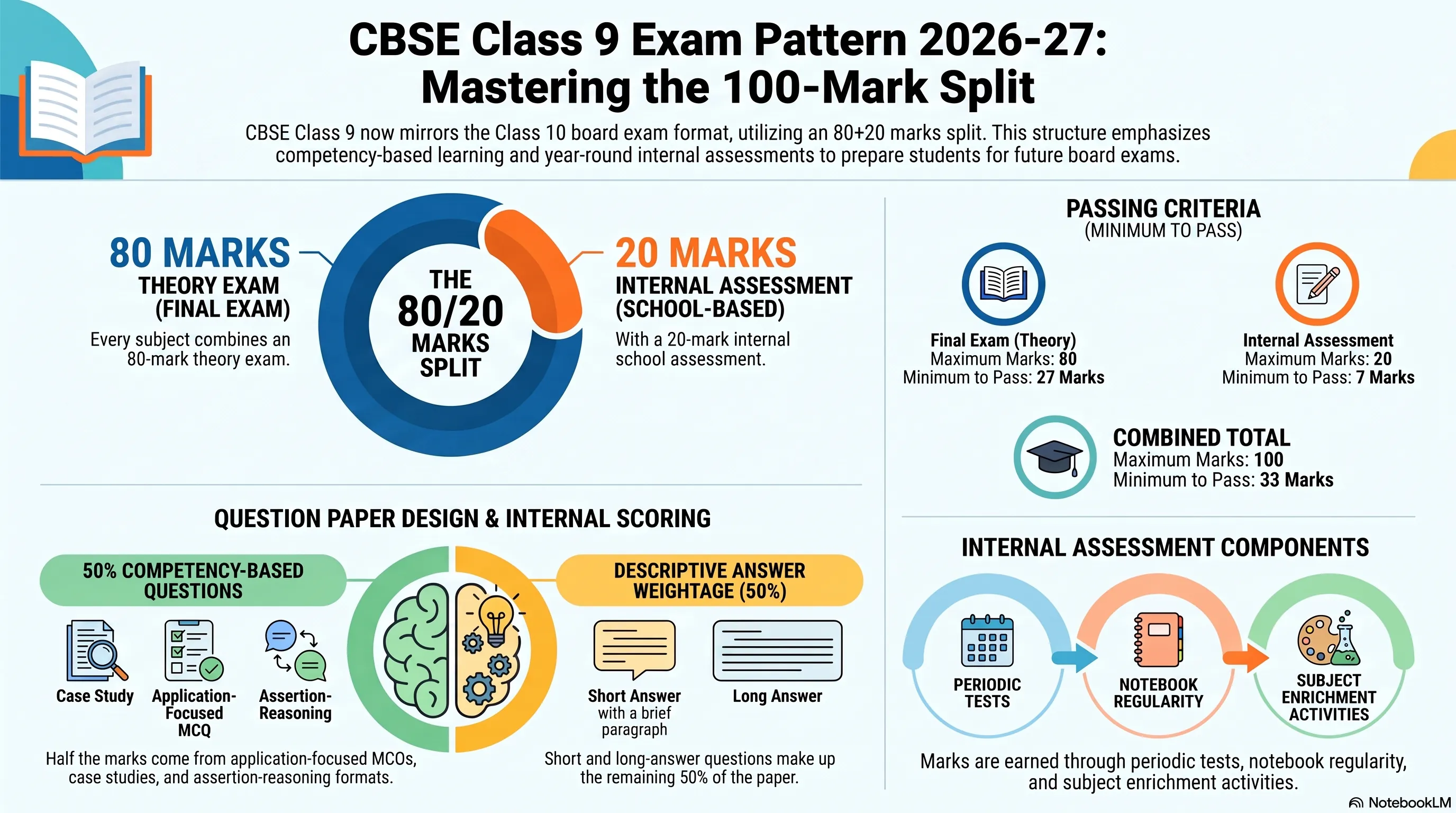
Table of Contents
- What Is the CBSE Class 9 Exam Pattern 2026-27?
- CBSE Class 9 Question Paper Design
- CBSE Class 9 Internal Assessment: 20 Marks Explained
- CBSE Class 9 Passing Criteria
- How Are Competency-Based Questions Different From MCQs?
- Subject-Wise Notes on the Class 9 Exam Pattern
- Why the Class 9 Exam Pattern Matters Before Class 10
- How to Prepare for the Class 9 Exam Pattern

eSaral ›Foundation courses ›CBSE Class 9 Exam Pattern 2026-27: Marking Scheme Explained

What Is the CBSE Class 9 Exam Pattern 2026-27?
CBSE structures every Class 9 subject around an 80-mark final exam plus a 20-mark internal assessment, for a maximum of 100 marks per subject. This mirrors the pattern used in Class 10, giving Class 9 students a genuine preview of board-exam-style assessment a full year early.
| Component | Marks | What It Covers |
|---|---|---|
| Final Exam (Theory) | 80 | Competency-based, short-answer, and long-answer questions |
| Internal Assessment | 20 | Periodic tests, notebook submissions, subject enrichment activities |
| Total | 100 |
Class 9 exams remain school-conducted, not administered directly by CBSE — but because CBSE affiliation requires following its prescribed marking scheme and question paper design, this 80+20 structure is what virtually every CBSE school follows for its Class 9 annual exam.
Why Does Class 9 Follow the Same Pattern as Class 10?
CBSE deliberately aligns the Class 9 exam pattern with Class 10's board-exam format so students get a full year of practice with competency-based questions, internal assessment discipline, and the 80-20 marks split before it actually counts toward a board certificate.
CBSE Class 9 Question Paper Design
The 80-mark final exam paper is divided into three question categories, each testing a different level of understanding.
| Question Type | Weightage | Marks (out of 80) | What It Tests |
|---|---|---|---|
| Competency-Based Questions (MCQs, case-based, assertion-reasoning) | 50% | 40 | Application and conceptual understanding |
| Short-Answer Questions (2-3 marks each) | 20% | 16 | Focused, point-wise explanation |
| Long-Answer Questions (5 marks each) | 30% | 24 | Detailed, descriptive answers with reasoning or diagrams |
Competency-based questions are the single biggest shift from how Class 8 exams are usually structured — they combine direct MCQs with case studies and assertion-reasoning formats, meaning a student can no longer simply memorise a definition and expect full marks.
💡 Expert Tip by eSaral Academic Team: Don't split your prep time evenly across question types. Since competency-based questions carry 50% of the paper, spend proportionally more practice time on case-based and assertion-reasoning formats — they're the section most students underprepare for.
CBSE Class 9 Internal Assessment: 20 Marks Explained
Internal assessment is entirely school-controlled and comes from three components: periodic tests, notebook submissions, and subject enrichment activities.
- Periodic Tests — short, school-conducted tests through the year, usually the largest chunk of the 20 marks.
- Notebook Submission — assessed for completeness, regularity, and correction of classwork and homework.
- Subject Enrichment Activities — practicals, projects, and activities specific to each subject (lab work in Science, map work in Social Science, and so on).
Because these 20 marks are earned steadily through the year rather than in one final sitting, they're also the most controllable part of a student's total score — a student who's consistent with classwork can secure a large share of this before the final exam even begins.
CBSE Class 9 Passing Criteria
To pass a subject in Class 9, a student needs at least 27 out of 80 in the final exam and at least 7 out of 20 in internal assessment, with a combined total of 33 out of 100.
| Component | Minimum Passing Marks |
|---|---|
| Final Exam (out of 80) | 27 marks (~33.75%) |
| Internal Assessment (out of 20) | 7 marks (~35%) |
| Combined Total (out of 100) | 33 marks |
Can a Student Fail Class 9 by Scoring Low in Just One Component?
Yes — a student who scores well in the final exam but falls below 7 out of 20 in internal assessment can still fail a subject overall, since both the final exam minimum and the internal assessment minimum must be met independently, not just the combined total.
This is exactly why treating internal assessment as "extra credit" rather than a real requirement is a common and avoidable mistake.
How Are Competency-Based Questions Different From MCQs?
A standard MCQ tests direct recall — you either know the fact or you don't. A competency-based question wraps the same underlying concept inside a case, a data set, or a real-world scenario, and asks you to apply your understanding across one or more linked sub-questions.
For example, instead of asking "What is photosynthesis?", a competency-based Science question might describe an experiment measuring oxygen output under different light conditions, then ask you to interpret the data, identify the limiting factor, and predict the outcome under a new condition. Getting this right needs genuine conceptual clarity, not memorised definitions — which is exactly the skill JEE, NEET, and every serious competitive exam test for.
Subject-Wise Notes on the Class 9 Exam Pattern
The 80+20, 50-20-30 structure applies across every core subject this session, but each subject layers its own emphasis on top of that base format.
- Mathematics: Long-answer questions concentrate heavily in Algebra and Geometry-linked chapters, where multi-step reasoning naturally fits the 5-mark format.
- Science: With the new Exploration textbook running a Proficiency and an Advanced level, schools may weight competency-based questions differently depending on which level a student is enrolled in — confirm this with your school directly.
- Social Science: Map work and source-based questions (reading a passage, image, or graph) are common in the competency-based section, especially in the Geography-linked chapters of the new integrated textbook.
- English: Literature typically carries the highest single weightage within the 80-mark paper, alongside a dedicated grammar and writing section.
💡 Expert Tip by eSaral Academic Team: If your school has opted into the Science Advanced Level track, ask specifically how it affects your internal exam weightage — some schools test Advanced-level content only in periodic tests, not the final 80-mark paper, and this varies school to school.
Why the Class 9 Exam Pattern Matters Before Class 10
Class 9 is deliberately built as a rehearsal year for Class 10's board exam format. The same 80+20 split, the same 50% competency-based weightage, and the same passing thresholds carry forward almost unchanged — so a student who takes Class 9 assessment seriously walks into Class 10 already fluent in the paper format that will actually appear on their board certificate.
Students who treat Class 9 marks as low-stakes often relearn exam discipline from scratch in Class 10, at exactly the point where the stakes are highest. Getting comfortable with case-based questions, assertion-reasoning formats, and consistent internal assessment habits now removes one major source of stress next year.
How to Prepare for the Class 9 Exam Pattern
- Build NCERT thoroughly, chapter by chapter. Most of the Class 9 paper draws directly from NCERT content, so working through NCERT Solutions for Class 9 Maths and Class 9 Science chapter by chapter remains the highest-leverage single activity.
- Practice competency-based question formats specifically. Case-based and assertion-reasoning questions have a distinct structure that needs its own practice, separate from standard textbook exercises.
- Treat internal assessment as 20 real marks, not a formality. With a hard 7-out-of-20 minimum, missing notebook submissions or periodic tests can fail a subject outright regardless of final-exam performance.
- Get comfortable with the new textbooks early. Since this session runs entirely on new NCERT books, download and review the NCERT Books for Class 9 directly rather than relying on older summarised notes that may reference the outgoing syllabus.
- Look ahead to Class 10's format now, not later. Since Class 9 mirrors Class 10's exam pattern closely, browsing NCERT Solutions for Class 10 Maths and Class 10 Science gives a useful preview of where this year's habits are headed.
If you're also building early JEE or NEET foundations alongside your Class 9 school exams, eSaral's Foundation Courses for Class 9 are worth exploring — they're structured to strengthen the same Maths and Science concepts your school exam tests, while building the early problem-solving habits JEE and NEET require later.
Frequently Asked Questions
Find answers to common questions.
What is the CBSE Class 9 exam pattern for 2026-27?
The CBSE Class 9 Exam Pattern 2026-27 follows an 80-mark final exam plus a 20-mark internal assessment, with the final exam split into 50% competency-based questions, 20% short-answer questions, and 30% long-answer questions.
What is the passing marks for Class 9 CBSE?
Students need at least 27 out of 80 in the final exam and at least 7 out of 20 in internal assessment, with a combined total of 33 out of 100 required to pass each subject.
How many marks is Class 9 internal assessment?
Internal assessment carries 20 marks, made up of periodic tests, notebook submissions, and subject enrichment activities such as projects and practicals, assessed by the school through the year.
What are competency-based questions in CBSE Class 9?
Competency-based questions are MCQs, case-based, and assertion-reasoning questions that test whether a student can apply a concept to a scenario or dataset, rather than simply recalling a fact, and they make up 50% of the Class 9 final exam.
Does CBSE conduct the Class 9 exam directly?
No, Class 9 exams are conducted and evaluated by individual schools, not by CBSE directly. However, CBSE-affiliated schools must follow the official marking scheme and question paper design CBSE prescribes.
Is the Class 9 exam pattern the same as Class 10?
Yes, CBSE deliberately aligns the Class 9 exam pattern with Class 10's 80+20 marks structure and 50-20-30 question-type split, giving students a full year of practice with board-exam-style assessment before it counts toward an actual board certificate.