General Formula of Alkenes
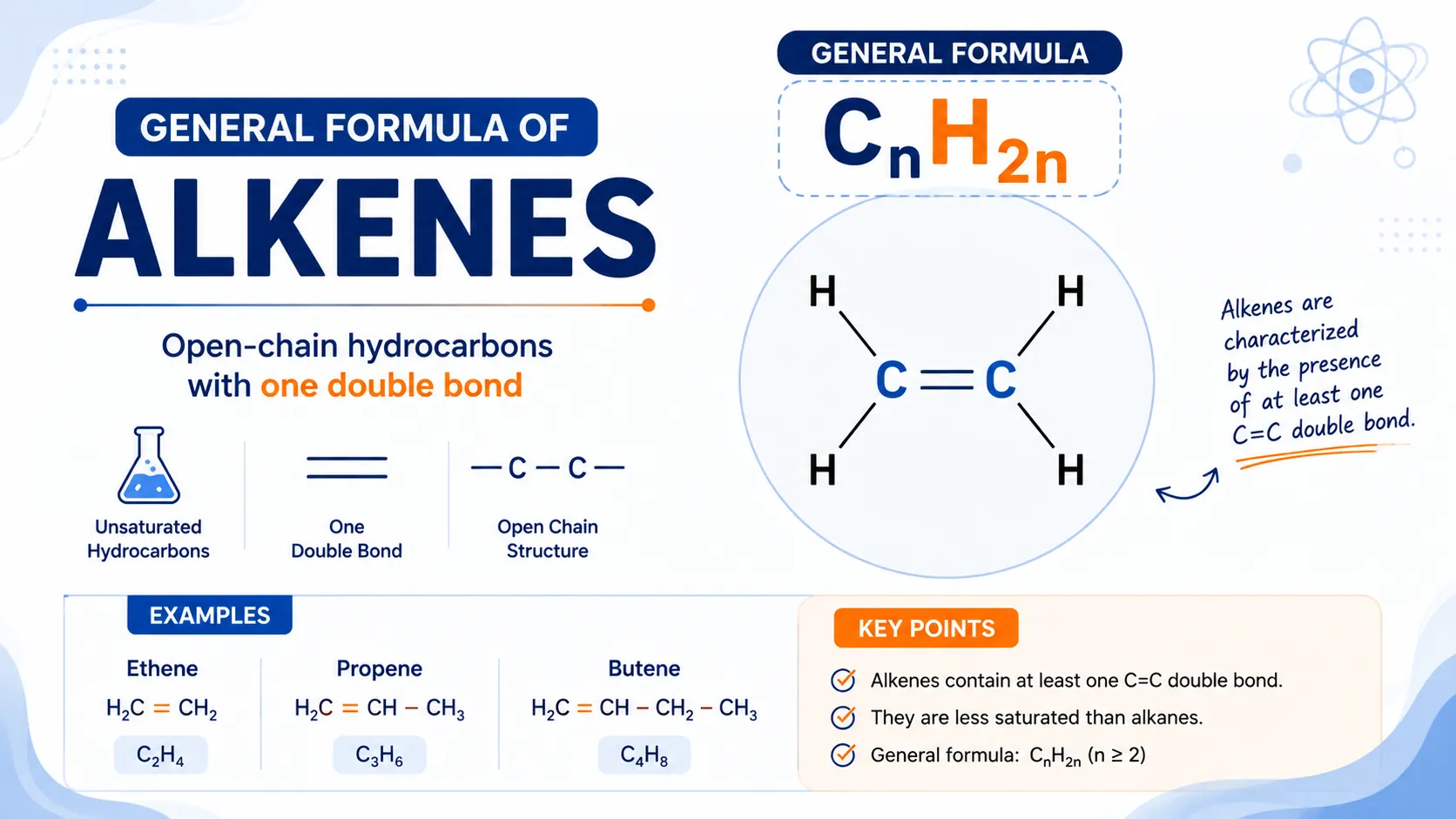
Table of Contents
- What Is the General Formula of Alkenes?
- Why Is $\ce{C_nH_{2n}}$ the General Formula of Alkene?
- General Formula of Alkenes: Homologous Series Table
- General Formula of Alkanes, Alkenes and Alkynes (Comparison)
- General Formula of Dienes and Cycloalkenes
- Physical Characteristics Linked to the Alkene General Formula

eSaral › Class 11 Chemistry › General Formula of Alkenes

If you have searched for the general formula of alkene, you already know the short answer is $\ce{C_nH_{2n}}$ — but writing just that in an exam or forgetting why it is $\ce{C_nH_{2n}}$ costs marks in both CBSE boards and JEE/NEET. This page explains the alkene general formula from first principles, shows how it changes for dienes and cycloalkenes, and gives you a ready homologous series table you can revise from directly.
What Is the General Formula of Alkenes?
Alkenes are acyclic, unsaturated hydrocarbons that contain one carbon–carbon double bond ($\ce{C=C}$) per molecule. The general formula of alkenes is written as:
$\ce{C_nH_{2n}}$ (where n = number of carbon atoms, and n ≥ 2)
This means for any alkene with 'n' carbon atoms, the molecule will always contain exactly '2n' hydrogen atoms. Alkenes are also known as olefins, a name that comes from the oily liquid products formed when the lower members react with halogens like chlorine or bromine.
Why Is $\ce{C_nH_{2n}}$ the General Formula of Alkene?
To understand the general formula of alkenes, compare it with that of alkanes, $\ce{C_nH_{2n+2}}$, which are fully saturated (all single $\ce{C-C}$ bonds).
When one $\ce{C-C}$ single bond in an alkane is converted into a $\ce{C=C}$ double bond, two hydrogen atoms are lost from the molecule — one from each of the two carbon atoms that now share the double bond. This is why an alkane converts into the corresponding alkene as follows:
$\ce{C_nH_{2n+2} - H2 -> C_nH_{2n}}$
(alkane loses one $\ce{H2}$ molecule to form the alkene)
This single double bond gives alkenes one degree of unsaturation, which is the reason their general formula always has two hydrogens fewer than the corresponding alkane with the same number of carbon atoms. Test how frequently this reasoning is tested with NEET Chapterwise PYQ, since Organic Chemistry basics carry significant NEET weightage.
Degree of Unsaturation in Alkenes
The degree of unsaturation (DoU) tells you how many rings or multiple bonds a molecule contains. For any alkene following the general formula $\ce{C_nH_{2n}}$, the degree of unsaturation is always 1, since there is exactly one $\ce{C=C}$ double bond and no ring in a simple open-chain alkene.
Preparing for NEET instead of JEE? Explore eSaral's NEET Course, which covers Organic Chemistry basics with the same formula-first approach.
General Formula of Alkenes: Homologous Series Table
Alkenes form a homologous series — a family of compounds with the same general formula, similar chemical properties, and a difference of one $\ce{CH2}$ unit between successive members. Applying the general formula of alkenes ($\ce{C_nH_{2n}}$) to the first ten members gives:
Homologous Series of Alkenes (First 10 Members)
| n (Carbon atoms) | IUPAC Name | Molecular Formula | Common Name |
|---|---|---|---|
| 2 | Ethene | $\ce{C2H4}$ | Ethylene |
| 3 | Propene | $\ce{C3H6}$ | Propylene |
| 4 | Butene | $\ce{C4H8}$ | Butylene |
| 5 | Pentene | $\ce{C5H10}$ | Amylene |
| 6 | Hexene | $\ce{C6H12}$ | — |
| 7 | Heptene | $\ce{C7H14}$ | — |
| 8 | Octene | $\ce{C8H16}$ | — |
| 9 | Nonene | $\ce{C9H18}$ | — |
| 10 | Decene | $\ce{C10H20}$ | — |
General Formula of Alkanes, Alkenes and Alkynes (Comparison)
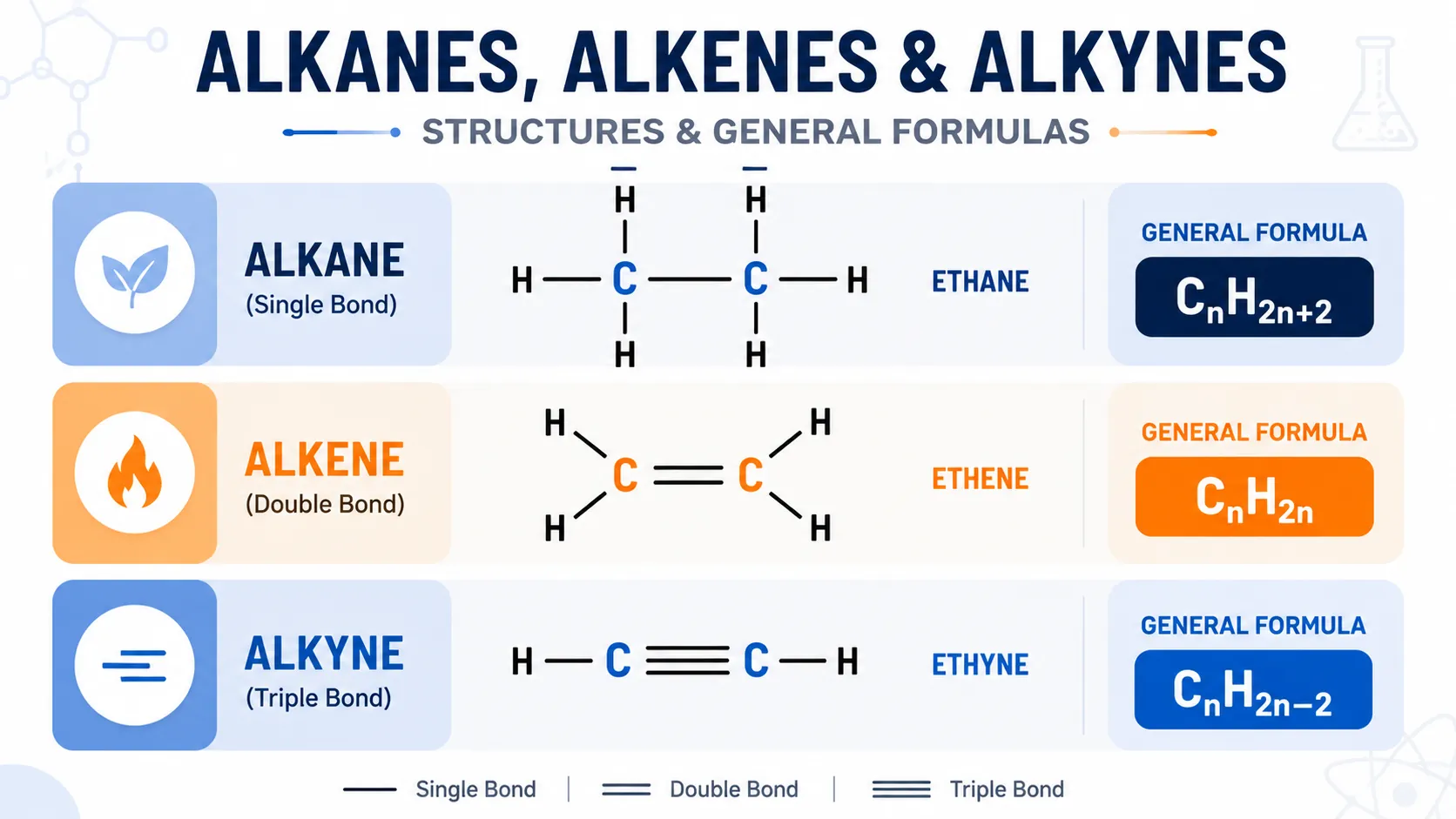
A frequent exam and viva question is to compare the general formula of alkenes with alkanes and alkynes. Here is the quick reference:
| Hydrocarbon Type | Bond Type | General Formula | Degree of Unsaturation | Example |
|---|---|---|---|---|
| Alkane | Only $\ce{C-C}$ single bonds | $\ce{C_nH_{2n+2}}$ | 0 | Ethane, $\ce{C2H6}$ |
| Alkene | One $\ce{C=C}$ double bond | $\ce{C_nH_{2n}}$ | 1 | Ethene, $\ce{C2H4}$ |
| Alkyne | One $\ce{C#C}$ triple bond | $\ce{C_nH_{2n-2}}$ | 2 | Ethyne, $\ce{C2H2}$ |
This table is one of the most tested comparisons in Class 11 Chemistry, since remembering $\ce{C_nH_{2n+2}}$, $\ce{C_nH_{2n}}$, and $\ce{C_nH_{2n-2}}$ together helps you instantly find molecular formulas of any member in these three series. This exact comparison is a recurring pattern in JEE Main Chapterwise PYQ, so it's worth memorising cold.
General Formula of Dienes and Cycloalkenes
The plain general formula of alkenes, $\ce{C_nH_{2n}}$, applies only to acyclic alkenes with a single double bond. Two related cases are commonly confused with it:
- Dienes (two double bonds): General formula is $\ce{C_nH_{2n-2}}$, since each additional double bond removes two more hydrogen atoms.
- Cycloalkenes (a ring + one double bond): General formula is also $\ce{C_nH_{2n-2}}$, because forming a ring itself removes two hydrogen atoms, same as adding a double bond — so a cycloalkene has the same formula as a diene despite being structurally different.
Confusing dienes with cycloalkenes is a common trap in JEE Advanced Chapterwise PYQ, since both share the same general formula despite being structurally different.
Physical Characteristics Linked to the Alkene General Formula
- The first three members of the homologous series that follow the general formula of alkene — ethene ($\ce{C2H4}$), propene ($\ce{C3H6}$), and butene ($\ce{C4H8}$) — are gases at room temperature.
- Members from $\ce{C5}$ to about $\ce{C17}$ are liquids, and higher members are solids — following the same trend seen in alkanes.
- Alkenes are generally insoluble in water but soluble in non-polar organic solvents such as benzene ($\ce{C6H6}$) and ether.
Once these physical trends are clear, test recall speed with eSaral's JEE Test Series, which includes dedicated Organic Chemistry mock sections on hydrocarbons.
Explore More on eSaral (Related Class 11 Chemistry Resources)
- Master the full chapter this topic belongs to: Hydrocarbons Class 11 Notes for IIT JEE & NEET →
- Quick visual revision of every alkene reaction: Mind Map for Hydrocarbons: Alkenes →
- Compare alkenes with the saturated series: Mind Map for Hydrocarbons: Alkanes →
- Solve NCERT exercise questions on this chapter: NCERT Solutions for Class 11 Chemistry – All Chapters →
- Revise the complete syllabus before your exam: NCERT Class 11 Chemistry Book – Free PDF →
Confusing $\ce{C_nH_{2n}}$, $\ce{C_nH_{2n+2}}$ and $\ce{C_nH_{2n-2}}$ under exam pressure? eSaral's Class 11 Chemistry course, built by IIT Bombay faculty, breaks down every hydrocarbon formula with memory tricks, solved examples, and a 5-layer doubt-solving system so concepts like the alkene general formula stick permanently. Start your free eSaral Class 11 Chemistry demo class today →
Frequently Asked Questions
Find answers to common questions.