Mind Map For Hydrocarbons: Alkenes | Class 11, JEE & NEET - Download from here
Hydrocarbons – Alkenes Mind Maps: These mind maps provide a concise visual summary of important concepts, nomenclature, preparation methods, physical and chemical properties, and key reactions of alkenes, helping students quickly revise and master the Hydrocarbons chapter for board and competitive exams.

eSaral › Class 12 >Mind Map For Hydrocarbons: Alkenes

🚀 Checkout eSaral Courses
Get to learn all important points and reactions of Hydrocarbons - Alkene through these mind maps. Download and share with your friends also. Download Mind Map 1 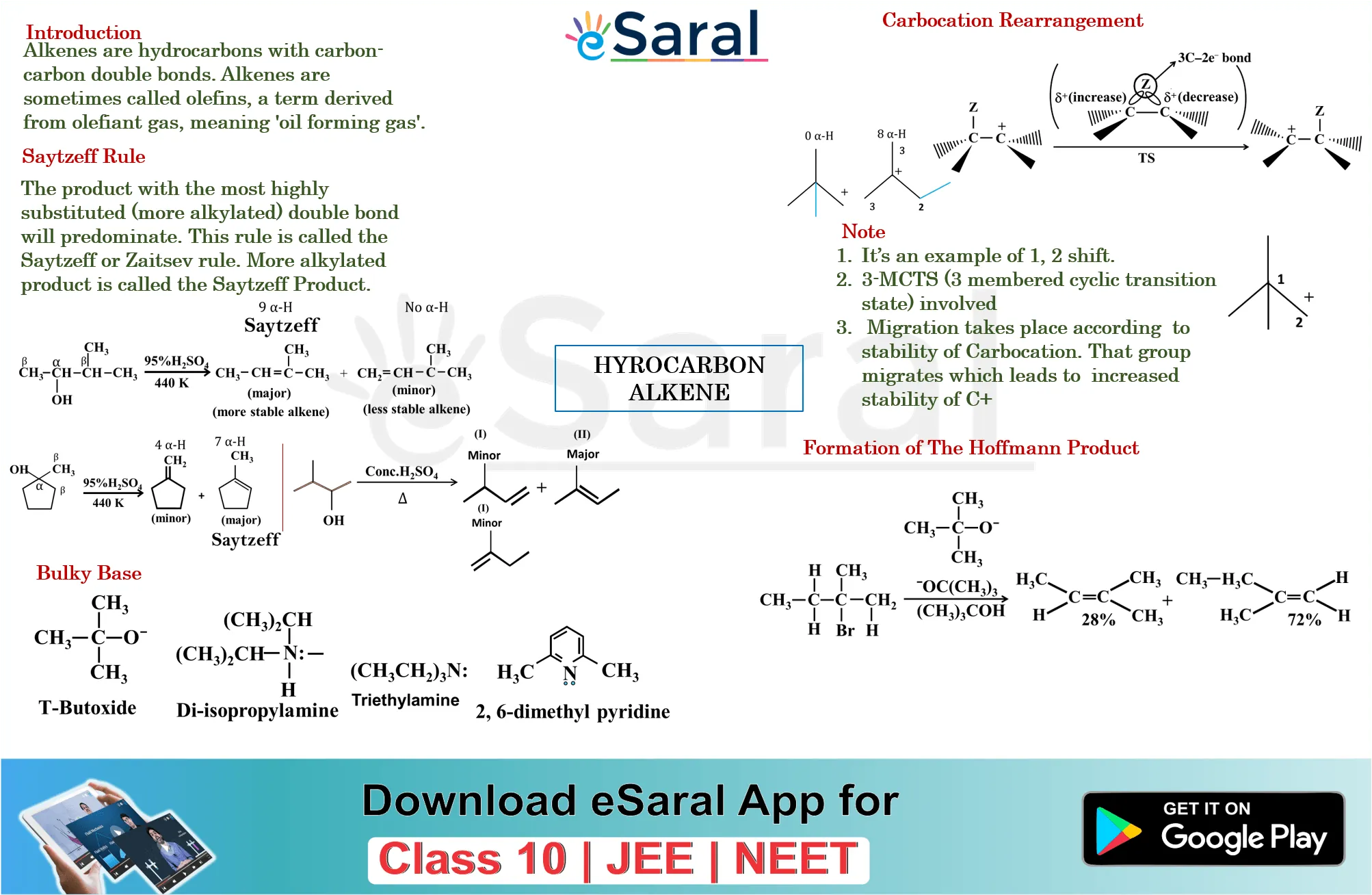 Download Mind Map 2
 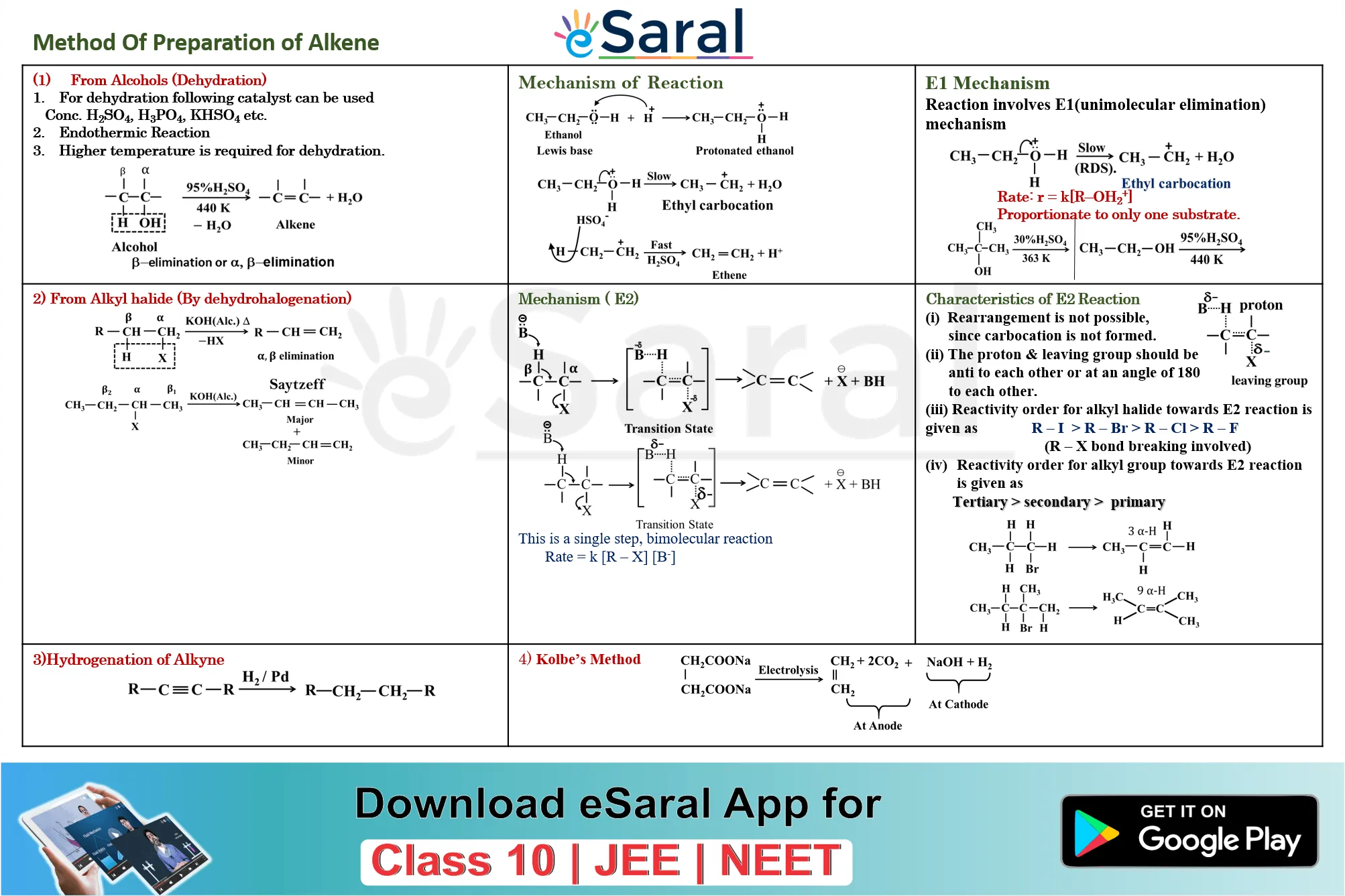 Download Mind Map 3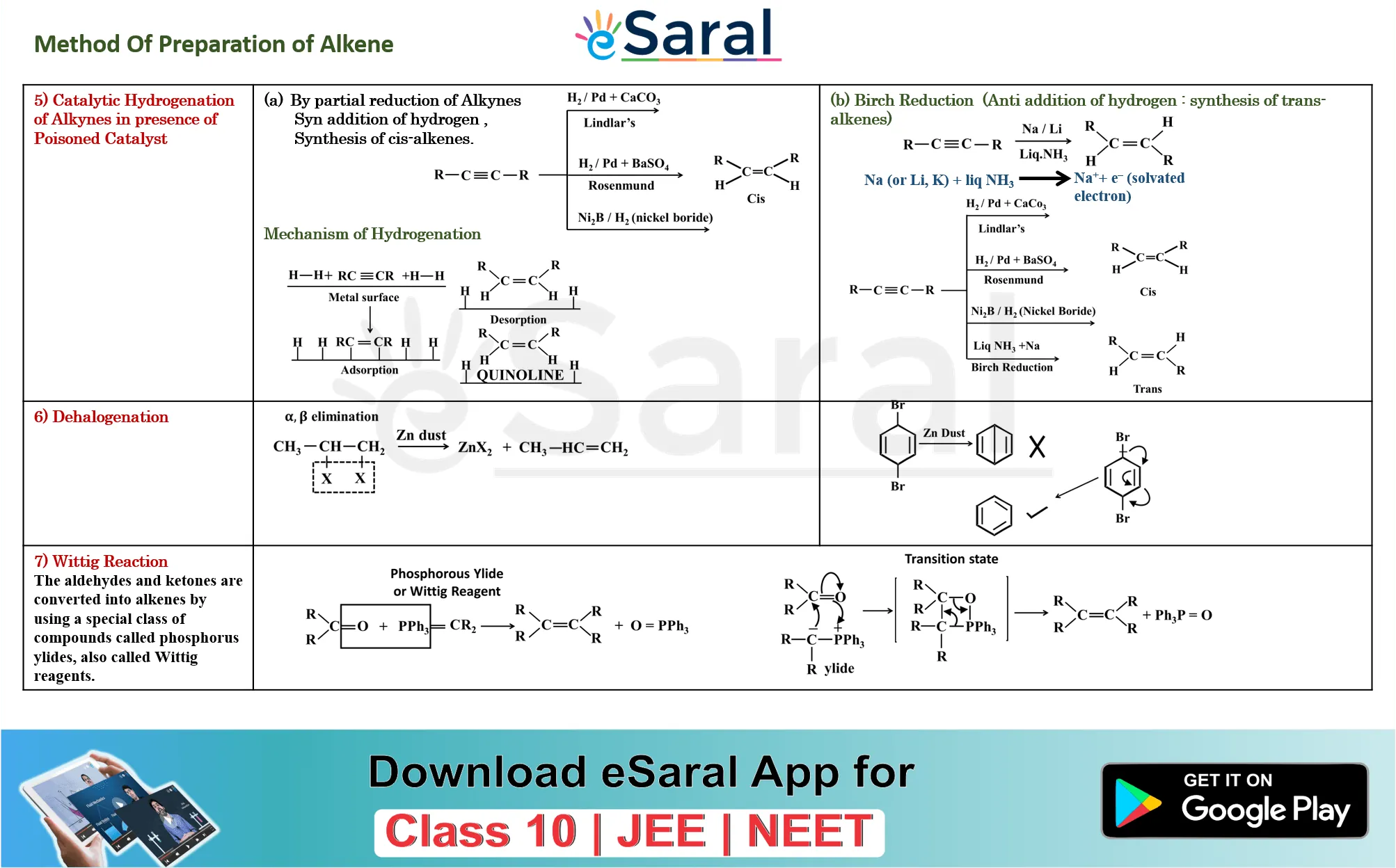
Frequently Asked Questions
Find answers to common questions.
What is the general formula of alkenes?
The general molecular formula of alkenes is CₙH₂ₙ, where n ≥ 2. Alkenes contain one carbon–carbon double bond (C=C), which makes them unsaturated hydrocarbons. The simplest alkene is ethene (C₂H₄), commonly called ethylene. This formula distinguishes alkenes from alkanes (CₙH₂ₙ₊₂) and alkynes (CₙH₂ₙ₋₂).
Which alkene reactions are most important for JEE Main?
For JEE Main, the highest-priority alkene reactions are Markovnikov addition of HX, ozonolysis (product identification), anti-Markovnikov addition with HBr/peroxides, and oxidation with KMnO₄. Questions on geometrical isomerism (cis-trans) and heat of hydrogenation also appear regularly. Mastering these seven topics covers approximately 80% of alkene-based JEE Main questions from the past five years.
What is Markovnikov's rule with an example?
Markovnikov's rule states that in HX addition to an unsymmetrical alkene, H adds to the carbon with more hydrogens. For propene (CH₃–CH=CH₂) + HBr: H adds to CH₂ (more H's), Br adds to CH (more substituted), giving 2-bromopropane — not 1-bromopropane. The rule is explained by carbocation stability: the secondary carbocation at C-2 is more stable than the primary at C-1.
What is the peroxide effect in alkene chemistry?
The peroxide effect (Kharasch effect) is the anti-Markovnikov addition of HBr to alkenes in the presence of organic peroxides (ROOR). Peroxides initiate a free-radical chain mechanism. The bromine radical adds to the less substituted carbon (forming the more stable secondary radical), giving the product opposite to Markovnikov's rule. Crucially, this reversal applies only to HBr — not HCl or HI.
How many mind maps are there for alkenes on eSaral?
eSaral provides three downloadable mind maps for alkenes: Mind Map 1 covers structure and nomenclature, Mind Map 2 covers isomerism (chain, position, and geometric), and Mind Map 3 covers all major reactions including addition, oxidation, and polymerisation. Together they cover the complete Class 11 Hydrocarbons – Alkenes syllabus for CBSE, JEE, and NEET.