Quadratic Formula: Derivation, Proof & Solved Examples
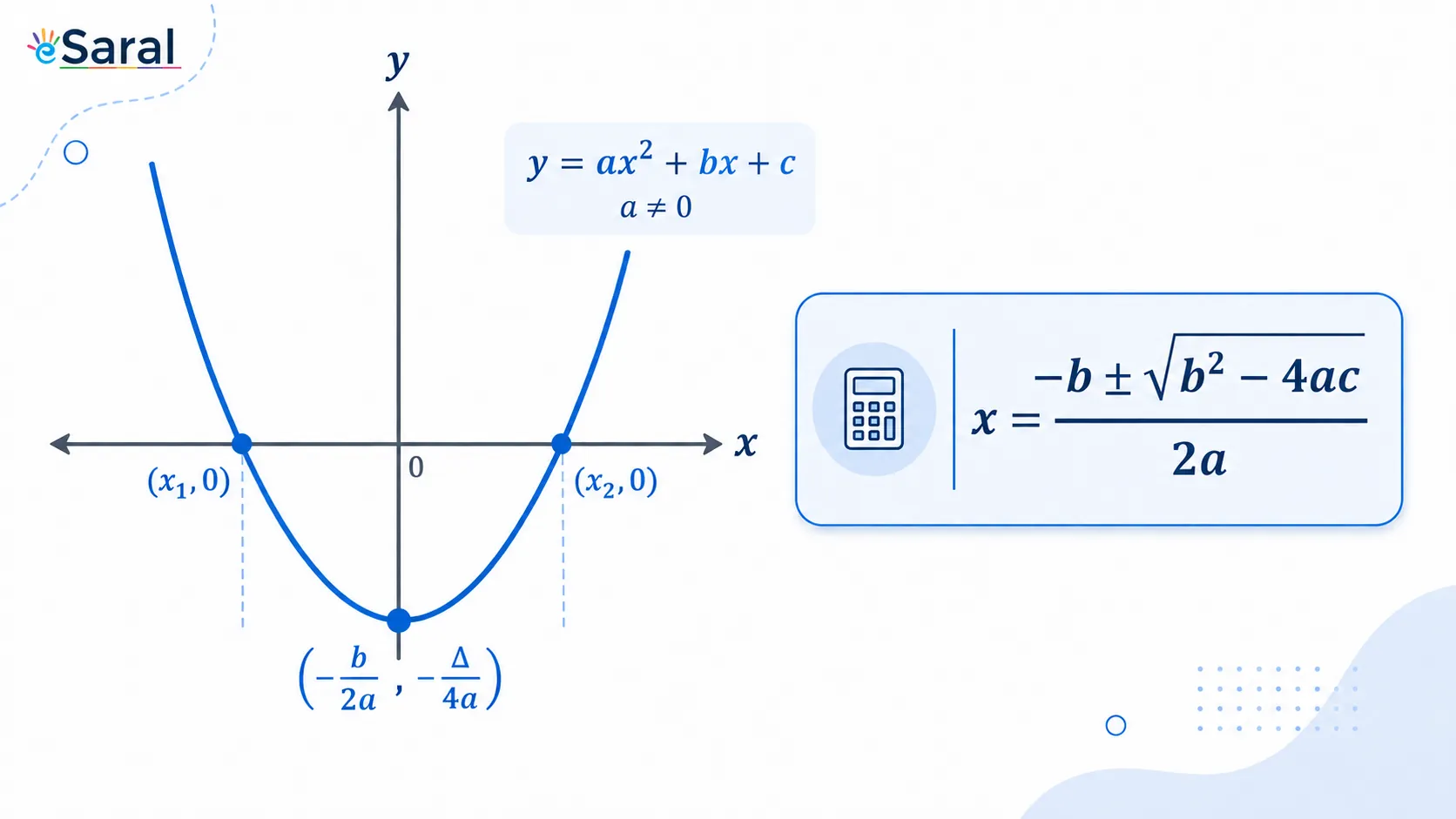
Table of Contents

eSaral › Class 11 Maths › Quadratic Formula: Derivation, Proof & Solved Examples

Quadratic Formula – Derivation, Proof & Examples (Standard Form)
Every problem here starts from the standard form of a quadratic equation, which is the starting point for everything that follows:
$ax^2 + bx + c = 0$
where $a$, $b$, and $c$ are real numbers and $a \neq 0$.
Here $a$ is the coefficient of $x^2$, $b$ is the coefficient of $x$, and $c$ is the constant term. The condition $a \neq 0$ is essential — if $a = 0$, the equation becomes linear, not quadratic, and the formula no longer applies. This is the same standard form students first learn in the quadratic formula class 10 syllabus, before it's extended here for JEE-level problems.
What Is the Quadratic Formula?
The quadratic formula, used to find the roots of any quadratic equation in standard form, is:
$x = \frac{-b \pm \sqrt{b^2 - 4ac}}{2a}$
This single quadratic equation formula gives both roots of the equation at once — one root using the $+$ sign and the other using the $-$ sign in front of the square root. Once you know this formula, you can use it as a quadratic formula calculator method manually, without needing a factorisation shortcut.
Quadratic Formula Calculator: Solve in 3 Steps
Even without an online tool, you can use the quadratic formula calculator method by hand in three steps:
Step 1: Identify a, b, and c from the standard form $ax^2 + bx + c = 0$.
Step 2: Calculate the discriminant, $D = b^2 - 4ac$.
Step 3: Substitute a, b, and D into $x = \frac{-b \pm \sqrt{D}}{2a}$ to get both roots.
This manual quadratic formula calculator approach works for every quadratic equation and takes under a minute once you're comfortable identifying a, b, and c correctly.
Quadratic Formula Derivation (Completing the Square Method)
The derivation of the quadratic formula starts from the standard form and uses the completing-the-square method:
Step 1: Start with $ax^2 + bx + c = 0$ and divide every term by $a$:
$x^2 + \frac{b}{a}x + \frac{c}{a} = 0$
Step 2: Move the constant term to the right side:
$x^2 + \frac{b}{a}x = -\frac{c}{a}$
Step 3: Add $\left(\frac{b}{2a}\right)^2$ to both sides to complete the square:
$x^2 + \frac{b}{a}x + \left(\frac{b}{2a}\right)^2 = \left(\frac{b}{2a}\right)^2 - \frac{c}{a}$
Step 4: Write the left side as a perfect square:
$\left(x + \frac{b}{2a}\right)^2 = \frac{b^2 - 4ac}{4a^2}$
Step 5: Take the square root of both sides:
$x + \frac{b}{2a} = \pm \frac{\sqrt{b^2 - 4ac}}{2a}$
Step 6: Isolate $x$ to get the final formula:
$x = \frac{-b \pm \sqrt{b^2 - 4ac}}{2a}$
This quadratic formula derivation is why the formula works for every quadratic equation, regardless of whether it can be factorised easily.
What Is the Discriminant in the Quadratic Equation Formula?
The expression under the square root, $D = b^2 - 4ac$, is called the discriminant, and it determines the nature of the roots without needing to solve the equation fully. Practicing quadratic formula questions that mix all three discriminant cases — positive, zero, and negative — is the fastest way to get comfortable reading a question's expected answer type before you even finish solving.
Nature of Roots Based on the Discriminant
| Condition | Nature of Roots |
|---|---|
| $D > 0$ | Two distinct real roots |
| $D = 0$ | Two equal real roots |
| $D < 0$ | No real roots (roots are complex/imaginary) |
Checking the discriminant first, before reaching for a quadratic formula calculator or working through the formula in full, is one of the fastest ways to predict the type of answer a question expects.
What Are the Sum and Product of Roots in the Quadratic Formula?
If $\alpha$ and $\beta$ are the two roots of $ax^2 + bx + c = 0$, then Vieta's formulas give:
Sum of roots: $\alpha + \beta = -\frac{b}{a}$
Product of roots: $\alpha\beta = \frac{c}{a}$
These relations are often used to form a new quadratic equation directly from its roots, using $x^2 - (\alpha+\beta)x + \alpha\beta = 0$, without needing to re-derive it. These root relations are a recurring theme in JEE Main PYQ, so it's worth memorising both formulas cold.
When Should You Use the Quadratic Formula Instead of Factorisation?
The quadratic formula should be used when the equation cannot be factorised easily, especially when the roots are irrational (such as $2 \pm \sqrt{3}$) or complex. It always works for any quadratic equation and is the most reliable method under timed exam conditions, unlike factorisation, which only works quickly when the roots are simple integers. The quadratic formula examples below show exactly when this method is faster than factorisation.
Quadratic Formula Examples with Step-by-Step Solutions
Here are four quadratic formula examples covering different types of roots — real, integer, fractional, and complex. Working through quadratic formula questions like these is the fastest way to get comfortable with the method, and a further practice set follows below.
Example 1: Solve $x^2 - 5x + 6 = 0$
Here $a = 1$, $b = -5$, $c = 6$
$x = \frac{-(-5) \pm \sqrt{(-5)^2 - 4(1)(6)}}{2(1)} = \frac{5 \pm \sqrt{25 - 24}}{2} = \frac{5 \pm 1}{2}$
$x = 3$ or $x = 2$
Example 2: Solve $2x^2 + 3x - 2 = 0$
Here $a = 2$, $b = 3$, $c = -2$
$x = \frac{-3 \pm \sqrt{9 - 4(2)(-2)}}{4} = \frac{-3 \pm \sqrt{9 + 16}}{4} = \frac{-3 \pm 5}{4}$
$x = \frac{1}{2}$ or $x = -2$
Example 3: Find the nature of the roots of $x^2 - 4x + 4 = 0$ without solving fully.
$D = b^2 - 4ac = 16 - 16 = 0$
Since $D = 0$, the equation has two equal real roots.
Example 4: Solve $x^2 + 2 = 0$
Here $a = 1$, $b = 0$, $c = 2$
$x = \frac{0 \pm \sqrt{0 - 8}}{2} = \frac{\pm \sqrt{-8}}{2} = \pm i\sqrt{2}$
Since $D < 0$, the roots are complex.
Quadratic Formula Questions for Practice
Try these quadratic formula questions on your own before checking the answers below. Use the standard form, identify $a$, $b$, and $c$, and apply the formula step by step.
- Solve $x^2 - 7x + 12 = 0$
- Solve $2x^2 - 5x - 3 = 0$
- Solve $x^2 + 6x + 9 = 0$
- Solve $3x^2 - 2x - 1 = 0$
- Solve $x^2 - 2x + 5 = 0$
- Solve $x^2 - 3x - 10 = 0$
Answers:
- $x = 3$ or $x = 4$
- $x = 3$ or $x = -0.5$
- $x = -3$ (equal roots)
- $x = 1$ or $x = -\frac{1}{3}$
- $x = 1 + 2i$ or $x = 1 - 2i$ (complex roots)
- $x = 5$ or $x = -2$
Once you're comfortable with these quadratic formula examples, test yourself further using eSaral's JEE Test Series, which includes chapter-wise quadratic formula questions and Algebra mock tests.
Explore More on eSaral (Related Quadratic Equations Resources)
Revise this chapter for class 10 concepts in the complete chapter notes: Quadratic Equation Class 10 Chapter 4 Short Notes →
Go deeper for JEE with the Class 11 chapter: Quadratic Equations Class 11 for IIT JEE →
Solve exercise-based questions step by step: NCERT Solutions for Class 10 Maths →
Download the complete syllabus reference: Class 10 Maths NCERT Book PDF →
Continue with Class 11 exercise solutions: NCERT Solutions for Class 11 Maths →
Watch it explained step by step: Quadratic Equations Revision Videos →
Practice quadratic-equation-based JEE Main questions with solutions: JEE Main Chapterwise PYQ with Solutions →
Confusing the quadratic formula with factorisation shortcuts under exam pressure? eSaral's Mathematics course, taught by IIT Bombay faculty, breaks down the quadratic formula derivation, discriminant tricks, and root relations with a 5-layer doubt-solving system so quadratic equations stay exam-ready every time — whether you're revising the quadratic formula class 10 basics or tackling JEE-level problems. Start your free eSaral Mathematics demo class today →
Frequently Asked Questions
Find answers to common questions.
What is the discriminant in the quadratic formula?
The discriminant is the expression $D = b^2 - 4ac$ found under the square root, and it tells you the nature of the roots — real and distinct, real and equal, or complex — before solving the equation.
How is the quadratic formula derived?
The quadratic formula derivation starts from $ax^2 + bx + c = 0$ using the completing-the-square method, which rearranges the equation into a perfect square before isolating $x$.
What is the quadratic equation formula used for?
The quadratic equation formula is used to solve any quadratic equation for its roots, especially when the equation cannot be factorised easily or when the roots are irrational or complex.
What is the quadratic formula?
The quadratic formula is $x = \frac{-b \pm \sqrt{b^2 - 4ac}}{2a}$, used to find the roots of any quadratic equation written in the standard form $ax^2 + bx + c = 0$.
Does the quadratic formula always give real roots?
When should you use the quadratic formula instead of factorisation?
Use this method when the equation cannot be factorised easily, especially when the roots are irrational or complex, since factorisation only works quickly for simple integer roots.
What are the sum and product of roots in the quadratic formula?
For $ax^2 + bx + c = 0$, the sum of roots is $\alpha + \beta = -\frac{b}{a}$ and the product of roots is $\alpha\beta = \frac{c}{a}$, both derived directly from it.
What is the standard form of a quadratic equation?
The standard form of a quadratic equation is $ax^2 + bx + c = 0$, where $a$, $b$, and $c$ are real numbers and $a \neq 0$.
Is the quadratic formula the same in Class 10 and Class 11?
Yes, the version taught in Class 10 (CBSE Chapter 4) is identical to the one used in Class 11 and JEE; only the complexity of the equations and applications increases.
How do I calculate the quadratic formula without a calculator?
You can use the quadratic formula calculator method manually in three steps — identify a, b, and c from the standard form, calculate the discriminant D = b² − 4ac, then substitute into x = (−b ± √D) / 2a to get both roots. This works for any quadratic equation without needing an online tool.