Quadratic Equation - Class 10 Chapter 4 Short Notes (Mind Maps)

Home > Class 10 Maths > Quadratic Equation Class 10 Notes, Mind Maps & Formulas

India's Best Exam Preparation for Class 10th - Download Now
Chapter 4 of Class 10 Mathematics is one of the highest-weightage chapters in CBSE board exams — questions from Quadratic Equations appear every year, carrying 4 to 6 marks. Beyond boards, this chapter is the direct foundation for JEE Main algebra topics, making it critical to get right at the Class 10 level itself.
Many students memorise the quadratic formula without understanding when to use factorisation, when to complete the square, and how the discriminant tells you everything about a problem before you even solve it. These notes are designed to fix exactly that gap.
The mind maps and short notes on this page help you revise all formulas, methods, and conditions in one place. Students who have used eSaral's structured Class 10 resources — built by IIT Bombay faculty, including AIR-41 rankers — have consistently reported faster revision and fewer silly mistakes in exams.
If you also need step-by-step solutions for textbook problems, explore our detailed NCERT Solutions for class 10 alongside these notes.
This is a good summary, but the NCERT solutions for class 10 Maths page has the complete, exercise-by-exercise solutions for deeper practice.
If this page is being used to revise fast, it's worth knowing there's a structured, all-subject version of that same idea: crash course class 10.
Revise Complete Mathematics for Class 10.
India's Best Exam Preparation for Class 10th - Download Now
Frequently Asked Questions
Find answers to common questions.
What is the quadratic formula and when should you use it?
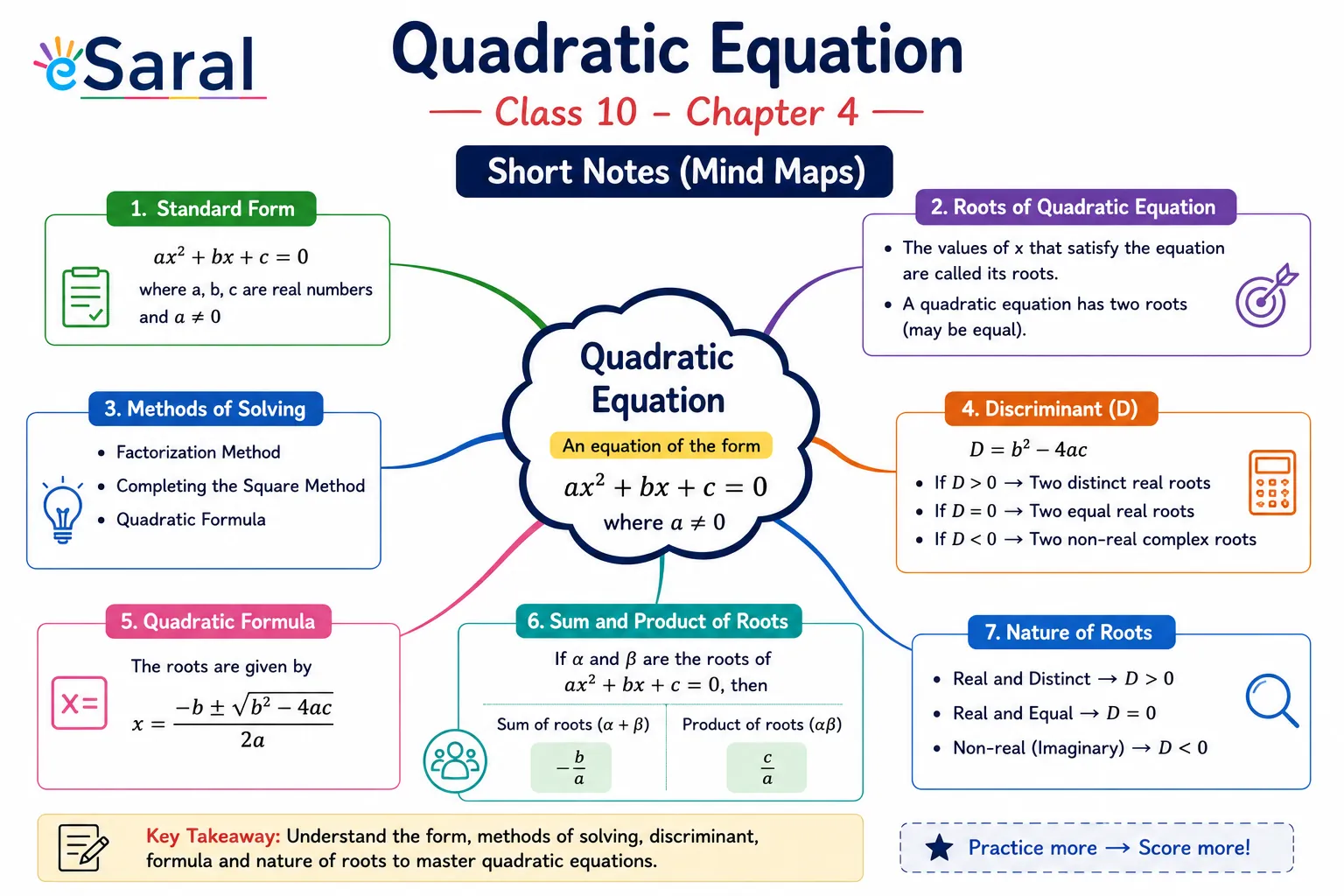
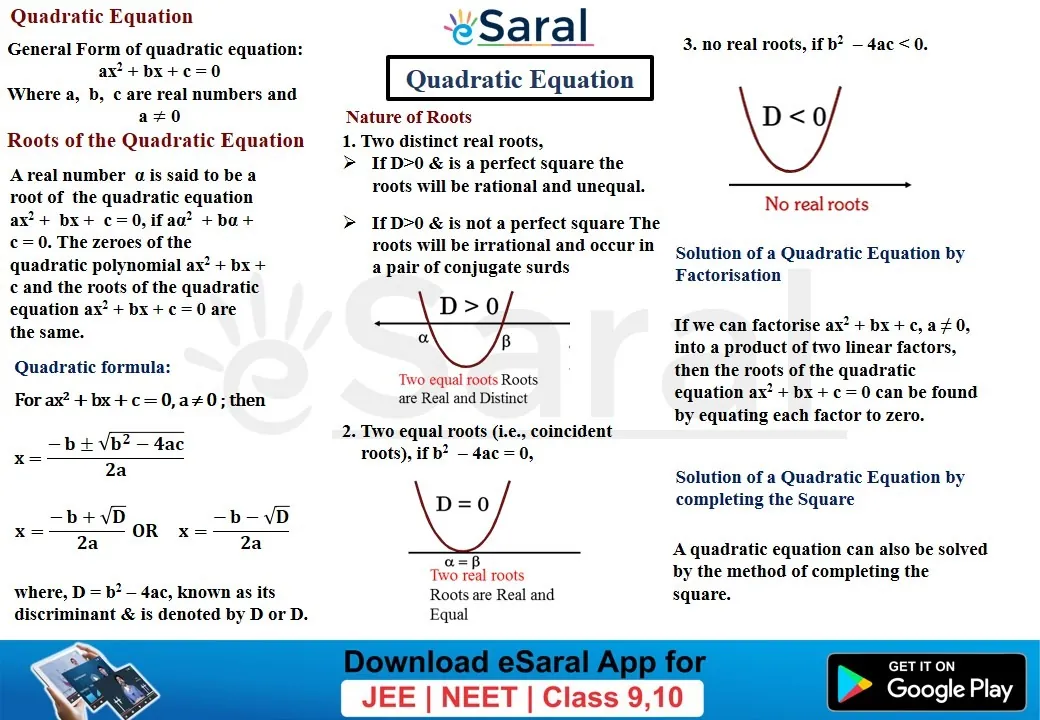
The quadratic formula is x = (−b ± √(b² − 4ac)) / 2a. Use it when the equation cannot be factorised easily — especially when roots are irrational (e.g., 2 ± √3). It always works for any quadratic equation and is the safest method in timed exam conditions.
How do you find the nature of roots without solving the equation?
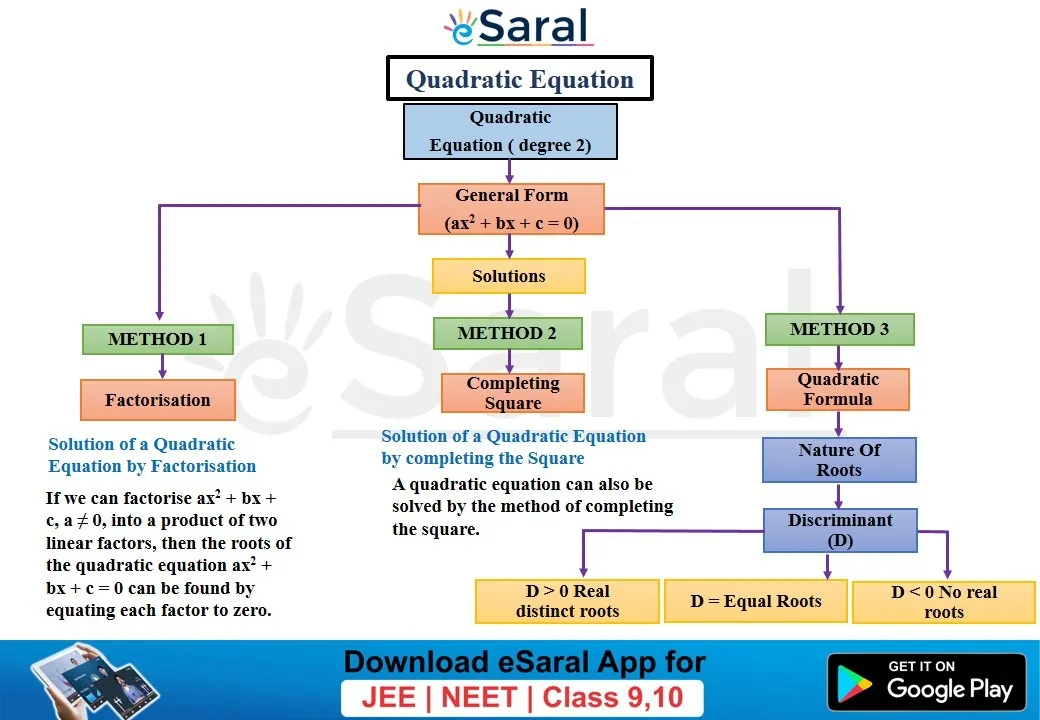
Calculate the discriminant D = b² − 4ac. If D > 0, the equation has two distinct real roots. If D = 0, it has two equal real roots. If D < 0, it has no real roots. This method is faster than solving and is directly tested in CBSE board exams.
What is the standard form of a quadratic equation in Class 10?
The standard form is ax² + bx + c = 0, where a, b, and c are real numbers and a ≠ 0. Here, a is the coefficient of x², b is the coefficient of x, and c is the constant. This form is the starting point for all solving methods taught in CBSE Class 10 Chapter 4.
What is the sum and product of roots formula for Class 10?
For the equation ax² + bx + c = 0 with roots α and β: the sum of roots α + β = −b/a and the product of roots αβ = c/a. These relationships allow you to form a new quadratic equation when roots are given, using: x² − (sum)x + (product) = 0.
What is the condition for a quadratic equation to have real roots?
A quadratic equation ax² + bx + c = 0 has real roots when its discriminant is D ≥ 0, meaning b² − 4ac ≥ 0. If b² − 4ac < 0, the equation has no real roots. This condition is commonly tested in CBSE with "find the value of k" problems
Can a quadratic equation have more than two roots?
No. By the Fundamental Theorem of Algebra, a polynomial of degree 2 has exactly 2 roots (counting multiplicity). A quadratic equation cannot have three or more roots. If D = 0, both roots are equal, so there is effectively one unique value — but it counts as a repeated root.