What Is a Tissue in Biology?
Table of Contents

eSaral › Class 11 › Biology › What is Tissue in Biology

A tissue in biology is a group of similar cells, along with the intercellular substances between them, that work together to perform a specific function. This is the direct answer to what is a tissue in biology — cells rarely work alone in multicellular organisms; instead, they are organised into tissues, and these tissues are further organised into organs and organ systems. Understanding what tissues in biology are is the starting point of the entire Structural Organisation chapter for Class 11 Biology.
This page covers the complete concept of what is tissue biology — its definition, classification into plant and animal tissues, examples, and how tissues relate to organs — aligned with the NCERT Solutions for Class 11 Biology Chapter 7 — Structural Organisation in Animals.
What Is a Tissue in Biology?
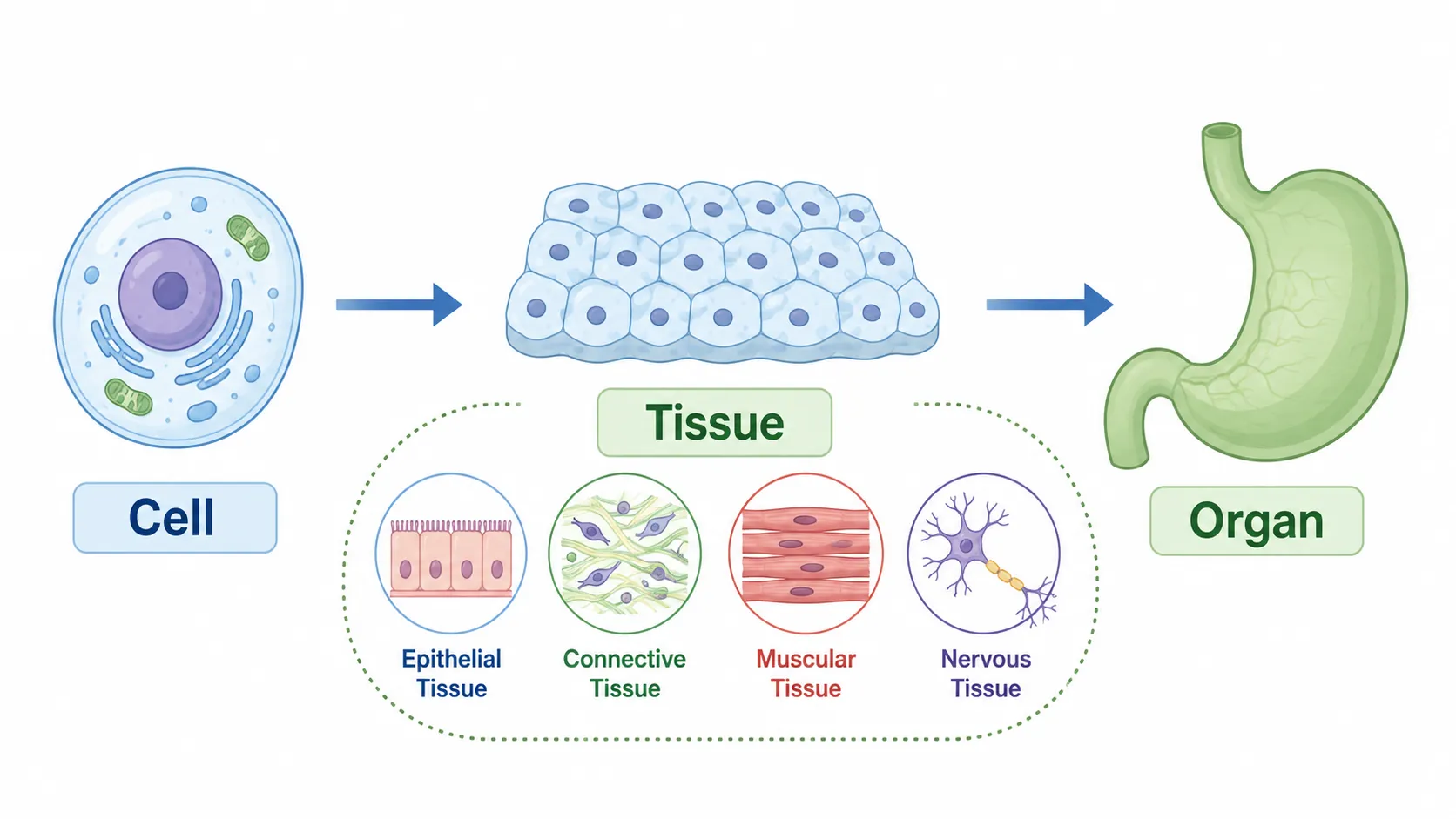
To understand what a tissue is in biology, think about how a single cell cannot perform every function of a large organism on its own. In multicellular organisms, cells with a similar structure group together and specialise to perform one shared function more efficiently — this organised group is called a tissue.
- A tissue consists of cells that are structurally similar and functionally coordinated.
- Cells within a tissue are often held together by an intercellular matrix or substance.
- The term "tissue" was first used by the French anatomist Marie François Xavier Bichat.
- Tissues are the second level of structural organisation in multicellular organisms, right after the cellular level.
Tissues – Definition & Types (Structural Organisation)
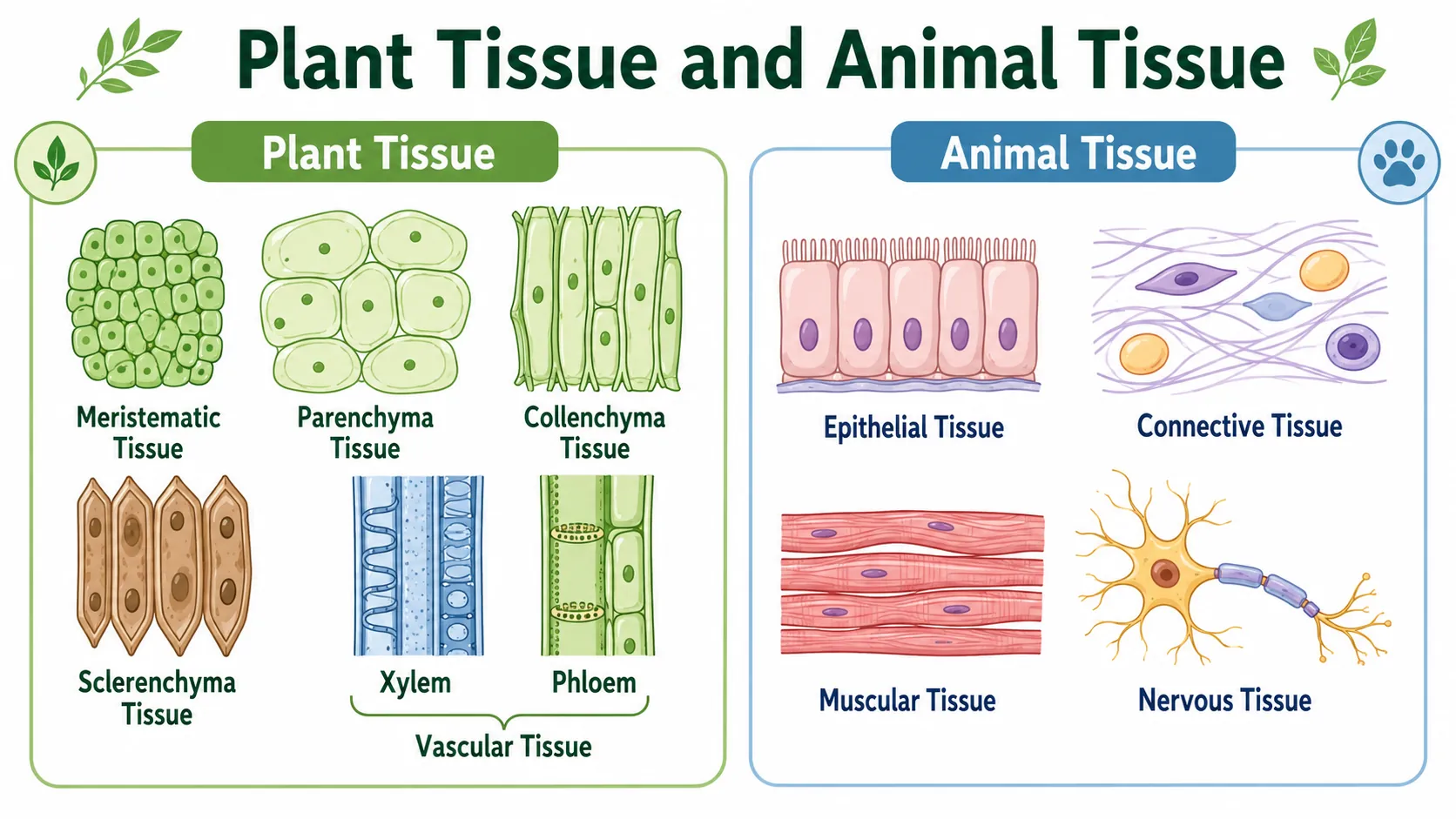
Now that the definition of what tissue biology is is clear, the next step in structural organisation is classification. Tissues are broadly divided into two major categories based on the kind of organism they belong to:
| Category | Found In | Broad Types |
|---|---|---|
| Plant tissues | Plants | Meristematic tissue, Permanent tissue |
| Animal tissues | Animals | Epithelial, Connective, Muscular, Nervous |
This two-way classification — plant tissue and animal tissue — is the core of what tissues are in biology at the Class 11 level, and each type is further divided based on structure, location, and function.
What Are the Types of Plant Tissue?
Plant tissues are classified based on whether their cells continue to divide or have stopped dividing:
- Meristematic tissue — made of actively dividing cells, found at the growing regions of the plant (root tip, shoot tip, and lateral regions). It is responsible for the plant's continuous growth throughout its life.
- Permanent tissue — formed when meristematic cells lose the ability to divide and become specialised for a fixed function. Permanent tissue is further divided into:
- Simple permanent tissue — made of similar cells, such as parenchyma, collenchyma, and sclerenchyma.
- Complex permanent tissue — made of more than one type of cell working together, such as xylem and phloem, which conduct water and food respectively.
What Are the Types of Animal Tissue?
Animal tissue is classified into four fundamental types, and every complex animal — including humans — is built from combinations of just these four:
| Tissue Type | Basic Function | Example |
|---|---|---|
| Epithelial tissue | Covers and lines body surfaces and cavities | Skin, lining of the gut |
| Connective tissue | Binds, supports, and connects other tissues | Bone, cartilage, blood |
| Muscular tissue | Enables movement through contraction | Skeletal, smooth, and cardiac muscle |
| Nervous tissue | Receives and transmits nerve impulses | Neurons in the brain and spinal cord |
Once you're confident identifying these four tissue types, reinforce them with eSaral's NEET Test Series, which includes chapter-wise diagrams and identification-based mock questions.
What Is the Difference Between a Plant Tissue and an Animal Tissue?
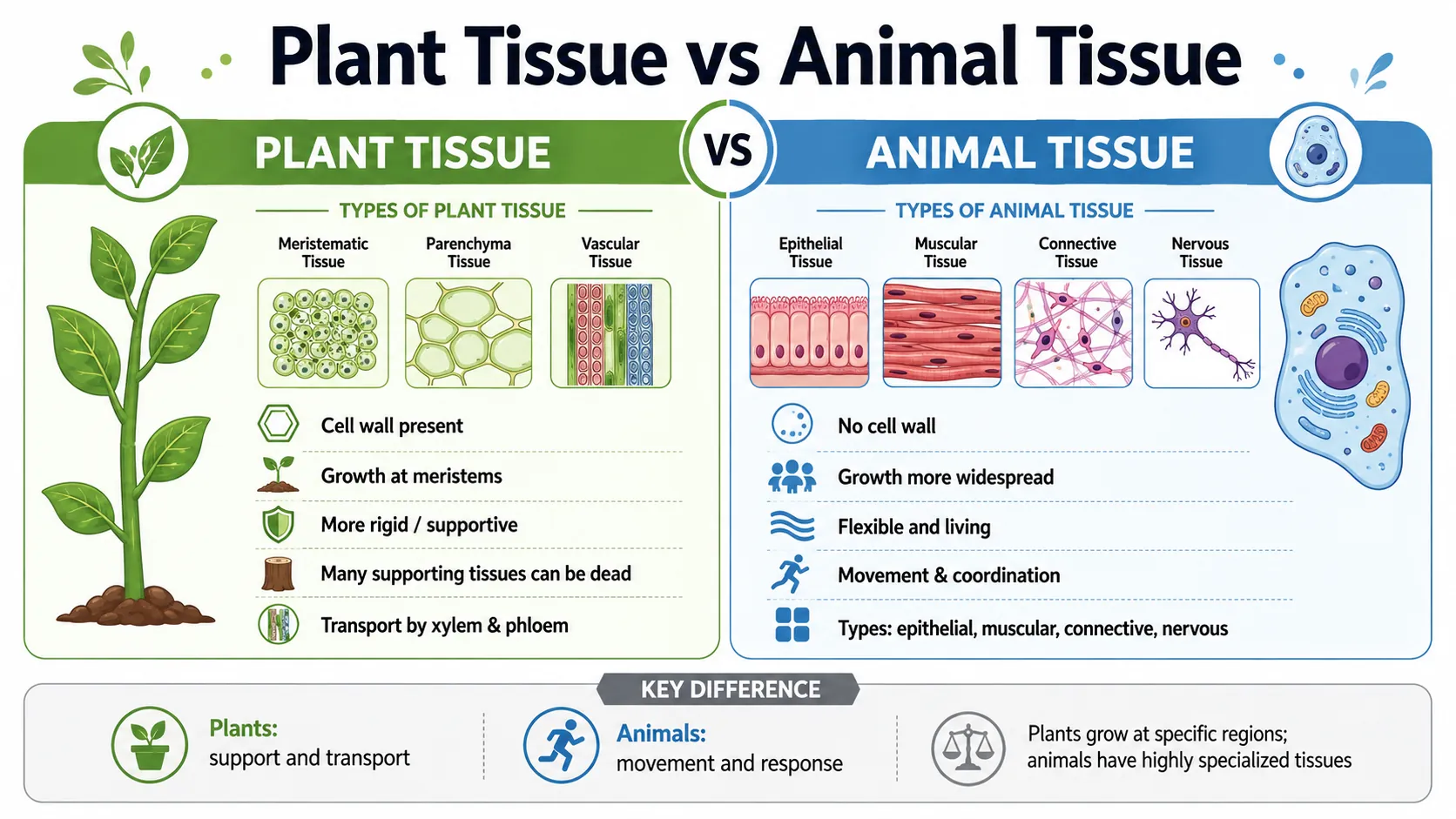
The main difference between plant tissue and animal tissue is how they are structured and what functions they perform.
What Is the Difference Between a Tissue, an Organ, and an Organ System?
A common point of confusion for beginners learning what a tissue in biology is is how it relates to an organ and an organ system. These three terms represent increasing levels of structural organisation:
| Level | Definition | Example |
|---|---|---|
| Tissue | A group of similar cells performing one specific function | Muscular tissue |
| Organ | A group of different tissues working together for a common function | Heart (made of muscular, connective, and nervous tissue) |
| Organ System | A group of organs working together for a broader function | Circulatory system (heart, blood vessels, blood) |
This hierarchy — cell to tissue to organ to organ system — is the fundamental idea behind the entire Structural Organisation in Animals and Plants unit, and it is why tissue-level understanding is essential before moving on to organ-level study. Check the NEET Syllabus to see exactly where Structural Organisation fits within the broader Biology weightage.
Why Is Understanding What Are Tissues in Biology Important for Exams?
Tissue classification is one of the highest-weightage, most exam-repeated topics in Class 11 Biology and NEET, because:
- It is frequently tested through diagram-based and identification-based questions.
- It forms the direct base for later chapters on plant and animal physiology.
- Assertion-reason and comparison-based questions on tissue types appear almost every year.
- It connects directly to the Cell: The Unit of Life chapter, since tissues are simply organised groups of cells.
Test your understanding of tissue-classification questions directly with NEET Chapterwise PYQ, where diagram-based tissue questions repeat almost every year
Continue Your Structural Organisation Preparation
- Master this exact chapter with NCERT Solutions for Class 11 Biology Chapter 7 — Structural Organisation in Animals.
- Revisit the cellular level before moving up with Cell: The Unit of Life NEET previous year questions.
- Go beyond the textbook with NCERT Exemplar Class 11 Biology for higher-order, diagram-based questions.
- Download the complete Class 11 Biology NCERT PDF Book chapter-wise for free.
- Explore the full NCERT Solutions for Class 11 Biology hub to plan your complete syllabus.
- Practice tissue-based NEET previous year questions: NEET Chapterwise PYQ with Solutions →
- Check the full weightage of this unit in the exam: NEET Syllabus 2026 →
Finding it hard to visualise and label tissue diagrams for your exam? Download the eSaral app for animated video lectures by Kota's top NEET faculty and a 5-layer doubt-solving system built for board and NEET success.
Frequently Asked Questions
Find answers to common questions.