Class 10 Chapterwise PYQs: Maths, Science, English, Hindi (2026)
Class 10 chapterwise previous year question papers are chapter-organised collections of past CBSE board exam questions for Maths, Science, English, and Hindi. Solving them chapter by chapter helps students master each topic individually, understand exact CBSE weightage, and build the exam discipline needed for boards and future JEE/NEET preparation.
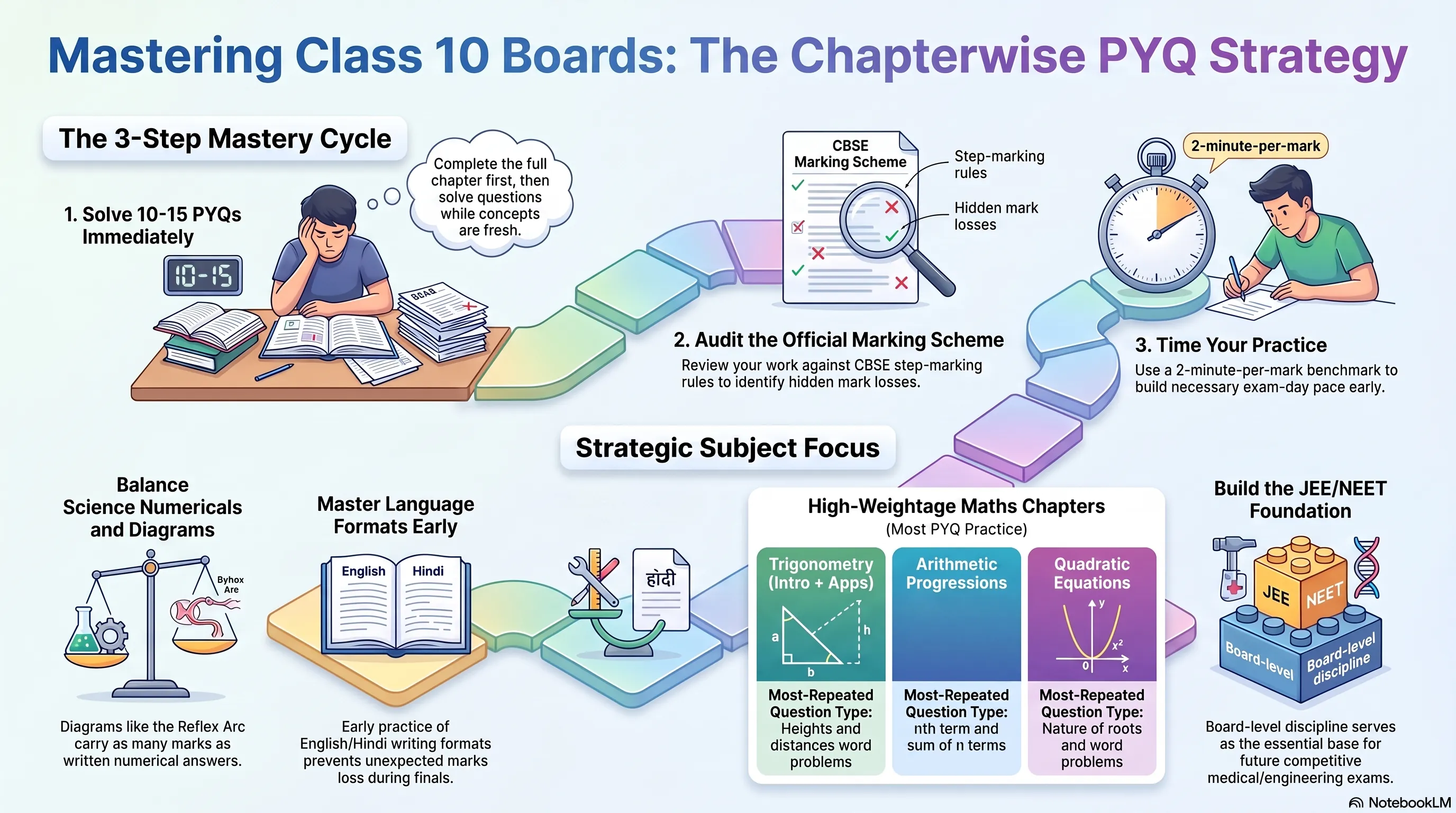
Table of Contents

eSaral ›Foundation courses ›Class 10 Chapterwise PYQs: Maths, Science, English, Hindi (2026)

Why Chapterwise Practice Matters More in Class 10
Class 10 is graded differently from Class 8 and 9. CBSE boards follow strict marking schemes, step-marking rules, and a fixed weightage per unit — and chapterwise PYQs are the fastest way to internalise all three.
It Builds Marking-Scheme Awareness Early
Before starting chapterwise practice, check the NCERT Books for Class 10 so every question you solve maps to the exact syllabus CBSE tests.
CBSE awards marks for correct method, not just the final answer, especially in Maths and Science numericals. Reviewing chapterwise PYQs against the official marking scheme teaches a student exactly how much detail earns full marks — a skill that reading the textbook alone never builds.
💡 Expert Tip by eSaral Academic Team: A chapter is not "done" until you've solved at least 10-12 previous year questions from it and checked your answers against the marking scheme. Reading a chapter twice is not the same as being able to answer questions from it under time pressure.
It Prevents Late-Stage Panic
Students who wait until two months before boards to start practising often discover, too late, that an entire chapter needs to be relearned. Chapterwise PYQs solved right after each chapter catch these gaps months earlier, when there's still time to fix them properly.
Class 10 Maths Chapterwise PYQs
Maths in Class 10 is highly formula-driven, and CBSE repeats question types from the same chapters nearly every year.
| Chapter | Most-Repeated Question Type | CBSE Weightage |
|---|---|---|
| Real Numbers | HCF/LCM, Euclid's division lemma | Low-Medium |
| Polynomials | Zeroes and coefficient relationships | Medium |
| Pair of Linear Equations | Word problems, graphical method | High |
| Quadratic Equations | Nature of roots, word problems | High |
| Arithmetic Progressions | nth term, sum of n terms | High |
| Triangles | Similarity theorems, proofs | High |
| Coordinate Geometry | Distance and section formula | Medium-High |
| Trigonometry (Intro + Applications) | Heights and distances word problems | High |
| Circles | Tangent-related proofs | Medium |
| Surface Areas and Volumes | Combination of solids | Medium-High |
| Statistics and Probability | Mean, median, mode; basic probability | Medium |
Which Maths Chapters Deserve the Most PYQ Practice?
Quadratic Equations, Arithmetic Progressions, Trigonometry Applications, and Triangles consistently carry the highest weightage across recent CBSE Class 10 papers. Practising 15-20 chapterwise PYQs from each of these four chapters alone covers a large share of the total Maths paper.
Class 10 Science Chapterwise PYQs
Use the NCERT Solutions for Class 10 Science alongside PYQs to check your written answers against the exact CBSE-approved method.
Class 10 Science splits into Physics, Chemistry, and Biology — and each rewards a different kind of chapterwise practice.
Physics — numerical and diagram-heavy:
- Light: Reflection and Refraction — ray diagrams, lens/mirror formula numericals
- Electricity — circuit numericals, resistance combinations
- Magnetic Effects of Electric Current — right-hand rule, diagram-based questions
Chemistry — reaction and equation-based:
- Chemical Reactions and Equations — balancing and identifying reaction types
- Acids, Bases and Salts — pH-based and everyday application questions
- Metals and Non-metals — reactivity series and extraction questions
Biology — definition and diagram-based:
- Life Processes — labelled diagrams of the heart, nephron, and digestive system
- Control and Coordination — reflex arc diagrams, hormone functions
- Heredity and Evolution — Mendel's experiments, genetic ratio problems
💡 Expert Tip by eSaral Academic Team: In Class 10 Science, Light and Electricity from Physics, and Chemical Reactions and Equations from Chemistry, together account for a large share of numerical and diagram-based marks every year. Prioritise chapterwise PYQs from these three first.
How Is Class 10 Science Different From Class 9 Science in Difficulty?
Class 10 Science introduces more numerical and application-based questions than Class 9, especially in Physics and Chemistry. Students moving up from Class 9 NCERT Solutions often find the jump noticeable, which is exactly why chapterwise PYQ practice matters more from this year onward.
Class 10 English and Hindi PYQs
English: Format Familiarity Wins Marks
English PYQs test unseen passage comprehension, grammar transformation (tense, voice, reported speech), and writing sections like letters and analytical paragraphs. A student who has practised the exact CBSE format even once scores noticeably higher than one attempting it for the first time in the exam hall.
Hindi: Grammar and Rachna Sections
Hindi PYQs repeat consistently across व्याकरण (संधि, समास, अलंकार) and रचना (पत्र लेखन, अनुच्छेद लेखन) sections. Solving 3-4 years of these chapterwise sections builds the writing speed CBSE's time limit demands.
Refer to the NCERT Class 10 English Book PDF and NCERT Class 10 Hindi Book PDF to cross-check literature-based PYQ answers directly against the textbook.
How to Use Class 10 Chapterwise PYQs Effectively
- Finish the full chapter before attempting PYQs. Partial knowledge leads to guesswork, not genuine practice.
- Solve 10-15 questions immediately after each chapter. This reinforces the concept while it is still fresh.
- Check every answer against the CBSE marking scheme, not just the final answer. Step-marks matter as much as accuracy.
- Time yourself even for chapterwise sets. A rough 2-minute-per-mark benchmark builds exam-pace early.
- Revisit each chapter's PYQs once more, closer to the pre-board exams. A second pass a few months later moves a topic from "solved once" to genuinely mastered.
Common Mistakes Students Make With Chapterwise PYQs
Mistake 1: Skipping the Marking Scheme
Many students check only whether their final answer matches, without reviewing how marks are distributed across steps. This means they never learn where they were losing partial marks on questions they technically "got right."
Mistake 2: Practising Only Numericals, Not Diagrams
In Science especially, diagram-based questions are just as high-frequency as numericals, but far easier to neglect in practice. A labelled diagram of the human eye or a reflex arc is worth the same marks as a full written answer.
Mistake 3: Leaving English and Hindi for the Last Week
Language subjects feel "easy" until the format-based sections cost marks unexpectedly. Chapterwise practice for grammar and writing sections needs the same regular attention as Maths and Science.
Why Class 10 PYQs Matter Beyond Boards
Explore eSaral's Foundation Courses for structured Class 8-10 preparation, alongside programs like Agni JEE, Shakti NEET, and Vajra NEET for students planning to start JEE or NEET preparation right after boards.
Class 10 board preparation isn't the finish line for most students who aim for engineering or medical colleges — it's the base year before JEE or NEET preparation formally begins. The discipline of chapter-wise practice, timed answers, and marking-scheme awareness built now carries directly into how these students will approach JEE and NEET-level questions in Class 11 and 12.
Frequently Asked Questions
Find answers to common questions.
Where can I find Class 10 chapterwise previous year question papers?
Chapterwise previous year question papers for Class 10 Maths, Science, English, and Hindi are available on eSaral, alongside NCERT solutions and NCERT books for Class 10 to help you verify every answer against the correct CBSE method.
How many PYQs should I solve per Class 10 chapter?
Solving 10-15 questions per chapter immediately after finishing it is usually enough to reinforce the concept properly. Revisit the same chapter's PYQs once more closer to the pre-boards for stronger retention.
Which Class 10 Maths chapters carry the highest CBSE weightage?
Quadratic Equations, Arithmetic Progressions, Trigonometry Applications, and Triangles consistently carry the highest weightage in recent CBSE Class 10 papers, making them the top priority for chapterwise PYQ practice.
Should I solve chapterwise PYQs or full-length sample papers first?
Chapterwise PYQs should come first, right after completing each chapter, since they build focused command over individual topics. Full-length timed sample papers work best closer to the board exam, once most chapters have already been practised.
Do Class 10 PYQs help with JEE or NEET preparation later?
Yes, indirectly but significantly. The discipline of chapterwise practice, timed answers, and marking-scheme awareness built during Class 10 board preparation carries directly into how students approach JEE and NEET-level questions from Class 11 onward.