NEET 2027 Preparation Strategy: Key Lessons From 2025-26
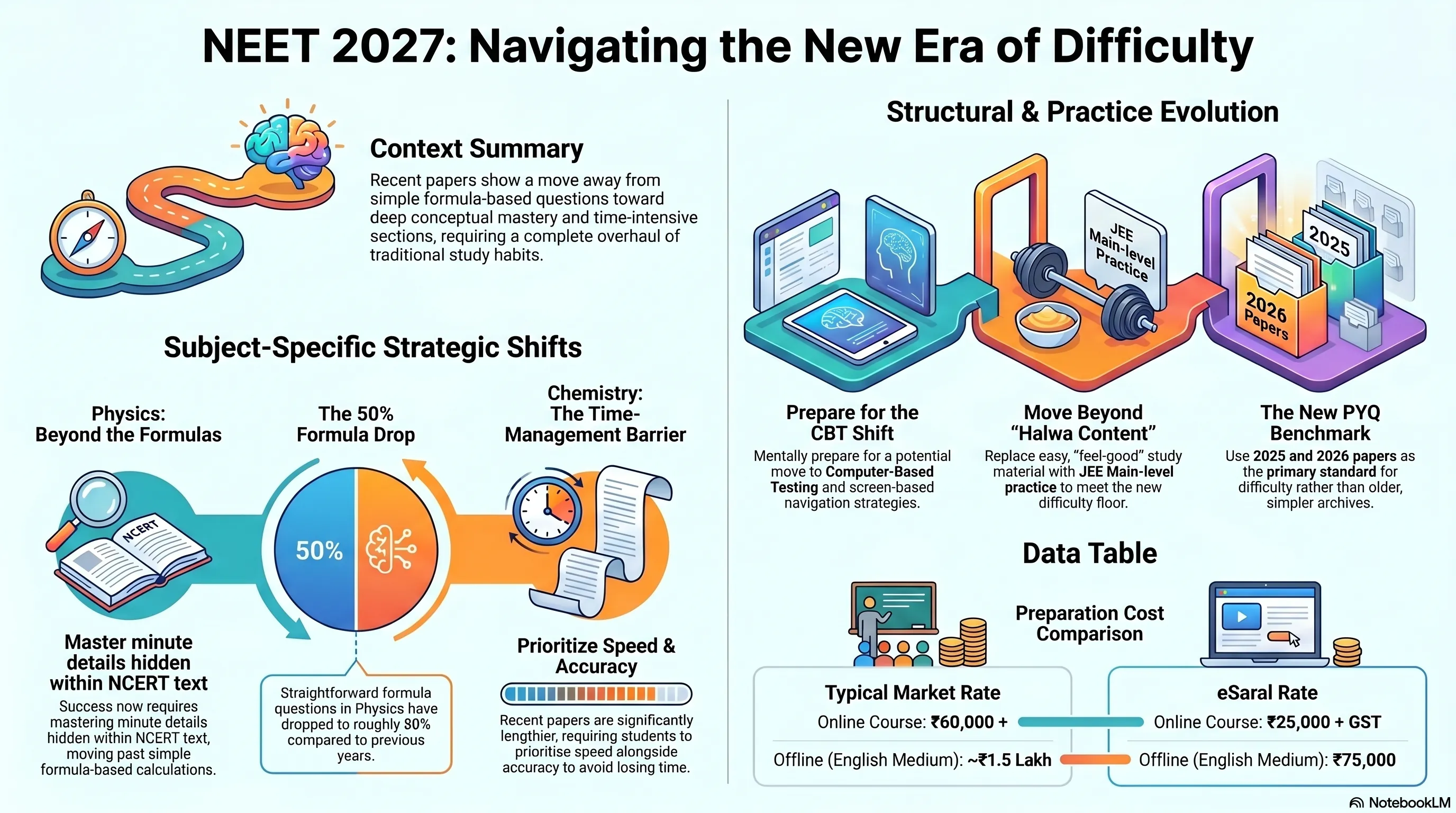
NEET 2027 preparation must account for two major shifts seen in the 2025 and 2026 papers: a lengthier, concept-deep Physics and Chemistry section, and the strong possibility of NEET moving to Computer-Based Test (CBT) mode with multiple shifts, similar to JEE Main. The NEET 2026 Physics paper introduced never-before-asked NCERT-based concepts, while Chemistry took over an hour to solve. eSaral is preparing droppers for these changes with CBT-ready topic-wise tests, 20-page analysis reports, and new batches launching 28 June and 5 July.

.webp)
Table of Contents
- What the NEET 2026 Physics Paper Changed for Droppers
- Why the NEET 2026 Chemistry Paper Ate Up Students' Time
- Will NEET 2027 Be a Computer-Based Test?
- The "Halwa Content" Warning Every 2027 Dropper Needs to Hear
- Why NEET 2025 and 2026 PYQs Are Different From Older Papers
- How eSaral Is Preparing Droppers for NEET 2027

eSaral › NEET › NEET 2027 Preparation Strategy: Key Lessons From 2025-26

What the NEET 2026 Physics Paper Changed for Droppers
The NEET 2026 Physics paper was unlike anything NEET has set before. The calculations were lengthy, some questions were long, and a few minute concepts appeared that NEET had never asked in its 25-year history.
One example: a question was based on a line hidden inside the NCERT textbook about the function involved in the Rutherford (Marsden) scattering experiment. This line is rarely taught — most teachers in India skip it entirely — yet it appeared as a direct question, including a follow-up graph-based question built on the same concept.
Another example was index correction — a concept from experimental physics. The question asked which experiment or measurement requires index correction, a detail that only students with genuinely deep preparation would know.
Out of 45 Physics questions, only 20 to 25 were straightforward formula-based questions requiring light calculation — close to 50% of what previous NEET papers typically offered. The rest demanded deep conceptual knowledge, such as:
- Calculating angular momentum about an outside point in rotational motion (a concept students usually memorize without practising the less common case)
- A charge introduced inside a cavity — a JEE Main-level concept, of the kind normally seen in JEE Main's 25-question, one-hour section
💡 Expert Tip from the eSaral faculty: If you are aiming for 180/180 in Physics, you now have to pay attention to the minute lines inside NCERT — not just the headline concepts.
This shift means 2027 droppers preparing for NEET cannot rely only on NEET physics weightage data from earlier years; the difficulty floor inside that weightage has moved up. Going back to the source material — the NCERT Class 11 Physics solutions and NCERT Class 12 Physics solutions — and reading every line, not just the bold formulas, is now part of the preparation, not an optional extra.

Why the NEET 2026 Chemistry Paper Ate Up Students' Time
Chemistry was reported as the toughest section of the NEET. Students took 1 hour to 1 hour 10 minutes to finish it — leaving very little time for Physics. Compared to 2025, the 2026 Chemistry paper was slightly easier level-wise, but far lengthier, which is what actually hurt students on time.
Because Chemistry consumed so much of the clock, students were left with barely enough time for Physics, even though they were given an extra 15 minutes this year. That extra time is not guaranteed for future attempts — if NEET shifts to CBT mode, the exam will most likely stay at a strict 3 hours.
This makes speed in Chemistry — not just accuracy — a real priority for NEET 2027 preparation. Strengthening NCERT-based Chemistry fundamentals through resources like NCERT Class 11 Chemistry solutions and NCERT Class 12 Chemistry solutions directly supports both the depth and the speed NEET now expects, and ties back to the kind of detail tested in NEET chemistry weightage data.
Will NEET 2027 Be a Computer-Based Test?
This is the single biggest structural change droppers need to prepare for mentally. NEET currently has around 22-23 lakh candidates. JEE Main, with about 15 lakh candidates, already needs around 10 shifts when conducted as a Computer-Based Test. If NEET moves to CBT, the number of shifts required for NEET's much larger candidate pool would be significantly higher — and India does not currently have enough computer labs to handle that scale in one shift.
If multiple shifts do get introduced, a normalisation system — similar to the percentile system JEE Main uses across its different shifts — could also come into NEET. Some shifts in JEE Main are easier, some are medium, and some are tougher, and percentile normalisation adjusts for that. If NEET implements the same system, students would effectively need to be prepared for all three difficulty levels, not just one.
Practically, this changes test-taking strategy too: there will be no time spent filling an OMR sheet, and the entire test strategy — how you allocate time, how you mark for review, how you navigate between sections — has to be rebuilt around a screen-based format rather than a paper-based one. Reviewing the NEET exam pattern page regularly as updates are announced is a sensible habit for 2027 droppers from now on.
The "Halwa Content" Warning Every 2027 Dropper Needs to Hear
A direct warning: many students feel confident because their study material feels easy — they're solving 9 or 10 out of 10 questions in class, everything "makes sense," and the class feels enjoyable. This is described as "halwa content" — content that feels good but doesn't prepare you for the actual exam.
The test for this is simple: if most of the questions you practised all year were the kind that build comfort, but those same kinds of questions didn't show up — or didn't help — in the actual NEET 2026 paper, that is the signal to raise your own level. Students who appeared in NEET 2026 and found they couldn't attempt certain questions need to seriously examine why, rather than assume the paper was simply "too hard."
The fix is not to abandon basics — basic, hands-on practice questions are still necessary — but to add a layer of level-up practice on top of them, including solving JEE Main-level Physics and Chemistry material, since that is the level NEET 2026 borrowed some of its toughest questions from.
Why NEET 2025 and 2026 PYQs Are Different From Older Papers
Previous Years' Questions up to 2024 were comparatively simple. The NEET 2025 and 2026 papers have created an entirely new, tougher category of PYQs. This means the older NEET question paper archive — including the NEET 2023, NEET 2022, NEET 2021, NEET 2020, and NEET 2019 papers — should still be solved for foundation and pattern familiarity, but cannot be the ceiling of a 2027 dropper's practice anymore. The 2025 and 2026 papers themselves now form the more relevant, higher-difficulty practice set.
How eSaral Is Preparing Droppers for NEET 2027
A few concrete steps from eSaral for the NEET 2027 dropper batch:
- A new "Special 27" material is being launched, built around the level of questions actually being asked in NEET now, specifically for practice.
- Online batches include one-to-one live classes with two-way interaction, so doubts can be solved directly with the teacher rather than in a 500-student group setting where interaction isn't possible.
- eSaral describes itself as the first institute in India that is NEET CBT-ready — offline batches get access to computer-lab test centres, and topic-wise tests can be taken on computer, mobile, or tablet for online students.
- Every test comes with a 20-page analysis report. Two student examples were cited: one scoring around 705 marks and another around 690, both of whom relied heavily on this topic-level analysis (for example, identifying repeated mistakes specifically in rolling motion within rotational motion) across their last 20 to 50 tests combined to close preparation gaps.
- Up to 100% scholarship is available based on a student's NEET 2026 marks.
- The next NEET attempt is expected in May, and batches are already running about 40-45 days behind schedule — an early start is recommended.
Alongside any structured batch, returning to fundamentals through the NEET syllabus and NCERT books — particularly NCERT Class 12 books and NCERT Class 11 books
Frequently Asked Questions
Find answers to common questions.
What made the NEET 2026 Physics paper different from previous years?
The NEET 2026 Physics paper had lengthy calculations and deep, minute concepts never asked before in NEET's history, including a question based on a rarely-taught NCERT line about the Rutherford scattering experiment. Only 20-25 of the 45 Physics questions were straightforward formula-based questions.
How long did the NEET 2026 Chemistry paper take to solve?
Students reportedly took 1 hour to 1 hour 10 minutes to complete the Chemistry section. It was level-wise slightly easier than 2025 but far lengthier, leaving little time for Physics.
Will NEET 2027 be conducted as a Computer-Based Test?
This isn't confirmed, but it's a real possibility being discussed, since NEET has around 22-23 lakh candidates and India currently lacks the computer lab capacity JEE Main uses for its much smaller candidate base. If implemented, NEET could also see multiple shifts and a JEE Main-style normalization system.
What is "halwa content" in NEET preparation?
It refers to study material that feels easy and builds false confidence — solving 9 or 10 out of 10 questions in class — without preparing students for the actual difficulty of the NEET paper. The fix is adding level-up practice, including JEE Main-level questions, on top of basics.
Are NEET 2025 and 2026 PYQs different from older PYQs?
Yes. PYQs up to 2024 were comparatively simple, while the 2025 and 2026 papers introduced a tougher category of questions. Both years are now considered essential practice material for NEET 2027 preparation, alongside the older archive.