Class 10 Board Exam Preparation Strategy: How to Recover 3 Lost Months and Still Aim for 95%
Students who have lost months of Class 10 board preparation can recover by clearing NCERT concepts first, focusing on high-weightage chapters in Maths and Science, revising each chapter at least three times, and following a distraction-free 3–4 hour daily self-study routine with 7–8 hours of sleep.
Table of Contents

eSaral ›Foundation courses ›Class 10 Board Exam Preparation Strategy: How to Recover 3 Lost Months and Still Aim for 95%

The Wake-Up Call: Where Has Your Time Gone?
Before building any study plan, it helps to be honest about where the last few months went. If the answer is "scrolling reels, hanging out with friends, and promising to start tomorrow," the first thing that needs to change is that promise itself. Even aiming for 70% at this point will take real effort — and reaching 95% needs an actual, written commitment, not just a wish.
The advice here is simple: if there's genuine fire to hit 95%, pause and write it down — "I will score 95%, no matter what." Saying it out loud, or writing it, is what starts to build the will to actually put in the work.
Step 1 — Clear Your Concepts With NCERT First
For every subject except Maths, the starting point is reading the NCERT textbook thoroughly and more than once. Each additional read of NCERT tends to reveal something new that wasn't clear the first time.
For Maths specifically, concept clarity is described as the real power. If the underlying concept is clear, solving only the conceptual questions from NCERT Class 10 Maths — without needing extra reference books — is enough to attempt any board-level question.
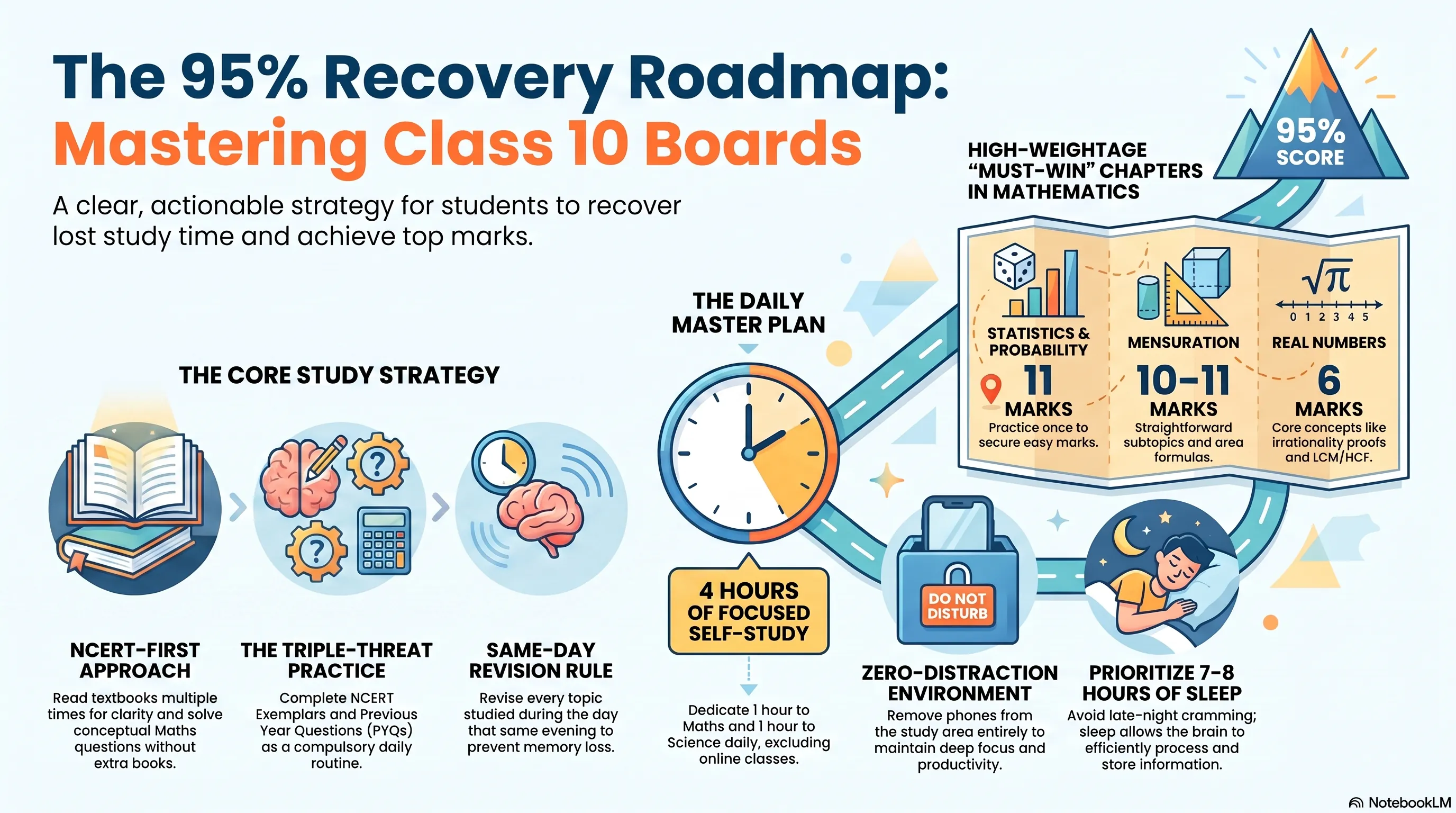
The second non-negotiable is practice: PYQs and practice questions, including NCERT Exemplar problems, should not be skipped. These are meant to be treated as a compulsory, targeted part of the routine — not optional extra work.
The third and most important step is revision. According to the strategy shared here, most students study but don't revise — and that gap is what costs marks. Whatever is studied during the day should be revised the same evening.
High-Weightage Chapters You Cannot Skip
Mathematics
| Chapter | Weightage / Marks | Focus Area |
|---|---|---|
| Real Numbers | 6 marks | 2–3 core concepts: proving √2 is irrational, and the LCM × HCF = a × b property |
| Polynomials, Linear Equations, Arithmetic Progression, Quadratic Equations | ~15 marks | Considered relatively easy chapters overall; Linear Equations can be a little tougher |
| Statistics and Probability | 11 marks | Described as a chapter that should never be skipped — practicing it once secures these marks |
| Triangles | 2–3 marks (from theorems alone) | A tough chapter overall, but memorizing just the theorems locks in these marks |
| Trigonometry | High weightage | Commonly feared, but every board-level question type in this chapter can be covered with practice |
| Mensuration (Surface Area & Volume, Areas Related to Circles) | 10–11 marks | Two straightforward subtopics worth a significant, easy-to-secure mark share |
Detailed chapter-wise practice for each of these topics is available in eSaral's NCERT Solutions for Class 10 Maths, with the full textbook available as an NCERT Class 10 Maths Book PDF and an NCERT Maths Book Class 10 in Hindi for Hindi-medium students.
Science
| Chapter | Focus Area |
|---|---|
| Chemical Reactions and Equations | Types of reactions and balancing equations — this alone secures a large share of marks; displacement and double-displacement reactions need thorough practice |
| The World of Living (Life Processes & Reproduction) | Biology chapters are many students' fear, but are described as easy to retain once understood properly |
| Natural Phenomena (Light) | Called out as an important chapter |
| Electricity | Called out as an important chapter |
These map to eSaral's NCERT Solutions for Class 10 Science, the NCERT Class 10 Science Book PDF (also available as an NCERT Science Book Class 10 in Hindi), and subject-specific PDFs: NCERT Class 10 Physics Book PDF / in Hindi for Light and Electricity, NCERT Class 10 Chemistry Book PDF for Chemical Reactions, and NCERT Class 10 Biology Book PDF / in Hindi for the World of Living unit.
Social Science
- History: Nationalism in India — a compulsory, high-scoring chapter.
- Geography: Manufacturing Industries and Lifeline of Economy.
- Political Science: Power Sharing, Federalism, and map work — eSaral's channel carries dedicated map-work videos that can help secure a guaranteed 5 marks through specific tricks.
English Preparation: Grammar, Writing, and Literature
- Reading passages: Practicing at least one passage a week (daily, if possible) builds the comfort needed during the actual board exam.
- Case-based questions: The same weekly-practice approach applies here — even one case-based question a week builds usable exam experience.
- Grammar: Credited to Anuj Sir, who brings 25 years of teaching experience to breaking grammar down clearly.
- Writing (Letters and Paragraphs): Memorizing the required formats secures 2 out of 5 marks immediately; the content itself becomes easy to write once the format is locked in.
- Literature: Treating stories and poems like a film narrative — the way you'd follow a movie — makes them far easier to remember than rote memorization.
- Point-wise answers: For subjective questions across Biology, Social Science, and English, writing answers as bullet points (the way topper answer sheets are typically structured) tends to score better than dense paragraph answers.
For the full syllabus reference, the NCERT Class 10 English Book PDF and NCERT Class 10 Hindi Book PDF are available for download.
The Daily Master Plan for Self-Study
The strategy is explicit that cramming in the final weeks — even 12–14 hours a day — caps out around 70–80%. Reaching 95%+ requires consistent effort across the full year. The daily routine recommended is:
- 3–4 hours of focused self-study daily. This does not include attending online classes — self-study means sitting down alone with a book or question set, phone put away in another room (even handed to a parent) until the session is done.
- 1 hour Maths + 1 hour Science, non-negotiable, every day. Given current CBSE paper trends and difficulty levels, skipping this combination is called out as a direct risk to the target score.
- A zero-distraction study area. No phone nearby during self-study sessions.
- A weekly self-test on weekends. On Saturday or Sunday, test yourself on whatever was covered that week — for example, Real Numbers and Polynomials in Maths, Chemical Reactions in Science. Free chapter-wise test sheets are available on the eSaral app, alongside using CBSE previous year question papers for Class 10 as mock tests, or eSaral's own test series.
- 7–8 hours of sleep, without exception. Studying until 2–3 AM and then waking for 8 AM school is flagged as counterproductive — it leads to a lethargic day that undoes the late-night effort. Sleep is what allows the brain to work efficiently on what's already been studied.
Aarohi's Comeback: What 3 Months of Focused Study Can Do
The strategy is illustrated through a real example: a student named Aarohi, who lost three to four months after completing Class 9, later went on to reach ISRO. Her approach was to set 15-day targets per subject — 15 days for Science, 15 days for Maths, 15 days for Social Science — completing her full course in three months through this cycle. She also revised every chapter a minimum of three times.
Her story is presented as proof that a similarly focused recovery is possible for any student starting today, regardless of how much time feels lost. Students currently in Class 9 building this same habit early can also work through eSaral's NCERT Solutions for Class 9, including Class 9 Maths and Class 9 Science solutions, or explore the Class 9 course page directly.
For students who also want to start JEE or NEET foundation preparation alongside board studies, this is described as possible through eSaral's Agni course — explore the Foundation Courses page, including Agni JEE and Agni NEET, for more detail.
Frequently Asked Questions
Find answers to common questions.
I've already lost 3 months of Class 10 board preparation — can I still score 95%?
Yes, according to this strategy, but it requires a genuine, written commitment rather than a last-minute cram. Cramming in the final weeks alone typically caps a score around 70–80%, while consistent daily effort starting now can still support a 95%+ target.
Which Class 10 Maths chapters carry the highest weightage?
Statistics and Probability (11 marks) and Mensuration (10–11 marks) are highlighted as high-weightage chapters that should never be skipped, alongside Real Numbers (6 marks) and the Polynomials–Linear Equations–AP–Quadratics group (around 15 marks combined).
How many hours should a Class 10 student self-study daily?
The recommended routine is 3–4 hours of focused, phone-free self-study every day, with 1 hour each dedicated specifically to Maths and Science, in addition to sleeping 7–8 hours a night.
Should I skip the Triangles chapter in Class 10 Maths since it's difficult?
Not entirely — while the chapter overall is considered tough, simply memorizing the theorems can secure 2–3 marks without needing to master the harder problem sets.
How can I improve my Class 10 English writing section marks?
Memorizing the required formats for letters and paragraphs secures 2 out of 5 marks immediately, and writing subjective answers in point form — like typical topper answer sheets — tends to score higher than paragraph-style answers.