Sample Paper Class 10 CBSE (2026-27): Free PDF + Marking Scheme Changes
The CBSE Class 10 sample paper for 2026-27 is the board's official model paper with a marking scheme, released on 21 September 2026 for the 2027 board exams. Each subject carries 80 theory marks and 20 internal assessment marks, so solve every sample paper class 10 set in 3 hours and check it against the official marking scheme.
eSaral › NCERT Class 10 › Sample Paper Class 10 CBSE (2026-27): Free PDF + Marking Scheme Changes
Sample paper class 10 is the official model question paper CBSE publishes for a session to show the exact question types, section-wise marks and marking scheme of the coming board exam. For 2026-27, CBSE released the Class 10 sample question papers and marking schemes on 21 September 2026, and every subject-wise PDF is listed below so you can practise the way the 2027 boards will be evaluated.
Not sure which Class X sample paper to start with? Begin with Mathematics and Science, since they carry the most application-based questions, then move to Social Science and languages. To compare this year's pattern with real exam papers, check CBSE Class 10 previous year question papers for 2020–2026, solved and free to download.
What Is a Sample Paper Class 10 and Why Does It Matter?
A sample paper for Class 10 is the model question paper CBSE releases each year to show students the exact question format, section-wise mark split and difficulty level of that session's board exam before the real exam happens. Unlike a previous year's question paper, which shows what was actually asked in a past year, a CBSE Class 10 sample question paper shows what CBSE intends to ask this year, making it a more reliable format guide for current-session preparation.
CBSE updates its question-paper design periodically, most recently by raising the share of competency-based questions. A class 10 sample paper from an older session can therefore mislead you. Always confirm you are solving the 2026-27 official paper before relying on it for pattern practice.
What Is New in the CBSE Class 10 Sample Paper 2026-27?
The 2026-27 papers follow the existing paper design, so there is no need to relearn the format. What changes in your preparation is how you are tested and how many attempts you get:
Competency-based focus: About half of each theory paper is case-based, analytical or application-driven, so memorised definitions alone will not carry the marks.
Two board exam phases: Class 10 now has a compulsory main exam and an optional improvement exam.
One sample set for both phases: The pattern does not change between attempts, so the same official sample papers prepare you for both.
Class 10 Board Exam Structure for 2026-27
Aspect
Phase 1 (Main Exam)
Phase 2 (Improvement Exam)
Timing
February–March 2027
May 2027 (tentative)
Compulsory?
Yes, for every student
No, optional
Subjects
All subjects
Up to 3 subjects
Score counted
Counted
Better of the two scores is retained
Internal assessment
20 marks, conducted once
Carried forward, not repeated
Exact dates come from the official CBSE date sheet, so check cbse.gov.in once it is published.
CBSE Class 10 Sample Paper Pattern: Section-Wise Marks Breakdown
Section
Question Type
Number of Questions
Marks
A
MCQs + Assertion-Reason
20 (1 mark each)
20
B
Very Short Answer
5 (2 marks each)
10
C
Short Answer
6 (3 marks each)
18
D
Long Answer
4 (5 marks each)
20
E
Case-Based Questions
3 (4 marks each)
12
Total (Theory)
80
Add 20 marks of internal assessment and the full Class 10 Maths paper is worth 100 marks. This section structure applies to both the Standard and Basic sample question papers; only the difficulty of individual questions differs. Students planning to take Mathematics in Class 11 should practise the Standard paper.
The high-weightage Maths units are Algebra (20 marks), Geometry (15 marks) and Trigonometry (12). Revise the matching chapters from NCERT solutions for Class 10 Maths before attempting each sample paper.
Why Section A Deserves 15 Minutes of Extra Practice
Section A alone carries 20 of the 80 theory marks, a quarter of the paper, in a format with no partial credit. One careless slip in an MCQ costs the full mark, whereas step-marking in Sections C and D can still save most of the marks even when the final answer is wrong. Timed MCQ drills from a sample paper for Class 10 pay off far more than the time they take.
Class 10 Science Sample Paper: Typical Section Structure
Section
Question Type
Questions
Marks
A
MCQs + Assertion-Reason
20 (1 mark each)
20
B
Very Short Answer
6 (2 marks each)
12
C
Short Answer
7 (3 marks each)
21
D
Long Answer
3 (5 marks each)
15
E
Case-Based Questions
3 (4 marks each)
12
Total (Theory)
80
CBSE Class 10 Sample Question Paper: Maths, Science, English, Social Science & Hindi Marks Split
Subject
Component
Marks
Mathematics
Number Systems
6
Mathematics
Algebra
20
Mathematics
Coordinate Geometry
6
Mathematics
Geometry
15
Mathematics
Trigonometry
12
Mathematics
Mensuration
10
Mathematics
Statistics & Probability
11
Science
Chemical Substances – Nature and Behaviour (Chemistry)
25
Science
World of Living (Biology)
25
Science
Natural Phenomena (Physics)
12
Science
Effects of Current (Physics)
13
Science
Natural Resources
5
English
Reading Skills
20
English
Writing & Grammar
20
English
Literature
40
Social Science
History
20
Social Science
Geography
20
Social Science
Political Science
20
Social Science
Economics
20
Hindi Course A
Apathit Bodh (Unseen Passage)
14
Hindi Course A
Vyavaharik Vyakaran (Grammar)
16
Hindi Course A
Textbook & Supplementary (Kshitij, Kritika)
30
Hindi Course A
Rachnatmak Lekhan (Creative Writing)
20
Hindi Course B
Apathit Bodh (Unseen Passage)
14
Hindi Course B
Vyavaharik Vyakaran (Grammar)
16
Hindi Course B
Textbook & Supplementary (Sparsh, Sanchayan)
28
Hindi Course B
Rachnatmak Lekhan (Creative Writing)
22
Every subject above is out of 80 theory marks, with 20 internal assessment marks added on top.
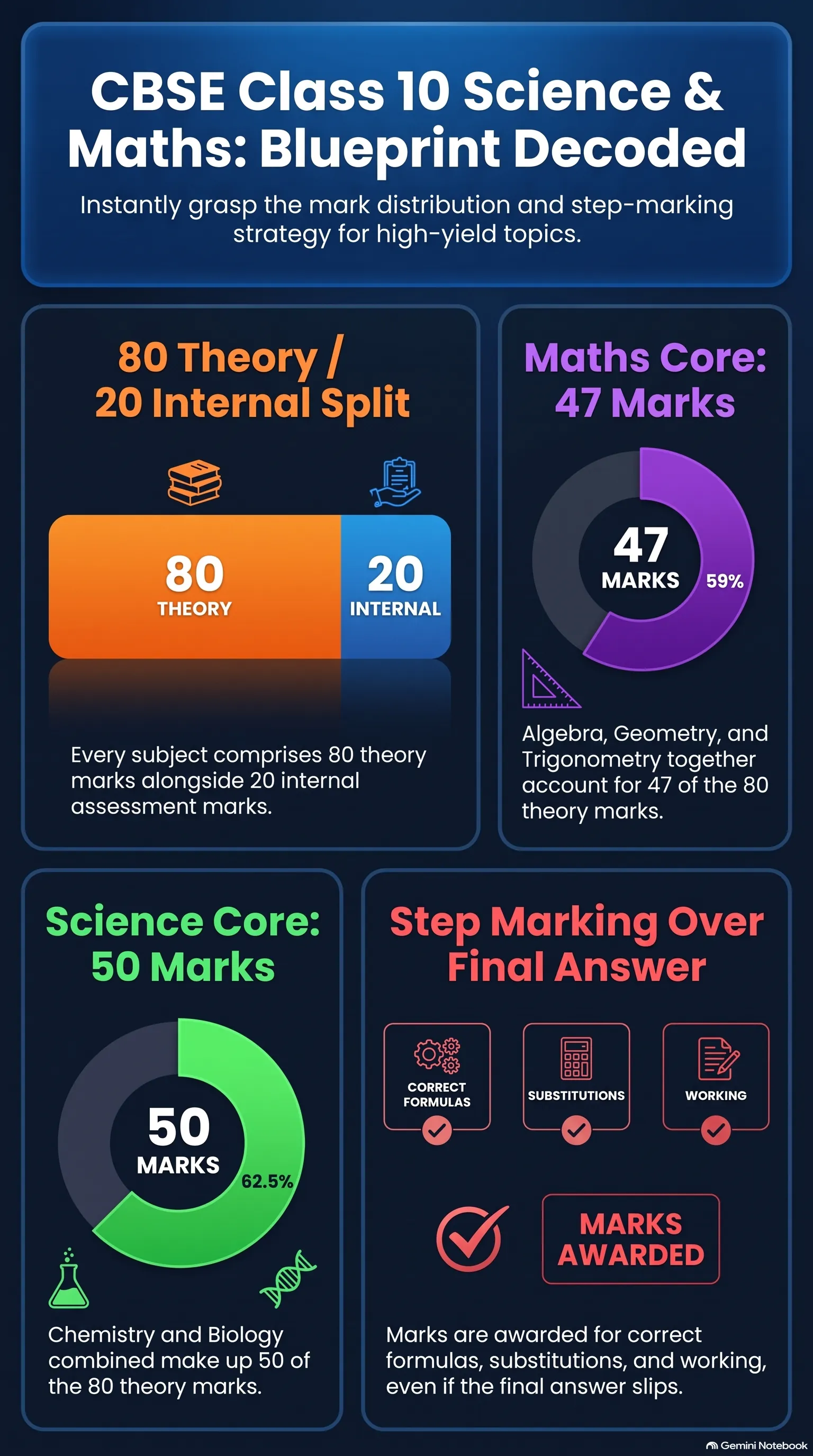
Insight:In Maths, Algebra, Geometry and Trigonometry together carry 47 of the 80 marks, so they deserve the most sample-paper practice. In Science, Chemistry and Biology carry 50 of 80. In Hindi, grammar and creative writing together carry 36 marks in Course A and 38 in Course B, and both are rule- and format-based, so they are among the easiest marks to secure. In Social Science, map-based questions carry 5 marks, so practise them in every Class X sample paper.
CBSE Marking Scheme for Class 10: How Examiners Actually Award Marks
CBSE's marking scheme does not award marks only for the final answer. It breaks each Long Answer question into value points, so credit is split across the correct approach or formula, accurate working and the final result. A student who applies the right method but slips in the last step can still collect most of a 5-mark question, and examiners accept other correct methods. This is why practising with the official marking scheme, and not the question paper alone, is non-negotiable.
Subject-Wise Marking Priorities
Subject
What the Marking Scheme Rewards
Where Students Lose Marks
Mathematics
Correct formula and method carry more combined weight than the final number
Skipping steps in 3- and 5-mark answers
Science
Formula, substitution, calculation and unit are credited separately
Missing units, unlabelled diagrams
Social Science
One mark per distinct key point, not per line written
Long paragraphs with few actual points
Languages
Content, grammar accuracy and structure are marked as separate components
Ignoring word limits and format
Has the CBSE Class 10 Marking Scheme Changed for 2026-27?
No. The CBSE Class 10 marking scheme and question paper design for 2026-27 are unchanged from the previous session. CBSE released the 2026-27 sample papers and marking schemes on 21 September 2026 without announcing any change to the assessment scheme or the passing criteria.
You can practise with the 2026-27 sample papers using the same answer-writing habits that earned marks in earlier years: show every step, write the key formula, add units and label diagrams. The real shift is not in the marking scheme but in the question style, with more case-based and application questions. Use each paper's official marking scheme PDF from the download table above to check its question-wise value points, which are specific to that paper.
How to Use a CBSE Class 10 Sample Paper for Maximum Score Gain
Step 1: Solve It in a Strict, Uninterrupted 3-Hour Window
Attempt the full class 10 sample paper exactly as you would the real exam: phone away, no breaks, no reference material. This one habit builds the pacing instinct most students lack on exam day.
Step 2: Grade Yourself Using the Official Marking Scheme
Check every answer against the official CBSE marking scheme PDF instead of deciding yourself whether an answer "looks right". Award partial marks only where the scheme allows it.
Step 3: Log Every Mistake Into Three Categories
For every wrong or partial answer, note whether it was a formula gap, a concept gap or a time-pressure slip. The fix for each is different, and lumping them together wastes revision time. A simple log works well:
Question No.
Section
Marks Lost
Error Type
Fix
Example: Q27
C
2
Formula gap
Revise the formula and re-solve 3 similar questions
Step 4: Solve at Least 5 Sample Papers Plus 5 Previous Year Papers
Sample paper for Class 10 shows this year's format, while a previous year question paper shows what has actually been asked. Use both together. Five of each per main subject is a realistic target before the board exam.
Suggested Practice Plan for the 2027 Boards
Period
Sample Papers per Subject
Focus
Oct–Nov 2026
1
Learn the format and marking scheme
December 2026
2
Timed attempts, section-wise time control
January 2027
2 + previous year papers
Full 3-hour papers, mistake-log revision
Before Phase 1
Revise the mistake log
Formulas, diagrams and case-based practice
Common Mistakes Students Make With Class 10 Sample Papers
Solving an older session's paper and treating it as the current pattern.
Peeking at the marking scheme mid-paper, which hides your real weak spots.
Skipping the case-based section to save time, even though it carries 12 marks.
Ignoring the marking scheme's wording for definitions and reasons, then writing "almost right" answers.
Solving papers without reviewing them, which repeats the same errors.
Sample Paper Class 10 vs Previous Year Question Paper: Which Should You Prioritise?
Aspect
Sample Paper Class 10
Previous Year Question Paper
Source
Released by CBSE for the current session
Actual paper from a past board exam year
Best used for
Learning this year's exact format and marking scheme
Want a structured, teacher-guided revision plan instead of tracking mistakes alone? Explore eSaral's Class 8–10 Foundation Courses for IIT Bombay faculty-designed lessons built around the current CBSE pattern.
Share Blog
Share via...
Or copy link
Frequently Asked Questions
Find answers to common questions.
Has CBSE released the sample paper class 10 for 2026-27?
Yes. CBSE released the Class 10 sample question papers and marking schemes for the 2026-27 session on 21 September 2026 on cbseacademic.nic.in. You can also download every subject-wise PDF from the table on eSaral
Where can I download the CBSE class 10 sample paper with marking scheme?
Use the subject-wise download table above for each class 10 sample paper and its marking scheme. The same official files are available on CBSE's academic website.
How many marks is a CBSE Class 10 sample paper?
Each main subject sample paper class 10 carries 80 theory marks, and internal assessment adds another 20, making the subject total 100 marks.
What is the difference between Standard and Basic Maths sample papers?
Both versions follow the same 80-mark section structure (Sections A–E). The Standard paper has more application-heavy and multi-step problems, while Basic focuses on core, straightforward calculations. Choose Standard if you plan to study Mathematics in Class 11.
Has the CBSE Class 10 Marking Scheme Changed for 2026-27?
No. The CBSE Class 10 marking scheme and question paper design for 2026-27 are unchanged from the previous session. CBSE released the 2026-27 sample papers and marking schemes on 21 September 2026 without announcing any change to the assessment scheme or the passing criteria.
How much of the class 10 sample paper 2026-27 is competency-based?
Around 50% of the theory paper is competency-based, covering case studies, application and reasoning questions. About 20% is MCQs and 30% is short and long answers.
Can I use the same CBSE class 10 sample paper for both board exams?
Yes. CBSE's pattern does not change between the compulsory February–March exam and the optional May improvement exam, so the same class10 sample paper set prepares you for both.
How should I divide time while solving a sample paper Class 10 in Maths?
A commonly effective split for the 3-hour Maths paper is about 25 minutes for Section A, 40 minutes for Section B, 60 minutes for Sections C and D combined, 45 minutes for Section E and 10 minutes for final review.
Should I solve CBSE Class 10 sample question papers subject-wise or as a full timed set?
Do both. Use individual subject papers early to master section-wise timing, then attempt full papers in one uninterrupted 3-hour sitting closer to the exam to build stamina.