JEE Main 2019 Question Paper with Solutions - PDF Download
Download JEE Main 2019 Question Papers with detailed solutions for all 16 shifts, complete subject-wise analysis, topic distribution, and previous year practice PDFs for Physics, Chemistry, and Mathematics.
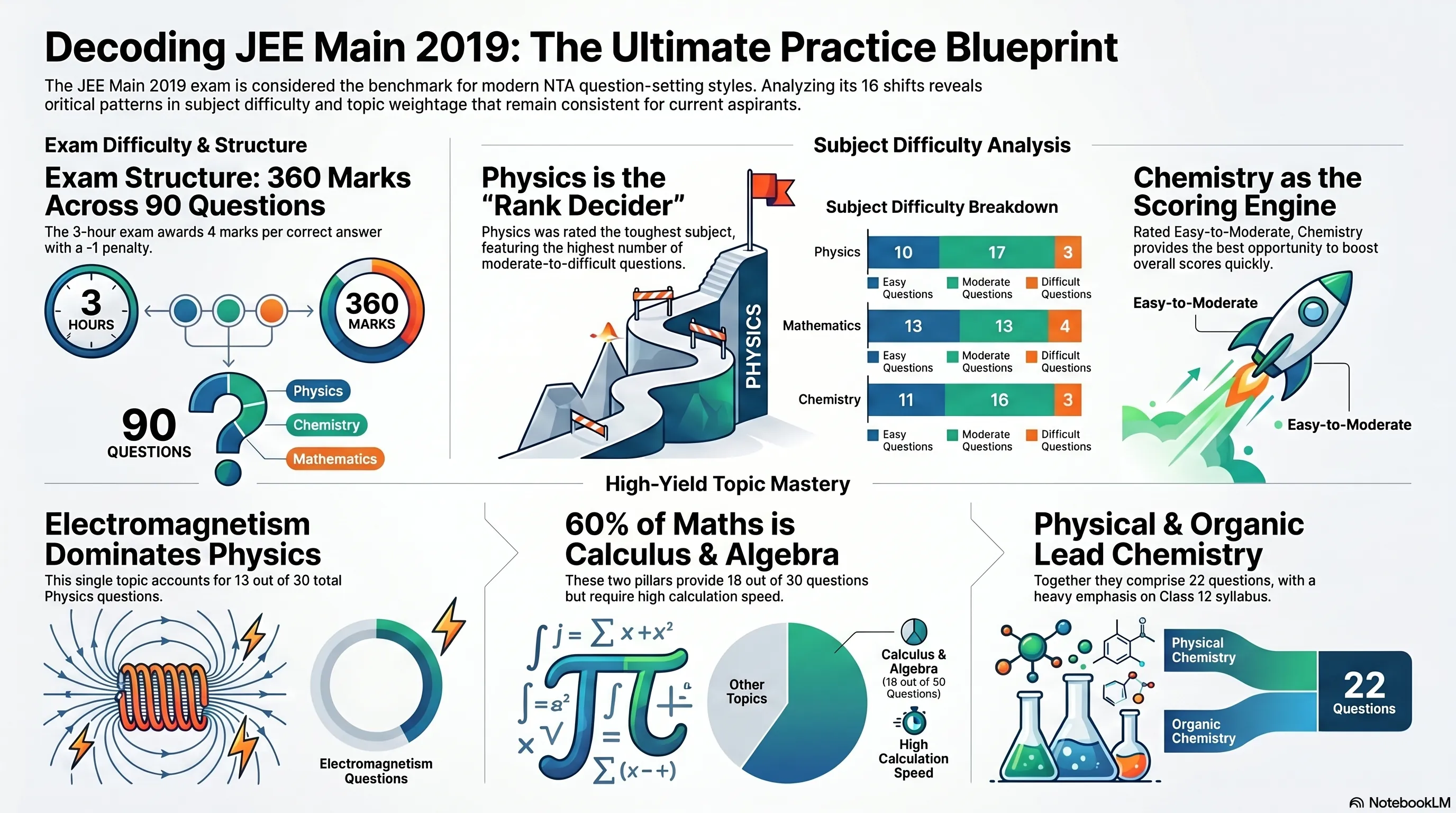
Table of Contents

eSaral › JEE › JEE Main › JEE Main 2019 Question Paper with Solutions - PDF Download

🚀 Checkout eSaral Courses
JEE Main 2019 Exam Overview
| Parameter | Details |
|---|---|
| Conducting Body | NTA (National Testing Agency) |
| Exam Mode | Computer-Based Test (CBT) |
| Sessions | Session 1: January 8–12, 2019 |
| Total Questions | 90 (30 per subject) |
| Total Marks | 360 (4 marks per question) |
| Negative Marking | −1 per wrong answer |
| Duration | 3 hours |
| Subjects | Physics, Chemistry, Mathematics |
| Language | English and Hindi |
💡 Expert Tip by eSaral Academic Team, IIT Bombay Faculty: "JEE Main 2019 is one of the best papers to practice from because NTA had fully settled into its question-setting style by this year. The topic distribution and difficulty ratios in 2019 papers closely mirror what you will face in JEE Main 2025 and 2026. Solve all 16 shifts — not just one or two."
Download: All 16 Shift-Wise Question Papers (Session 1 + Session 2)
|
Sr No. |
JEE Main 2019 Session 1 |
Question Paper |
|
1 |
9th Jan 2019 - Shift 1 |
|
|
2 |
9th Jan 2019 - Shift 2 |
|
|
3 |
10th Jan 2019 - Shift 1 |
|
|
4 |
10th Jan 2019 - Shift 2 |
|
|
5 |
11th Jan 2019 - Shift 1 |
|
|
6 |
11th Jan 2019 - Shift 2 |
|
|
7 |
12th Jan 2019 - Shift 1 |
|
|
8 |
12th Jan 2019 - Shift 2 |
|
|
JEE Main 2019 Session 2 |
||
|
9 |
8th Apr 2019 - Shift 1 |
|
|
10 |
8th Apr 2019 - Shift 2 |
|
|
11 |
9th Apr 2019 - Shift 1 |
|
|
12 |
9th Apr 2019 - Shift 2 |
|
|
13 |
10th Apr 2019 - Shift 1 |
|
| 14 |
10th Apr 2019 - Shift 2 |
|
| 15 |
12th Apr 2019 - Shift 1 |
Maths Physics Chemistry |
| 16 |
12th Apr 2019 - Shift 2 |
JEE Main 2019 Paper Analysis: Subject-Wise Breakdown
eSaral's faculty team reviewed all 16 shifts of JEE Main 2019 and compiled the following analysis based on student feedback and expert review.
Overall Difficulty Summary
| Subject | Difficulty Level | Easy | Moderate | Difficult |
|---|---|---|---|---|
| Physics | Challenging | 10 | 17 | 3 |
| Mathematics | Moderate | 13 | 13 | 4 |
| Chemistry | Easy-Moderate | 11 | 16 | 3 |
Key observations:
- Chemistry was the most scoring section — equal weightage to organic and inorganic, with Class 12 topics dominating (17 questions from Class 12, 13 from Class 11)
- Mathematics was moderate but time-consuming — many questions involved multi-step calculations
- Physics was the toughest section, especially Electromagnetism which alone contributed 13 of the 30 Physics questions
Topic-Wise Distribution: Physics, Maths, Chemistry
Physics — Topic Distribution
| Topic | Questions |
|---|---|
| Electromagnetism | 13 |
| Mechanics | 8 |
| Optics | 3 |
| Thermodynamics | 3 |
| Modern Physics | 2 |
| SHM and Waves | 1 |
Takeaway: Electromagnetism dominates JEE Main Physics. Students who are weak in Electromagnetic Induction, Current Electricity, and Magnetic Effects consistently lose the most marks in this section.
Mathematics — Topic Distribution
| Topic | Questions |
|---|---|
| Calculus | 9 |
| Algebra | 9 |
| Coordinate Geometry | 8 |
| Probability, Statistics, Mathematical Reasoning | 4 |
Takeaway: Calculus and Algebra together account for 18 of 30 Maths questions. The 2019 paper was calculation-heavy — students who practise speed without sacrificing accuracy perform significantly better.
Chemistry — Topic Distribution
| Topic | Questions |
|---|---|
| Physical Chemistry | 12 |
| Organic Chemistry | 10 |
| Inorganic Chemistry | 8 |
Takeaway: Physical and Organic Chemistry together account for 22 of 30 Chemistry questions. Class 12 topics carried more weight than Class 11 in 2019 Chemistry. Students who leave Inorganic Chemistry incompletely prepared consistently score below their potential in this section.
💡 Expert Tip by eSaral Academic Team, IIT Bombay Faculty: "The 2019 JEE Main topic distribution has stayed remarkably consistent through subsequent years. Electromagnetism dominating Physics, Calculus + Algebra dominating Maths, and Physical + Organic leading Chemistry — these patterns hold in 2022, 2023, and 2024 papers too. Plan your preparation around them."
JEE Main Previous Year Question Papers — All Years
Solving papers from multiple years builds pattern recognition that no mock test can replicate. Here are all available JEE Main and JEE Advanced previous year papers:
JEE Main Previous Year Papers
- JEE Main 2024 Question Paper with Solutions
- JEE Main 2023 Question Paper with Solutions
- JEE Main 2022 Question Paper with Solutions
- JEE Main 2021 Question Paper with Solutions
- JEE Main 2020 Question Paper with Solutions
- JEE Main 2019 Question Paper with Solutions ← You are here
JEE Advanced Previous Year Papers
- JEE Advanced 2023 Question Paper with Solutions
- JEE Advanced 2022 Question Paper with Solutions
- JEE Advanced 2021 Question Paper with Solutions
- JEE Advanced 2020 Question Paper with Solutions
- JEE Advanced 2019 Question Paper with Solutions
Why Solving JEE Main PYQs Is Non-Negotiable
Every JEE topper will tell you the same thing: previous year papers are not just practice — they are intelligence. Here is what solving them actually gives you:
1. Real Pattern Recognition
Mock tests simulate JEE. PYQs are JEE. After solving 8–10 years of JEE Main papers, you will notice that certain topics appear in certain formats year after year. Electromagnetism numerical questions, Coordinate Geometry locus problems, Organic Chemistry reaction mechanisms — these recur predictably. No coaching material or mock test captures this as accurately as the real papers.
2. Accurate Self-Assessment
Solving a PYQ under timed conditions gives you a calibrated difficulty benchmark. You find out exactly which topics consistently cost you marks and which ones you're comfortably strong in. This is far more reliable than subjective self-assessment.
3. Speed and Accuracy Under Real Pressure
JEE Main gives you 3 hours for 90 questions — 2 minutes per question. Working through actual past papers in timed sessions trains this rhythm in a way that studying chapters does not. Speed and accuracy at this pace is a skill that must be practised.
4. Confidence From Familiarity
Walking into the actual exam having solved papers from 2019, 2020, 2021, 2022, 2023, and 2024 means nothing in the question paper looks entirely unfamiliar. That familiarity reduces exam anxiety — which directly improves performance.
5. Identify High-Value Topics
Topic distribution data across years shows which chapters JEE consistently tests heavily. Electromagnetism, Calculus, Conic Sections, Organic Reactions — these are not guesses. They are patterns confirmed by 6+ years of real exam data. Prioritise them.
🚀 Checkout eSaral Courses
Frequently Asked Questions
Find answers to common questions.
How was the JEE Main 2019 paper difficulty level overall?
JEE Main 2019 was moderate in overall difficulty. Chemistry was the easiest and most scoring section. Mathematics was moderate but time-consuming due to heavy calculations. Physics was the most challenging section, with Electromagnetism contributing 13 of the 30 Physics questions. The overall difficulty was comparable to 2020 and slightly easier than 2022.
How many shifts did JEE Main 2019 have?
JEE Main 2019 had 16 shifts across two sessions — 8 shifts in Session 1 (January 9–12) and 8 shifts in Session 2 (April 8–12). Each shift had a different question paper with the same syllabus, pattern, and marks distribution. All 16 shift-wise papers are available for download on this page.
Which subject was easiest in JEE Main 2019?
Chemistry was the easiest and most scoring subject in JEE Main 2019. The section had 11 easy questions, 16 moderate, and only 3 difficult questions. Equal weightage was given to Organic and Inorganic Chemistry. Class 12 topics contributed 17 questions versus 13 from Class 11, making thorough Class 12 Chemistry preparation particularly important.
Is solving JEE Main 2019 paper useful for JEE Main 2026 preparation?
Yes, JEE Main 2019 papers remain highly relevant for 2026 preparation. NTA's topic distribution and question style have remained largely consistent from 2019 onwards. The dominance of Electromagnetism in Physics, Calculus and Algebra in Maths, and Physical Chemistry in Chemistry — all established clearly in 2019 — continues through recent papers. Solving 2019 papers gives you calibrated difficulty benchmarks and real pattern data.
Where can I find JEE Main papers from all years in one place?
All JEE Main previous year question papers from 2019 to 2024 — with complete solutions — are available on eSaral's JEE Main Question Paper archive page. JEE Advanced papers from 2019 to 2023 are available on the JEE Advanced Question Paper page.