CBSE Class 12 Maths Revision Notes 2026-27 Chapte-rwise PDF Download
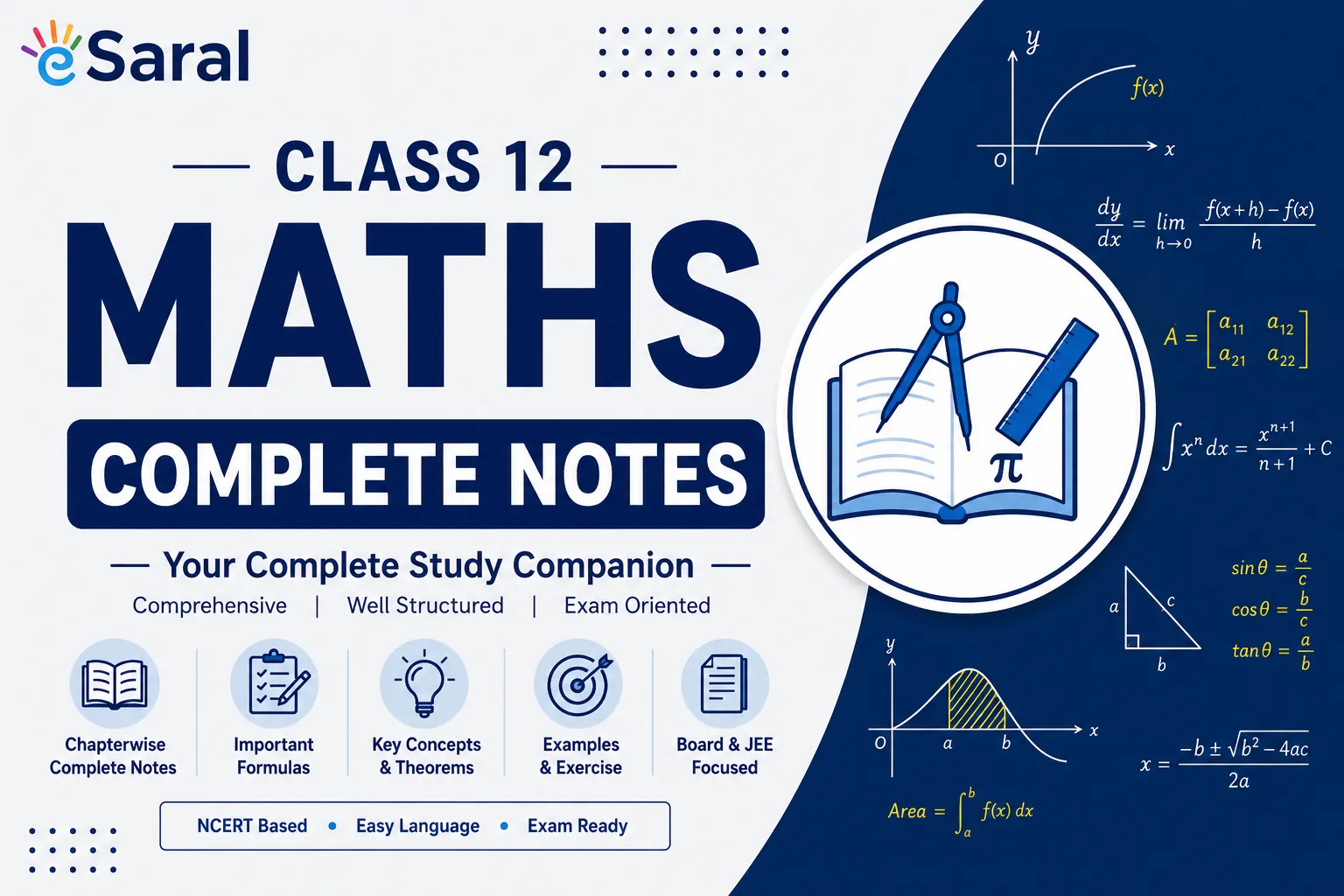
Table of Contents

eSaral › CBSE › Class 12 › Maths Revision Notes

During board exams, students need concise revision notes for the exams. As the 12th board exams are near, students require well-prepared revision notes to recall various formulas and theorems at the end of the time. We provide revision notes containing many important notes and points to recall before exams.
When studying, you mainly encounter various formulas and theorems that need to be understood and grasped by students to understand the concepts. These class 12 maths revision notes PDFs are prepared by us and are fully equipped with all the formulas and theorems.
These revision notes for class 12 maths are prepared in a summarised way without leaving any important theorems and formulas. These revision notes are very handy. Students can revise and practice easily. With the help of these, students can easily grasp the theorem, formulas, and other important points. Regular revisions also help them improve their problem-solving skills and time.
CBSE Class 12 Maths revision notes are concise, exam-focused summaries of every chapter in the NCERT Class 12 Maths textbook. They distil the full syllabus — spanning calculus, algebra, vectors, probability, and more — into clear, formula-rich pages that students can review in a fraction of the time it takes to re-read the textbook.
Who Should Use These Notes?
These notes are built for:
- Board exam students who need to revise all 13 chapters quickly
- JEE Main aspirants who want to keep their Class 12 concepts sharp alongside JEE preparation
- Students who missed classes and need a clean, structured summary to catch up
- Last-minute revisers who need formulas and key theorems in one place the night before the exam
What Do These Notes Cover?
Every chapter note includes:
- All important formulas and identities are listed clearly
- Key theorems with statements (proof hints where relevant)
- Solved examples showing how to apply each concept
- Common mistakes to avoid in the board exam
For step-by-step solutions to every NCERT exercise, pair these notes with our NCERT Solutions for Class 12 Maths.
Table of Contents
| Chapter | Chapter Name | Key Concepts Covered |
|---|---|---|
| 1 | Relations and Functions | Types of relations, bijective functions, composition, inverse |
| 2 | Inverse Trigonometric Functions | Principal values, properties, identities, range/domain |
| 3 | Matrices | Types of matrices, operations, transpose, and symmetric matrices |
| 4 | Determinants | Properties, minors, cofactors, adjoint, inverse, Cramer's rule |
| 5 | Continuity and Differentiability | Continuity rules, chain rule, implicit/logarithmic differentiation |
| 6 | Application of Derivatives | Increasing/decreasing functions, tangents, maxima and minima |
| 7 | Integrals | Methods of integration, standard forms, partial fractions |
| 8 | Application of Integrals | Area under curves, area between two curves |
| 9 | Differential Equations | Order, degree, variable separable, homogeneous, linear DEs |
| 10 | Vector Algebra | Dot product, cross product, scalar/vector triple product |
| 11 | Three-Dimensional Geometry | Direction cosines, lines, planes, angles between them |
| 12 | Linear Programming | Feasible region, corner point method, objective function |
| 13 | Probability | Conditional probability, Bayes' theorem, random variables |
Chapter-wise Note Links
|
Class 12 Maths Revision Notes Chapter-wise |
|
Most Important Topics and Marks Weightage
According to the official CBSE Class 12 Maths syllabus issued by CBSE (Central Board of Secondary Education), the paper carries 80 marks (theory) and 20 marks (internal assessment). The theory paper is divided into units as follows:
| Unit | Chapters Included | Marks (Theory) |
|---|---|---|
| Relations and Functions | Ch. 1, 2 | 8 |
| Algebra | Ch. 3, 4 | 10 |
| Calculus | Ch. 5, 6, 7, 8, 9 | 35 |
| Vectors and 3D Geometry | Ch. 10, 11 | 14 |
| Linear Programming | Ch. 12 | 5 |
| Probability | Ch. 13 | 8 |
| Total | 80 |
Which Chapters Should You Prioritise?
Calculus (35 marks) is the single heaviest unit — Chapters 5 through 9 together account for nearly 44% of the total theory marks. If you are short on time, ensure you have solid notes for:
- Continuity and Differentiability — high formula density, frequently tested
- Integrals — largest chapter; know all substitution and partial fraction methods
- Application of Derivatives — maxima/minima problems are almost always in the exam
- Differential Equations — linear first-order DEs appear every year
Which Chapters Are Easiest for Quick Marks?
- Linear Programming (Ch. 12): Mostly graphical — 15–30 minutes of revision can secure full marks
- Probability (Ch. 13): Bayes' theorem formula + practice 3–4 standard problems = consistent marks
- Matrices and Determinants (Ch. 3–4): Rule-based; formula notes make these very revision-efficient
How to Use These Revision Notes Effectively Before Board Exams
Having the notes is only half the work. The sequence in which you use them determines how much you actually retain on exam day.
Step 1: First Pass — Read, Don't Solve
Go through the revision notes for one chapter from start to finish without stopping to solve problems. The goal is to map out what the chapter contains and flag anything you don't recognise.
Step 2: Second Pass — Formula Drill
Write every formula from the notes by hand on a separate sheet. Research from cognitive science consistently shows that writing beats highlighting for retention. This single step can recover forgotten formulas before they cost marks.
Step 3: Pair with NCERT Solutions
Once you have reviewed the notes, attempt 2–3 NCERT exercise questions per concept. Use our NCERT Solutions for Class 12 Maths to check your working method — not just the final answer.
Step 4: Time-Boxed Revision
In the final 7 days before the board exam, assign one chapter's notes per sitting of 45 minutes. Thirteen chapters over seven days means some sittings will cover two chapters — plan for Matrices + Determinants together and Vectors + 3D Geometry together, as they share concepts.
Why Chapter-wise Notes Work Better Than Textbook Re-reading
The Problem With Re-reading NCERT Before Exams
The NCERT Class 12 Maths textbook is 450+ pages. Re-reading it in full during revision is not a productive use of board exam preparation time. The textbook is written for learning — not for revision. It includes worked examples, exercises, and exploratory text that slows down recall when you are short on time.
What Chapter-wise Notes Do Differently
Revision notes extract only what the examiner tests:
- Formulas stated clearly — no derivation required unless specified by CBSE
- Theorem statements — precisely as expected in the answer sheet
- Key properties listed — e.g., properties of determinants, properties of definite integrals
- Standard result patterns — the types of questions that appear every year
How This Saves Time Without Sacrificing Accuracy
A well-prepared set of chapter notes reduces 30–40 pages of NCERT content into 4–6 pages of exam-relevant material. A student can review a chapter's notes in 20–25 minutes versus 90+ minutes for a textbook re-read.
For Class 11 revision alongside boards, our NCERT Solutions for Class 11 Maths cover foundation topics that often appear indirectly in Class 12 exam questions.
You can also download the official NCERT Books for Class 12 directly from eSaral if you need the source text alongside these notes.
All 13 chapter notes are available for free above. Download the ones you need most first and work through them systematically.
Want structured guidance, not just notes? eSaral's Class 12 board preparation courses are taught by IIT Bombay faculty — including teachers with All India Ranks of AIR-41 — the same faculty who teach Kota-quality JEE content online at accessible prices. Students also get access to a 5-layer doubt-solving system, so no question goes unanswered before exam day.
Frequently Asked Questions
Find answers to common questions.
Can I download all 13 chapters' revision notes as a single PDF?
Yes. Each chapter is available individually above. eSaral's revision notes are free to download. For the full NCERT textbook content, visit our NCERT Books for Class 12 page, where all subjects are available.
Which is the hardest chapter in Class 12 Maths for most students?
Integrals (Chapter 7) is consistently reported as the hardest chapter because it requires recognising which method to apply — substitution, partial fractions, integration by parts — often under time pressure. The revision notes for this chapter list all standard forms and method-selection rules in one place to reduce that confusion.
Are these Class 12 Maths revision notes enough to score 90+ in boards?
These notes cover all formulas, theorems, and key concepts from the CBSE syllabus — which is what the board exam directly tests. For 90+ marks, revision notes should be paired with NCERT exercise practice and at least 2–3 previous year papers. Notes alone build knowledge; practice papers build exam speed and accuracy.
Do these notes follow the latest CBSE 2024–25 syllabus?
Yes. These revision notes are aligned with the CBSE Class 12 Maths syllabus for 2024–25 as prescribed by the Central Board of Secondary Education. Any chapters or topics removed from the reduced syllabus are not included, so students are not wasting time on non-exam content.
When should I start using revision notes — before or after finishing the syllabus?
Start using chapter revision notes as soon as you finish studying each chapter, not at the end of the year. Using them after each chapter creates a running revision log that makes the final pre-board revision significantly faster and less stressful
How are these revision notes different from the NCERT Solutions?
Revision notes summarise formulas, theorems, and key concepts — they are designed for fast recall. NCERT Solutions provide step-by-step working for every exercise question — they are designed for practice and error correction. Both serve different purposes and work best when used together. Find the complete NCERT Solutions here.