Circle - Class 9 Maths Chapter 8 Short Notes (Mind Maps)
The Circle chapter introduces the definition, key terms, formulas, and important properties of circles through a visual mind map, helping Class 9 students quickly revise concepts and strengthen their understanding for exams.
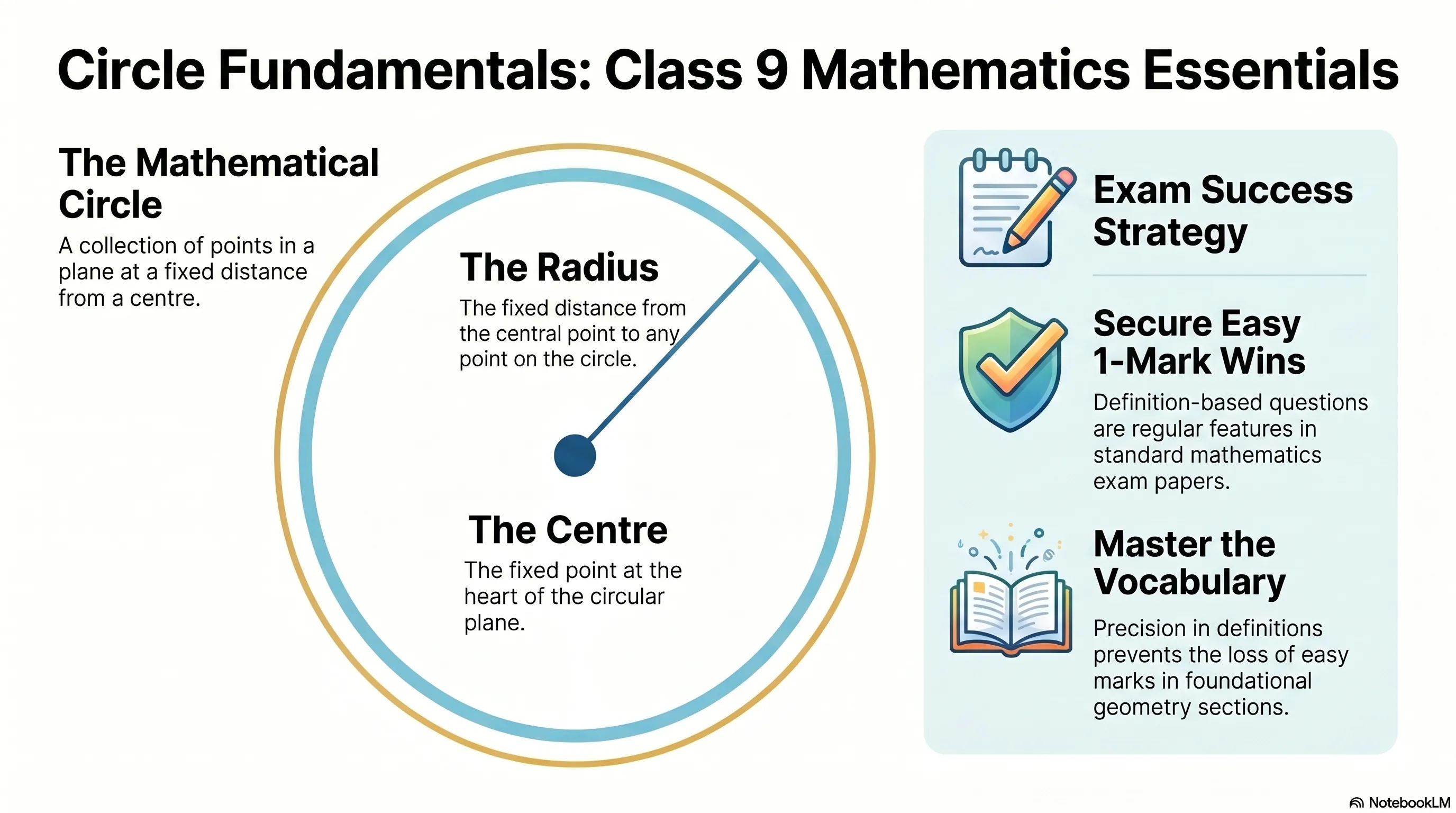
Table of Contents

eSaral ›Foundation courses ›Circle

What Is a Circle?
A circle is the collection of all points in a plane that are at a fixed distance (called the radius) from a fixed point (called the centre). This single sentence is the foundation of everything in Chapter 9.
Before jumping into theorems, it is essential to know the building-block vocabulary. Exam papers from CBSE regularly ask definition-based 1-mark questions, and getting these wrong costs easy marks.
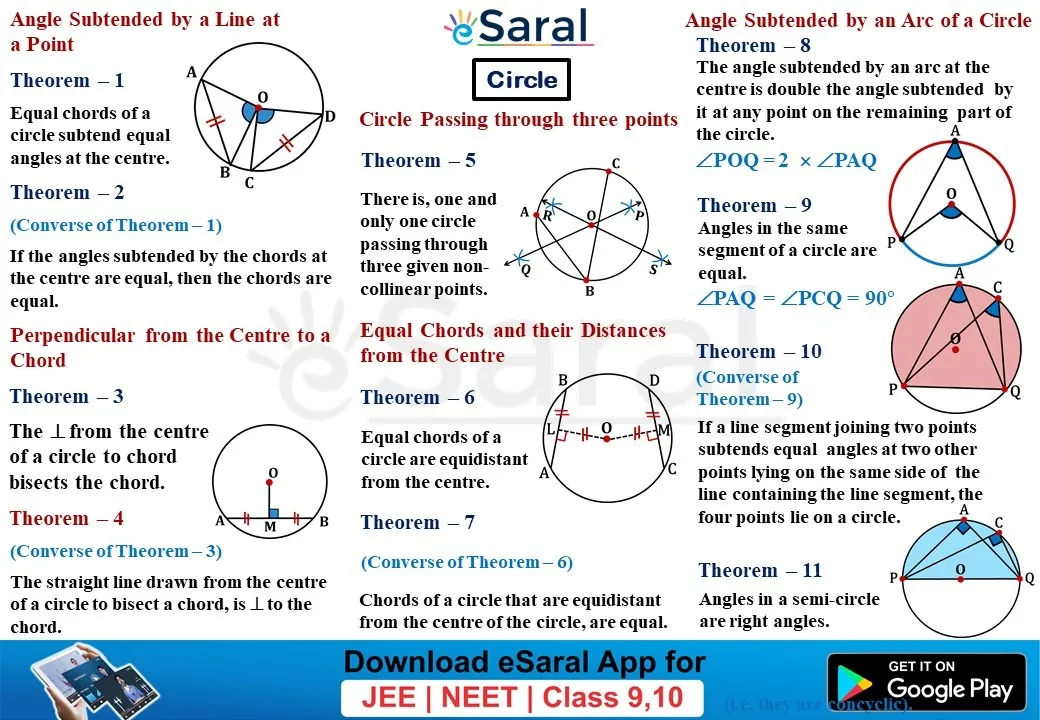
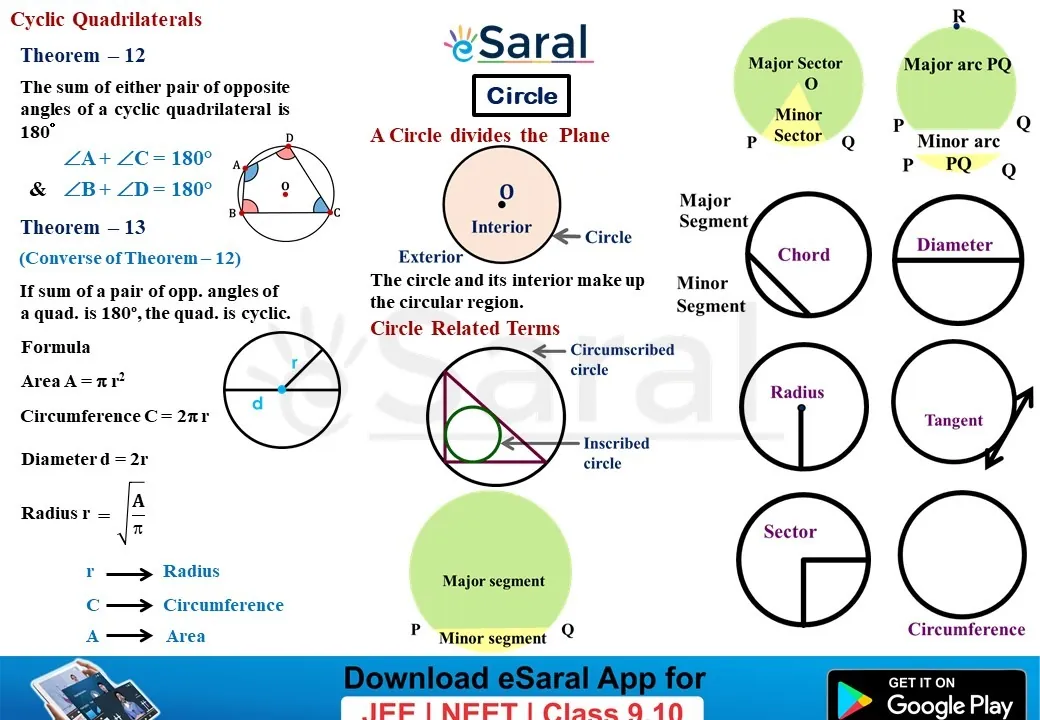
Get to learn all the formulae and important points of Circle through this Mind Map. Download and share with your friends also.
India's Best Exam Preparation for Class 9th - Download Now
Revise Complete Mathematics for Class 9.
India's Best Exam Preparation for Class 9th - Download Now
Frequently Asked Questions
Find answers to common questions.
How many theorems are there in Circle Class 9 Chapter 9?
There are 9 theorems in NCERT Class 9 Maths Chapter 9 on Circles. They cover equal chords and distances from the centre, angles subtended by arcs (including the rule that a central angle is twice the inscribed angle), the angle in a semicircle being 90°, and properties of cyclic quadrilaterals where opposite angles sum to 180°.
What is the most important theorem in Circle Class 9 for exams?
Theorem 4 — "The angle subtended by an arc at the centre is double the angle subtended by it at any point on the remaining circle" — is the most frequently tested. It directly leads to Theorem 5 (equal angles in same segment) and Theorem 6 (angle in semicircle = 90°), so mastering Theorem 4 unlocks three theorems at once.
What is a cyclic quadrilateral and what is its key property?
A cyclic quadrilateral is a four-sided polygon whose all four vertices lie on a circle. Its key property is that opposite angles are supplementary, meaning each pair of opposite angles adds up to 180°. For example, in cyclic quadrilateral ABCD: ∠A + ∠C = 180° and ∠B + ∠D = 180°. This property is directly tested in 3-mark and 5-mark CBSE problems.
Is the angle in a semicircle always 90°?
Yes. The angle inscribed in a semicircle is always 90°. This is Theorem 6 in Class 9 Chapter 9. It follows from Theorem 4: since the arc is a semicircle, the central angle is 180°, and the inscribed angle is half of that — exactly 90°. This result holds for any point on the circle (other than the endpoints of the diameter).
What is the difference between a minor arc and a major arc?
A minor arc is the shorter arc connecting two points on a circle, while the major arc is the longer arc. If the two points divide the circle into equal halves, both arcs are called semicircles. The minor arc is associated with the minor segment (smaller region), and the major arc with the major segment (larger region).