Gravitation - JEE Main Previous Year Questions with Solutions


Home > JEE Main Previous Year Questions > Gravitation JEE Main PYQs with Solutions

JEE Main Previous Year Question of Physics with Solutions are available here. Practicing JEE Main Previous Year Papers Questions of Physics will help all the JEE aspirants in realizing the question pattern as well as help in analyzing their weak & strong areas. Get detailed Class 11th &12th Physics Notes to prepare for Boards as well as competitive exams like IIT JEE, NEET etc. eSaral helps the students in clearing and understanding each topic in a better way. eSaral is providing complete chapter-wise notes of Class 11th and 12th both for all subjects. Besides this, eSaral also offers NCERT Solutions, Previous year questions for JEE Main and Advance, Practice questions, Test Series for JEE Main, JEE Advanced and NEET, Important questions of Physics, Chemistry, Math, and Biology and many more. Download eSaral app for free study material and video tutorials. Simulator Previous Years AIEEE/JEE Mains Questions 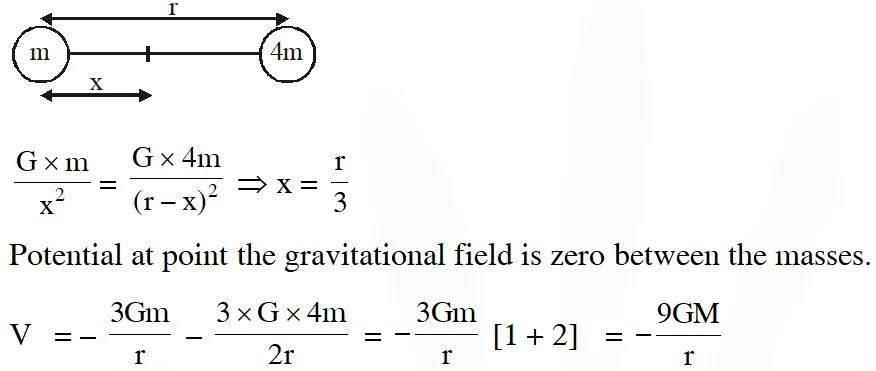
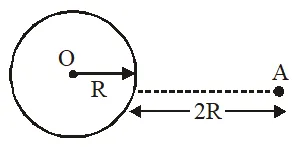 From force balance at A, $\frac{\mathrm{GMm}}{(3 \mathrm{R})^{2}}=\frac{\mathrm{mv}^{2}}{3 \mathrm{R}} \Rightarrow \mathrm{V}^{2}=\frac{\mathrm{GM}}{3 \mathrm{R}}$ ...........(ii) from (i) & (ii) $\mathrm{KE}_{\text {suface }}=\frac{5}{6} \frac{\mathrm{GMm}}{\mathrm{R}}$
 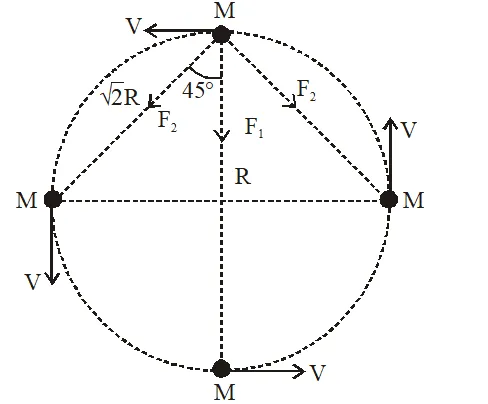 Net force on one particle $\mathrm{F}_{\mathrm{net}}=\mathrm{F}_{1}+2 \mathrm{F}_{2} \cos 45^{\circ}=$ Centripetal force $\Rightarrow \frac{\mathrm{GM}^{2}}{(2 \mathrm{R})^{2}}+\left[\frac{2 \mathrm{GM}^{2}}{(\sqrt{2} \mathrm{R})^{2}} \cos 45^{\circ}\right]=\frac{\mathrm{MV}^{2}}{\mathrm{R}}$ $\mathrm{V}=\frac{1}{2} \sqrt{\frac{\mathrm{GM}}{\mathrm{R}}(1+2 \sqrt{2})}$ $\mathrm{V}=-\frac{\mathrm{GM}}{2 \mathrm{R}^{3}}\left[3 \mathrm{R}^{2}-\frac{\mathrm{R}^{2}}{4}\right]+\frac{3 \mathrm{G}}{2} \frac{\mathrm{M}}{8 \frac{\mathrm{R}}{2}}$ $=\frac{-11 \mathrm{GM}}{8 \mathrm{R}}+\frac{3 \mathrm{GM}}{8 \mathrm{R}}=-\frac{\mathrm{GM}}{\mathrm{R}}$
 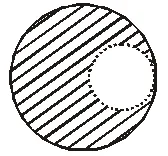 (1) $\frac{-2 \mathrm{GM}}{3 \mathrm{R}}$ (2) $\frac{-2 \mathrm{GM}}{\mathrm{R}}$ (3) $\frac{-\mathrm{GM}}{2 \mathrm{R}}$ (4) $\frac{-\mathrm{GM}}{\mathrm{R}}$ [JEE-Mains 2015]
  [JEE-Mains 2017]
 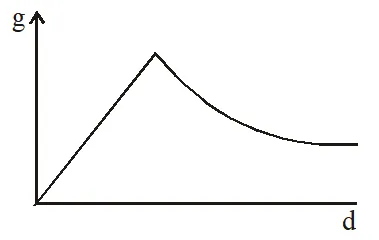 option (2)
Once you finish Gravitation, use the JEE Mains PYQs chapter wise archive to move smoothly into the next topics.
Solved a few Gravitation problems here? The complete JEE Main last year paper has full, year-wise papers so you can see how Gravitation questions actually show up in the real exam.
Frequently Asked Questions
Find answers to common questions.
What is the difference between orbital velocity and escape velocity?
Orbital velocity (v₀ = √(GM/R)) is the speed needed to maintain a circular orbit at radius R. Escape velocity (v_e = √(2GM/R)) is the speed needed to escape the gravitational field entirely from that radius. The escape velocity is always √2 times the orbital velocity at the same radius — a relationship that appears directly in the 2016 JEE Main question above.
Is Gravitation important for JEE Main or only for JEE Advanced?
Gravitation is important for both exams, but the JEE Main questions are more formula-based and direct. JEE Advanced tests deeper conceptual understanding — for example, variable density planets or non-uniform gravitational fields. For JEE Main preparation, mastering the standard PYQ question types shown above is sufficient to score full marks on this chapter.
How many questions come from Gravitation in JEE Main each year?
JEE Main typically includes 1 to 2 questions from Gravitation per paper, worth 4–8 marks. According to NTA's official question distribution, the chapter appears in almost every session. While the marks count is modest, the questions are often straightforward if you know the three core formulas (g variation, gravitational potential, orbital/escape velocity), making it a reliable scoring opportunity.
What is the minimum energy required to launch a satellite to an altitude of 2R from the planet's surface?
The minimum launch energy is 5GMm/6R, where M is the planet's mass, m is the satellite's mass, and R is the planet's radius. This result comes from adding the kinetic energy needed for the circular orbit at 3R (= GMm/6R) to the change in gravitational potential energy from the surface to altitude 2R (= 2GMm/3R). The full derivation appears in the 2013 JEE Main solution above.
Which chapters in Class 11 Physics are most closely linked to Gravitation?
Gravitation connects most directly to Laws of Motion (centripetal force for orbital problems), Work, Energy and Power (launch/escape energy calculations), and Rotational Motion (angular momentum in Kepler's second law). Reviewing these chapters alongside Gravitation will speed up your problem-solving. The NCERT Solutions for Class 11 Physics cover all four chapters with solved examples.
How do I find the gravitational potential at the point where the field is zero between two masses?
First, locate the zero-field point by setting the two gravitational fields equal and solving for distance (the point lies closer to the smaller mass). Then calculate the scalar gravitational potential from each mass at that point separately — potential is a scalar so you simply add them with their negative signs. This method solved the 2011 AIEEE question above