Heat Transfer - JEE Main Previous Year Questions with Solutions
Heat Transfer – JEE Main Previous Year Questions features exam-focused problems on conduction, radiation, Newton’s law of cooling, temperature variation, and heat flow in composite systems, helping students master the most frequently tested concepts in JEE Main Thermal Physics.
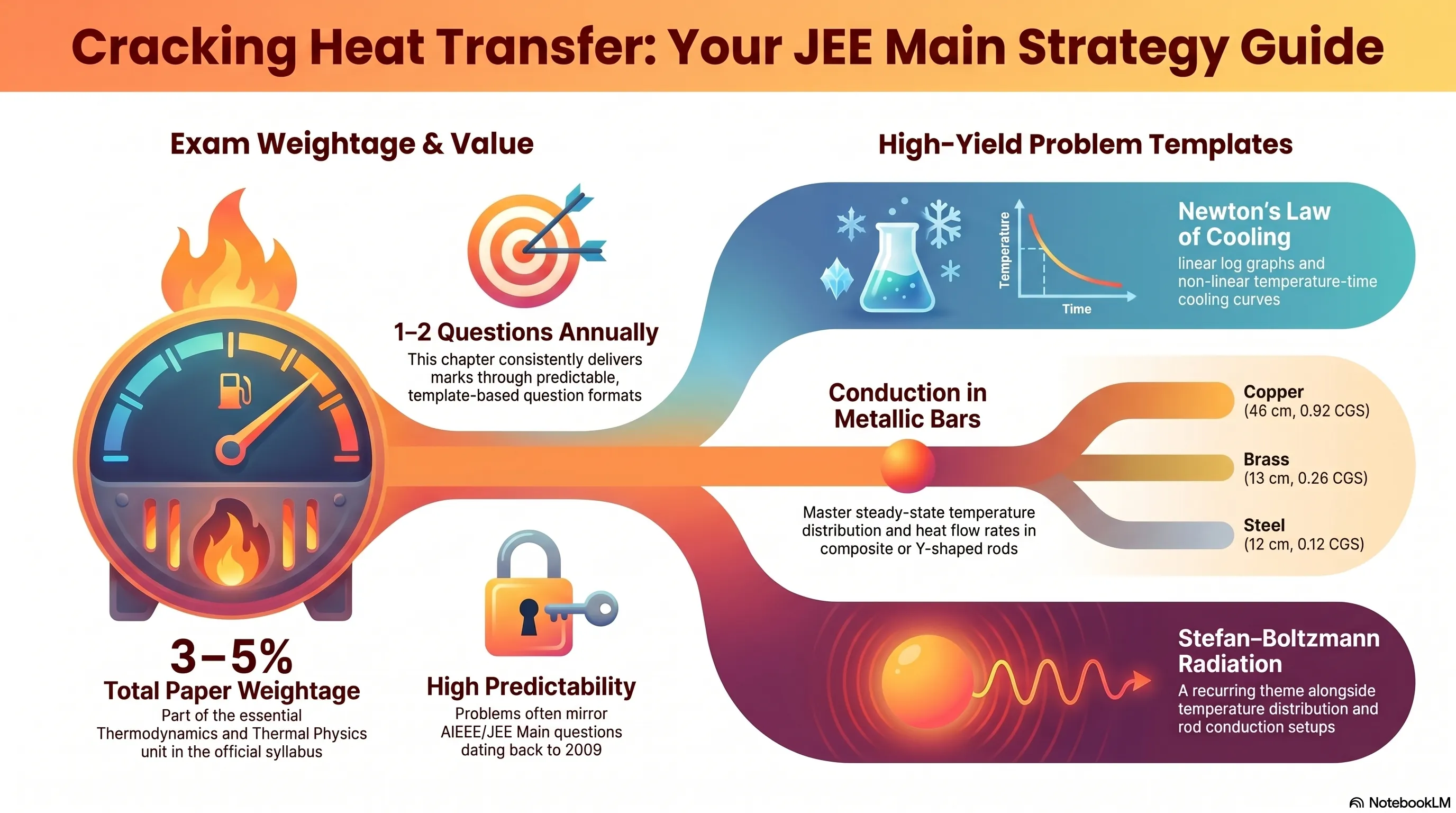
Table of Contents

eSaral › JEE › JEE Main ›Heat Transfer - JEE Main Previous Year Questions with Solutions

🚀 Checkout eSaral Courses
What Is Heat Transfer and Why Does It Matter for JEE Main?
Heat Transfer is a chapter from Class 11 Physics (Chapter 11 — Thermal Properties of Matter) that consistently delivers 1–2 questions in JEE Main every year. According to NTA's official syllabus, the chapter is part of the Thermodynamics and Thermal Physics unit, which carries roughly 3–5% of the total paper weightage.
What makes this chapter valuable for JEE Main preparation is the predictability of its questions. NTA has returned repeatedly to four themes: temperature distribution along conducting rods, Newton's law of cooling graphs, Stefan–Boltzmann radiation problems, and composite-rod (series/parallel) conduction setups. A student who has worked through every previous year question from AIEEE 2009 onwards will recognise the template of almost every new question that appears.
Heat Transfer JEE Main Previous Year Questions & Solutions
Download eSaral app for free study material and video tutorials. Simulator Previous Years AIEEE/JEE Mains Questions  [AIEEE - 2009]
 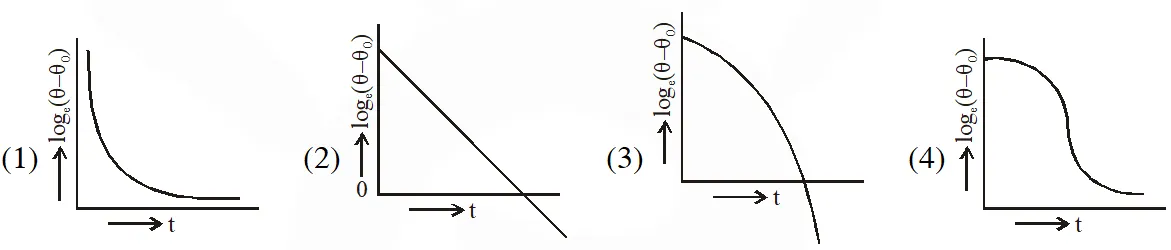 [AIEEE 2012]
  [JEE-Main- 2013]
 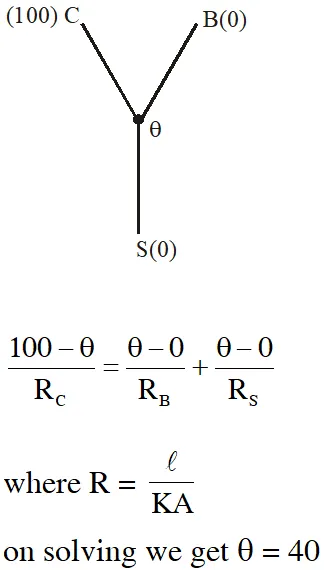 Heat flow per unit time through copper rod $=\frac{(100-40)}{\ell_{\mathrm{c}}}\left(\mathrm{K}_{\mathrm{c}} \mathrm{A}_{\mathrm{c}}\right)$ $=\frac{60}{46} \times 0.92 \times 4$ $=4.8 \mathrm{cal} / \mathrm{s}$
For Heat Transfer and other Physics topics, the JEE Mains PYQ chapter wise page provides chapter-wise questions for focused practice.
For a true exam simulation, pair this Heat Transfer practice with our JEE Main previous year question paper, which has complete papers from past sessions.
Frequently Asked Questions
Find answers to common questions.
How many questions come from Heat Transfer in JEE Main each year?
NTA typically sets 1–2 questions from Heat Transfer in JEE Main. The chapter is part of the broader Thermal Physics unit, which contributes 3–5 questions in total. Based on the pattern from 2009 to 2024, at least one question every year involves either a Newton's law of cooling graph or a conduction rod calculation.
Is Heat Transfer important for JEE Advanced as well?
Yes. JEE Advanced tests Heat Transfer at a deeper level, often combining it with thermodynamic processes. Problems may involve Wien's law, emissivity comparisons, or multi-mode heat transfer. Students aiming for IIT ranks should understand the Stefan–Boltzmann derivation and be able to apply it under time pressure.
What is the formula for Newton's law of cooling and how is it derived?
Newton's law of cooling states dθ/dt = −k(θ − θ₀), where θ is the body's temperature, θ₀ is the surroundings' temperature, and k is a positive constant. It is derived as a limiting case of Stefan's radiation law when the temperature difference is small. Integrating gives ln(θ − θ₀) = −kt + C, so temperature falls exponentially toward θ₀.
How do I solve composite rod problems (series and parallel) quickly?
For rods in series, the total thermal resistance is R_total = R₁ + R₂ + … and heat current (dQ/dt) is the same through all rods. For rods in parallel, the total conductance is the sum of individual conductances (kA/L), and the temperature difference is the same across all rods. Always draw the thermal circuit before writing equations.
Which graph appears most often in JEE Main Heat Transfer questions?
The ln(θ − θ₀) versus time graph from Newton's law of cooling appears most frequently — it has appeared in AIEEE 2012 and in multiple JEE Main sessions since. The second most common is the temperature versus distance graph for a conducting rod under steady state. Both have appeared at least five times between 2009 and 2026.