Government Colleges Accepting JEE Main Score — NITs, IIITs & GFTIs Full List
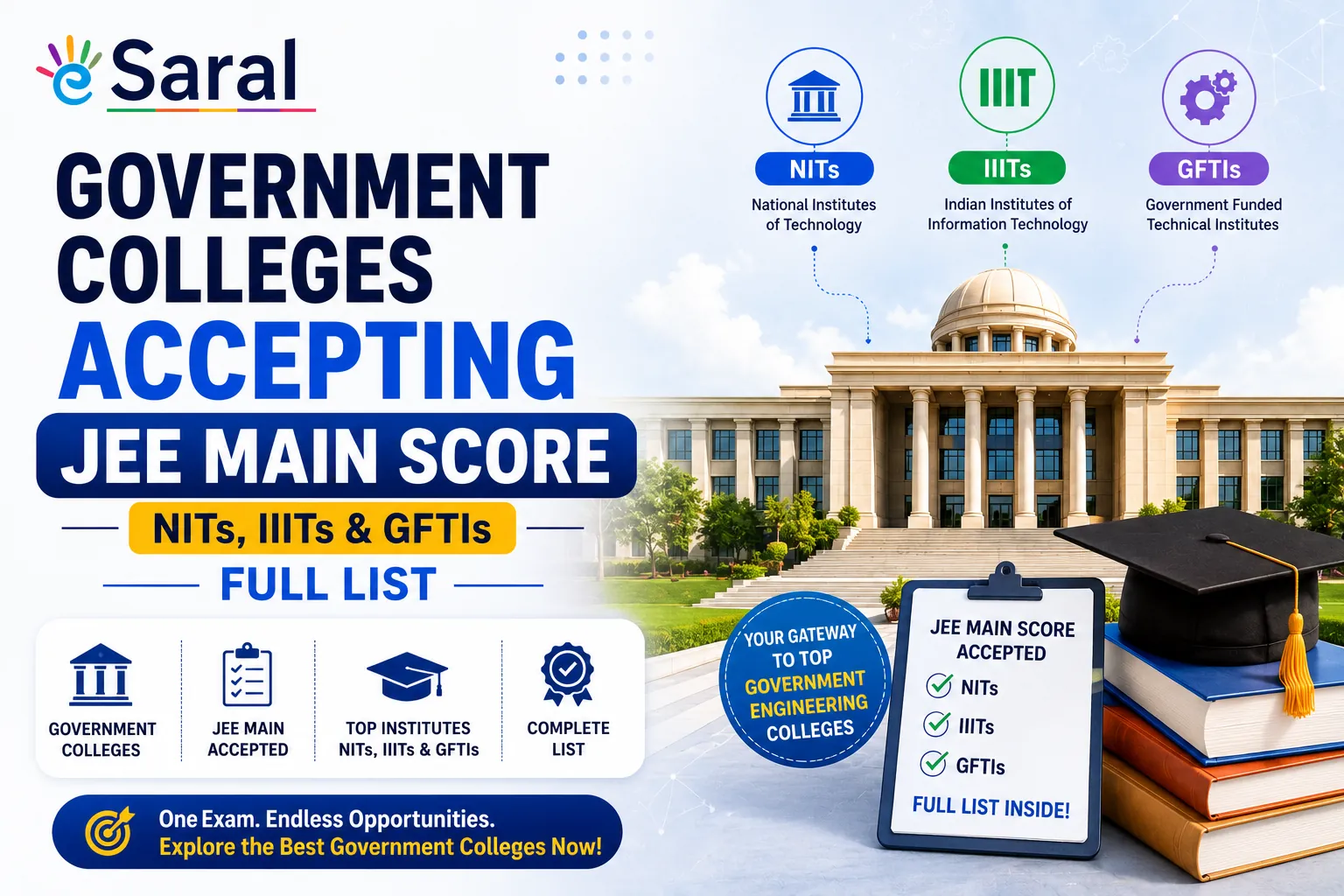
Table of Contents
- What Are the Categories of Government Colleges Accepting JEE Main?
- NITs vs IIITs vs GFTIs — Quick Comparison
- List of Government Funded Technical Institutes (GFTIs)
- List of NITs in India
- List of IIITs in India
- Why Do Students Prefer Government Engineering Colleges?
- What Is the Placement Status of Government Colleges?
- How to Prepare for JEE Main to Secure a Government College Seat

eSaral > JEE > Government Colleges Accepting JEE Main Score
.webp)
India's government engineering colleges — NITs, IIITs, and GFTIs — are among the most sought-after institutions in the country. Every year, over 12 lakh students register for JEE Main (conducted by NTA), and a significant share of them aim specifically for government college seats because of the lower tuition fees, strong academic reputation, and superior placement records.
Unlike IITs, which require JEE Advanced qualification, government colleges accepting JEE Main score are accessible through JoSAA (Joint Seat Allocation Authority) counselling, which uses your JEE Main rank directly. This makes JEE Main the single most important exam for students targeting affordable, high-quality engineering education.
This page gives you the complete, updated list of all NITs, IIITs, and GFTIs accepting JEE Main scores, a side-by-side comparison of each category, placement insights, and a preparation roadmap to help you get there.
What Are the Categories of Government Colleges Accepting JEE Main?
Three Main Categories Under JoSAA Counselling
All government engineering colleges accepting JEE Main scores fall under three broad categories, all of which participate in the centralised JoSAA counselling:
- NITs (National Institutes of Technology) — 31 institutions, centrally funded, among India's most prestigious engineering colleges after IITs.
- IIITs (Indian Institutes of Information Technology) — 28 institutions, specialised in IT and computer science disciplines.
- GFTIs (Government Funded Technical Institutes) — 36 institutions, covering specialised domains like food technology, carpet technology, planning and architecture, and more.
How Does JoSAA Counselling Work?
After JEE Main results are declared by NTA, students register on the official JoSAA portal (josaa.nic.in). Seat allotment is done over multiple rounds based on your All India Rank (AIR), preferred branches, category (General/OBC/SC/ST/EWS), and home-state quota. Students must fill choices carefully, as rank, category, and round all affect the final allotment.
NITs vs IIITs vs GFTIs — Quick Comparison
| Feature | NITs | IIITs | GFTIs |
|---|---|---|---|
| Number of Institutes | 31 | 28 | 36 |
| Funding | Central Government | Central + State (PPP model) | Central/State Government |
| Specialisation | All engineering branches | IT, CS, Electronics | Domain-specific (food tech, architecture, etc.) |
| Approx. Annual Fee | ₹1.25–1.75 lakh | ₹1–2.5 lakh | ₹50K–1.5 lakh |
| Admission Route | JEE Main (JoSAA) | JEE Main (JoSAA) | JEE Main (JoSAA) |
| Placement Tier | High (top NITs in Tier-1) | Moderate–High | Moderate |
| Reservation Policy | As per GoI norms | As per GoI norms | Varies by institute |
List of Government Funded Technical Institutes (GFTIs)
GFTIs are a diverse group of 36 specialised institutions funded by the central or state government. They cover areas from engineering to architecture to food processing technology.
| Institute Name | Location | |
|---|---|---|
| 1 | Assam University | Silchar, Assam |
| 2 | Birla Institute of Technology | Mesra, Jharkhand |
| 3 | Gurukul Kangri Vishwavidyalaya | Jagjeetpur, Haridwar |
| 4 | Indian Institute of Carpet Technology | Bhadohi, Uttar Pradesh |
| 5 | Institute of Infrastructure Technology Research and Management | Ahmedabad, Gujarat |
| 6 | Institute of Technology, Guru Ghasidas Vishwavidyalaya | Bilaspur, Chhattisgarh |
| 7 | J.K. Institute of Applied Physics and Technology | Allahabad, Uttar Pradesh |
| 8 | National Institute of Electronics and Information Technology | Aurangabad, Maharashtra |
| 9 | National Institute of Foundry and Forge Technology | Ranchi, Jharkhand |
| 10 | Sant Longowal Institute of Engineering and Technology | Longowal, Punjab |
| 11 | School of Engineering & Technology, Mizoram University | Aizawl, Mizoram |
| 12 | School of Engineering, Tezpur University | Tezpur, Assam |
| 13 | School of Planning & Architecture | Bhopal, Madhya Pradesh |
| 14 | School of Planning & Architecture | New Delhi |
| 15 | School of Planning & Architecture | Vijayawada, Andhra Pradesh |
| 16 | Shri Mata Vaishno Devi University | Katra, Jammu & Kashmir |
| 17 | Indian Institute of Crop Processing Technology | Thanjavur, Tamil Nadu |
| 18 | School of Engineering & Technology, Bengal Engineering and Science University | Shibpur, West Bengal |
| 19 | University of Hyderabad | Hyderabad, Telangana |
| 20 | North-Eastern Hill University | Shillong, Meghalaya |
| 21 | Institute of Chemical Technology | Mumbai, Maharashtra |
| 22 | Chhattisgarh Swami Vivekananda Technical University (CSVTU) | Bhilai, Chhattisgarh |
| 23 | Indian Institute of Handloom Technology (IIHT) | Varanasi, Uttar Pradesh |
| 24 | North Eastern Regional Institute of Science and Technology | Itanagar, Arunachal Pradesh |
| 25 | Indian Institute of Food Processing Technology | Thanjavur, Tamil Nadu |
| 26 | National Institute of Food Technology Entrepreneurship and Management | Sonepat, Haryana |
| 27 | Central University of Rajasthan | Ajmer, Rajasthan |
| 28 | Ghani Khan Choudhury Institute of Engineering and Technology | Malda, West Bengal |
| 29 | Pondicherry Engineering College | Puducherry |
| 30 | Central Institute of Technology | Kokrajhar, Assam |
| 31 | International Institute of Information Technology | Bhubaneswar, Odisha |
| 32 | Jawaharlal Nehru University | Delhi |
| 33 | Punjab Engineering College | Chandigarh, Punjab |
| 34 | International Institute of Information Technology, Naya Raipur | Raipur, Chhattisgarh |
| 35 | HNB Garhwal University | Srinagar, Uttarakhand |
List of NITs in India
There are 31 NITs established across India. NITs are centrally funded institutions of national importance and are among the top engineering colleges for JEE Main qualifiers.
| Name of NIT | Established | |
|---|---|---|
| 1 | NIT Trichy (NITT) | 1964 |
| 2 | NIT Karnataka (NITK) | 1960 |
| 3 | NIT Rourkela (NITRKL) | 1961 |
| 4 | NIT Warangal (NITW) | 1959 |
| 5 | NIT Calicut (NITC) | 1961 |
| 6 | NIT Nagpur (VNIT) | 1960 |
| 7 | NIT Durgapur (NITDGP) | 1960 |
| 8 | NIT Silchar (NITS) | 1967 |
| 9 | NIT Jaipur (MNIT) | 1963 |
| 10 | NIT Allahabad (MNNIT) | 1961 |
| 11 | NIT Kurukshetra (NITKKR) | 1963 |
| 12 | NIT Jalandhar (NITJ) | 1987 |
| 13 | NIT Surat (SVNIT) | 1961 |
| 14 | NIT Meghalaya (NITM) | 2010 |
| 15 | NIT Patna (NITP) | 1886 |
| 16 | NIT Raipur (NITRR) | 1956 |
| 17 | NIT Srinagar (NITSRI) | 1960 |
| 18 | NIT Bhopal (MANIT) | 1960 |
| 19 | NIT Agartala (NITA) | 1965 |
| 20 | NIT Goa (NITG) | 2010 |
| 21 | NIT Jamshedpur (NITJSR) | 1960 |
| 22 | NIT Manipur (NITMN) | 2010 |
| 23 | NIT Hamirpur (NITH) | 1986 |
| 24 | NIT Uttarakhand (NITUK) | 2010 |
| 25 | NIT Puducherry (NITPY) | 2010 |
| 26 | NIT Arunachal Pradesh (NITAP) | 2010 |
| 27 | NIT Sikkim (NITSKM) | 2010 |
| 28 | NIT Delhi (NITD) | 2010 |
| 29 | NIT Mizoram (NITMZ) | 2010 |
| 30 | NIT Nagaland (NITN) | 2010 |
| 31 | NIT Andhra Pradesh (NITANP) | 2015 |
Which NITs Are the Most Sought-After?
Among the 31 NITs, the top five by placement record, research output, and closing ranks are NIT Trichy, NIT Warangal, NIT Surathkal (Karnataka), NIT Calicut, and VNIT Nagpur. These institutes consistently receive candidates in the top 10,000–20,000 AIR range for core engineering branches.
List of IIITs in India
IIITs are specialised in information technology, computer science, and electronics. They follow a Public-Private Partnership (PPP) model in most cases, with the central government, state government, and industry each contributing to funding.
| # | Name of Institute | Established |
|---|---|---|
| 1 | IIIT Hyderabad | 1998 |
| 2 | ABV IIIT Gwalior | 1997 |
| 3 | IIIT Bangalore | 1998 |
| 4 | IIIT Allahabad | 1999 |
| 5 | IIITDM Kanchipuram | 2007 |
| 6 | IIIT Bhubaneswar | 2006 |
| 7 | IIIT Guwahati | 2013 |
| 8 | IIIT Kota | 2013 |
| 9 | IIIT Sri City | 2013 |
| 10 | IIIT Vadodara | 2013 |
| 11 | IIIT Tiruchirapalli | 2013 |
| 12 | IIIT Kalyani | 2014 |
| 13 | IIIT Una | 2014 |
| 14 | IIIT Sonepat | 2014 |
| 15 | IIIT Lucknow | 2015 |
| 16 | IIIT Dharwad | 2015 |
| 17 | IIIT Kottayam | 2015 |
| 18 | IIIT Manipur | 2015 |
| 19 | IIITDM Kurnool | 2015 |
| 20 | IIIT Karnataka | 2015 |
| 21 | IIIT Ranchi | 2016 |
| 22 | IIIT Nagpur | 2016 |
| 23 | IIIT Pune | 2016 |
| 24 | IIIT Bhagalpur | 2017 |
| 25 | IIIT Bhopal | 2017 |
| 26 | IIIT Surat | 2017 |
| 27 | PDSM IIITDM Jabalpur | 2017 |
| 28 | IIIT Agartala | 2018 |
Why Do Students Prefer Government Engineering Colleges?
Lower Fee Structure Compared to Private Colleges
Annual tuition fees at NITs typically range between ₹1.25 lakh and ₹1.75 lakh, which is a fraction of what private engineering colleges charge for equivalent or lesser-quality programmes. Many government colleges also offer merit-based and need-based scholarships, making high-quality engineering education genuinely accessible across income groups.
Stronger Academic Infrastructure and Faculty
Government colleges — especially NITs and IIITs — follow AICTE-approved, industry-aligned curricula and regularly update their labs and computing facilities. Faculty at top NITs hold PhDs from IITs, IISc, and foreign universities. The academic rigour matches what students at IITs experience, at a significantly lower cost.
Research Opportunities and Industry Collaboration
Most NITs have dedicated research centres and tie-ups with industry partners like ISRO, DRDO, and major IT firms. Students can participate in live projects, internships, and sponsored research from their second year itself — an experience that adds real weight to a résumé.
Social Diversity and Peer Quality
Government colleges draw students from every state and economic background. The peer group quality — particularly at top NITs — is high, because every student has cleared a competitive national exam. This creates a strong learning environment and a wide alumni network.
What Is the Placement Status of Government Colleges?
Public Sector and Government Recruitment
Government colleges have a natural pipeline into public sector undertakings (PSUs) like BHEL, ONGC, NTPC, and GAIL, which recruit directly from NIT campuses through GATE scores and campus placement drives. Civil services preparation is also common among government college graduates, given the exam-focused culture.
Private Sector and IT Placements
Top NITs (Trichy, Warangal, Surathkal, Calicut) consistently report placement rates above 85–90% for eligible students, with median packages ranging from ₹8–14 LPA and top offers from companies like Google, Microsoft, Amazon, and Goldman Sachs. IIITs, especially IIIT Hyderabad and ABV IIIT Gwalior, also report strong IT sector placements given their CS-focused curriculum.
How Alumni Networks Strengthen Placement Outcomes
Established NITs like NIT Trichy (founded 1964) and NIT Warangal (founded 1959) have alumni networks spanning six decades, with former students now in senior positions at MNCs, startups, and academia. These networks directly feed internship and placement referrals back to current students.
How to Prepare for JEE Main to Secure a Government College Seat
Clearing JEE Main at a rank good enough for an NIT or IIIT requires consistent, structured preparation across Physics, Chemistry, and Mathematics. Your Class 11 and 12 NCERT foundation is the starting point — the JEE Main paper directly tests concepts from the NCERT syllabus, especially in Chemistry.
Strong NCERT preparation matters: students who thoroughly study NCERT Class 11 Physics and NCERT Class 12 Physics find that nearly 35–40% of JEE Main Physics questions are directly concept-based from those chapters. Similarly, NCERT Class 11 Maths and NCERT Class 12 Maths cover the core calculus, algebra, and coordinate geometry topics that form the backbone of JEE Main Mathematics.
eSaral's faculty — including IIT Bombay graduate with AIR-41 — teach JEE Main preparation at Kota-quality depth, fully online. The platform's 5-layer doubt-solving system means no question goes unanswered, a common problem with self-study. In recent batches, eSaral students have secured seats in top NITs and IITs with structured 12-month and dropper programmes. You can also access NCERT Books for Class 11 and Class 12 directly on eSaral to build your foundation before moving to advanced JEE material.
Frequently Asked Questions
Find answers to common questions.
Is JEE Main score enough for NIT admission, or is JEE Advanced also needed?
JEE Main score alone is sufficient for admission to NITs, IIITs, and GFTIs. JEE Advanced is only required for IIT admission. Students who clear JEE Main and register for JoSAA counselling are eligible for all NIT, IIIT, and GFTI seats without taking JEE Advanced.
What rank is required to get into an NIT through JEE Main?
For top NITs like NIT Trichy or NIT Warangal, CSE branches typically close around AIR 8,000–15,000 for the General category. For newer or regional NITs, seats are available up to AIR 50,000–80,000 depending on the branch and category. Home-state quota also significantly affects closing ranks.
How many government colleges accept JEE Main score in India?
Over 95 government-funded institutions accept JEE Main score, including 31 NITs, 28 IIITs, and 36 GFTIs. All of these are covered under the JoSAA centralised counselling process managed by NTA. The exact number may vary slightly year to year as new institutions are added.
Which government college is best for Computer Science through JEE Main?
IIIT Hyderabad and ABV IIIT Gwalior are top choices for CS specifically, with strong research output and excellent IT placements. Among NITs, NIT Trichy, NIT Warangal, and VNIT Nagpur have the most competitive CSE closing ranks, reflecting their placement strength. The best choice depends on your specific rank and category.
Are GFTIs good colleges? What are their fees?
GFTIs are government-funded institutes that offer domain-specific programmes — for example, architecture, food technology, carpet technology. They are good options for students with mid-range JEE Main ranks (typically AIR 50,000+). Annual fees at most GFTIs range from ₹50,000 to ₹1.5 lakh, making them among the most affordable engineering options.
What is JoSAA counselling and how does it work?
JoSAA (Joint Seat Allocation Authority) is the official body that allocates seats in IITs, NITs, IIITs, and GFTIs after JEE results. Students register on josaa.nic.in, fill college and branch choices in order of preference, and seats are allotted over 5–6 rounds based on AIR, category, and choice order. Missing a JoSAA round results in losing your chance for that round's allotment.
Can students from any state apply to all NITs through JEE Main?
Yes. All Indian citizens who qualify JEE Main can apply to any NIT across India. However, 50% of NIT seats are reserved under the Home State Quota (HSQ), meaning students from the state where the NIT is located get a separate seat pool with different (usually more accessible) closing ranks