JEE Main 2026 Maths Syllabus - PDF Download

Table of Contents

eSaral › JEE › JEE Main ›JEE Main 2026 Maths Syllabus

JEE Main Mathematics Syllabus 2026
Unit-wise syllabus of mathematics of JEE Main is given in the table below
|
Unit no. |
Topic’s Name |
|
|
Sets, Relations, and Functions |
|
|
Complex Numbers and Quadratic Equations |
|
|
Matrices and determinants |
|
|
Permutations and combinations |
|
|
Mathematical induction |
|
|
Binomial theorem and its simple applications |
|
|
Sequences and series |
|
|
Limit, continuity, and differentiability |
|
|
Integral calculus |
|
|
Differential calculus |
|
|
Coordinate geometry |
|
|
Three-dimensional geometry |
|
|
Vector algebra |
|
|
Statistics probability |
|
|
Trigonometry |
|
|
Mathematical reasoning |
JEE Main Mathematics Syllabus Topics
Candidates applying for the Joint Eligibility-cum-Entrance Examination (JEE) may also consult the comprehensive list of the above-mentioned concepts.
Unit 1: Sets, Relations, and Functions
-
Sets and representation of sets
-
Union, intersection, and complement of sets and their algebraic properties.
-
Powerset
-
Relation, types of relations, equivalence relations.
-
Functions: one-to-one, into and onto functions, and the compositions of functions.
Unit 2: Complex Numbers and Quadratic Equations
-
Complex numbers as ordered pair of reals.
-
Representation of complex numbers in the form (a+ib) and their representation in a plane, ana Argand diagram.
-
Algebra of complex numbers, modulus and argument ( or amplitude) of a complex number, square root of a complex number.
-
Triangle inequality
-
Quadratic equations in the real and complex number systems and their solutions.
-
The relation between roots and coefficients, the nature of roots, and the formation of quadratic equations with given roots.
Unit 3: Matrices and Determinants
-
Matrix algebra of matrices, types of matrices, and matrices of order two and three.
-
Determinants: properties of determinants, evaluation of determinants, and area of triangles using determinants.
-
Adjoints and evaluations of the inverse of a square matrix using determinants and elementary transformations.
-
Test of consistency and solution of simultaneous linear equations in two or three variables using determinants and matrices.
Unit: Permutations and Combinations
-
The fundamental principle of counting.
-
Permutation is an arrangement, and a combination is a selection.
-
The meaning of P(n,r) and C(n,r), simple applications.
Unit 5: Mathematical Induction
-
The principle of mathematical induction and its simple applications.
Unit 6 Binomial Theorem and itItsimple Applications
-
Binomial theorem for a positive integral index.
-
General term and middle term.
-
Properties of binomial coefficients and simple applications.
Unit 7: Sequence and Series
-
Arithmetic and geometric progressions, insertion of arithmetic and geometric means between two given numbers.
-
The relation between the arithmetic mean and the geometric mean, summed up in terms of the special series: Sn, Sn2, etc.
Unit 8: Limit, Continuity, and Differentiability
-
Real-valued functions, algebra of functions, polynomials, rational, trigonometric, and exponential functions, inverse functions.
-
Graph of simple functions.
-
Limits, continuity, and differentiability.
-
Differentiation of the um, difference, product, and quotient of two functions.
-
Differentiation of trigonometric, inverse trigonometric, logarithmic, exponential, composite, and implicit functions; derivatives of order up to two.
-
Rolle’s and Lagrange's mean value theorems.
-
Applications of derivatives: rate of change of quantities, monotonic increasing and decreasing functions, maxima and minima of a function of one variable, tangents and normals.
Unit: Integral Calculus
-
Integral as an antiderivative.
-
Fundamental integrals involving algebraic, trigonometric, exponential, and logarithmic functions.
-
Integration by substitution, by parts, and by partial functions.
-
Integration using trigonometric identities.
-
Integral as the limit of a sum.
-
Fundamental theorem of calculus.
-
Properties of definite integrals, evaluation of definite integrals, and determining areas of the regions bounded by simple curves in standard form.
Unit 10: Differential Calculus
-
Ordinary differential equations, their order and degree.
-
Formation of differential equations.
-
The solution of differential equations by the method of separation of variables.
-
The solutionof aa homogeneouanddd linear differential equation
Unit 11: Coordinate Geometry
-
Cartesian system of rectangular coordinates in a plane, distance formula, section formula, locus and its equation, translation of axes, the slope of a line, parallel and perpendicular lines, intercepts of a line on the coordinate axes.
-
Straight lines: various forms of equations of a line, intersection of lines, angles between two lines, condition for the concurrence of three lines.
-
Distance of a point from a line, equation of internal and external bisectors of angles between two lines, coordinates of centroid, orthocentre, and circumcentre of a triangle, equation of the family of lines passing through the point of intersection of two lines.
-
Circles, conic sections: standard form of the equation of a circle, the general form of the equation of a circle, its radius and centre, equation of a circle when the endpoints of a diameter are given, points of a line and a circle with the centre at the origin, and condition for a line to be tangent to a circle, equation of the tangent.
-
Sections of conics, equations of conic sections (parabola, ellipse, and hyperbola) in standard forms, conditions for y = mx + c to be a tangent, and points of tangency.
Unit 12 Three-Dimensional Geometry
-
Coordinates of a point in space, the distance between two points.
-
Section formula, direction ratios, direction cosines, and the angle between two intersecting lines.
-
Skew lines, the shortest distance between them, and their equation.
-
Equations of a line and a plane in different forms, the intersection of a line and a plane, and coplanar lines.
Unit 13: Vector Algebra
-
Vectors and scalars, the addition of vectors, and components of a vector in two and three-dimensional space.
-
Scalar products, vector products, and vector triple product.
Unit 14: Statistics and Probability
-
Measures of dispersion: calculation of mean, median, mode of grouped and ungrouped data, calculation of standard deviation, variance, and mean deviation for grouped and ungrouped data.
-
Probability: probability of an event, addition and multiplication theorem of probability, Bayes’theorem, probability distribution of a random variable, Bernoulli trials, and binomial distribution.
Unit 15: Trigonometry
-
Trigonometric identities and equations.
-
Trigonometric functions, inverse trigonometric functions, and their properties.
-
Height and distance
Unit 16: Mathematical Reasoning
-
Statements and logical operations: or, and, implies, implied by, if and only if, understanding of tautology, contradiction, converse, and contrapositive.
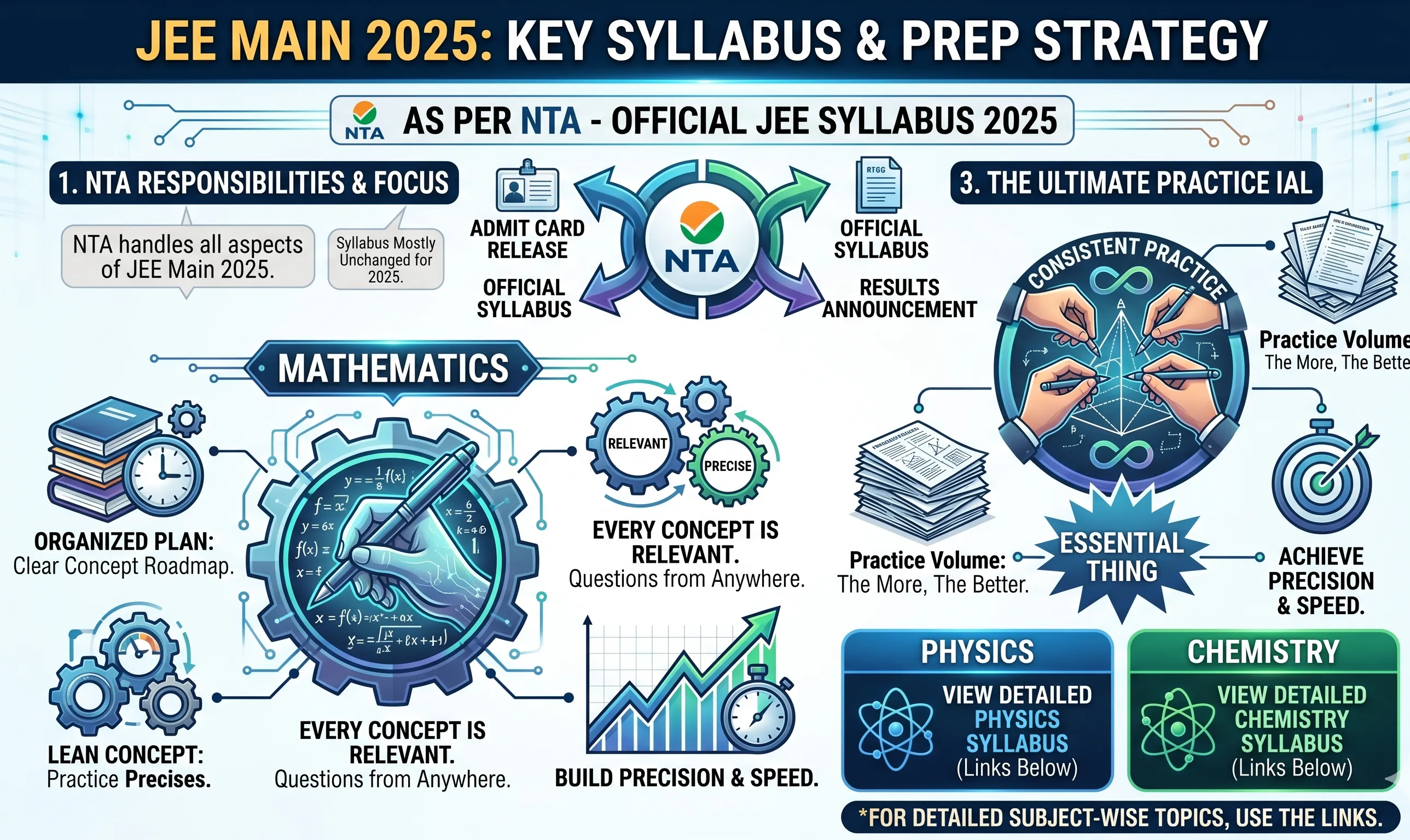
JEE Mains 2023 weightage for Mathematics (Topic-wise)
Table of JEE Mains 2023 weightage for Mathematics (Topic-wise) given below
|
Topic’s name |
Number of questions |
marks |
|
Sets, Relations, and Functions |
1 |
4 |
|
Complex Numbers and Quadratic Equations |
2 |
8 |
|
Matrices and determinants |
2 |
8 |
|
Permutations and combinations |
1 |
4 |
|
Mathematical induction |
1 |
4 |
|
Binomial theorem and its simple applications |
1 |
4 |
|
Sequences and series |
1 |
4 |
|
Limits, continuity, and differentiability |
3 |
12 |
|
Integral calculus |
3 |
12 |
|
Differential calculus |
1 |
4 |
|
Coordinate geometry |
5 |
20Three-dimensional |
|
l geometry |
2 |
8 |
|
Vector algebra |
2 |
8 |
|
Statistics and probability |
2 |
8 |
|
Mathematical reasoning |
1 |
4 |
Best Books to Completely Cover JEE Main Maths Syllabus
Every JEE Main aspirant during JEE Main preparation often comes across the question,“ Which is the best book for JEE Main mathematics?” Since the mathematics paper is quite lengthy and includes comprehensive problems hence considered the toughest of all subjects. JEEmain mathematics preparation requires a lot of practice with relevant questions and a deep understanding of concepts. Aspirants can refer to the best books for JEE Main Mathematics to get a deep knowledge of the subject.
Table of Best Books of JEE Main Mathematics given below:
|
S.No. |
Name of the Book |
Author |
|---|---|---|
|
1 |
Objective mathematics |
R D Sharma |
|
2 |
Plane trigonometry |
S L Loney |
|
3 |
The elements of coordinate geometry |
S L Loney |
|
4 |
Play with graphs |
Amit M Agarwal |
|
5 |
Differential calculus |
Amit M Agarwal |
Practice these high-priority chapters using chapter-wise JEE Main previous year question papers with solutions available on eSaral.
JEE Main PYQs & Notes
Chapter-wise questions with solutions. Free to access.
Chapter-wise PYQs → Free Notes Revision Notes
Frequently Asked Questions
Find answers to common questions.
Why is covering the complete JEE Main Maths syllabus beneficial?
There are several Benefits of covering the whole JEE syllabus 2026 PDF download. The JEE Main Maths syllabus is mentioned below.
Complexity: The Maths syllabus in JEE Main is designed to provide you with a comprehensive knowledge of different mathematical principles and topics. This will help you to build a solid foundation in mathematics.
Conceptually, every topic in the syllabus is related to others. By studying the whole syllabus, students will have a clear comprehension of the fundamental concepts and their application. This will help them to approach problems with more clarity and improve their chances of successfully solving them.
Scoring Power: JEE Main is a highly competitive exam. Therefore, it is important to cover the whole syllabus to maximise the scoring potential. Although some topics may seem less important or have fewer questions in the past, the exam pattern may change, and any given topic can be thoroughly tested in any year.
Scoring Potential: JEE Main is a highly competitive exam, and every mark matters. By covering the whole syllabus, you can maximise your score. Although a particular topic may seem less important or may have fewer questions in the past, it is important to note that the exam pattern may change and any topic may be tested thoroughly in any given year, so it is essential to cover the entire syllabus to maximise your score.
Confidence Management: Having covered the whole syllabus of JEE Mains 2026 Maths gives you a good foundation, a broader perspective, and the skills you need to face any challenge during the exam. Having covered the full syllabus gives you confidence and time management. You are better prepared to face any question as you have practised various problems across various topics. Comprehensive preparation also helps you in managing your time well during the exam, as you can easily identify the type of questions and the correct approach to solve them.
All in all, covering the entire syllabus of the JEE Main Maths provides you with a good foundation, a wider perspective, and skills that will help you in facing any challenge while taking the exam.
How should I prepare for Maths for JEE Main 2026?
First, you need to understand the basic concepts of each topic under JEE Main Mathematics. Then, you need to practice solving a variety of problems from various sources, including textbooks, JEE Main papers from previous years, and online sources. Finally, you need to use study materials, video tutorials, and other resources specially designed for the preparation of JEE Main. Mock tests, sample papers, etc., will help you to evaluate your progress and enhance your time management.
How many questions are asked from Mathematics in JEE Main?
A total of 30 questions are asked in the Mathematics section, out of which 25 need to be attempted, carrying a total of 100 marks.
How important are previous year questions (PYQs) for Maths?
PYQs are extremely important as they help understand the exam pattern, repeated concepts, and difficulty level of questions.
Which books are best for JEE Main Mathematics preparation?
Some recommended books include Objective Mathematics by R.D. Sharma, Amit M Agarwal series, and S.L. Loney for Trigonometry and Coordinate Geometry.
How much time should be dedicated daily to Mathematics?
Students should ideally dedicate 2–4 hours daily to Mathematics, focusing on concept clarity, problem-solving, and revision.