Kinematics 1D- JEE Advanced Previous Year Questions with Solutions


eSaral > JEE Advanced Physics PYQs > Kinematics 1D

JEE Advanced Previous Year Questions of Physics with Solutions are available at eSaral. Practicing JEE Advanced Previous Year Papers Questions of Physics will help the JEE aspirants in realizing the question pattern as well as help in analyzing weak & strong areas. Get detailed Class 11th & 12th Physics Notes to prepare for Boards as well as competitive exams like IIT JEE, NEET etc. eSaral helps the students in clearing and understanding each topic in a better way. eSaral is providing complete chapter-wise notes of Class 11th and 12th for all subjects. Click Here for JEE Main Previous Year Topic Wise Questions of Physics with Solutions Download the eSaral app for free study material and video tutorials. Simulator Previous Years JEE Advanced Questions
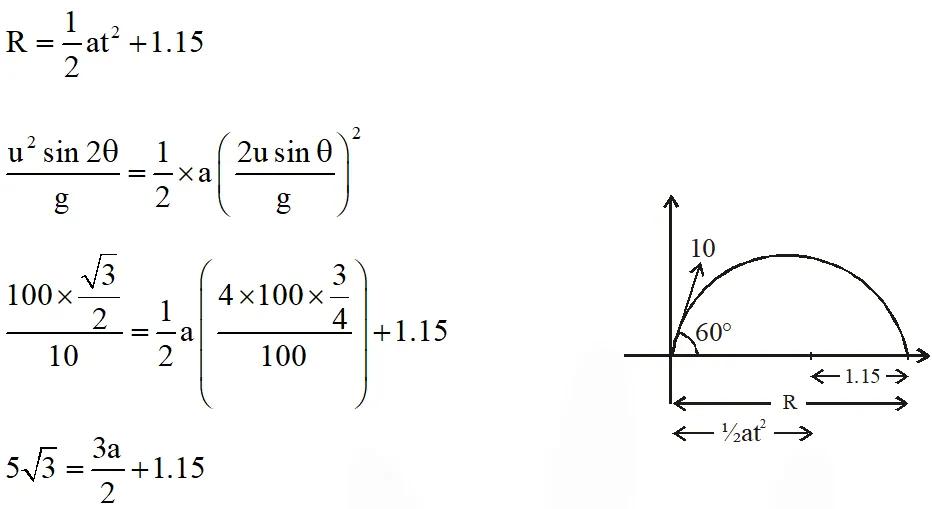
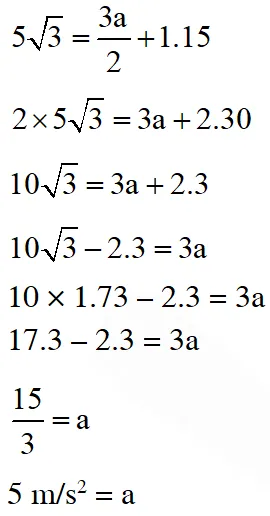
 [JEE Advanced 2014]
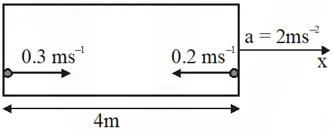
 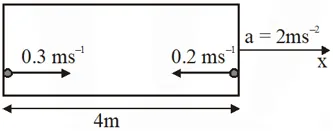 $\mathrm{V}_{\text {relative }}=0.5 \mathrm{m} / \mathrm{s}$ $\mathrm{S}_{\text {relative }}=4 \mathrm{m}$ time $=\frac{4}{0.5}=8 \mathrm{m} / \mathrm{s}$ Alternate Assuming closed chamber In the frame of chamber :
 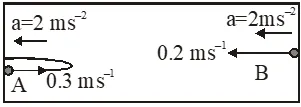 Maximum displacement of ball A from its left end is $\frac{\mathrm{u}_{\mathrm{A}}^{2}}{2 \mathrm{a}}=\frac{(0.3)^{2}}{2(2)}=0.0225 \mathrm{m}$ This is negligible with respect to the length of chamber i.e. 4m. So, the collision will be verym close to the left end. Hence, time taken by ball B to reach left end will be given by $\mathrm{S}=\mathrm{u}_{\mathrm{B}} \mathrm{t}+\frac{1}{2} \mathrm{at}^{2}$ $4=(0.2)(\mathrm{t})+\frac{1}{2}(2)(\mathrm{t})^{2}$ Solving this, we get $\mathrm{t} \approx 2 \mathrm{s}$
  [JEE Advanced-2014]
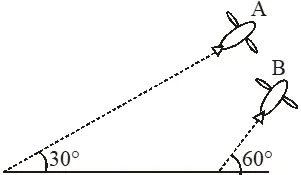
 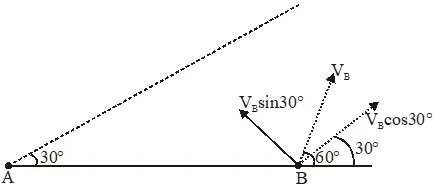 As observed from A, B moves perpendicular to line of motion of A. It means velocity of B along A is equal to velocity of A $\mathrm{V}_{\mathrm{B}} \cos 30=100 \sqrt{3}$ $\mathrm{V}_{\mathrm{B}}=200$ If A is observer A remains stationary therefore $\mathrm{t}=\frac{500}{\mathrm{V}_{\mathrm{B}} \sin 30}=\frac{500}{100}=5$
 Once you have worked through these JEE Advanced questions, Irodov Selected Questions for JEE Advanced can be a useful resource for encountering more challenging problems and exploring different approaches to Physics.
After working through Kinematics (1D) - JEE Advanced PYQs (Physics), test your timing with real papers from the JEE Advanced exam paper archive.
Frequently Asked Questions
Find answers to common questions.
What is the weightage of Kinematics in the JEE Advanced syllabus?
According to the official JEE Advanced syllabus (Joint Admission Board), Kinematics falls under General Physics / Mechanics. While no fixed percentage weightage is announced, Mechanics as a whole contributes roughly 30–35% of Physics marks across both papers. Kinematics, including both 1D and 2D, is a foundation topic for all of Mechanics.
Is Kinematics 1D harder in JEE Advanced than JEE Main?
Yes, significantly harder. JEE Main tests direct formula application with clean numbers. JEE Advanced always adds a layer — a non-inertial frame, a calculus-based relationship, or a constraint that links two objects' motions. The same concepts are tested but at a fundamentally deeper problem-solving level.
How many questions from Kinematics 1D appear in JEE Advanced each year?
Kinematics 1D typically contributes 1–2 questions per year in JEE Advanced. It is not always a standalone question — sometimes kinematics concepts appear embedded inside mechanics problems involving Newton's Laws or Work-Energy. Over the last 10 years, it has appeared as a direct question in approximately 6 out of 10 papers.
Where can I find more JEE Advanced Physics previous year questions?
eSaral provides chapter-wise and topic-wise JEE Advanced previous year questions across all Physics topics on its website and app. You can also supplement with NCERT Solutions for Class 11 Physics and Class 12 Physics for concept-level practice before attempting advanced questions.
Can I skip Kinematics 1D and focus on other Physics topics for JEE Advanced?
Skipping Kinematics 1D is a high-risk strategy. It is a prerequisite concept for Projectile Motion, Circular Motion, Newton's Laws, and even Rotational Dynamics. Weak kinematics fundamentals will create compounding errors in every mechanics topic that follows. 30–60 minutes of focused daily practice for 2 weeks is enough to master it.
Which formulas are most important for Kinematics 1D in JEE Advanced?
The three equations of motion (v = u+at, s = ut+½at², v² = u²+2as) are starting points, but JEE Advanced demands more. The most critical tools are: relative velocity formula (V_AB = V_A – V_B), the pseudo-force equation in non-inertial frames (F_pseudo = –ma_frame), and the calculus definitions (v = dx/dt, a = dv/dt). Practice deriving results rather than memorising them.