Kinematics 1D- JEE Main Previous Year Questions with Solutions


eSaral > JEE Main Physics PYQs > Kinematics 1D

JEE Main Previous Year Question of Physics with Solutions is available here. Practicing JEE Main Previous Year Papers Questions of Physics will help all the JEE aspirants in realizing the question pattern, as well as help in analyzing their weak & strong areas.
Get detailed Class 11th &12th Physics Notes to prepare for Boards as well as competitive exams like IIT JEE, NEET, etc.
eSaral helps the students in clearing and understanding each topic in a better way. eSaral is providing complete chapter-wise notes of Class 11th and 12th for all subjects.
Besides this, eSaral also offers NCERT Solutions, Previous year questions for JEE Main and Advanced, Practice questions, Test Series for JEE Main, JEE Advanced and NEET, Important questions of Physics, Chemistry, Math, and Biology, and many more.
Download the eSaral app for free study material and video tutorials.
Simulator Previous Years AIEEE/JEE Mains Questions 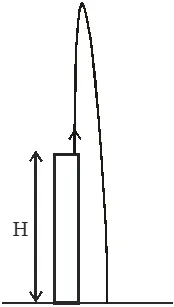 $\Rightarrow 2 \mathrm{gH}=\mathrm{nu}^{2}(\mathrm{n}-2)$
  [JEE Mains - 2017]
 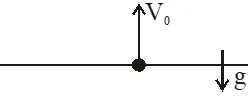 v = u + at v = v0 + (–g)t $\mathrm{v}=\mathrm{v}_{0}-\mathrm{gt}$ $\Rightarrow$ straight line with negative slope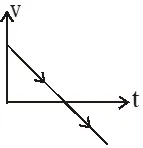
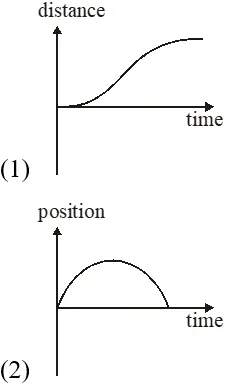
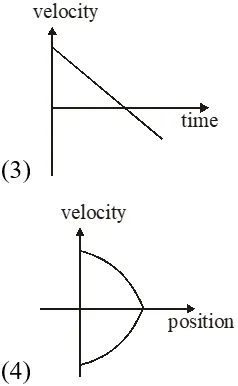 [JEE Mains - 2018]
 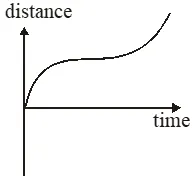 Hence incorrect graph is option (1)
After finishing this chapter, browse the complete JEE Mains PYQ chapter-wise PDF download collection to choose the next topic for revision.
These Kinematics (1D) questions are pulled from real exams — see them in their original paper format on our previous years JEE Main question papers page.
Frequently Asked Questions
Find answers to common questions.
What is the best way to study Kinematics 1D for JEE Main?
Start with NCERT Chapter 3 (Class 11 Physics) to build concept clarity, then solve previous year questions chapter-wise. Focus on sign conventions, graph interpretation, and variable acceleration problems. Use eSaral's NCERT Solutions for Class 11 Physics for concept-aligned explanations, then progress to PYQs and test series.
Is Kinematics 1D important for JEE Advanced as well?
Yes. Kinematics 1D concepts directly underpin JEE Advanced questions on relative motion, projectile motion, and constraint-based problems. While standalone 1D questions are less common in Advanced, the chapter's calculus applications — particularly $a = v\, dv/ds$ — appear frequently in harder mechanics problems. Mastering it at JEE Main level is the right starting point.
How many questions from Kinematics 1D appear in JEE Main each year?
JEE Main typically includes 1 to 2 questions from Kinematics 1D (Motion in a Straight Line) per session. Given that JEE Main is now conducted in multiple sessions annually, you can expect this chapter to appear in most papers. Based on NTA's official question distribution, it carries 4–8 marks and has moderate difficulty.
Where can I find more JEE Main Physics PYQs chapter-wise?
eSaral provides chapter-wise JEE Main and JEE Advanced PYQs across all Physics chapters, with detailed solutions. You can also access NCERT Solutions for Class 12 Physics for higher-level concept revision. The eSaral app additionally offers full mock tests modelled on NTA's official exam pattern.
Can I skip Kinematics 1D if I am short on time?
Skipping it is not advisable. It is one of the shortest chapters in Class 11 Physics and requires less memorisation than most. With 4–6 hours of focused study, you can cover all the concepts needed to solve JEE Main questions from this chapter. The return on time invested is high relative to chapters like Thermodynamics or Modern Physics.
Which topics within Kinematics 1D are asked most often in JEE Main?
The highest-frequency topics are: (1) velocity-time and position-time graph questions, (2) bodies thrown vertically upward from heights (tower problems), and (3) variable acceleration using integration. Equations of motion with constant acceleration appear in easier questions, often as single-step calculations.