Mind Maps for Atomic Structure Revision - Class 12, JEE, NEET
Table of Contents
Home > Class 12 > Atomic Structure Mind Map Class 12

Why Atomic Structure Needs a Mind Map
Atomic Structure is one of the highest-yield chapters in Class 12 Chemistry — and also one of the most formula-dense. According to NTA's official JEE Main information bulletin, Chemistry accounts for 25% of the total paper, and atomic structure questions appear in nearly every session.
The problem most students face is not understanding the concepts — it is connecting them. Bohr's postulates lead to radius and energy formulas. Those connect to spectral lines. Spectral lines connect to quantum numbers. Quantum numbers connect to the electronic configuration. By exam day, this chain of logic must fire in under 90 seconds per question.
A well-structured atomic structure mind map collapses this entire chain onto one visual page. Instead of flipping through 15 notebook pages at 11 PM before your exam, you review one diagram and rebuild the full picture mentally."
What Does This Mind Map Cover?
Core Conceptual Nodes
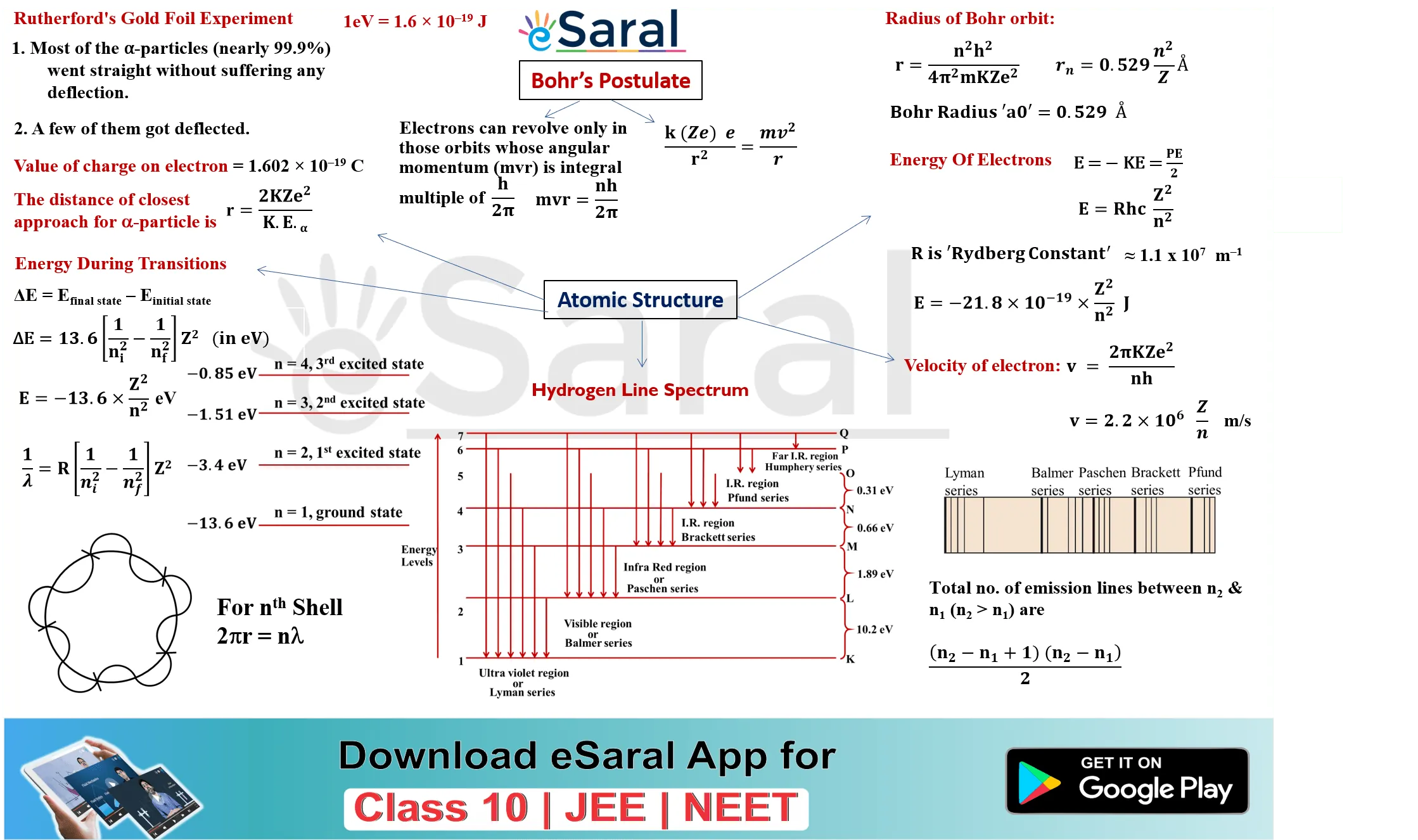
The atomic structure mind map on this page organises the chapter into six primary branches. Each branch corresponds to a cluster of questions that regularly appear in JEE Main and NEET.
- Subatomic Particles — Properties of electrons, protons, and neutrons; Thomson's plum-pudding model; Rutherford's nuclear model and its limitations.
- Bohr's Atomic Model — Postulates, derivation of radius, energy, velocity, and their quantised values for hydrogen-like atoms.
- Dual Nature and de Broglie's Hypothesis — Wave-particle duality, de Broglie wavelength formula, Davisson-Germer experiment.
- Heisenberg's Uncertainty Principle — Statement, mathematical form, and its implications for electron orbit models.
- Quantum Mechanical Model — Schrödinger's wave equation (conceptual), atomic orbitals, shapes of s, p, and d orbitals.
- Electronic Configuration — Aufbau principle, Pauli's exclusion principle, Hund's rule, (n+l) rule, anomalous configurations of Cr and Cu.
What Is NOT on the Mind Map (and Where to Find It)
The mind map focuses on formulas and concept connections. For derivations and solved examples, pair it with the NCERT Solutions for Class 12 Chemistry, which walk through every textbook problem step-by-step.
All Important Atomic Structure Formulas at a Glance
Bohr Model Formulas for Hydrogen-Like Atoms
| Quantity | Formula | Units |
|---|---|---|
| Radius of nth orbit | rₙ = 0.529 × (n²/Z) Å | Ångström |
| Energy of nth orbit | Eₙ = –13.6 × (Z²/n²) eV | eV |
| Velocity in nth orbit | vₙ = 2.18 × 10⁶ × (Z/n) m/s | m/s |
| Frequency of revolution | f = v / 2πr | Hz |
| Number of spectral lines | N = n(n−1)/2 | — |
Quantum Number Summary
| Quantum Number | Symbol | Values | Defines |
|---|---|---|---|
| Principal | n | 1, 2, 3 ... | Shell/energy level |
| Azimuthal | l | 0 to (n−1) | Subshell / orbital shape |
| Magnetic | ml | −l to +l | Orbital orientation |
| Spin | ms | +½ or −½ | Electron spin direction |
Other Key Formulas
- de Broglie wavelength: λ = h/mv = h/√(2mKE)
- Heisenberg's Uncertainty Principle: Δx · Δp ≥ h/4π
- Energy of photon: E = hν = hc/λ
- Rydberg equation: 1/λ = R∞ × Z² × (1/n₁² − 1/n₂²)
For full derivations and NCERT-aligned solutions, see NCERT Solutions for Class 11 Chemistry and Physics.
How Is Atomic Structure Tested in JEE and NEET?
Topic Weightage Comparison: JEE Main vs NEET
Understanding how the exams differ helps you prioritise what to memorise from the mind map.
| Sub-Topic | JEE Main Focus | NEET Focus |
|---|---|---|
| Bohr's model calculations | High — numerical on energy, radius, velocity | Medium — conceptual questions |
| Quantum numbers | Medium — integer-type questions | High — orbital filling, Hund's rule |
| Electronic configuration | Medium — anomalous configurations | High — direct questions on Cr, Cu, etc. |
| de Broglie & uncertainty | High — formula-based numericals | Low — definition-level only |
| Spectral series | Medium — identify series from n₁, n₂ | Medium — name the series |
| Shapes of orbitals | Low | High — visual identification |
What JEE Advanced Adds
JEE Advanced may test multi-concept problems — for example, combining Bohr's energy levels with photoelectric effect data. The mind map's value here is ensuring no formula is forgotten under pressure.
In JEE Advanced 2019, a question combined Bohr's radius formula with de Broglie's wavelength in a single problem. Students who had drilled these formulas together — not in isolation — solved it in under 2 minutes. That is exactly the kind of connection a good mind map builds.
Atomic Structure in Class 12 comprises a variety of cases with important formulae and key points. So here is the mind map to help you remember all the formulas and important key concepts at your fingertips. Download
Frequently Asked Questions
Find answers to common questions.
How is atomic structure different in JEE versus NEET?
JEE Main places more weight on numerical problems — Bohr's model calculations, de Broglie wavelength, and uncertainty principle problems. NEET focuses more on conceptual questions: electronic configuration, orbital shapes, and quantum number assignments. The mind map covers both types, so one download serves both exams.
Is this mind map sufficient for JEE Main preparation?
The mind map is an excellent revision tool for JEE Main. However, it should be used alongside solved previous year papers and NCERT solutions, not as a standalone resource. For JEE Advanced, deeper practice with multi-concept problems is also needed. The mind map ensures no formula is forgotten under time pressure.
What topics are covered in the atomic structure mind map for Class 12?
The mind map covers Bohr's atomic model, quantum numbers (n, l, mₗ, mₛ), de Broglie's hypothesis, Heisenberg's uncertainty principle, electronic configuration rules (Aufbau, Pauli, Hund's), shapes of orbitals, and all key formulas for radius, energy, velocity, and spectral lines. It is aligned with the NCERT Class 12 Chemistry syllabus and JEE/NEET exam patterns.
How many questions from atomic structure appear in JEE Main each year?
Based on NTA's official JEE Main papers from 2020–2024, atomic structure typically accounts for 1–2 questions per session in the Chemistry section. Given the chapter's high formula density, even one correct question gained from thorough mind map revision can improve your percentile meaningfully in a competitive field.
Where can I find solved NCERT questions on atomic structure?
Full step-by-step solutions for every NCERT Class 12 Chemistry question — including all atomic structure problems — are available in eSaral's NCERT Solutions for Class 12 Chemistry. These solutions are written to match board exam answer formats.
Can Class 11 students use this mind map?
Yes. Although atomic structure appears in Class 12 Chemistry (NCERT Chapter 2), the foundational concepts introduced here are also relevant for Class 11 students taking early preparation seriously. The formulas and concept map are identical regardless of which class you are in.