Describe the important properties of enzymes.
Enzymes are highly specific biological catalysts that speed up biochemical reactions without being consumed, work best at an optimum pH and temperature, have high efficiency due to their turnover number, and their activity depends on substrate concentration.

eSaral › Class 11› Describe the important properties of enzymes.

Describe the important properties of enzymes.
Properties of enzymes
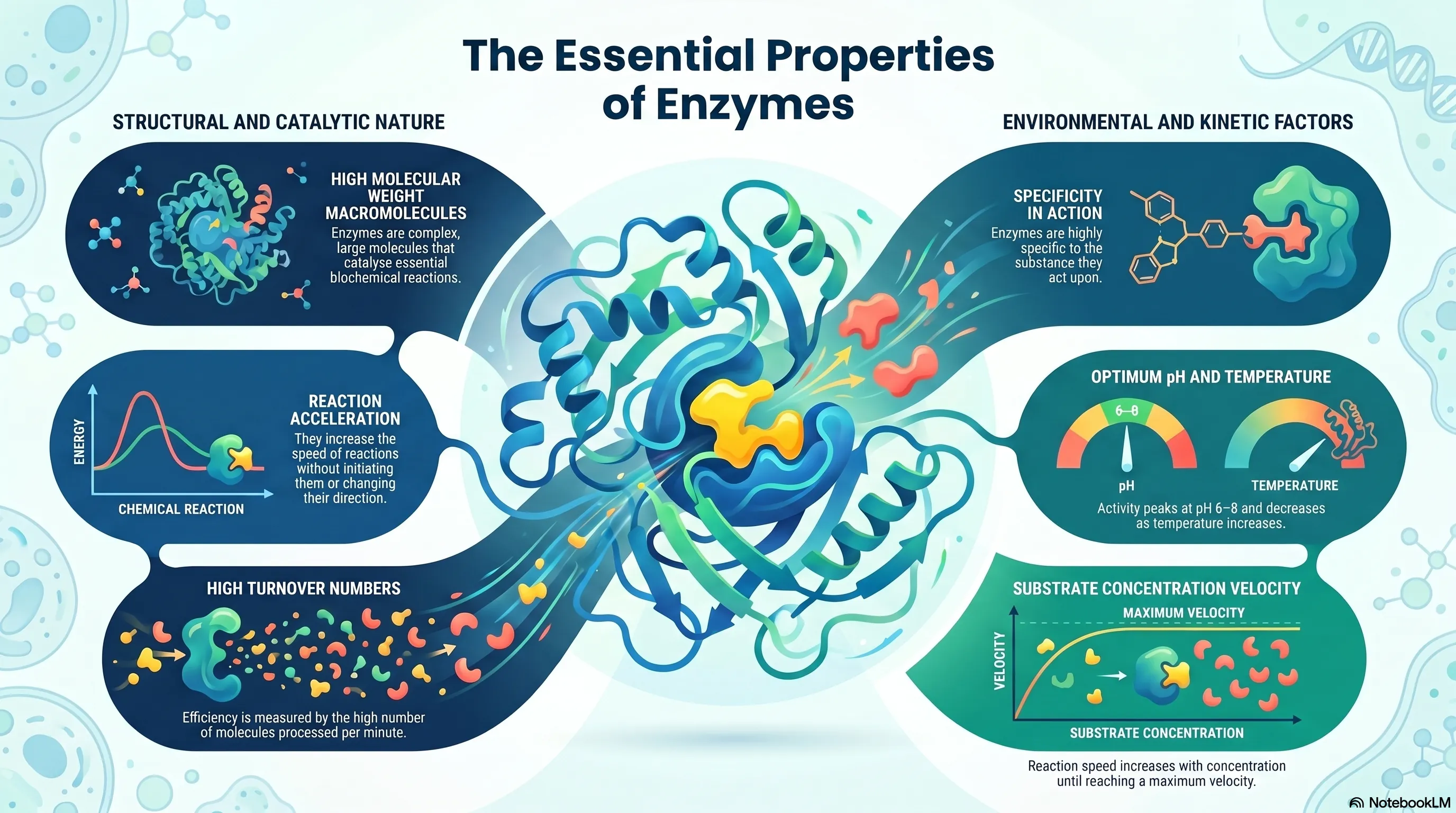
(1) Enzymes are complex macromolecules with high molecular weight.
(2) They catalyze biochemical reactions in a cell. They help in the breakdown of large molecules into smaller molecules or bring together two smaller molecules to form a larger molecule.
(3) Enzymes do not start a reaction. However, they help in accelerating it.
(4) Enzymes affect the rate of biochemical reaction and not the direction.
(5) Most of the enzymes have high turnover number. Turnover number of an enzyme is the number of molecules of a substance that is acted upon by an enzyme per minute. High turnover number of enzymes increases the efficiency of reaction.
(6) Enzymes are specific in action.
(7) Enzymatic activity decreases with increase in temperature.
(8) They show maximum activity at an optimum pH of 6 – 8.
(9) The velocity of enzyme increases with increase in substrate concentration and then, ultimately reaches maximum velocity.
Frequently Asked Questions
Find answers to common questions.
What are the most important properties of enzymes for NEET?
The most tested enzyme properties in NEET are specificity, turnover number, effect of pH, effect of temperature, and substrate concentration (Michaelis-Menten kinetics). Understanding how these properties connect to real biological examples — like pepsin working at pH 2 or catalase's high turnover number — will help you answer both factual and application-based MCQs confidently.
What is the turnover number of an enzyme?
The turnover number is the number of substrate molecules converted into product by one enzyme molecule per minute under optimal conditions. A high turnover number means the enzyme is very efficient. For example, carbonic anhydrase has a turnover number of 36 million molecules per minute, making it one of the fastest known enzymes.
What happens to enzyme activity when temperature increases?
Enzyme activity increases as temperature rises, up to the optimum temperature (around 37°C for most human enzymes). Beyond this point, the enzyme denatures — its protein structure unfolds and the active site changes shape, causing a rapid and irreversible loss of activity. Most human enzymes lose significant activity above 40–45°C.
Why do different enzymes have different optimum pH values?
The optimum pH is the pH at which the ionic state of the enzyme's active site allows maximum substrate binding. Different enzymes are adapted to function in different cellular compartments with different pH values. For example, pepsin works in the acidic stomach (pH ~2), while trypsin works in the alkaline small intestine (pH ~8).
What is the difference between the Lock and Key model and the Induced Fit model?
In the Lock and Key model (Fischer, 1894), the enzyme's active site has a rigid, fixed shape that perfectly matches the substrate — like a key fitting a lock. In the Induced Fit model (Koshland, 1958), the active site is flexible and changes shape slightly when the substrate binds, creating a tighter, more complementary fit. The Induced Fit model is now more widely accepted as it better explains enzyme flexibility.