Find the greatest number that will divide 43, 91 and 183 so as to leave the same remainder in each case.
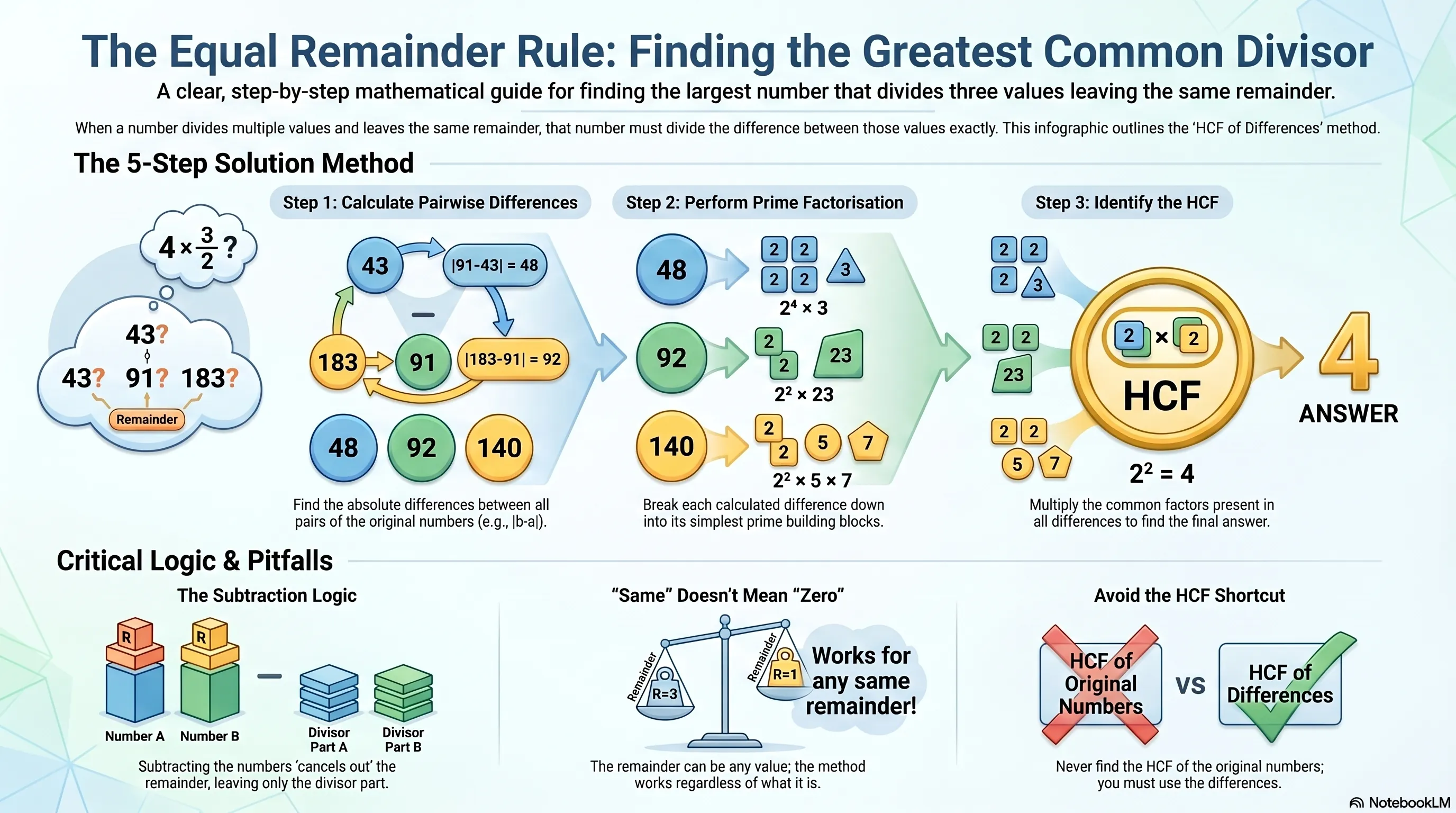
To find the greatest number that divides given numbers leaving the same remainder: (1) Subtract the numbers pairwise, (2) Find the HCF (Highest Common Factor) of these differences, (3) The HCF is the answer. Example: For 43, 91, 183 → Differences: 92, 140, 48 → HCF = 4. Verification: 43÷4 remainder 3, 91÷4 remainder 3, 183÷4 remainder 3.


🚀 Checkout eSaral Courses
What Does This Problem Mean?
Understanding the Problem
Problem Statement: "Find the greatest number that will divide 43, 91, and 183 so as to leave the same remainder in each case."
What this means: We're looking for a number that:
- Divides 43 and leaves some remainder (let's say remainder = r)
- Divides 91 and leaves the same remainder r
- Divides 183 and leaves the same remainder r
And this number should be the greatest (largest) such number.
Visual Example
Let's say we find that the number is 4:
- 43 ÷ 4 = 10 remainder 3
- 91 ÷ 4 = 22 remainder 3
- 183 ÷ 4 = 45 remainder 3
Notice: All three divisions leave the same remainder (3). And 4 is the greatest number that does this.
Real-World Application
This concept is useful in:
- Distribution problems: Dividing items into groups where each group has leftover items
- Time scheduling: Finding cycles that align differently occurring events
- Inventory management: Organizing products where some items always remain
Why Does This Method Work? The Mathematical Logic
The Key Insight
When a number divides two different numbers and leaves the same remainder, it must divide their difference exactly (with no remainder).
Proof Through Example
Let's say number D divides both 91 and 183 leaving remainder 3:
- 91 = D × q₁ + 3 (where q₁ is quotient)
- 183 = D × q₂ + 3 (where q₂ is quotient)
Subtracting the first equation from the second:
- 183 − 91 = D × q₂ + 3 − (D × q₁ + 3)
- 92 = D × (q₂ − q₁) + 0
- 92 = D × (q₂ − q₁)
This means D divides 92 exactly (no remainder)!
Generalization
If a number D divides three numbers (43, 91, 183) with the same remainder, then:
- D divides (183 − 91) = 92
- D divides (183 − 43) = 140
- D divides (91 − 43) = 48
Therefore, D must be a common divisor of 92, 140, and 48.
The greatest such D is the HCF of these differences.
💡 Why This Works: The remainder "cancels out" when we subtract. Only the divisor part remains. So finding HCF of differences gives us the greatest divisor that produces equal remainders.
Step-by-Step Method to Solve
The Complete Algorithm
Step 1: Write down all numbers
- Original numbers: a, b, c
Step 2: Find all pairwise differences
- Difference 1: |b − a|
- Difference 2: |c − a|
- Difference 3: |c − b|
- (Or just pick two differences; the HCF will be the same)
Step 3: Find prime factorization of each difference
- Factor each difference completely
Step 4: Identify common factors
- Find factors that appear in ALL differences
Step 5: Multiply common factors to get HCF
- The product of all common factors = HCF = Answer
Quick Reference Chart
| Step | Action | Example |
|---|---|---|
| 1 | List numbers | 43, 91, 183 |
| 2 | Find differences | 92, 140, 48 |
| 3 | Prime factorize | 2²×23, 2²×5×7, 2⁴×3 |
| 4 | Common factors | 2² (appears in all) |
| 5 | Calculate HCF | 2² = 4 |
Solved Example 1: Find Greatest Number Dividing 43, 91, 183
Complete Solution (As Given)
Given Numbers: 43, 91, 183
Step 1: Find Pairwise Differences
183−91=92183 - 91 = 92 183−43=140183 - 43 = 140 91−43=4891 - 43 = 48
Step 2: Prime Factorization of Each Difference
92=22×2392 = 2^2 \times 23 140=22×5×7140 = 2^2 \times 5 \times 7 48=24×348 = 2^4 \times 3
Step 3: Identify Common Factors
Looking at the prime factorizations:
- 92 has: 2², 23
- 140 has: 2², 5, 7
- 48 has: 2⁴, 3
Common factor present in ALL three: 2² = 4
Step 4: Calculate HCF
HCF(92,140,48)=22=4\text{HCF}(92, 140, 48) = 2^2 = 4
Answer: 4
Verification
Let's verify that 4 is correct:
- 43 ÷ 4 = 10 remainder 3 ✓
- 91 ÷ 4 = 22 remainder 3 ✓
- 183 ÷ 4 = 45 remainder 3 ✓
All three divisions leave the same remainder (3). ✓
Solved Example 2: Different Numbers, Same Method
Problem
Find the greatest number that divides 65, 117, and 169 leaving the same remainder.
Solution
Step 1: Find Pairwise Differences
169−117=52169 - 117 = 52 169−65=104169 - 65 = 104 117−65=52117 - 65 = 52
(Notice: 169−117 and 117−65 give the same difference. This happens sometimes!)
Step 2: Prime Factorization
52=22×1352 = 2^2 \times 13 104=23×13104 = 2^3 \times 13
(We only need two different differences for HCF)
Step 3: Common Factors
- 52 has: 2², 13
- 104 has: 2³, 13
Common factors: 2² and 13
Step 4: Calculate HCF
HCF(52,104)=22×13=4×13=52\text{HCF}(52, 104) = 2^2 \times 13 = 4 \times 13 = 52
Answer: 52
Verification
- 65 ÷ 52 = 1 remainder 13 ✓
- 117 ÷ 52 = 2 remainder 13 ✓
- 169 ÷ 52 = 3 remainder 13 ✓
All leave remainder 13. The answer is correct!
How to Find HCF Using Prime Factorization
Method Explained
HCF (Highest Common Factor) is found by:
- Writing each number as a product of prime factors
- Identifying which prime factors appear in ALL numbers
- Multiplying the common factors (taking lowest power if they repeat)
Example with the Original Problem
Numbers: 92, 140, 48
| Number | Prime Factorization | Factorization |
|---|---|---|
| 92 | 2² × 23 | 4 × 23 |
| 140 | 2² × 5 × 7 | 4 × 5 × 7 |
| 48 | 2⁴ × 3 | 16 × 3 |
Common factors (in ALL three): 2²
HCF = 2² = 4 ✓
Why Prime Factorization Works
Prime factorization breaks numbers into their simplest building blocks (prime numbers). Common building blocks are the factors shared by all numbers. Multiplying these shared blocks gives the HCF.
Alternative: Finding HCF Using Euclidean Algorithm
What is the Euclidean Algorithm?
The Euclidean Algorithm is a method to find HCF using repeated division:
- Divide larger number by smaller
- Replace larger with smaller, smaller with remainder
- Repeat until remainder is 0
- The last non-zero remainder is the HCF
Step-by-Step Example
Find HCF(140, 92):
140=92×1+48140 = 92 \times 1 + 48 92=48×1+4492 = 48 \times 1 + 44 48=44×1+448 = 44 \times 1 + 4 44=4×11+044 = 4 \times 11 + 0
The HCF is 4 (last non-zero remainder)
Advantages of Euclidean Algorithm
| Method | Advantage | Disadvantage |
|---|---|---|
| Prime Factorization | Easy for small numbers, visual | Tedious for large numbers |
| Euclidean Algorithm | Works fast for large numbers | Less intuitive for beginners |
For exams: Use prime factorization if numbers are small (under 1000). Use Euclidean Algorithm if numbers are large.
Common Mistakes Students Make
Mistake 1: Forgetting to Find Differences First
Wrong Approach: Finding HCF of original numbers directly
- HCF(43, 91, 183) = 1 ❌
Correct Approach: Find HCF of differences
- HCF(92, 140, 48) = 4 ✓
Why the mistake happens: Students think "find HCF of given numbers" without understanding why differences are needed.
Mistake 2: Finding Only Some Differences
Wrong Approach:
- Difference 1: 183 − 91 = 92
- Finding HCF of just 92 ❌
Correct Approach: Find at least 2–3 differences and then HCF
- Differences: 92, 140, 48
- HCF(92, 140, 48) = 4 ✓
Why this matters: Using only one difference might give wrong answer if that difference has extra factors.
Mistake 3: Misunderstanding "Same Remainder"
Common Confusion: "Same remainder" means remainder = 0
Correct Understanding: "Same remainder" means all divisions leave the same remainder (could be 0, could be 3, could be any value)
Example: The answer 4 leaves remainder 3 in all cases—not remainder 0!
Mistake 4: Calculating HCF Incorrectly
Wrong Approach: Multiplying all common prime factors without checking
92 = 2² × 23 140 = 2² × 5 × 7 48 = 2⁴ × 3
Mistakenly thinking: Common factors are 2, 2, 3, so HCF = 2 × 2 × 3 = 12 ❌
Correct Approach: Find prime factors present in ALL three
- Only 2² is in all three
- HCF = 2² = 4 ✓
Frequently Asked Questions
Find answers to common questions.
What if the given numbers have no common factors (HCF = 1)?
If HCF of differences is 1, then no number greater than 1 can divide all given numbers leaving the same remainder. The answer would be 1, meaning every number leaves different remainders.
Example: Find greatest number dividing 10, 13, 19 leaving same remainder.
Differences: 9, 3, 6
HCF(9, 3, 6) = 3
Answer: 3
What if two of the given numbers are the same?
A: If two numbers are identical, their difference is 0. We ignore the 0 and use the other differences.
Example: Find greatest number dividing 50, 50, 70 leaving same remainder.
Difference 1: 70 − 50 = 20
Difference 2: 50 − 50 = 0 (ignore)
HCF of remaining difference = 20
Answer: 20
Verification: 50 ÷ 20 = 2 remainder 10; 70 ÷ 20 = 3 remainder 10 ✓
Can the answer ever be larger than the smallest given number?
No. The greatest number that divides any integer cannot be larger than the integer itself. The answer will always be ≤ smallest number.
Mathematical reason: If number D divides n, then D ≤ n always.
Is this problem related to divisibility rules?
Not directly. Divisibility rules (like "divisible by 2 if last digit is even") are different. This problem is about division and remainders using HCF/GCD concepts.
What if we're asked to find the remainder value also?
Find the HCF as usual. Then divide any original number by the HCF to get the remainder.
Example: Find greatest number and remainder when dividing 43, 91, 183.
Greatest number: 4 (from HCF)
Remainder: 43 ÷ 4 = 10 remainder 3
Answer: Greatest number = 4, Remainder = 3