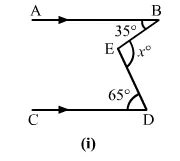
In each of the figures given below, AB || CD. Find the value of x in each case.
Learn how to find unknown angles using properties of parallel lines, transversals, and angle relationships with step-by-step Class 9 geometry solutions.


In each of the figures given below, AB || CD. Find the value of x in each case.\
 Solution:
(i)
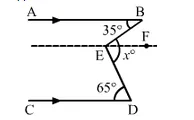 Draw $E F\|A B\| C D$.
Now, $A B \| E F$ and $B E$ is the transversal.
Then,
$\angle A B E=\angle B E F \quad[$ Alternate Interior Angles $]$
$\Rightarrow \angle B E F=35^{\circ}$
Again. $E F \| C D$ and $\mathrm{DE}$ is the transversal.
Then,
$\angle D E F=\angle F E D$
$\Rightarrow \angle F E D=65^{\circ}$
$\therefore x^{\circ}=\angle B E F+\angle F E D$
$=(35+65)^{\circ}$
$=100^{\circ}$
or, $x=100$
(ii)
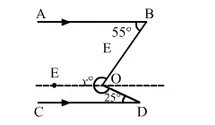 Draw $E O\|A B\| C D$.
Then, $\angle E O B+\angle E O D=x^{\circ}$
Now, $E O \| A B$ and $B O$ is the transversal.
$\therefore \angle E O B+\angle A B O=180^{\circ} \quad[$ Consecutive Interior Angles $]$
$\Rightarrow \angle E O B+55^{\circ}=180^{\circ}$
$\Rightarrow \angle E O B=125^{\circ}$
Again, $E O \| C D$ and $D O$ is the transversal.
$\therefore \angle E O D+\angle C D O=180^{\circ} \quad$ [Consecutive Interior Angles]
$\Rightarrow \angle E O D+25^{\circ}=180^{\circ}$
$\Rightarrow \angle E O D=155^{\circ}$
Therefore,
$x^{\circ}=\angle E O B+\angle E O D$
$=(125+155)^{\circ}$
$=280^{\circ}$
or, $x=280$
(iii)
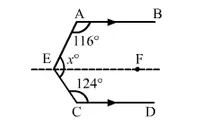 Draw $E F\|A B\| C D$.
Then, $\angle A E F+\angle C E F=x^{\circ}$
Now, $E F \| A B$ and $A E$ is the transversal.
$\therefore \angle A E F+\angle B A E=180^{\circ} \quad$ [Consecutive Interior Angles]
$\Rightarrow \angle A E F+116=180$
$\Rightarrow \angle A E F=64^{\circ}$
Again, $E F \| C D$ and $C E$ is the transversal.
$\angle C E F+\angle E C D=180^{\circ} \quad[$ Consecutive Interior Angles $]$
$\Rightarrow \angle C E F+124=180$
$\Rightarrow \angle C E F=56^{\circ}$
Therefore,
$x^{\circ}=\angle A E F+\angle C E F$
$=(64+56)^{\circ}$
$=120^{\circ}$
or, $x=120$
Frequently Asked Questions
Find answers to common questions.
Why do we draw an auxiliary line parallel to AB and CD in these problems?
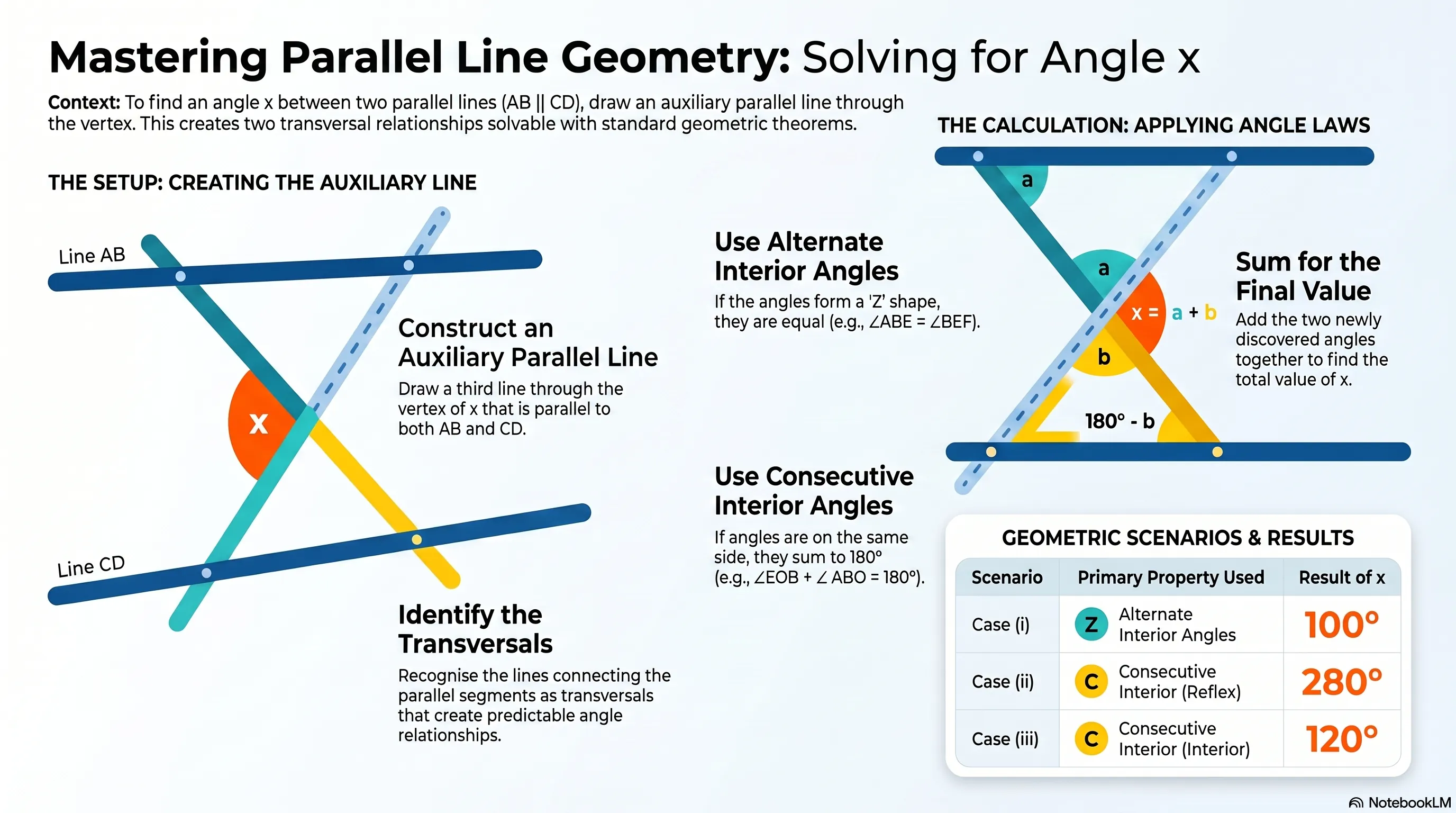
Drawing an auxiliary line EF ∥ AB ∥ CD through the vertex of x splits the unknown angle into two parts. Each part can then be found using a standard theorem — alternate interior angles or consecutive interior angles — applied to two separate pairs of parallel lines. Without this construction, there is no direct theorem linking x to the given angles
What is the difference between alternate interior angles and co-interior angles?
Alternate interior angles lie on opposite sides of the transversal and are equal when lines are parallel. Co-interior angles (also called consecutive or allied angles) lie on the same side of the transversal and add up to 180° when lines are parallel. Getting these two confused is the single most common error in Lines and Angles problems.
Can x be greater than 180° when AB ∥ CD?
Yes. As shown in Figure (ii), x = 280°, which is a reflex angle. This happens when the angle is measured on the larger arc around a point between the two parallel lines. Always read the diagram carefully to confirm on which side of the construction line the angle x opens.
Is this topic important for JEE Main?
Lines and Angles concepts from Class 9 appear directly in JEE Main in questions involving triangles, polygons, and circle geometry — especially problems using the exterior angle theorem or properties of cyclic quadrilaterals. A firm grip on parallel-line theorems saves time on multi-step geometry problems. The NCERT Solutions for Class 11 Maths cover the higher-level geometry built on these foundations.
Where can I find more practice problems on parallel lines for Class 9?
The NCERT textbook Chapter 6 (Lines and Angles) contains graded exercises covering all standard configurations. For step-by-step solutions to every NCERT exercise, visit eSaral's NCERT Solutions.