In the given figure, AB || CD. Prove that ∠BAE − ∠DCE = ∠AEC.
This proof uses an auxiliary line through E parallel to AB and CD, applies the co-interior angles theorem to form supplementary angle equations, and simplifies them to show that ∠BAE − ∠DCE = ∠AEC.
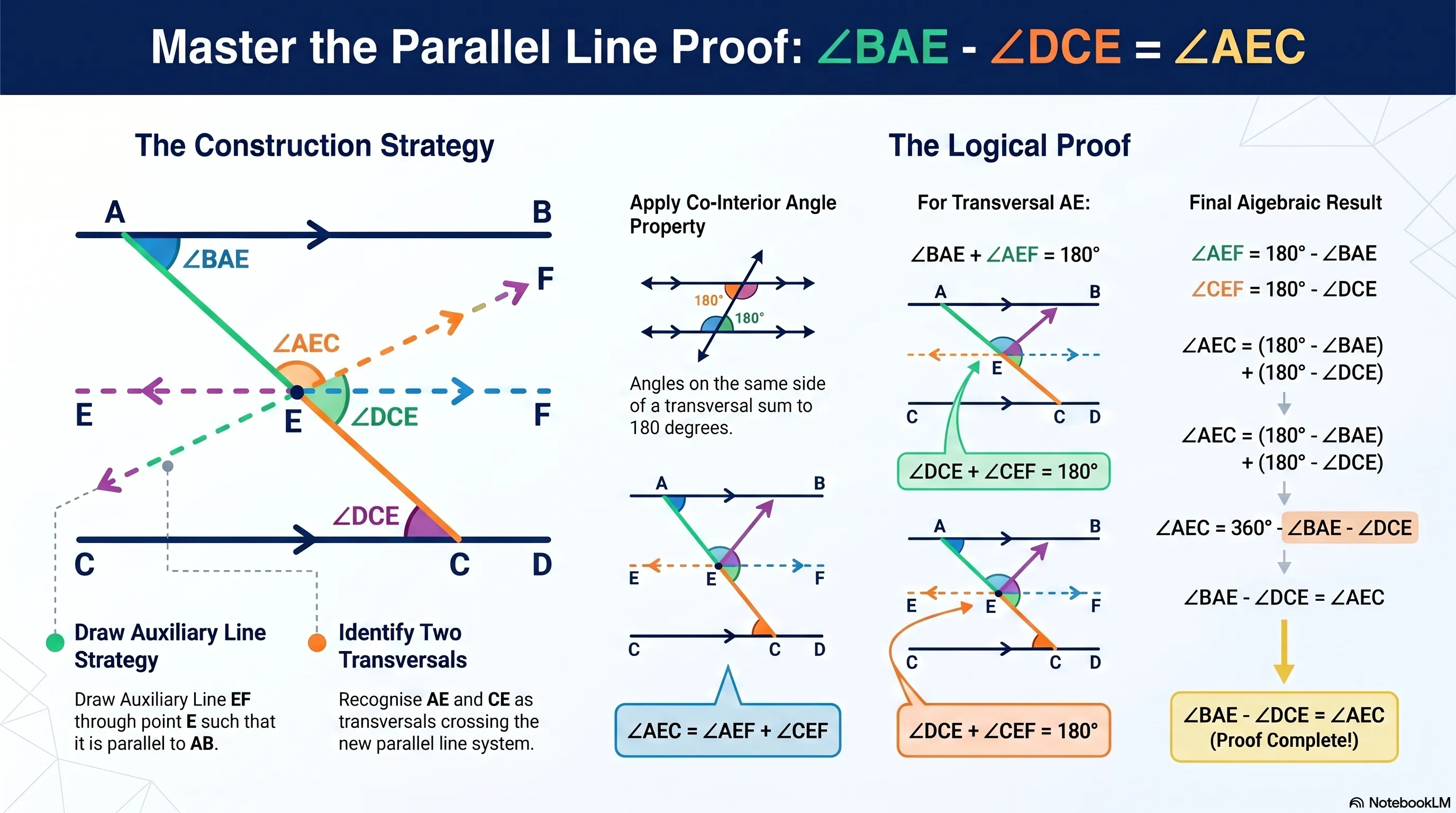

eSaral ›Foundation courses ›In the given figure, AB || CD. Prove that ∠BAE − ∠DCE = ∠AEC.

What This Problem Is About
This is a classic proof question from NCERT Class 9 Mathematics, Chapter 6 — Lines and Angles. It tests whether you can apply the co-interior angles theorem (also called consecutive interior angles or same-side interior angles) using a clever construction technique: drawing an auxiliary line parallel to the given parallel lines through a specific point.
The result — ∠BAE − ∠DCE = ∠AEC — looks unusual at first glance because it involves a difference of angles rather than a sum or equality. That is precisely what makes this question a favourite in school exams and a good warm-up for the logical reasoning style needed in JEE.
Understanding this proof builds your ability to:
- Recognise when and how to draw an auxiliary (helper) line
- Apply the supplementary angle property of co-interior angles
- Set up and simplify algebraic angle equations from geometric statements
In the given figure, AB || CD. Prove that ∠BAE − ∠DCE = ∠AEC.
Draw $E F\|A B\| C D$ through $\mathrm{E}$.
Now, $E F \| A B$ and $\mathrm{AE}$ is the transversal.
Then, $\angle B A E+\angle A E F=180^{\circ} \quad$ [Angles on the same side of a transversal line are supplementary]
Again, $E F \| C D$ and $\mathrm{CE}$ is the transversal.
Then
$\angle D C E+\angle C E F=180^{\circ} \quad$ [Angles on the same side of a transversal line are supplementary]
$\Rightarrow \angle D C E+(\angle A E C+\angle A E F)=180^{\circ}$
$\Rightarrow \angle D C E+\angle A E C+180^{\circ}-\angle B A E=180^{\circ}$
$\Rightarrow \angle B A E-\angle D C E=\angle A E C$
Frequently Asked Questions
Find answers to common questions.
Why do we draw EF parallel to AB through point E in this proof?
Drawing EF ∥ AB ∥ CD through point E creates two new co-interior angle pairs — one on transversal AE and one on transversal CE. These pairs connect ∠BAE and ∠DCE to the angles at point E, making it possible to express ∠AEC in terms of those two angles and prove the required result algebraically.
What is the co-interior angles theorem used in this proof?
The co-interior angles theorem states that when a transversal crosses two parallel lines, the two angles formed on the same side of the transversal (between the parallel lines) add up to 180°. In this proof, it is applied twice — once with transversal AE and once with transversal CE — to get two supplementary angle equations.
Can this proof be done without an auxiliary line?
No straightforward proof exists without an auxiliary line for this configuration. The three angles ∠BAE, ∠DCE, and ∠AEC are at three different points (A, C, and E). Only by introducing EF through E — the common point — can you link all three angles using known theorems. The auxiliary line is essential, not optional.
Is this question from NCERT Class 9 Chapter 6?
Yes. This proof comes from NCERT Class 9 Mathematics, Chapter 6 — Lines and Angles. It is a standard exercise that tests the application of properties of parallel lines (co-interior angles) and the construction technique of drawing an auxiliary parallel line. It frequently appears in CBSE school exams and is a conceptual building block for Class 10 geometry.
What other theorems about parallel lines are important for Class 9 geometry proofs?
Four main theorems are essential: (1) Corresponding angles are equal when lines are parallel. (2) Alternate interior angles are equal when lines are parallel. (3) Co-interior angles are supplementary when lines are parallel. (4) If two lines are each parallel to a third line, they are parallel to each other. This fourth theorem justifies why EF ∥ AB and EF ∥ CD simultaneously is valid in this proof.