Tangent & Normal — JEE Main Previous Year Questions with Step-by-Step Solutions

Table of Contents

Home > JEE Main Previous Year Questions > Tangent & Normal JEE Main Previous Year Questions

What Is Tangent & Normal in JEE Main Calculus?
Tangent and Normal is one of the most consistently tested sub-topics within Application of Derivatives, a chapter that typically carries 2–3 questions in every JEE Main session according to the National Testing Agency (NTA) official syllabus and past paper trends.
A tangent to a curve at a given point is the straight line that touches the curve at that point and has the same instantaneous slope. The normal is the line perpendicular to the tangent at the same point. Both are found using the first derivative, dy/dx, evaluated at the point of interest.
This chapter bridges Class 12 Maths fundamentals with real problem-solving under exam pressure. Students who build a clear picture of what the derivative means geometrically — not just algebraically — solve these questions in under two minutes. If your Class 12 fundamentals need a refresh, start with the NCERT Solutions for Class 12 Maths to ensure your base is solid before tackling JEE-level problems.
Across JEE Main papers from 2010 to 2026, questions have been tested:
- Equation of a tangent parallel to the x-axis or a given line
- Equation of the normal at a specific point
- Curves intersecting at right angles (orthogonal curves)
- Normal passing through a given external point
Key Formulas You Must Know
What are the essential formulas for Tangent & Normal?
You need exactly four core relationships. Every JEE Main Tangent & Normal question maps to one of them.
| Formula | Expression |
|---|---|
| Slope of Tangent at (x₁, y₁) | m = (dy/dx) at (x₁, y₁) |
| Equation of Tangent | y − y₁ = m(x − x₁) |
| Slope of Normal | −1/m (negative reciprocal of tangent slope) |
| Equation of Normal | y − y₁ = (−1/m)(x − x₁) |
| Tangent parallel to x-axis | dy/dx = 0 |
| Tangent parallel to y-axis | dy/dx → ∞ (or dx/dy = 0) |
| Condition for orthogonal curves | m₁ × m₂ = −1 |
How do orthogonal curves appear in JEE Main?
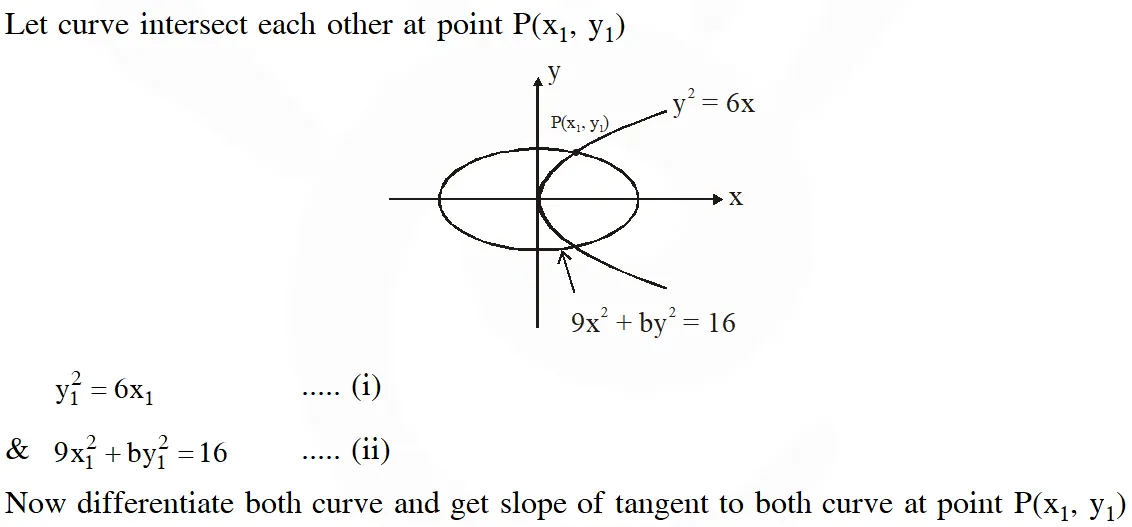
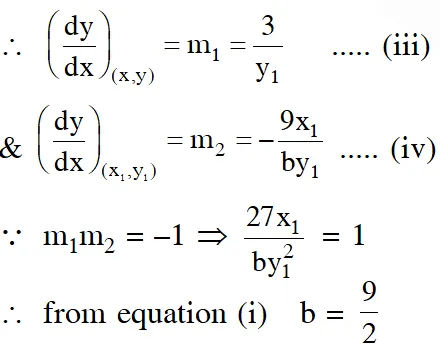
Two curves are said to intersect orthogonally when the tangents to both curves at their point of intersection are perpendicular to each other. This requires m₁ × m₂ = −1, where m₁ and m₂ are the slopes of the respective tangents at the intersection point. The 2016 JEE Main question on y² = 6x and 9x² + by² = 16 is a direct application of this condition.
Topic-wise Question Distribution in JEE Main (2010–2026)
The table below shows how sub-topics within Tangent & Normal have appeared across past JEE Main papers. Use this to prioritise your preparation.
| Sub-topic | No. of Questions (2010–2026) | Difficulty Level |
|---|---|---|
| Tangent parallel to x-axis / given line | 3 | Easy–Medium |
| Equation of normal at a point | 4 | Medium |
| Normal passing through external point | 3 | Medium–Hard |
| Orthogonal curves | 2 | Medium |
| Tangent using parametric curves | 2 | Hard |
| Intercepts of tangent on axes | 2 | Medium |
Takeaway: Equations of normal and tangent parallel to a line together account for over 50% of questions. Master these two sub-topics first.
JEE Main Previous Year Question of Math with Solutions are available at eSaral. Practicing JEE Main Previous Year Papers Questions of mathematics will help the JEE aspirants in realizing the question pattern as well as help in analyzing weak & strong areas. eSaral helps the students in clearing and understanding each topic in a better way. eSaral is providing complete chapter-wise notes of Class 11th and 12th both for all subjects. Besides this, eSaral also offers NCERT Solutions, Previous year questions for JEE Main and Advance, Practice questions, Test Series for JEE Main, JEE Advanced and NEET, Important questions of Physics, Chemistry, Math, and Biology and many more. Download eSaral app for free study material and video tutorials. 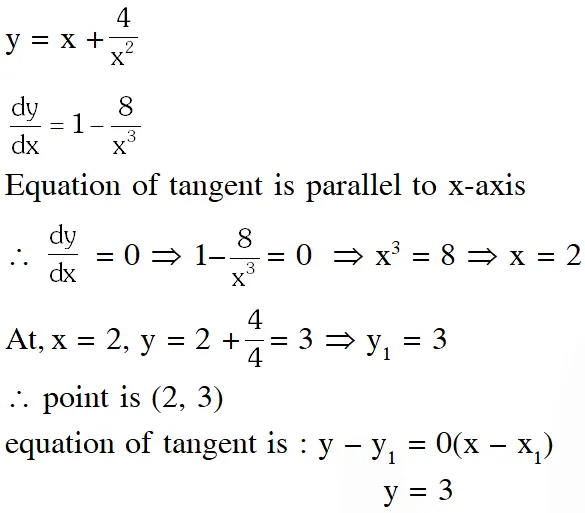
Tangent & Normal is part of a much larger Maths collection, so explore the JEE Mains chapter wise PYQ archive to practise other chapters.
Don't stop at Tangent & Normal alone — our JEE Main previous year question paper lets you attempt complete question sets exactly as NTA set them.
How Should You Approach Tangent & Normal Problems in JEE Main?
What is the fastest strategy for solving these questions under exam pressure?
Follow this four-step method every time — it works for all five question types that appear in JEE Main:
- Identify what is given and what is asked. Is the tangent parallel to a line? Is the normal passing through a point? Label clearly.
- Differentiate the curve (explicitly or implicitly) to get dy/dx.
- Apply the specific condition — set dy/dx = 0 for horizontal tangent, set dy/dx equal to given slope for parallel tangent, use m₁m₂ = −1 for orthogonal curves.
- Write the line equation using point-slope form and verify against the answer options.
For implicit differentiation practice and a strong calculus base, the NCERT Solutions for Class 11 Maths covers the foundational limits and derivatives you need. Once comfortable, move to NCERT Solutions for Class 12 Maths for the full Application of Derivatives chapter.
Which mistakes do students make most often?
| Common Mistake | How to Avoid It |
|---|---|
| Using the slope of the tangent for the normal equation | Always flip the sign and take the reciprocal for normal |
| Forgetting to check if the intersection point satisfies both curves | Substitute back to verify |
| Sign error in implicit differentiation | Write each differentiated term before simplifying |
| Confusing parallel with perpendicular condition | Parallel → equal slopes; Perpendicular → product = −1 |
Frequently Asked Questions
Find answers to common questions.
What is the equation of the tangent to a curve at a given point?
The equation of the tangent to y = f(x) at point (x₁, y₁) is y − y₁ = f'(x₁)(x − x₁). Here, f'(x₁) is the value of the derivative at x₁ and gives the slope of the tangent. If f'(x₁) = 0, the tangent is horizontal (parallel to the x-axis). This formula directly solves AIEEE 2010 and similar questions.
Is Tangent & Normal important for JEE Advanced as well?
Yes. Tangent and Normal questions in JEE Advanced are more involved — they often combine with curve sketching, parametric equations, or inequality-based conditions. However, the same core formulas (dy/dx for slope, point-slope form for the line equation) remain the foundation. Students who master JEE Main-level problems first find JEE Advanced questions significantly easier to approach
How many questions from Tangent & Normal appear in JEE Main each year?
JEE Main typically includes 1–2 questions from Tangent and Normal per session. Since JEE Main is now held in multiple sessions annually, you can expect to see this topic in at least one session. It falls under Application of Derivatives, which NTA consistently weighs as a high-priority chapter in the official JEE Main Mathematics syllabus.
Where can I find more Application of Derivatives practice for JEE Main?
The best starting point is NCERT Class 12 Maths Chapter 6 (Application of Derivatives) — work through every example and exercise. eSaral's NCERT Solutions for Class 12 Maths provide fully worked-out steps for every NCERT problem, explained by IIT Bombay faculty. After NCERT, move to previous year JEE Main papers for exam-pattern practice.
How do I find the x-intercept of a tangent line?
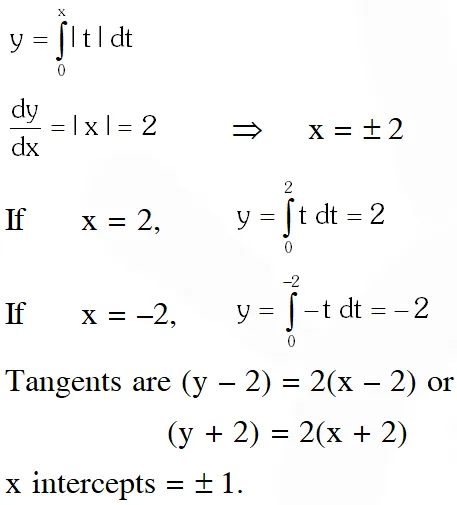
Write the equation of the tangent in the form y − y₁ = m(x − x₁). Set y = 0 and solve for x. The result is x = x₁ − y₁/m. This is the x-intercept. The 2013 JEE Main question tests exactly this — finding x-intercepts of tangents to a definite-integral curve that are parallel to a given line.
What does it mean for two curves to intersect at right angles?
Two curves intersect at right angles (orthogonally) when their tangents at the point of intersection are perpendicular. The condition is m₁ × m₂ = −1, where m₁ and m₂ are the slopes of the respective tangents at the intersection point. This was directly tested in JEE Main 2016 (y² = 6x and 9x² + by² = 16 question).