Thermodynamics - JEE Advanced Previous Year Questions with Solutions


Home > JEE Advanced Previous Year Questions > Thermodynamics – JEE Advanced Questions with Solutions

JEE Advanced Previous Year Questions of Physics with Solutions are available at eSaral. Practicing JEE Advanced Previous Year Papers Questions of Physics will help the JEE aspirants in realizing the question pattern as well as help in analyzing weak & strong areas. Get detailed Class 11th & 12th Physics Notes to prepare for Boards as well as competitive exams like IIT JEE, NEET etc. eSaral helps the students in clearing and understanding each topic in a better way. eSaral is providing complete chapter-wise notes of Class 11th and 12th both for all subjects. Click Here for JEE main Previous Year Topic Wise Questions of Physics with Solutions Download eSaral app for free study material and video tutorials. Simulator Previous Years JEE Advance Questions 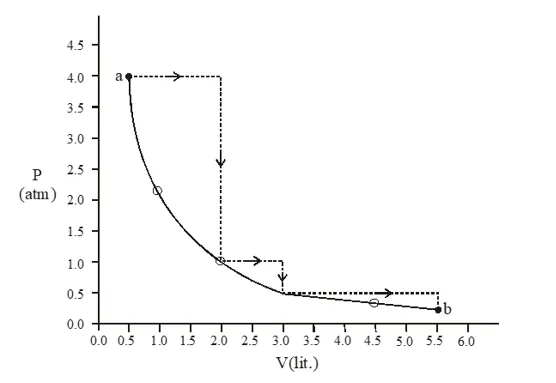 [JEE 2010]
 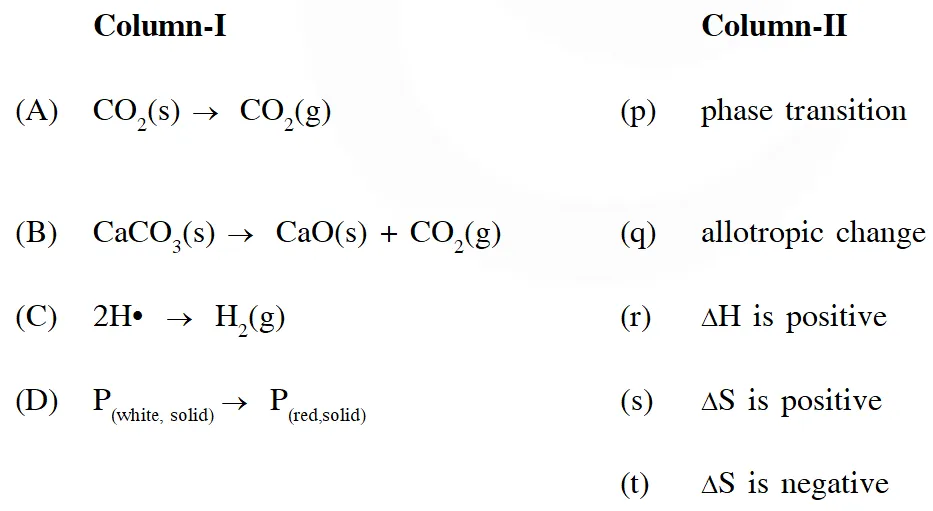 [JEE 2011]
 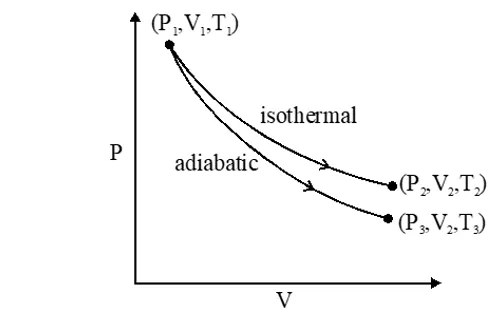 (A) $\mathrm{T}_{1}=\mathrm{T}_{2}$ (B) $\mathrm{T}_{3}>\mathrm{T}_{1}$ (C) $\mathrm{W}_{\text {isothermal }}>\mathrm{W}_{\text {adiabatic }}$ (D) $\Delta \mathrm{U}_{\text {isothemal }}>\Delta \mathrm{U}_{\text {adibaic }}$ [JEE 2012]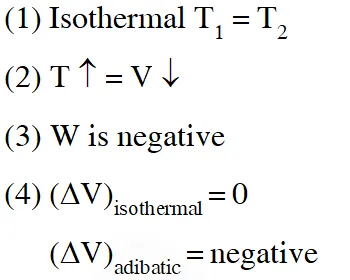
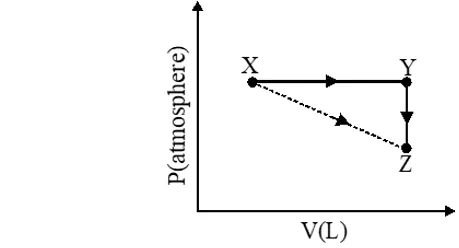 (A) $\Delta \mathrm{S}_{\mathrm{x} \rightarrow \mathrm{z}}=\Delta \mathrm{S}_{\mathrm{x} \rightarrow \mathrm{y}}+\Delta \mathrm{S}_{\mathrm{y} \rightarrow \mathrm{z}}$ (B) $\mathrm{W}_{\mathrm{x} \rightarrow \mathrm{z}}=\mathrm{W}_{\mathrm{x} \rightarrow \mathrm{y}}+\mathrm{W}_{\mathrm{y} \rightarrow \mathrm{z}}$ (C) $\mathrm{W}_{\mathrm{x} \rightarrow \mathrm{y} \rightarrow \mathrm{z}}=\mathrm{W}_{\mathrm{x} \rightarrow \mathrm{y}}$ (D) $\Delta \mathrm{S}_{\mathrm{x} \rightarrow \mathrm{y} \rightarrow \mathrm{z}}=\Delta \mathrm{S}_{\mathrm{x} \rightarrow \mathrm{y}}$ [JEE 2012]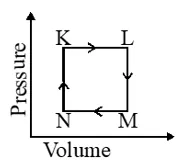
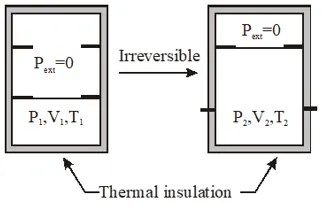 (A) q = 0 (B) $\mathrm{T}_{2}=\mathrm{T}_{1}$ (C) $\mathrm{P}_{2} \mathrm{V}_{2}=\mathrm{P}_{1} \mathrm{V}_{1}$ $(\mathrm{D}) \mathrm{P}_{2} \mathrm{V}_{2}^{\gamma}=\mathrm{P}_{1} \mathrm{V}_{1}^{\gamma}$ [JEE 2014]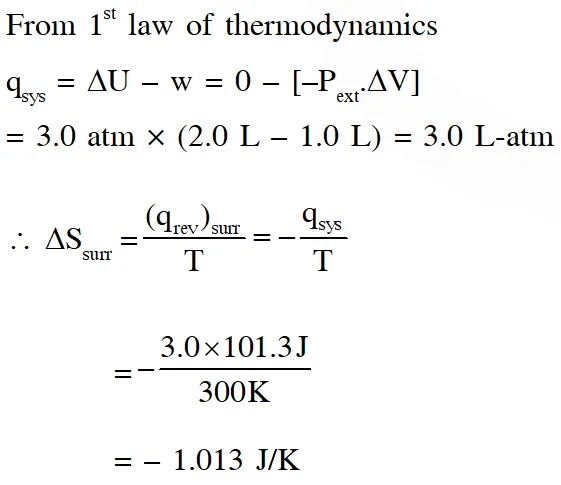
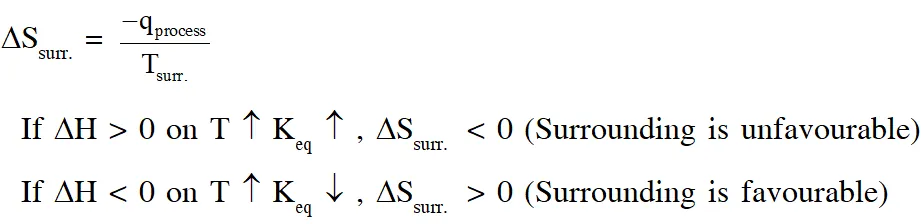
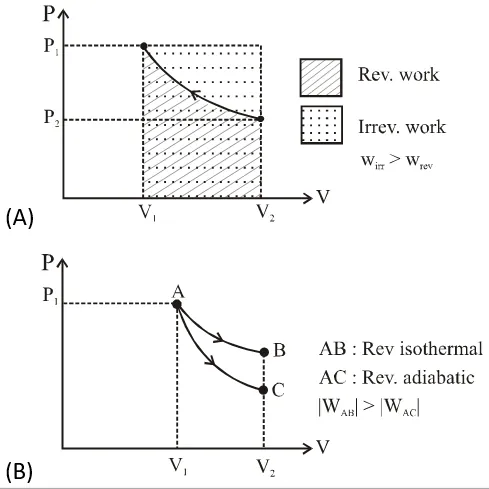 (3) (i) $\left.\Delta \mathrm{U}=\mathrm{nC}_{\mathrm{v}} \Delta \mathrm{T}=0 \text { (isothermal hence } \Delta \mathrm{T}=0\right)$ (ii) $\Delta \mathrm{U}=\mathrm{q}+\mathrm{w}=-\mathrm{ve}(\mathrm{q}=0, \mathrm{w}<0)$ $\Delta \mathrm{U}=\mathrm{nC}_{\mathrm{v}} \Delta \mathrm{T} \Rightarrow \Delta \mathrm{T}<0$ $\begin{aligned}(\mathbf{4}) \mathrm{q} &=0(\text { adiabatic }), \mathrm{w}=0(\text { free expansion }) \\ \Delta \mathrm{U} &=0 \Rightarrow \Delta \mathrm{T}=0 \text { (isothermal) } \end{aligned}$
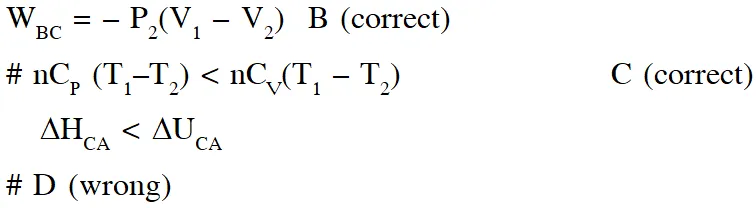
 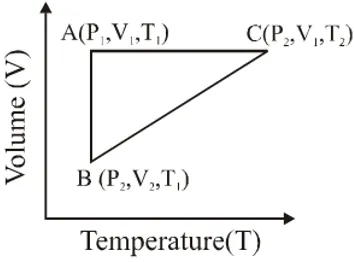 The correct option(s) is (are) (A) $\mathrm{q}_{\mathrm{AC}}=\Delta \mathrm{U}_{\mathrm{BC}}$ and $\mathrm{w}_{\mathrm{AB}}=\mathrm{P}_{2}\left(\mathrm{V}_{2}-\mathrm{V}_{1}\right)$ (B) $\mathrm{w}_{\mathrm{BC}}=\mathrm{P}_{2}\left(\mathrm{V}_{2}-\mathrm{V}_{1}\right)$ and $\mathrm{q}_{\mathrm{BC}}=\Delta \mathrm{H}_{\mathrm{AC}}$ (C) $\Delta \mathrm{H}_{\mathrm{CA}}<\Delta \mathrm{U}_{\mathrm{CA}}$ and $\mathrm{q}_{\mathrm{AC}}=\Delta \mathrm{U}_{\mathrm{BC}}$ (D) $\mathrm{q}_{\mathrm{BC}}=\Delta \mathrm{H}_{\mathrm{AC}}$ and $\Delta \mathrm{H}_{\mathrm{CA}}>\Delta \mathrm{U}_{\mathrm{CA}}$ [JEE - Adv. 2018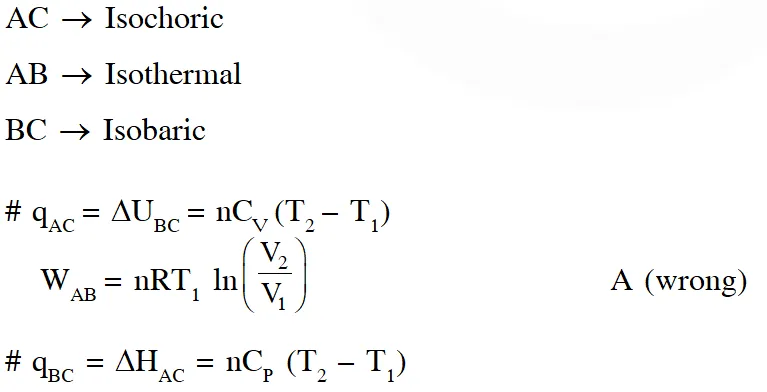
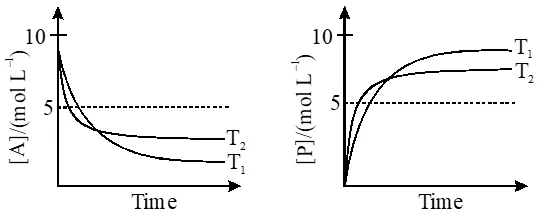 If $\mathrm{T}_{2}>\mathrm{T}_{1},$ the correct statement(s) is (are) (Assume $\Delta \mathrm{H}^{\theta}$ and $\Delta \mathrm{S}^{\theta}$ are independent of temperature and ratio of $\ln \mathrm{K}$ at $\mathrm{T}_{1}$ to $\ln \mathrm{K}$ at $\mathrm{T}_{2}$ is greater than $\mathrm{T}_{2 / \mathrm{T}_{\mathrm{T}}}$. Here H, S, G and K are enthalpy, entropy, Gibbs energy and equilibrium constant, respectively.) (A) $\Delta \mathrm{H}^{\theta}<0, \Delta \mathrm{S}^{\theta}<0$ (B) $\Delta \mathrm{G}^{\theta}<0, \Delta \mathrm{H}^{\theta}>0$ (C) $\Delta \mathrm{G}^{\theta}<0, \Delta \mathrm{S}^{\theta}<0$ (D) $\Delta \mathrm{G}^{\theta}<0, \Delta \mathrm{S}^{\theta}>0$ [JEE - Adv. 2018]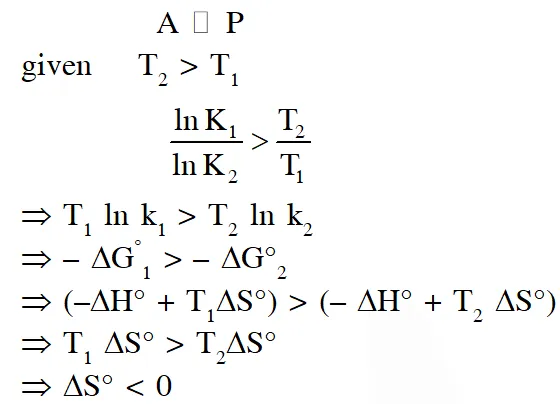
To build the deeper conceptual clarity JEE Advanced numericals demand, follow up this Thermodynamics PYQ set with our Irodov questions for JEE.
After mastering Thermodynamics - JEE Advanced PYQs (Physics), test your understanding under real paper conditions with the JEE Advanced exam paper.
Frequently Asked Questions
Find answers to common questions.
What is the difference between state functions and path functions in JEE Advanced context?
State functions (internal energy U, enthalpy H, entropy S, Gibbs energy G) depend only on the current state — not how the system got there. Path functions (heat q, work w) depend on the specific process. JEE Advanced 2009 tested this directly. Any time a question asks "which is always the same regardless of path," the answer involves state functions only.
Is Class 11 or Class 12 thermodynamics more important for JEE Advanced?
Both are tested together. Class 11 covers the laws of thermodynamics, internal energy, enthalpy, and work (Chapter 6 of NCERT Chemistry Part 1). Class 12 builds on this with Gibbs energy, equilibrium constant, and spontaneity. JEE Advanced questions frequently combine both — for example, using ΔG° = −RT ln K alongside first-law calculations.
How many questions come from Thermodynamics in JEE Advanced each year?
Thermodynamics typically contributes 2–4 questions per year in JEE Advanced Chemistry. Between 2009 and 2018, it appeared every year without exception. The questions are usually multi-correct or paragraph-based, carrying 3–8 marks each, making it one of the highest-value single chapters in Physical Chemistry.
What is free expansion and why is it both isothermal and adiabatic for an ideal gas?
Free expansion occurs when a gas expands against zero external pressure (P_ext = 0). Since w = −P_ext × ΔV = 0, and if the vessel is thermally insulated q = 0, then ΔU = 0. For an ideal gas, internal energy depends only on temperature, so ΔT = 0 — the process is isothermal. It is simultaneously adiabatic (q = 0) and isothermal (ΔT = 0). JEE Advanced 2014 and 2017 both tested this concept.
Why does K decrease with temperature for exothermic reactions?
For an exothermic reaction, ΔH° < 0. The entropy gain of surroundings equals −ΔH°/T. As temperature increases, this term decreases in magnitude, making the overall ΔS_total less positive — shifting equilibrium back toward reactants and reducing K. This is the entropy-based explanation tested in JEE Advanced 2017, option (C).
How do I calculate entropy change of surroundings in JEE Advanced problems?
Use ΔS_surr = −q_sys / T. First calculate q_sys using q = ΔU − w or directly from the process conditions. For an isothermal expansion against constant external pressure: w = −P_ext × ΔV, and for an ideal gas ΔU = 0, so q_sys = −w = P_ext × ΔV. Then divide by temperature in Kelvin and apply the negative sign. This was exactly the method needed for the 2016 question.