Atomic Structure -JEE Advanced Previous Year Questions with Solutions

Table of Contents

Home > JEE Advanced Previous Year Questions > Atomic Structure JEE Advanced Previous Year Questions

Why Atomic Structure Matters in JEE Advanced
Atomic Structure is one of the most conceptually rich chapters in JEE Advanced Physical Chemistry. Questions from this chapter have appeared in every JEE Advanced paper from 2010 to 2017 and test a wide range of sub-topics — from Bohr's model energy calculations and quantum number assignments to probability density graphs and the mathematics of orbital wave functions.
Unlike JEE Main, where questions are largely formula-based, JEE Advanced tests deep conceptual understanding. A single paragraph-type question (like the Li²⁺ problem from 2010) can carry 3 questions worth 9–12 marks. Getting this chapter right can meaningfully shift your rank.
According to NTA's official syllabus (available at jeeadv.ac.in), Atomic Structure falls under Physical Chemistry and is directly connected to topics like Chemical Bonding, Spectroscopy, and Quantum Mechanics basics.
To build the foundation before attempting these PYQs, revising your NCERT Solutions for Class 11 Chemistry is strongly recommended — especially Chapters 2 and 3.
Topic-Wise Weightage Table (JEE Advanced)
| Sub-Topic | No. of Questions | Marks (Approx.) | Difficulty Level |
|---|---|---|---|
| Quantum Numbers & Electronic Configuration | 3 | 9 | Medium |
| Bohr Model — Energy & Radius | 2 | 6 | Medium–Hard |
| de Broglie Wavelength | 1 | 4 | Medium |
| Photoelectric Effect | 1 | 4 | Easy–Medium |
| Wave Functions & Probability Density | 4 | 12 | Hard |
| Radial Nodes & Angular Nodes | 3 | 9 | Hard |
| Total | 14 | 44 | — |
JEE Advanced Previous Year Questions of Chemistry with Solutions are available at eSaral. Practicing JEE Advanced Previous Year Papers Questions of Chemistry will help the JEE aspirants in realizing the question pattern as well as help in analyzing weak & strong areas. Simulator Previous Years JEE Advance Questions Paragraph for questions 1 to 3 The hydrogen-like species $\mathbf{L} \mathbf{i}^{2+}$ is in a spherically symmetric state $\mathrm{S}_{1}$ with one radial node. Upon absorbing light the ion undergoes transition to a state $\mathrm{S}_{2}$ The state $\mathrm{S}_{2}$ has one radial node and its energy is equal to the ground state energy of the hydrogen atom. 
 [JEE 2011]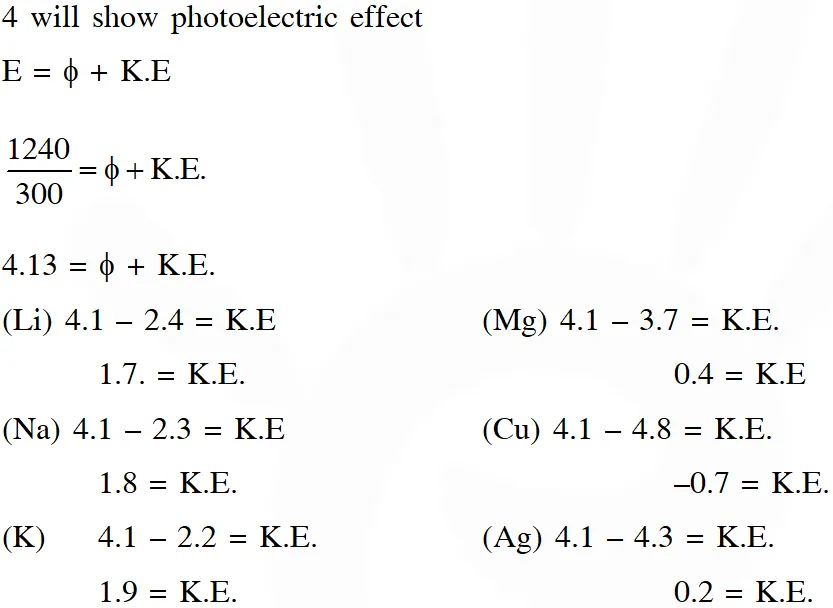
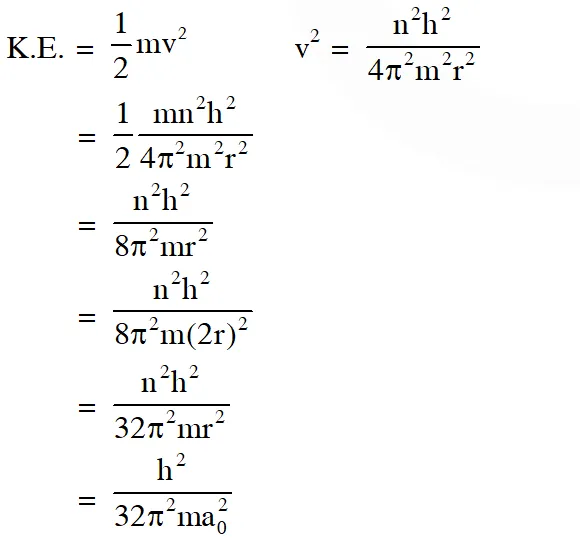
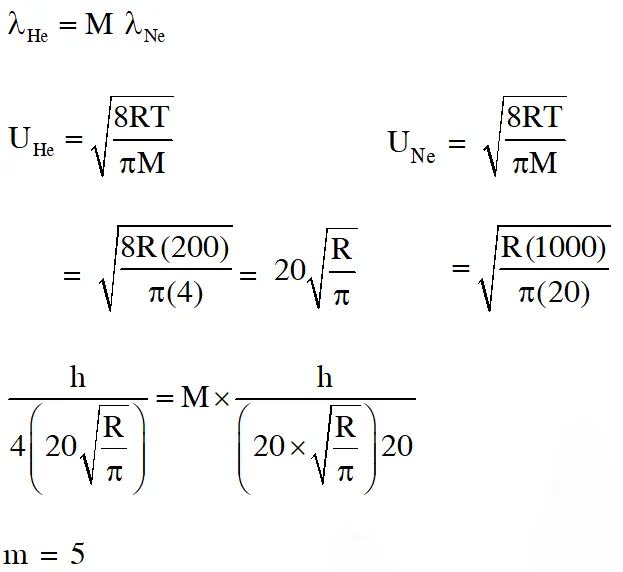
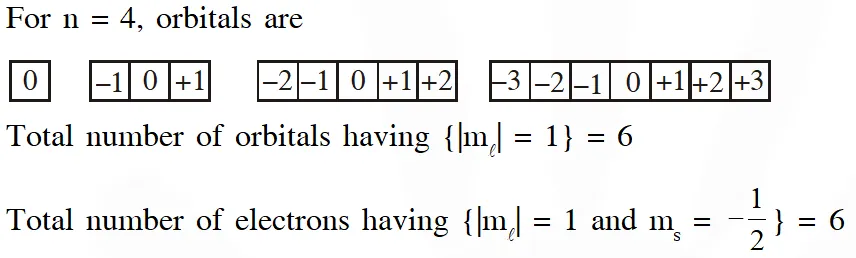
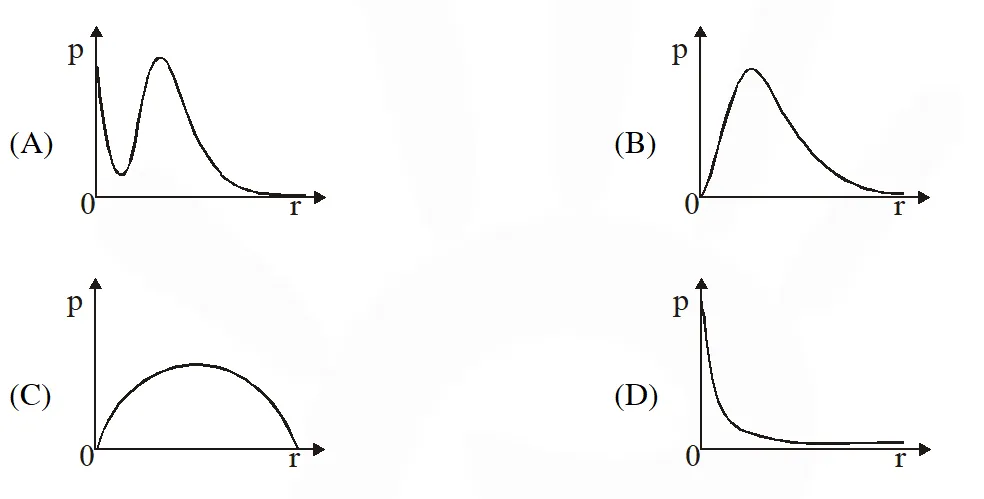 [JEE Adv. 2017]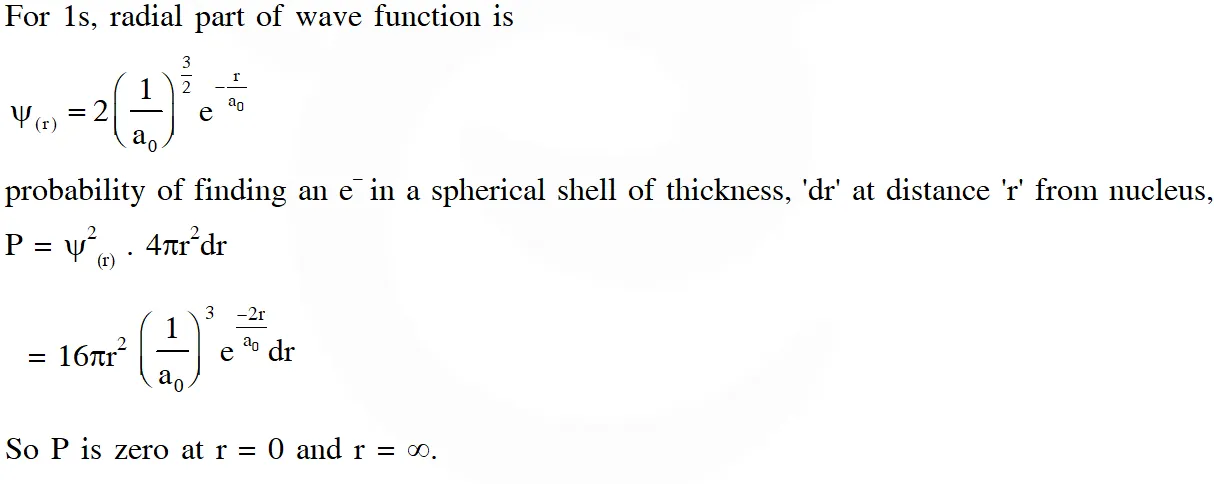
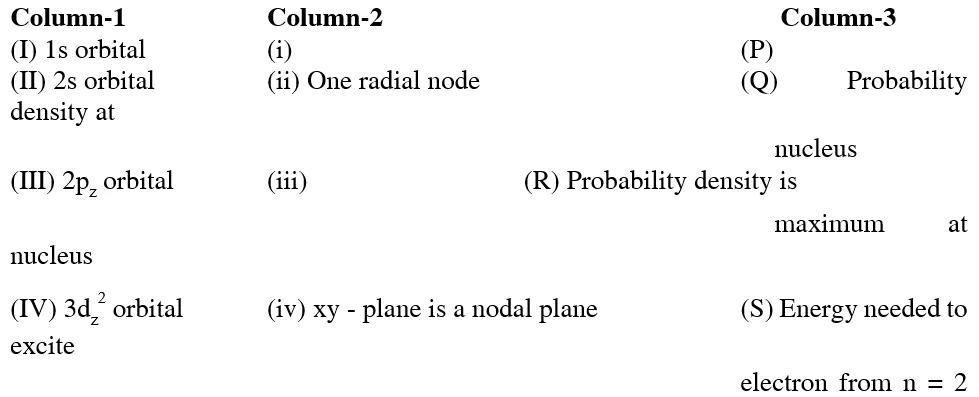

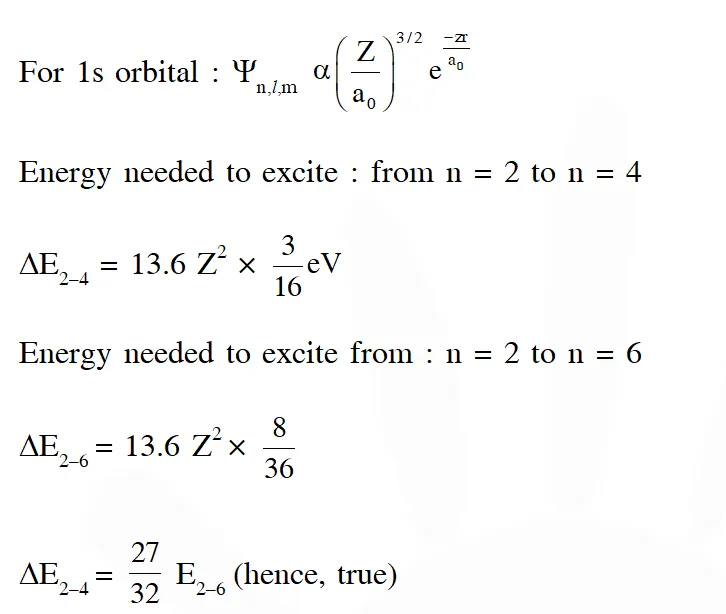
After completing Atomic Structure - JEE Advanced PYQs (Physics), move to full unsolved papers through the JEE Advanced exam paper.
Expert Strategy: How to Approach Atomic Structure in JEE Advanced
What sub-topics carry the most marks?
Wave functions, orbital shapes, and node calculations account for nearly 50% of all marks from this chapter. Bohr model calculations and quantum number assignments each contribute roughly 20%.
How should you sequence your preparation?
- Master NCERT first. The foundation for all JEE Advanced Atomic Structure questions lies in a thorough reading of NCERT Class 11 Chemistry Chapter 2. Use the NCERT Solutions for Class 11 Chemistry alongside.
- Solve JEE Main PYQs before tackling JEE Advanced questions — they build the calculation speed you need.
- Dedicate focused sessions to wave functions. Understand ψ, ψ², and 4πr²ψ² separately before attempting 2017-type questions.
- Work through eSaral's structured problem sets — taught by IIT Bombay faculty who have cleared JEE with AIR-41, these sessions break down exactly how examiners construct traps in quantum number problems.
What mistakes do most students make?
| Common Mistake | Correction |
|---|---|
| Confusing radial nodes with angular nodes | Radial nodes = n − l − 1; Angular nodes = l |
| Using wrong temperature unit in the de Broglie formula | Always convert °C to Kelvin |
| Misidentifying spherically symmetric orbitals | Only s-orbitals (l = 0) are spherically symmetric |
| Calculating energy without squaring Z | Eₙ = −13.6 × Z²/n² eV — Z must be squared |
| Mixing probability density with radial probability | These are different — 4πr²ψ² ≠ ψ² |
After completing these Atomic Structure PYQs, students can take their problem-solving practice to the next level with Irodov Selected Questions for JEE Advanced. These selected questions are especially helpful for students who want to strengthen their conceptual approach and become more confident with challenging problems.
For deeper conceptual reinforcement across Physical Chemistry, the NCERT Solutions for Class 12 Chemistry also contain relevant quantum mechanics applications worth revisiting.
Frequently Asked Questions
Find answers to common questions.
What is the formula for radial nodes in JEE Advanced questions?
The number of radial nodes in an orbital = n − l − 1, where n is the principal quantum number and l is the azimuthal quantum number. For example, a 3p orbital has 3 − 1 − 1 = 1 radial node. Angular nodes = l. Total nodes = n − 1.
Which sub-topic of Atomic Structure is hardest in JEE Advanced?
Wave function and orbital mathematics — including matching wave function expressions to quantum numbers, identifying nodal planes, and interpreting probability density graphs — are consistently the hardest sub-topics. Questions from JEE Advanced 2017 (the matrix-match set on ψ, radial nodes, and angular nodes) are considered among the most difficult ever asked in this chapter.
How many questions from Atomic Structure appear in JEE Advanced each year?
Typically, 2 to 4 questions appear from Atomic Structure in JEE Advanced each year, often clubbed as paragraph-based or matrix-match sets that carry 9–12 marks total. The chapter has appeared consistently in every paper from 2010 to 2017 and remains a high-priority topic according to the official JEE Advanced syllabus published by IIT on jeeadv.ac.in.
Is NCERT enough for Atomic Structure in JEE Advanced?
NCERT Class 11 Chemistry Chapter 2 is necessary but not sufficient for JEE Advanced. NCERT covers the core concepts — Bohr model, quantum numbers, shapes of orbitals, and the photoelectric effect — but JEE Advanced questions go deeper into wave function mathematics, probability density graphs, and multi-concept paragraph problems. After NCERT, practise all available PYQs and eSaral's topic-wise advanced problem sets.
How is de Broglie wavelength calculated for gas molecules in JEE Advanced?
For a gas at temperature T (in Kelvin), the thermal de Broglie wavelength is λ = h/√(3mkT), where m is mass per molecule and k is Boltzmann's constant. When comparing two gases, use the ratio λ₁/λ₂ = √(m₂T₂/m₁T₁). Always convert temperatures to Kelvin before applying this formula.
How do I calculate the energy of a hydrogen-like species in JEE Advanced?
Use the formula Eₙ = −13.6 × Z²/n² eV, where Z is the atomic number and n is the principal quantum number. For Li²⁺ (Z = 3) in n = 2: E = −13.6 × 9/4 = −30.6 eV, which equals 2.25 times the hydrogen ground state energy of −13.6 eV.