Calorimetry - JEE Main Previous Year Questions with Solutions
Practice JEE Main previous year capacitor and electrostatics questions with detailed solutions covering RC circuits, capacitance, dielectrics, charging, discharging, and electric fields.

eSaral › JEE › JEE Main ›Calorimetry - JEE Main Previous Year Questions with Solutions

🚀 Checkout eSaral Courses
Download eSaral app for free study material and video tutorials. Simulator Previous Years AIEEE/JEE Mains Questions 
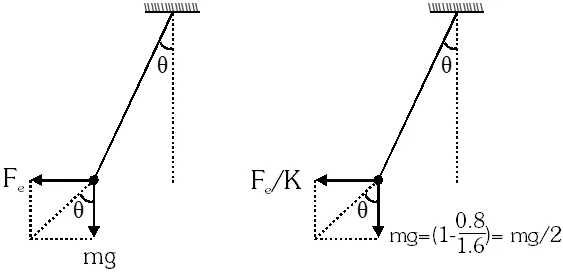 Therefore K =2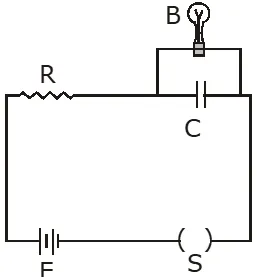
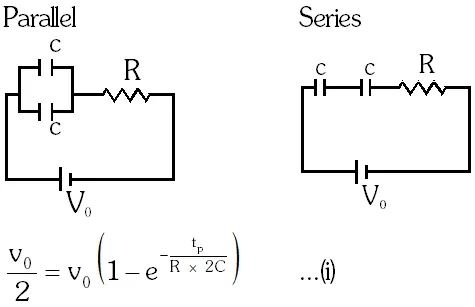
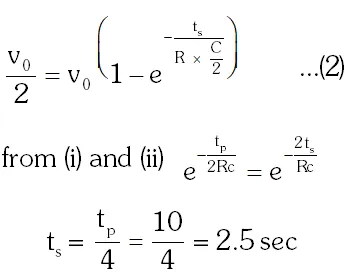
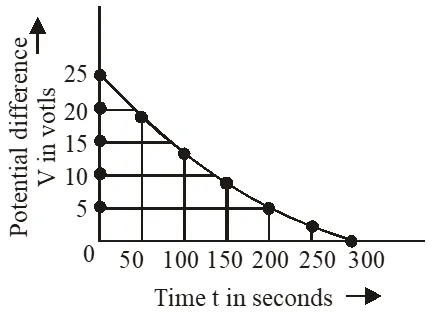 (1) 100 sec and 150 sec (2) 150 sec and 200 sec (3) 0 and 50 sec (4) 50 sec and 100 sec [AIEEE-2012]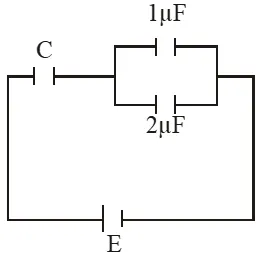
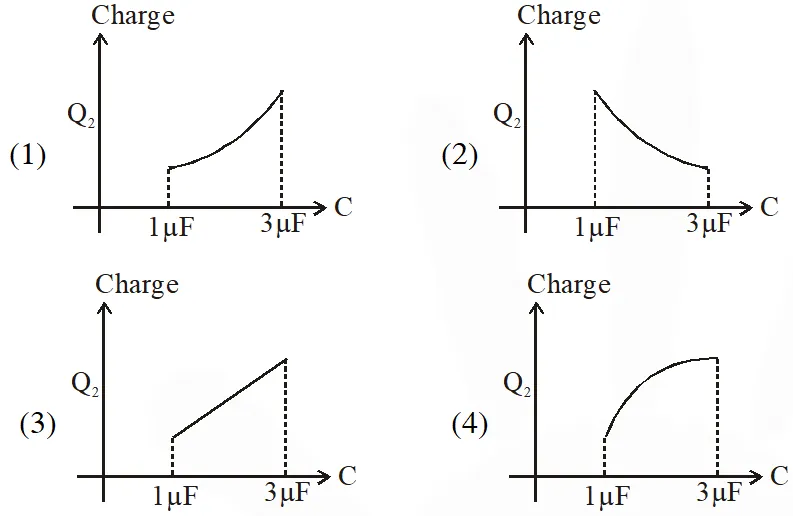 [JEE-Mains-2015]
 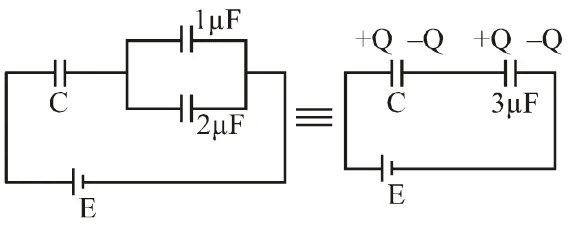 $\mathrm{C}_{\mathrm{eq}}=\frac{3 \mathrm{C}}{3+\mathrm{C}} \quad \mathrm{Q}=\mathrm{Ceq} \mathrm{E}$ $\mathrm{Q}_{2}=\frac{2 \mathrm{CE}}{(\mathrm{C}+3)}=\frac{3 \mathrm{CE}}{(\mathrm{C}+3)}$ $=2 \mathrm{E}\left[1-\frac{3}{\mathrm{C}+3}\right]$ $\mathrm{Q}_{2 / \mathrm{when}} \mathrm{C}=1_{\mathrm{HF}}=2 \mathrm{E}\left[\frac{1}{4}\right]=\frac{\mathrm{E}}{2}$ $\mathrm{Q}_{2 / \mathrm{when}} \mathrm{C}=3_{1 \mathrm{F}}=2 \mathrm{E}\left[\frac{1}{2}\right]=\mathrm{E}$ $\frac{\mathrm{dQ}}{\mathrm{d} \mathrm{C}}=-\frac{2 \mathrm{E} \cdot 3}{(\mathrm{C}+3)}(-1)=\frac{6 \mathrm{E}}{(\mathrm{C}+3)^{2}}>0$ $\frac{\mathrm{d}^{2} \theta}{\mathrm{d} \mathrm{C}^{2}}=\frac{6 \mathrm{E}(-2)}{(\mathrm{C}+3)^{3}}=-\frac{12 \mathrm{E}}{(\mathrm{C}+3)^{2}}<0$
 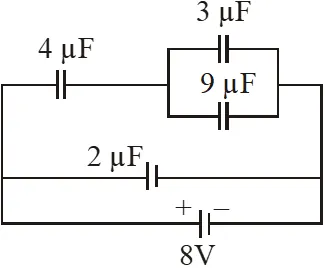 (1) 480 N/C (2) 240 N/C (3) 360 N/C (4) 420 N/C [JEE-Mains-2016]
 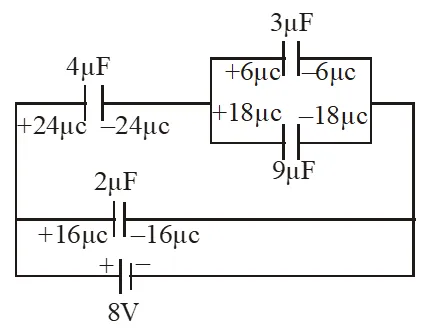 $\mathrm{Q}=24+18=42 \mu \mathrm{c}$ $\mathrm{E}=\frac{\mathrm{KQ}}{\mathrm{r}^{2}}$ $\Rightarrow \mathrm{E}=\frac{9 \times 10^{9} \times 42 \times 10^{-6}}{(30)^{2}}=420 \mathrm{N} / \mathrm{C}$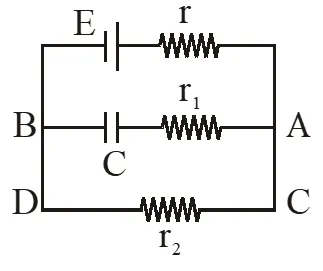
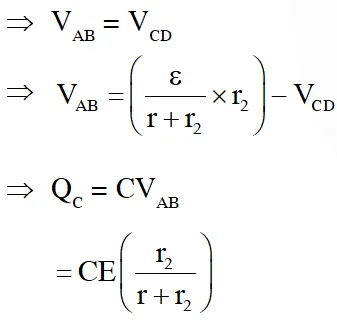
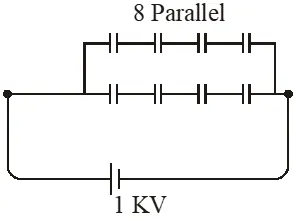 $\Rightarrow$ Minimum no. of capacitors $=8 \times 4=32$
 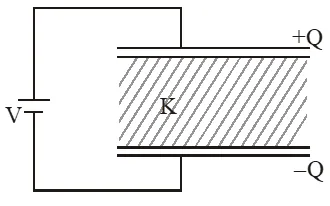 $\mathrm{Q}=(\mathrm{k} \mathrm{C}) \mathrm{V}$ $=\left(\frac{5}{3} \times 90 \mathrm{pF}\right)(20 \mathrm{V})$ = 3000 pC = 3nC induced charges on dielectric $\mathrm{Q}_{\mathrm{ind}}=\mathrm{Q}\left(1-\frac{1}{\mathrm{K}}\right)=3 \mathrm{nC}\left(1-\frac{3}{5}\right)=1.2 \mathrm{nC}$
After practising Calorimetry, explore the JEE Mains PYQ chapter wise collection to work through other Physics chapters from the same organised index.
These Calorimetry questions are pulled from real exams — see them in their original paper format on our JEE Main last year paper page.
Frequently Asked Questions
Find answers to common questions.
What topics are covered under calorimetry in JEE Main?
Calorimetry in JEE Main covers specific heat capacity, latent heat of fusion and vaporisation, the principle of calorimetry (heat lost = heat gained), water equivalent of calorimeter, and mixing problems involving solids, liquids, and gases at different temperatures. NTA includes this under Thermal Properties of Matter in the Class 11 Physics syllabus.
How many questions are asked from calorimetry in JEE Main each year?
NTA typically asks 1 question from calorimetry per JEE Main session, worth 4 marks. Occasionally, 2 questions appear when the paper is heavy on thermal physics. Over the last 10 years, calorimetry has appeared in nearly every paper, making it a reliable scoring topic.
Is calorimetry important for JEE Advanced as well?
Yes. JEE Advanced extends calorimetry into more complex mixing problems, problems with temperature-dependent specific heats (where Q = ∫mcdt must be integrated), and combined thermodynamics problems. Mastering JEE Main-level calorimetry first is essential before tackling Advanced-level problems.
What is the principle of calorimetry used in JEE Main problems?
The principle states that in an isolated system, heat lost by a hotter body equals heat gained by a cooler body: Q_lost = Q_gained, i.e., m₁c₁ΔT₁ = m₂c₂ΔT₂. When phase changes are involved, latent heat terms (mL) must be added to the appropriate side of the equation.
What is the difference between specific heat and latent heat in JEE problems?
Specific heat (c) measures energy needed to change temperature by 1°C per unit mass (Q = mcΔT) — temperature changes. Latent heat (L) measures energy needed to change phase (solid↔liquid or liquid↔gas) at constant temperature (Q = mL) — no temperature change occurs. Missing this distinction is the most common error in JEE calorimetry questions.