CBSE Class 10 Science Revision Notes: Chapter-Wise Physics, Chemistry & Biology Summaries (2026-27)
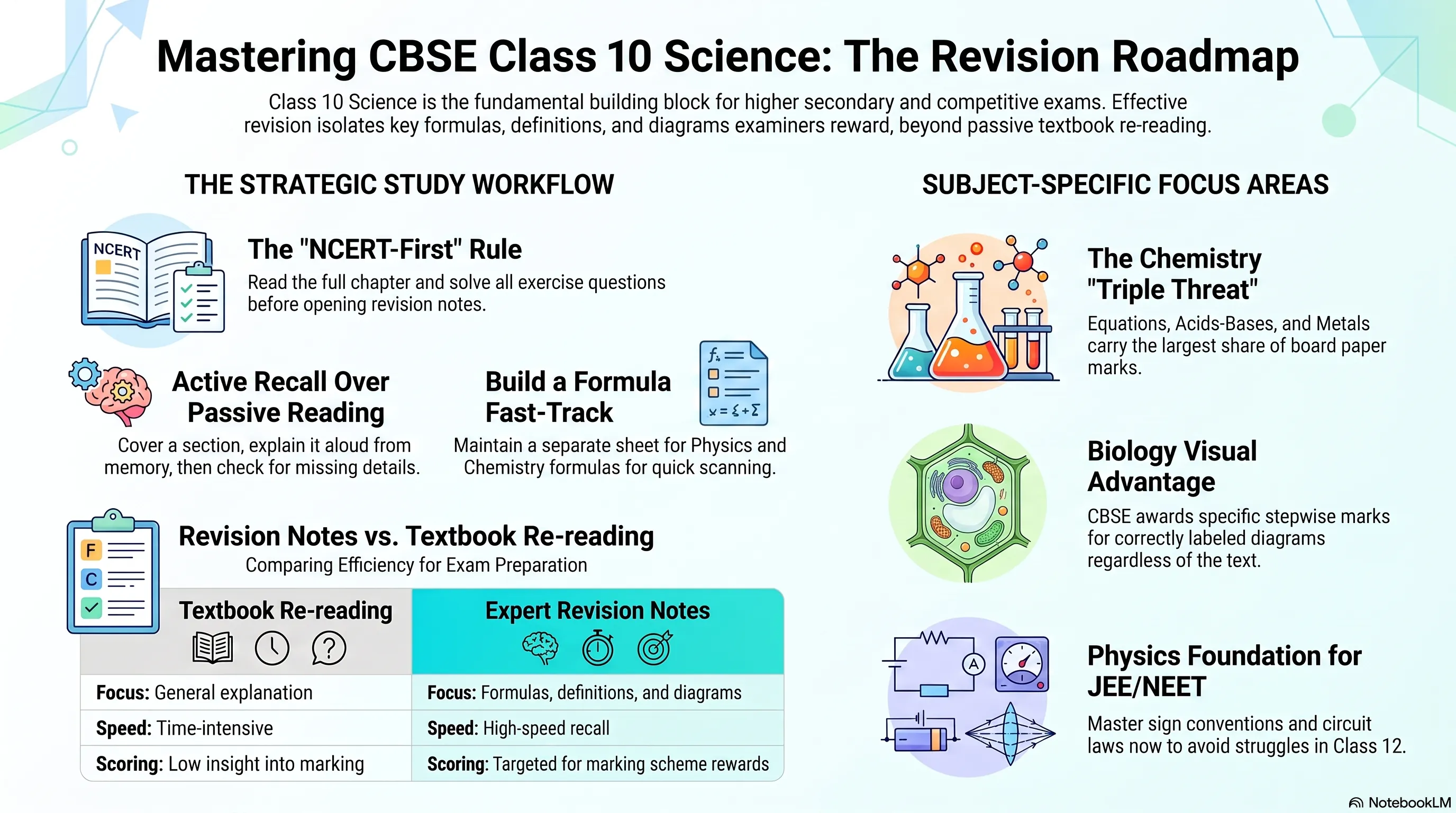
Table of Contents
- Why Class 10 Science Notes Matter More Than You Think
- Physics: Light, Electricity, and Magnetism
- Chemistry: Reactions, Acids, and Metals
- Biology: Life Processes, Reproduction, and Heredity
- How to Actually Study From These Notes
- Common Mistakes That Cost Marks in Science
- Revision Techniques That Work Before Boards
- Pairing Notes with NCERT Solutions

eSaral ›Foundation courses ›Class 10›CBSE Class 10 Science Revision Notes: Chapter-Wise Physics, Chemistry & Biology Summaries (2026-27)

Why Class 10 Science Notes Matter More Than You Think
Most students treat Class 10 Science as one more subject to clear. It isn't. The concepts here — reactions, circuits, life processes — reappear in Class 11 and 12, and again in JEE and NEET syllabi. A shaky Class 10 foundation shows up as a struggle two years later, usually at the worst possible time.
💡 Expert Tip: Students preparing for JEE or NEET often revisit their Class 10 notes on light, electricity, and periodic classification, since these chapters set up the physical and chemical concepts tested at a much deeper level in Class 11-12.
Why Do Good Revision Notes Score Better Than Textbook Re-Reading?
Good revision notes score better because they isolate the formulas, definitions, and diagrams an examiner is actually checking for, instead of the full explanatory text around them. Re-reading a textbook chapter takes far longer and doesn't tell you which sentence the marking scheme rewards.
Board papers also increasingly test application-based and case-study questions rather than pure recall. Notes that connect a concept to a real example — Ohm's Law to a phone charger heating up, or Mendel's laws to family traits — make it easier to answer these without freezing on unfamiliar phrasing.
Physics: Light, Electricity, and Magnetism
Physics in Class 10 splits cleanly into two zones: natural phenomena (reflection, refraction, the human eye) and electric and magnetic effects.
Reflection and Refraction
- Spherical mirrors, focal length, and the mirror formula
- Magnification concepts
- Refraction through different media and the lens formula
- The human eye and common vision defects
Electricity and Magnetism
- Electric current, potential difference, and Ohm's Law
- Factors affecting resistance; series vs. parallel circuits
- Magnetic field lines and Fleming's Left-Hand Rule
- AC vs. DC and their everyday applications
Which Physics Topics Carry Forward Into JEE and NEET?
Light, electricity, and magnetic effects carry forward almost directly into JEE and NEET physics, where they're extended into optics, current electricity, and electromagnetism. Getting the Class 10 fundamentals — sign conventions, circuit laws, field direction rules — solid now saves significant relearning later.
Chemistry: Reactions, Acids, and Metals
Chemical reactions and equations form the base layer of Class 10 Chemistry. Balancing equations correctly comes first; everything else — combination, decomposition, displacement, and redox reactions — builds on that skill.
Acids, Bases and Salts
- Properties of acids and bases, and the pH scale
- Common applications: sodium hydroxide, washing soda
Metals and Non-Metals
- The reactivity series
- Formation of ionic compounds
- Extraction and metallurgical processes
💡 Expert Tip: Chemical Reactions and Equations, Acids-Bases-Salts, and Metals-Non-Metals together account for a large share of the Chemistry section in the board paper — get these three chapters exam-tight before moving to Carbon Compounds or the Periodic Table.
Biology: Life Processes, Reproduction, and Heredity
Biology ties most directly to everyday life, which makes it easier to retain if you study it that way rather than as isolated facts.
Life Processes
- Nutrition in plants and animals
- Respiration, transport, and excretion
Control and Coordination
- Tropic movements in plants
- Basics of the nervous system and hormonal regulation
Reproduction and Heredity
- Asexual vs. sexual reproduction
- Mendel's laws of inheritance and sex determination
Why Are Diagrams So Important in Biology Answers?
Diagrams are important in Biology answers because CBSE awards stepwise marks specifically for correctly labelled figures, separate from the written explanation. Skipping a diagram for the human digestive system or a neuron often means losing marks you could have picked up in under a minute.
How to Actually Study From These Notes
Revision notes work best in a fixed sequence — used out of order, they lose most of their value.
- NCERT first. Read the full chapter and solve every exercise question before opening the notes. CBSE papers are set directly from NCERT, so this step isn't optional.
- Notes for revision, not first learning. Use the chapter notes to revise what you've already studied — not to learn a topic for the first time.
- Colour-code as you revise. A simple system works well: formulas in one colour, definitions in another, experimental steps in a third, and real-world examples in a fourth.
- Build a separate formula sheet. Physics and Chemistry formulas should be quick to scan in the final days before the exam, without hunting through full notes.
- Practise active recall. Cover a section, explain it out loud from memory, then check what you missed. This works better than passively re-reading the same page.
Common Mistakes That Cost Marks in Science
Memorising without understanding. Facts learnt by rote fall apart the moment a question is phrased differently from the textbook. Ask "why" before "what," and try explaining each concept in your own words after reading it.
Skipping diagrams and experiments. Diagrams and numerical problems from light, electricity, and magnetism appear year after year. Practising them from memory, not just recognising them, is what protects those marks.
Studying from outdated notes. CBSE's question patterns shift — competency-based and case-study questions have grown as a share of the paper in recent years. Notes built for an older pattern can leave real gaps, so check that whatever you're using matches the current syllabus.
Revision Techniques That Work Before Boards
- Flashcards for formulas and definitions force active recall, which builds stronger memory than reading a list passively.
- Group study, done well, means each person explains a sub-topic to the others — teaching a concept is one of the fastest ways to find the gaps in your own understanding.
- Weekly sample papers under timed conditions build both speed and exam temperament. Review every mistake afterward and revise that specific gap, not the whole chapter again.
- Digital notes PDFs are useful for last-minute, searchable revision — keep them organised by chapter so you're not scrolling to find what you need.
Pairing Notes with NCERT Solutions
Revision notes are for recall, not for practising full board-style answers. For that, use the NCERT Solutions for Class 10 Science, which walk through every in-text and exercise question with complete, marking-scheme-aligned answers.
If a chapter still feels unclear after revising the notes, it's usually faster to go back to the source rather than re-read the notes again. You can download the official NCERT Class 10 Science Book PDF, or the Hindi-medium version from the NCERT Science Book Class 10 in Hindi page. Subject-specific PDFs are also available separately for Physics (also in Hindi), Chemistry, and Biology (also in Hindi).
For the rest of your subjects, the NCERT Solutions for Class 10 and NCERT Solutions for Class 10 Maths follow the same revise-then-practise approach, backed by the complete NCERT Books for Class 10.
These short notes are already the compressed version of one chapter — a full, guided compression of every chapter is here: crash course for class 10.
Frequently Asked Questions
Find answers to common questions.
Why are CBSE Class 10 Science revision notes important?
They condense complex Physics, Chemistry, and Biology chapters into formulas, definitions, and diagrams that are quick to revise repeatedly. This matters most in the final weeks before boards, when re-reading full textbook chapters isn't practical.
Should I study new topics directly from notes?
No, notes should only be used to revise what you've already learnt from NCERT. Studying a topic for the first time from condensed notes often skips explanations that only the full textbook covers.
How many chapters are in CBSE Class 10 Science?
There are 16 chapters in total, split across Physics, Chemistry, and Biology under the 2026-27 CBSE syllabus. Chemistry and Biology chapters together carry the largest share of marks in the final paper.
Which Class 10 Science chapters carry the most marks?
Chemical Reactions and Equations, Acids-Bases-Salts, Metals and Non-Metals, Life Processes, and Reproduction and Heredity are typically the highest-weightage chapters. Electricity and Light also carry significant numerical and diagram-based marks in Physics.
How should I use diagrams while revising Science?
Draw every diagram yourself rather than only reading it, since CBSE gives stepwise marks for correctly labelled figures. This applies especially to Biology diagrams like the human eye, neuron, and digestive system, and to Physics diagrams like circuits and ray paths.