CBSE Class 10 Social Science Revision Notes: Chapter-Wise Summaries for Faster Exam Prep (2026-27)
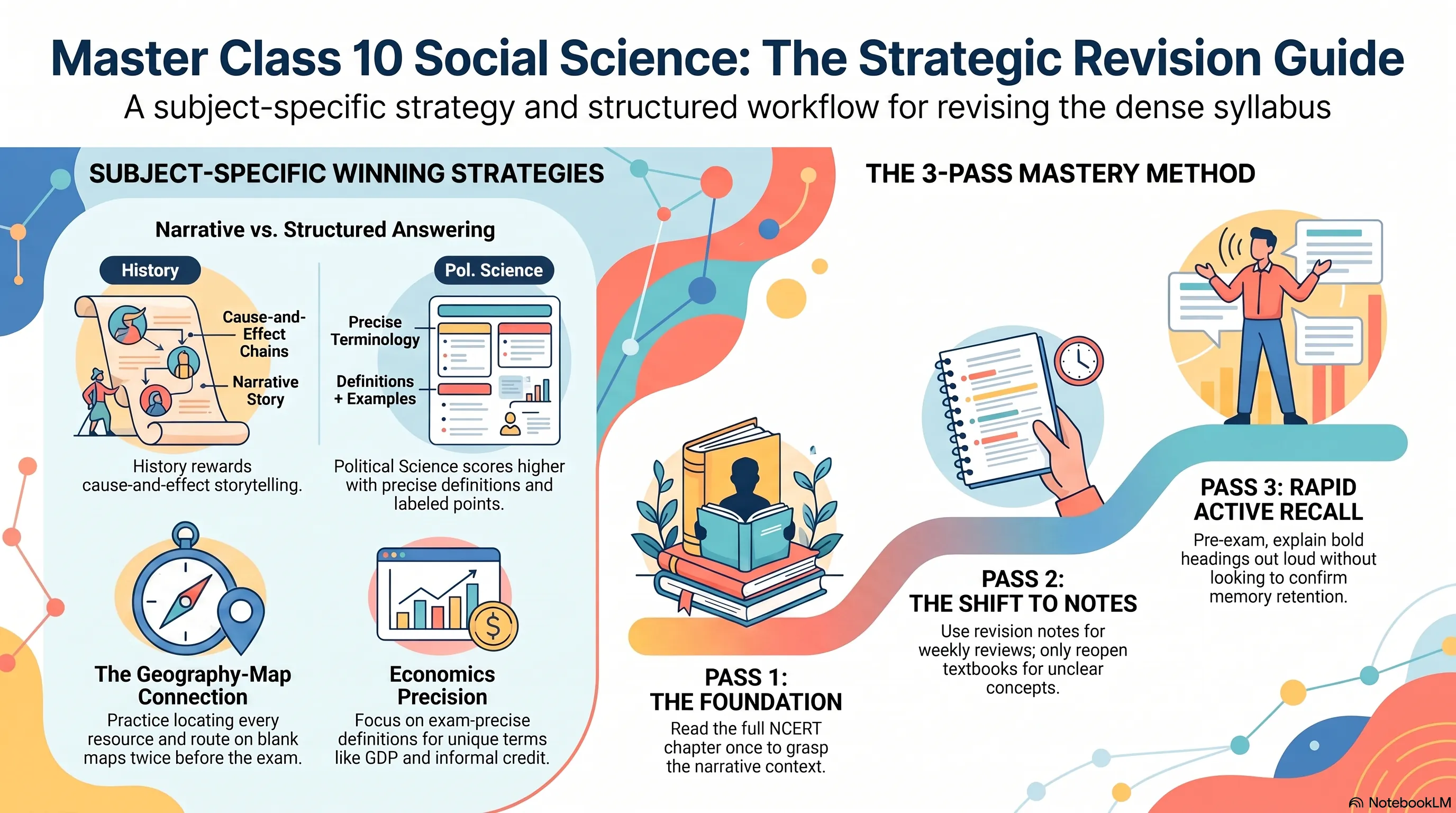
Table of Contents
- Why Class 10 Social Science Feels Harder Than It Should
- History Revision Notes: Chapter List
- Political Science Revision Notes: Chapter List
- Economics Revision Notes: Chapter List
- Geography Revision Notes: Chapter List
- How to Actually Use These Notes While Revising
- Pairing Revision Notes with NCERT Solutions

eSaral ›Foundation courses ›Class 10›CBSE Class 10 Social Science Revision Notes 2026-27

Why Class 10 Social Science Feels Harder Than It Should
Social Science in Class 10 isn't conceptually difficult — it's simply dense. Four subjects, dozens of chapters, hundreds of names, dates, and terms, all bundled into one paper. Most students don't struggle with understanding the content; they struggle with holding all of it in their heads at once.
That's the exact problem chapter-wise revision notes are built to solve. Instead of re-reading full NCERT chapters a week before the exam, you get a distilled version: the facts, causes, effects, and definitions the exam actually tests, without the surrounding narrative.
Below are the notes organised subject-wise, chapter-wise, so you can jump straight to what you need.
History Revision Notes: Chapter List
💡 Study Tip: History chapters in Class 10 are heavy on cause-and-effect chains. Instead of memorising events in isolation, note what led to what — that's how most board questions are framed.
| Chapter | Topic |
|---|---|
| Chapter 1 | The Rise of Nationalism in Europe |
| Chapter 2 | Nationalism in India |
| Chapter 3 | The Making of a Global World |
| Chapter 4 | The Age of Industrialisation |
| Chapter 5 | Print Culture and the Modern World |
Each chapter note covers the key movements, dates, and personalities the CBSE marking scheme rewards, along with the map-based questions commonly asked from Chapters 1 and 2.
Political Science Revision Notes: Chapter List
Political Science, or Democratic Politics, tends to be the most scoring section if you're clear on definitions and examples. Board answers here are checked heavily against precise terminology.
| Chapter | Topic | Chapter | Topic | |
|---|---|---|---|---|
| Chapter 1 | Power Sharing | Chapter 5 | Popular Struggles and Movements | |
| Chapter 2 | Federalism | Chapter 6 | Political Parties | |
| Chapter 3 | Democracy and Diversity | Chapter 7 | Outcomes of Democracy | |
| Chapter 4 | Gender, Religion and Caste | Chapter 8 | Challenges to Democracy |
How Should You Revise Political Science Differently From History?
Political Science rewards structured, definition-first answers rather than narrative ones. Where a History answer can flow as a story, a Political Science answer scores better when it opens with a clear definition, followed by two or three labelled points or examples.
Economics Revision Notes: Chapter List
| Chapter | Topic |
|---|---|
| Chapter 1 | Development |
| Chapter 2 | Sectors of the Indian Economy |
| Chapter 3 | Money and Credit |
| Chapter 4 | Globalisation and the Indian Economy |
| Chapter 5 | Consumer Rights |
Economics is the shortest of the four subjects but the one students most often underprepare for, since it introduces terms — GDP, formal and informal credit, globalisation — that don't appear anywhere else in the Class 10 syllabus. The revision notes focus on getting these definitions exam-precise.
Geography Revision Notes: Chapter List
💡 Study Tip: Geography is the subject most tied to the map-work section of the board paper. Alongside written revision, practise locating every resource, industry, and route mentioned in these chapters on a blank map at least twice before the exam.
How to Actually Use These Notes While Revising
Revision notes only work if they replace re-reading, not add to it. Here's the sequence that gets the best results:
- First pass — Read the full NCERT chapter once, properly, when you're first learning it.
- Second pass — Switch to the revision notes for that chapter during weekly revision. Don't reopen the textbook unless something feels unclear.
- Third pass (pre-exam) — Use only the notes, ideally the headings and bold terms, to do a rapid recall check. If you can explain a heading out loud without looking, you're ready; if you can't, that's exactly where to spend your remaining time.
Why Do Revision Notes Help With Memory Retention?
Revision notes highlight only the load-bearing facts of a chapter, so your brain isn't re-processing paragraphs of context every time you revise. Repetition of the same short summary, rather than the full chapter, is what moves information from short-term to long-term memory before an exam.
Notes also travel well — between classes, on the bus, or during a ten-minute gap — which matters more than it sounds, since most last-minute revision happens in small, scattered windows rather than long study sessions.
Pairing Revision Notes with NCERT Solutions
Revision notes are built for recall. They are not built to help you write full-length board answers or solve numerical-style questions — that's where NCERT Solutions for Class 10 come in, with fully worked answers to every in-text and end-of-chapter question.
Use the two together: revise the chapter's key facts from the notes, then check your answer-writing against the NCERT Solutions for Class 10 to see how a full-mark answer is structured. The same approach works for NCERT Solutions for Class 10 Science and NCERT Solutions for Class 10 Maths, which follow the same revise-then-practise pattern.
If any Social Science chapter still feels shaky, it usually helps to go back to the original textbook rather than the notes alone. You can download the official NCERT Books for Class 10 in PDF form, including the Class 10 Science NCERT book, the Class 10 Maths NCERT book, and the Class 10 English book.
Mind maps work because there's no time left to reread the whole chapter — that's exactly the pace this is built around: class 10 crash course.
Frequently Asked Questions
Find answers to common questions.
What is included in CBSE Class 10 Social Science revision notes?
They include chapter-wise summaries of History, Geography, Political Science, and Economics, covering key dates, definitions, causes, and effects. Diagrams and maps are included where the chapter is map-heavy, such as Resources and Development or Nationalism in India.
Are Class 10 Social Science revision notes enough to score full marks?
Revision notes alone are not enough; they're meant for quick recall, not full answer-writing practice. Pair them with NCERT Solutions and past papers to convert the recalled facts into complete, well-structured board answers.
How many chapters are there in CBSE Class 10 Social Science?
There are 20 chapters in total across four subjects: 5 in History, 8 in Political Science, 5 in Economics, and 7 in Geography under the 2026-27 CBSE syllabus. Each subject is scored and evaluated separately within the same paper.
When should I start using revision notes for Class 10 Social Science?
Start using revision notes for weekly recall once you've completed a chapter in class, rather than waiting until just before the exam. This spaced repetition is what makes the facts stick, instead of cramming them in the final week.
Which Class 10 Social Science subject is the highest scoring?
Political Science is generally considered the most scoring, since its answers rely on precise, learnable definitions rather than long descriptive explanations. Economics is a close second for the same reason, provided its core terms are learnt exactly.