Classification of Elements and Periodicity in Properties Class 11, IIT JEE & NEET
Master Classification of Elements and Periodicity for JEE & NEET with complete notes on periodic trends, atomic radius, ionisation enthalpy, electron affinity, electronegativity, block classification, and key exceptions like Be–B and N–O.

Table of Contents
- Chapter Overview and JEE/NEET Weightage
- Historical Development: From Döbereiner to Mendeleev
- Modern Periodic Law and the Long-Form Periodic Table
- Classification of Elements and Periodicity in Properties Notes
- How Are Elements Classified in the Periodic Table?
- What Are Periodic Properties and How Do They Change Across Periods and Groups?
- Most Important Topics for JEE Main and NEET From This Chapter
- How to Study Classification of Elements for JEE and NEET

eSaral ›Classification of Elements and Periodicity in Properties Class 11, IIT JEE & NEET

Chapter Overview and JEE/NEET Weightage
Classification of Elements and Periodicity in Properties forms the structural backbone of all of inorganic chemistry. Every chapter you study after this — chemical bonding, p-block, d-block, coordination compounds — builds directly on the periodic trends introduced here.
Expected questions in JEE Main: 1–2 questions per paper (mostly application-based on periodic trends) Expected questions in NEET: 2–3 questions per paper (concept + assertion-reasoning type) Class 12 Board weightage: Concepts from this chapter appear in questions on s-block and p-block elements
If your understanding of periodic trends is weak, you will lose marks in at least 4–5 chapters downstream. This is a chapter worth mastering fully, not skimming.
Historical Development: From Döbereiner to Mendeleev
Döbereiner's Triads (1829)
Johann Döbereiner observed that certain groups of three elements (triads) had similar properties. In each triad, the atomic weight of the middle element was approximately the average of the first and third.
Example Triad:
| Element | Symbol | Atomic Weight |
|---|---|---|
| Calcium | Ca | 40 |
| Strontium | Sr | 87.6 ≈ (40+135)/2 |
| Barium | Ba | 135 |
Limitation: Only a few elements could be grouped into triads. The law did not extend to all known elements.
Newlands' Law of Octaves (1865)
John Newlands arranged elements in order of increasing atomic weight and found that every eighth element had properties similar to the first. He called this the Law of Octaves (by analogy with musical notes).
Limitation: The law worked only up to calcium (atomic weight 40). Beyond that, the pattern broke down. Noble gases had not yet been discovered, and some slots had to be filled with two elements.
Mendeleev's Periodic Law (1869)
Dmitri Mendeleev arranged all 63 known elements in order of increasing atomic weight. His key contribution was leaving gaps for undiscovered elements and predicting their properties. Three predictions were confirmed within his lifetime:
| Predicted Element | Discovered As | Year of Discovery |
|---|---|---|
| Eka-boron | Scandium (Sc) | 1879 |
| Eka-aluminium | Gallium (Ga) | 1875 |
| Eka-silicon | Germanium (Ge) | 1886 |
Anomalies in Mendeleev's table:
- Position of isotopes was not defined
- Hydrogen's placement was ambiguous
- Certain element pairs were reversed in atomic weight order to maintain chemical similarity (e.g., Ar before K, Co before Ni)
Modern Periodic Law and the Long-Form Periodic Table
Modern Periodic Law
"The physical and chemical properties of elements are a periodic function of their atomic numbers." — Henry Moseley, 1913
Moseley's work showed that atomic number (number of protons), not atomic weight, is the fundamental property that determines an element's chemical behaviour. This resolved all the anomalies in Mendeleev's table.
Structure of the Long-Form Periodic Table
The modern periodic table has 118 elements arranged in 18 groups (vertical columns) and 7 periods (horizontal rows).
| Period | Number of Elements | Electron Shells Filling |
|---|---|---|
| 1 | 2 | 1s |
| 2 | 8 | 2s, 2p |
| 3 | 8 | 3s, 3p |
| 4 | 18 | 4s, 3d, 4p |
| 5 | 18 | 5s, 4d, 5p |
| 6 | 32 | 6s, 4f, 5d, 6p |
| 7 | 32 | 7s, 5f, 6d, 7p |
💡 Expert Tip by Prateek Gupta, IIT Bombay: "Students often lose marks by confusing period number with shell number. Remember — the period number tells you the highest principal quantum number (n) of the valence shell for that row. Period 4 elements have n = 4 as their outermost shell."
Classification of Elements and Periodicity in Properties Notes
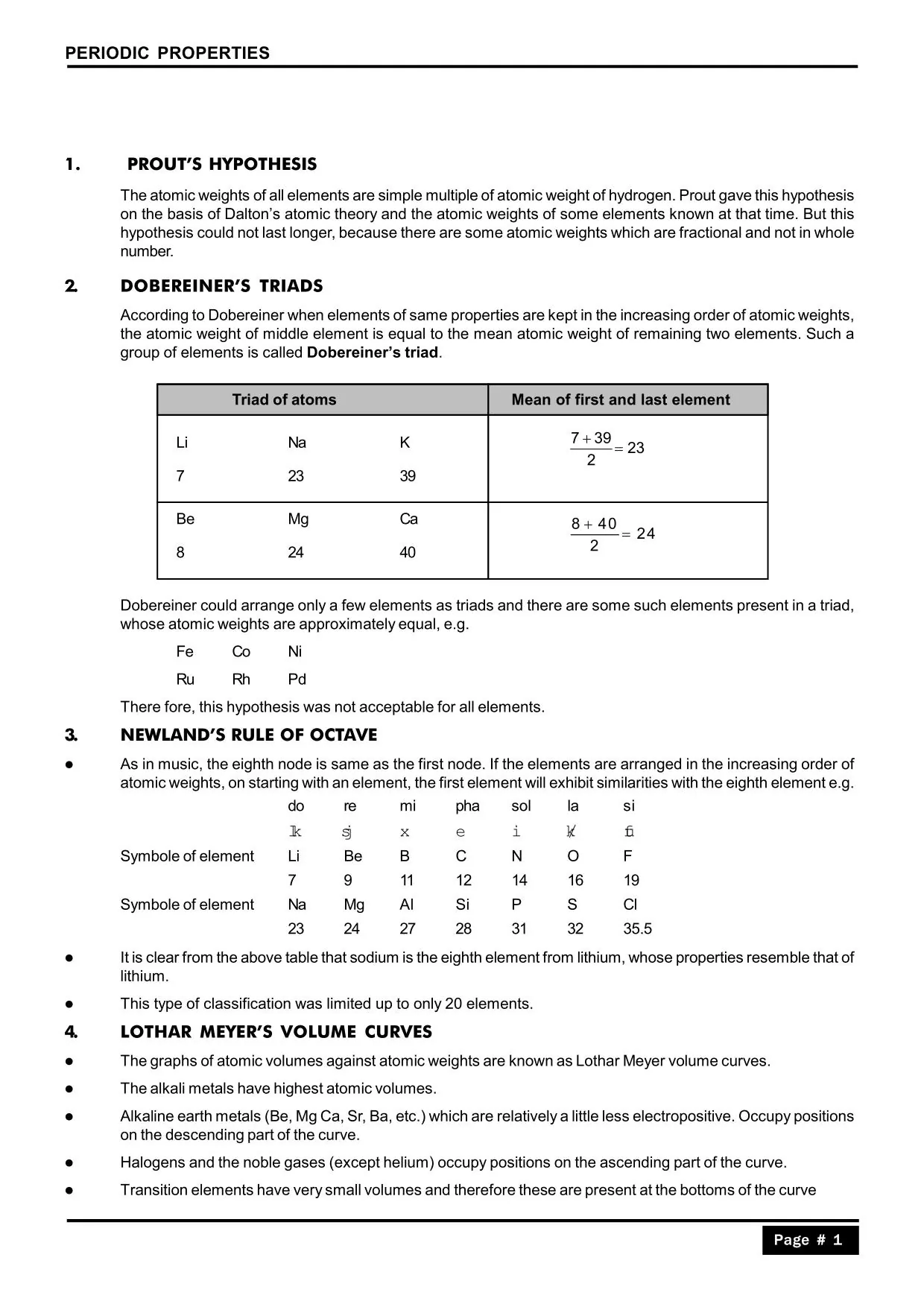
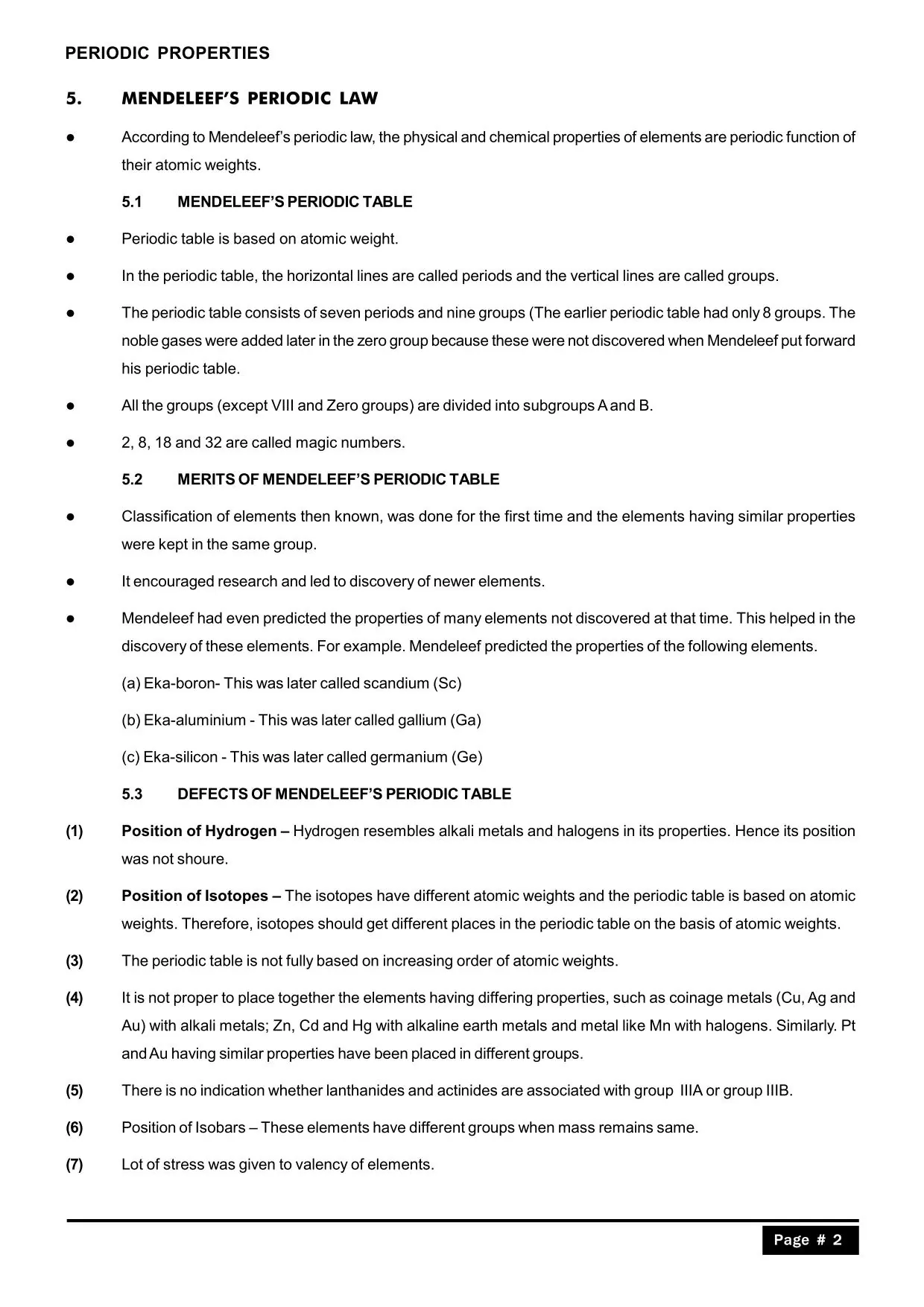
India's Best Exam Preparation for Class 11th - Download Now
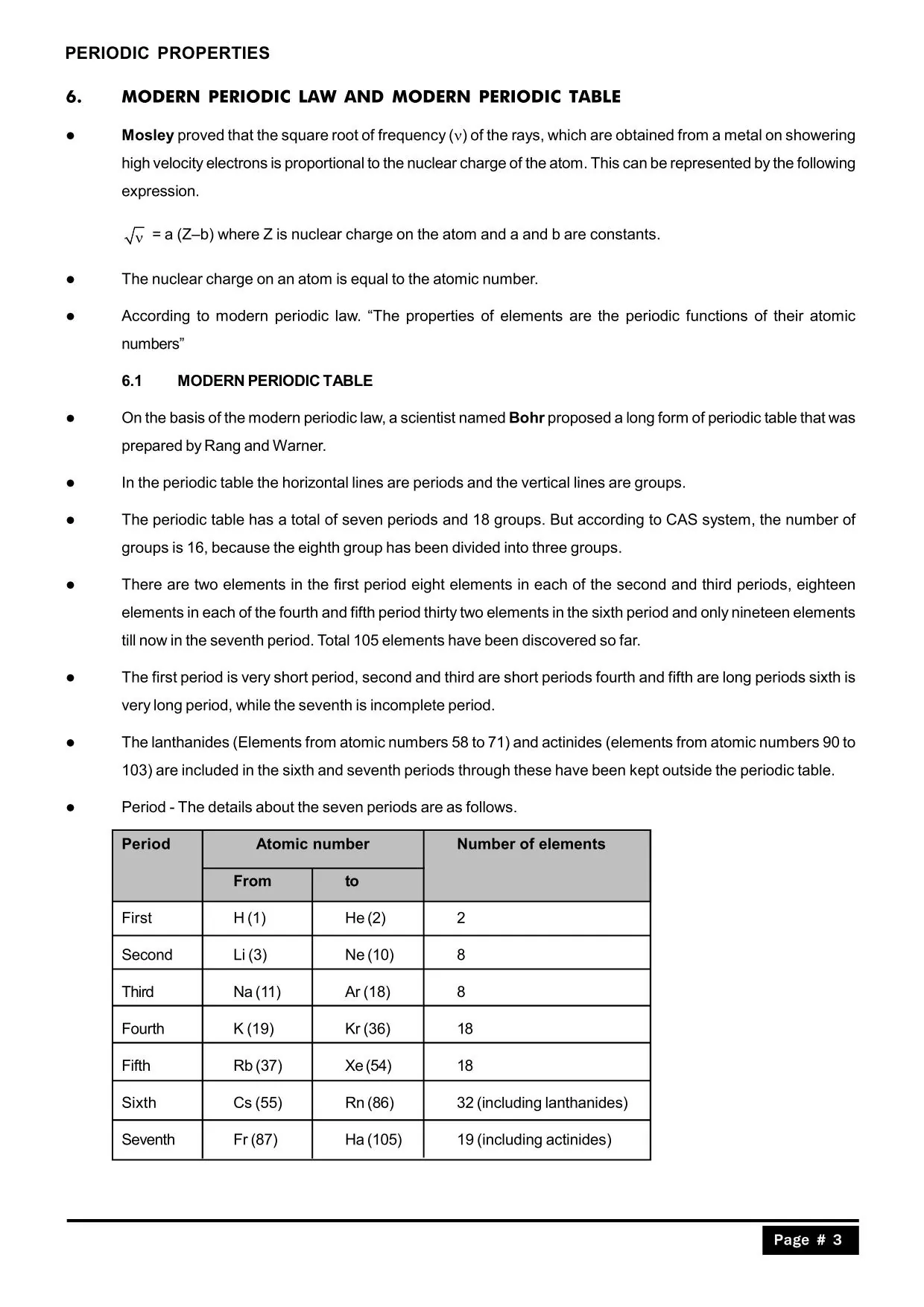
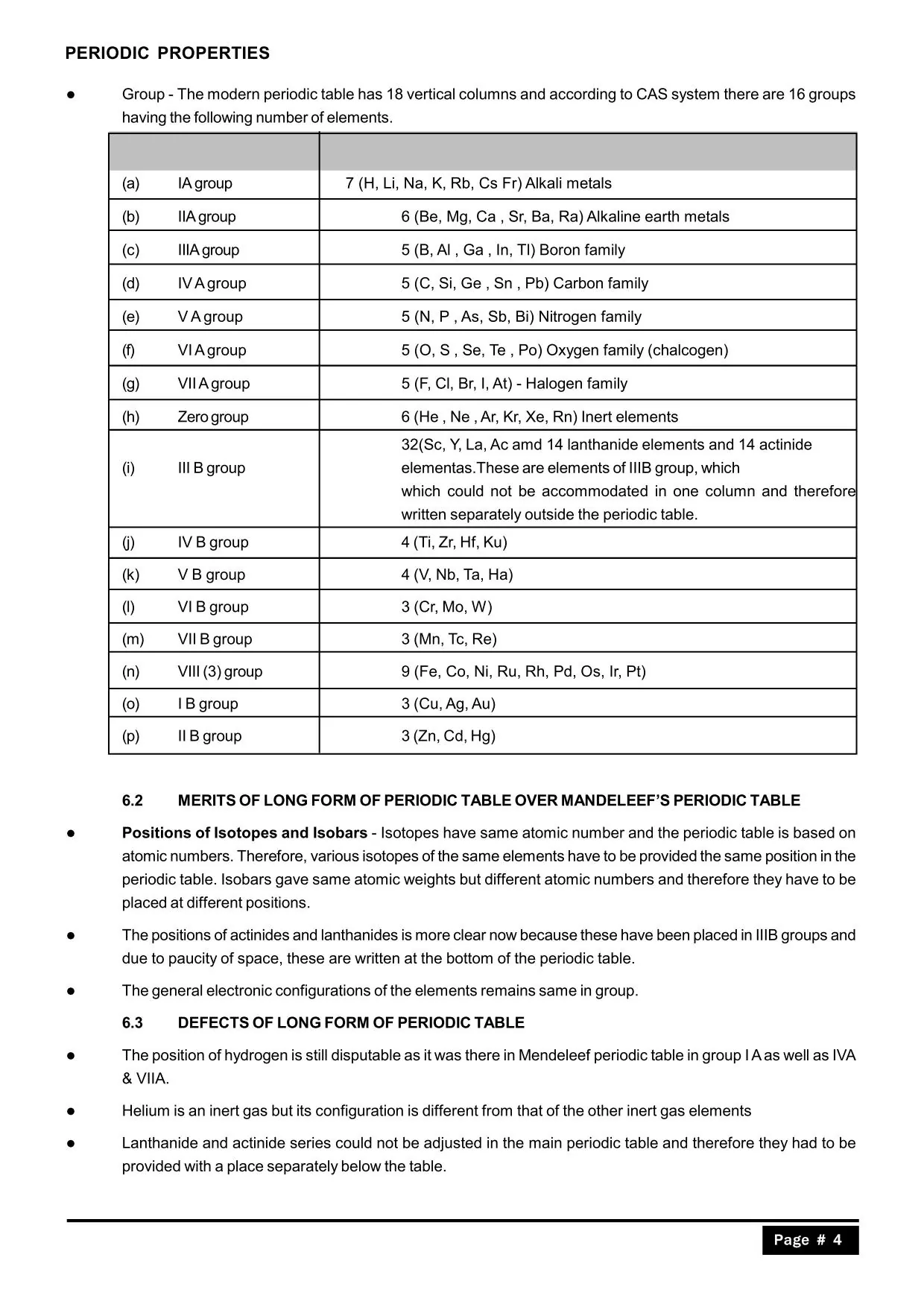
India's Best Exam Preparation for Class 11th - Download Now
India's Best Exam Preparation for Class 11th - Download Now
India's Best Exam Preparation for Class 11th - Download Now
How Are Elements Classified in the Periodic Table?
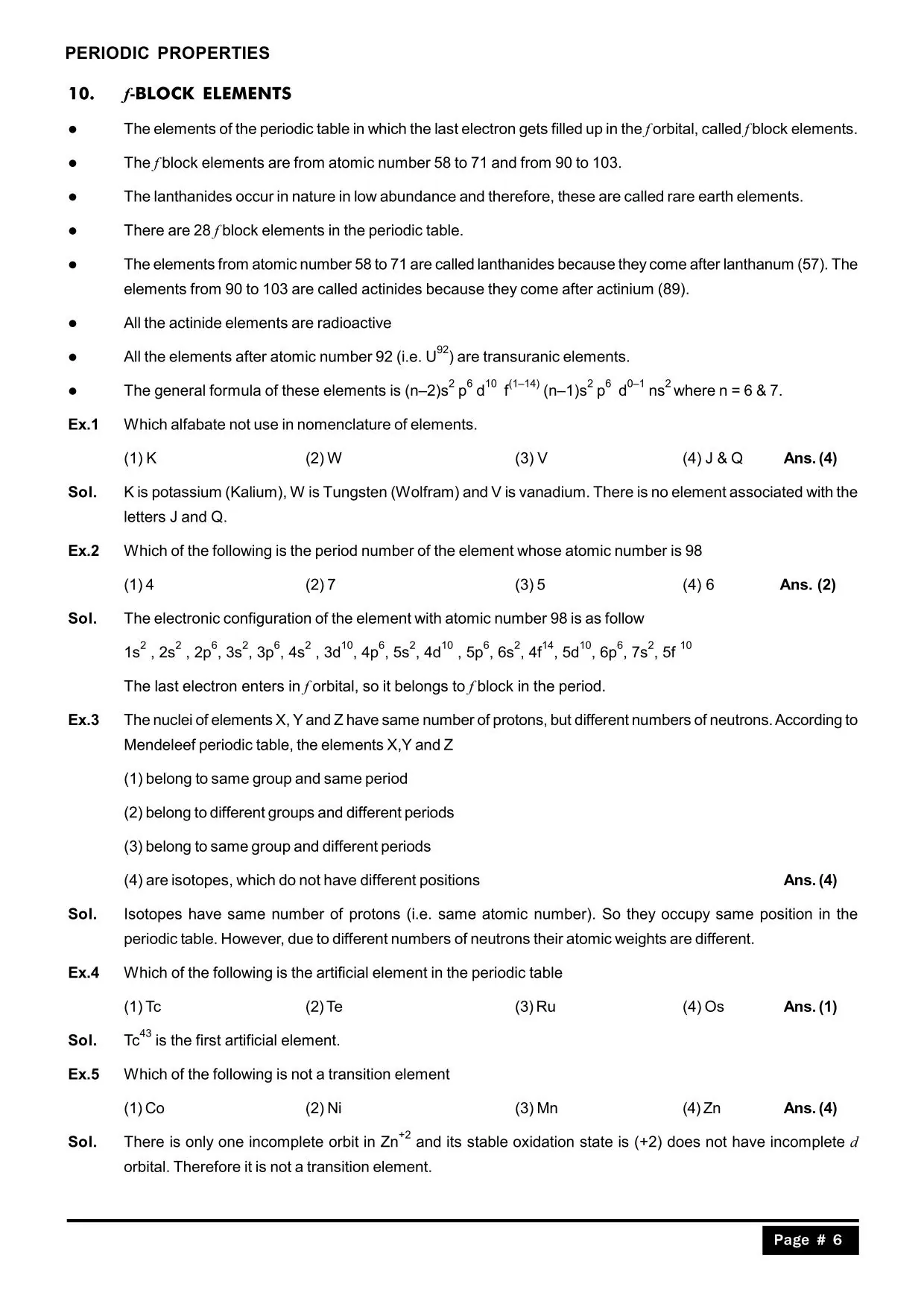
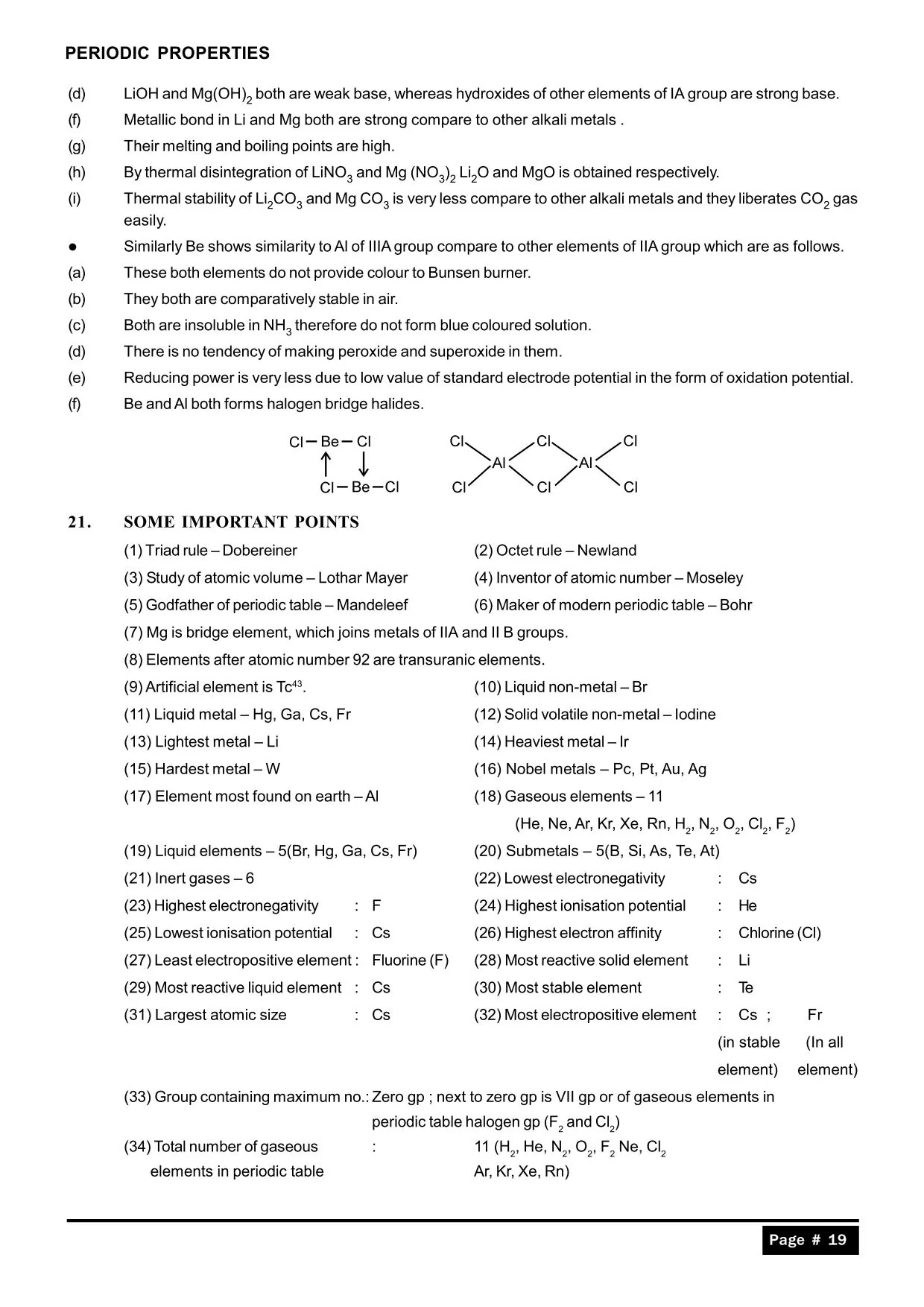
Elements are divided into four blocks based on the subshell being filled by the last electron (the differentiating electron):
s-Block Elements (Groups 1 and 2)
- Last electron enters the s subshell
- Includes alkali metals (Group 1) and alkaline earth metals (Group 2)
- Highly reactive metals; form basic oxides
p-Block Elements (Groups 13 to 18)
- Last electron enters the p subshell
- Includes metals, metalloids, non-metals, and noble gases
- Most diverse block; covers a huge range of properties
d-Block Elements (Groups 3 to 12)
- Last electron enters the d subshell
- Also called transition metals
- Exhibit variable oxidation states; important in coordination chemistry
f-Block Elements (Lanthanoids and Actinoids)
- Last electron enters the f subshell
- Placed separately at the bottom of the table
- Lanthanoids (58–71), Actinoids (90–103)
Classification of elements based on properties:
- Metals: left and centre of the table (~80 elements)
- Non-metals: upper right of the table
- Metalloids: a diagonal band between metals and non-metals (B, Si, Ge, As, Sb, Te, Po)
- Noble gases: Group 18 — chemically inert, complete outer shells
What Are Periodic Properties and How Do They Change Across Periods and Groups?
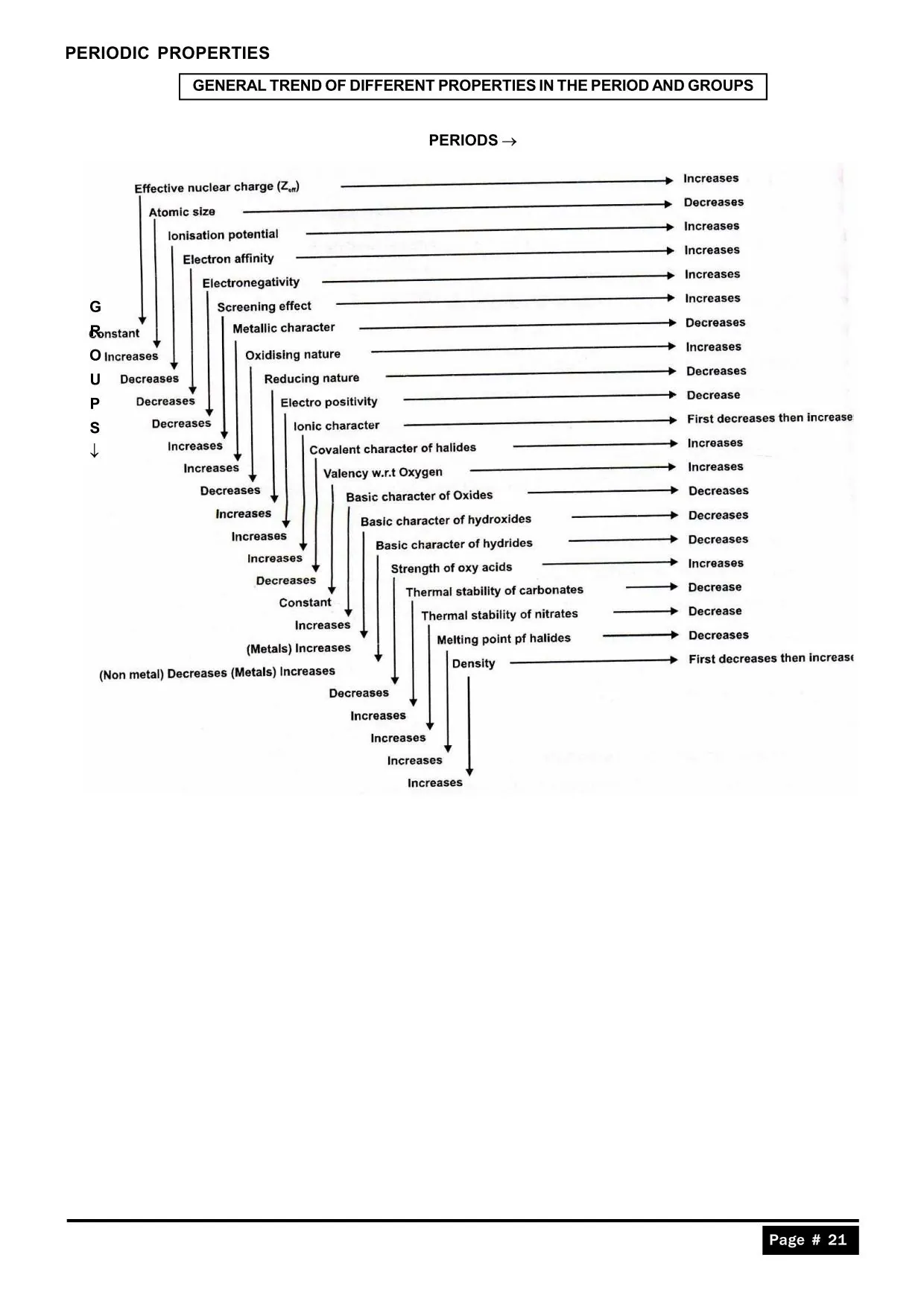
Periodic properties are measurable characteristics that show a regular, predictable pattern across periods and down groups. These trends are the most frequently tested aspect of this chapter in both JEE and NEET.
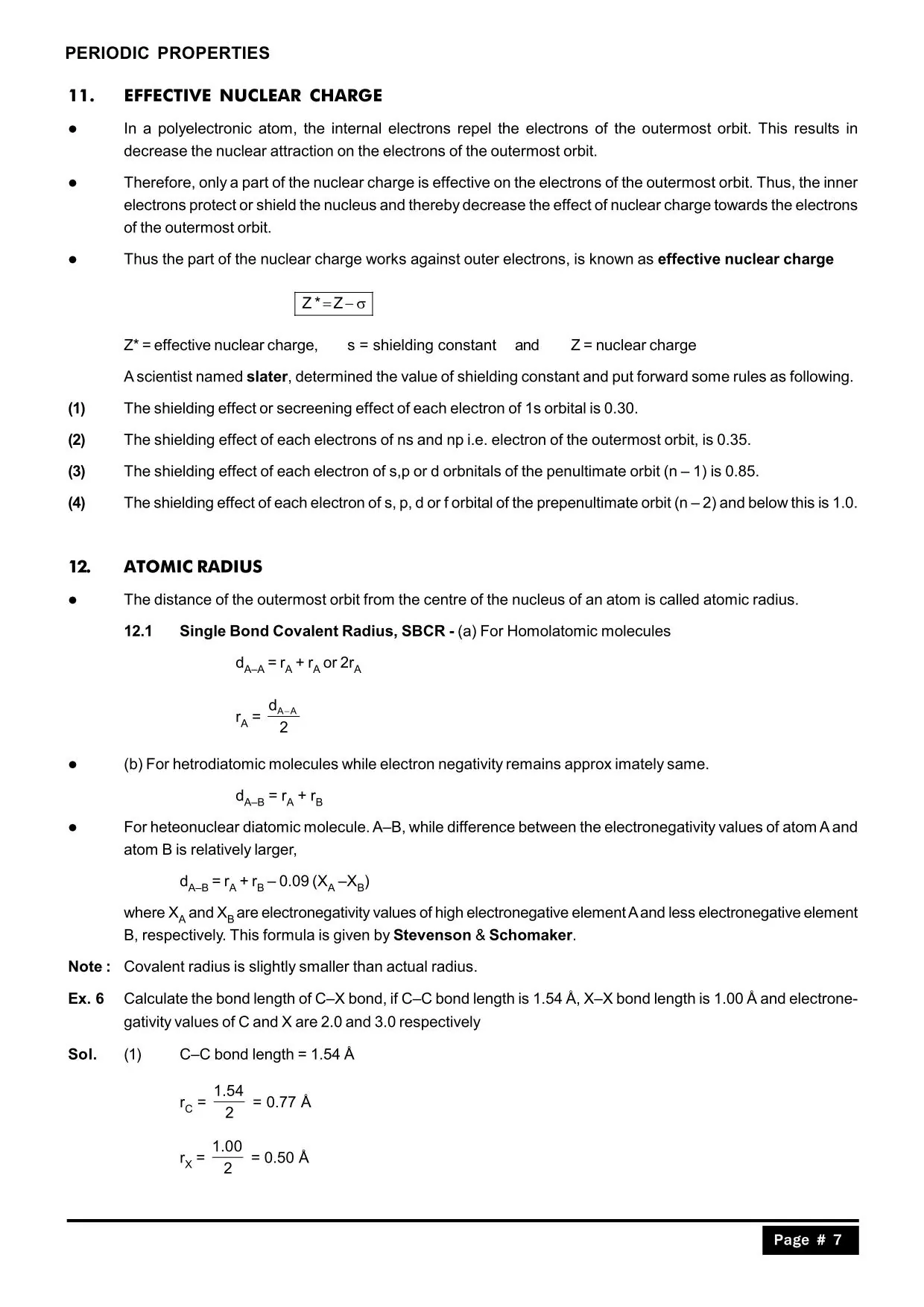
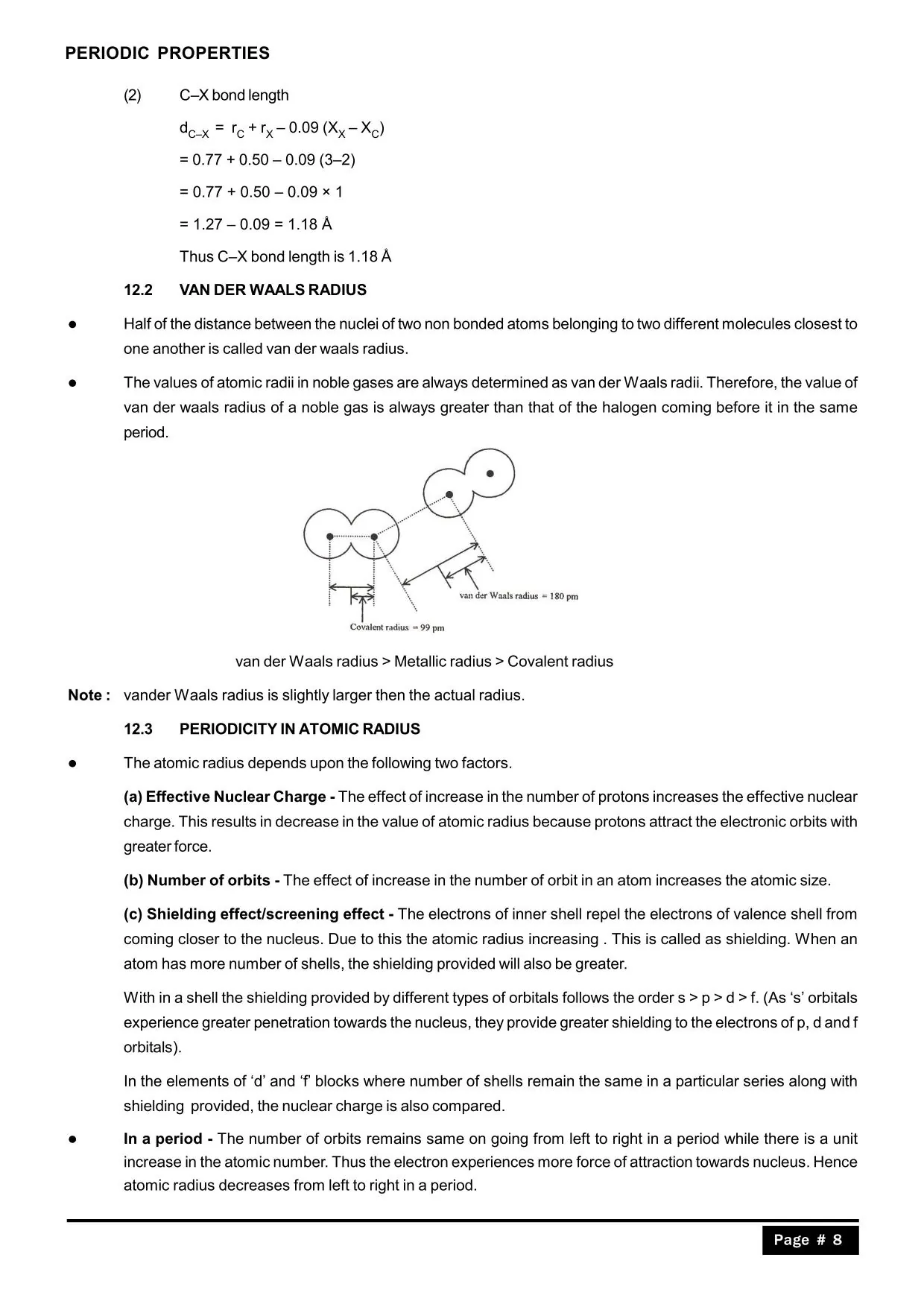
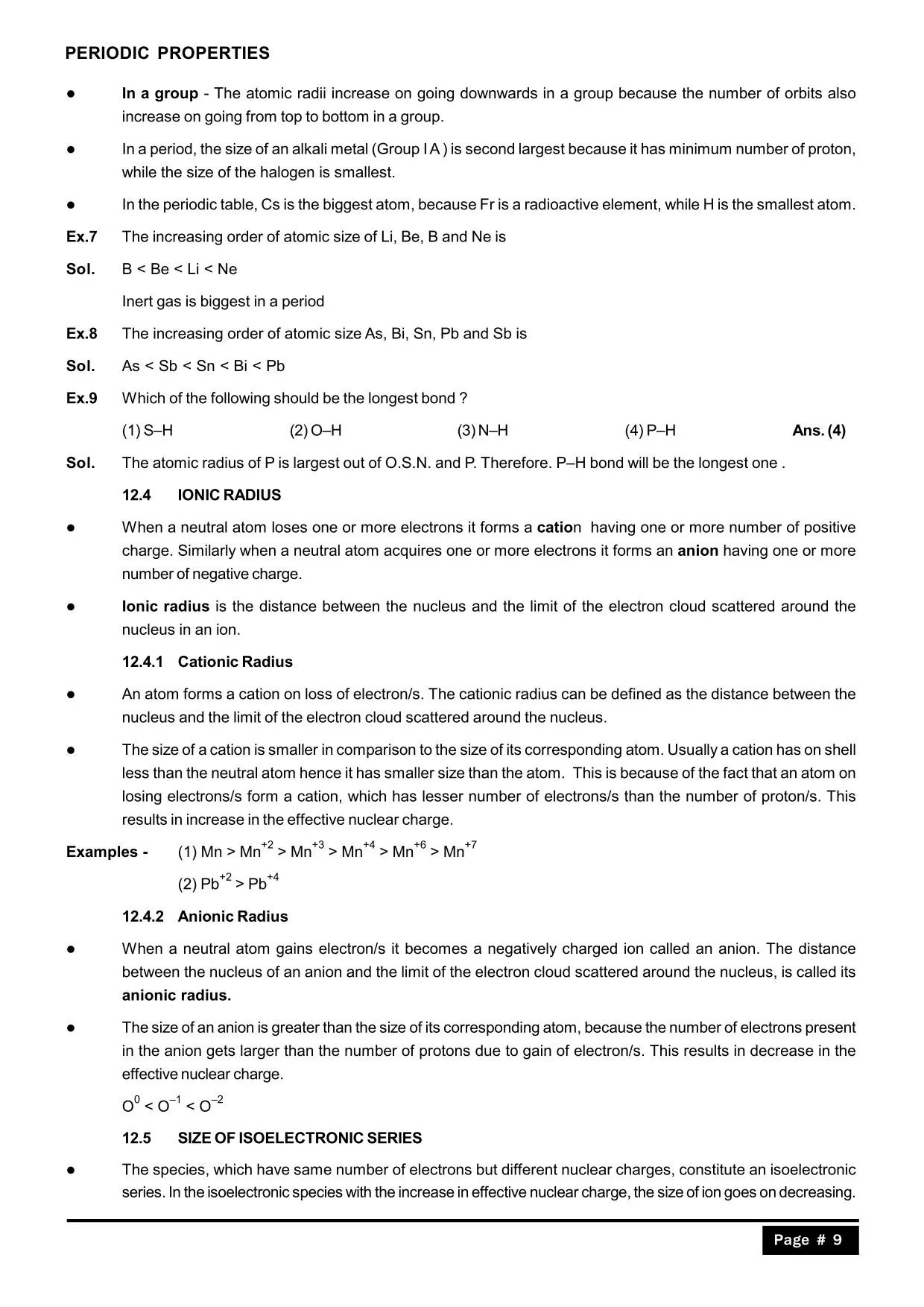
Atomic Radius
Atomic radius is the distance from the nucleus to the outermost electron shell.
- Across a period (left to right): Atomic radius decreases — nuclear charge increases with each element, pulling electrons closer.
- Down a group (top to bottom): Atomic radius increases — new electron shells are added, shielding the outermost electrons from the nucleus.
Exception: Noble gases are excluded from atomic radius comparisons because they do not form covalent bonds.
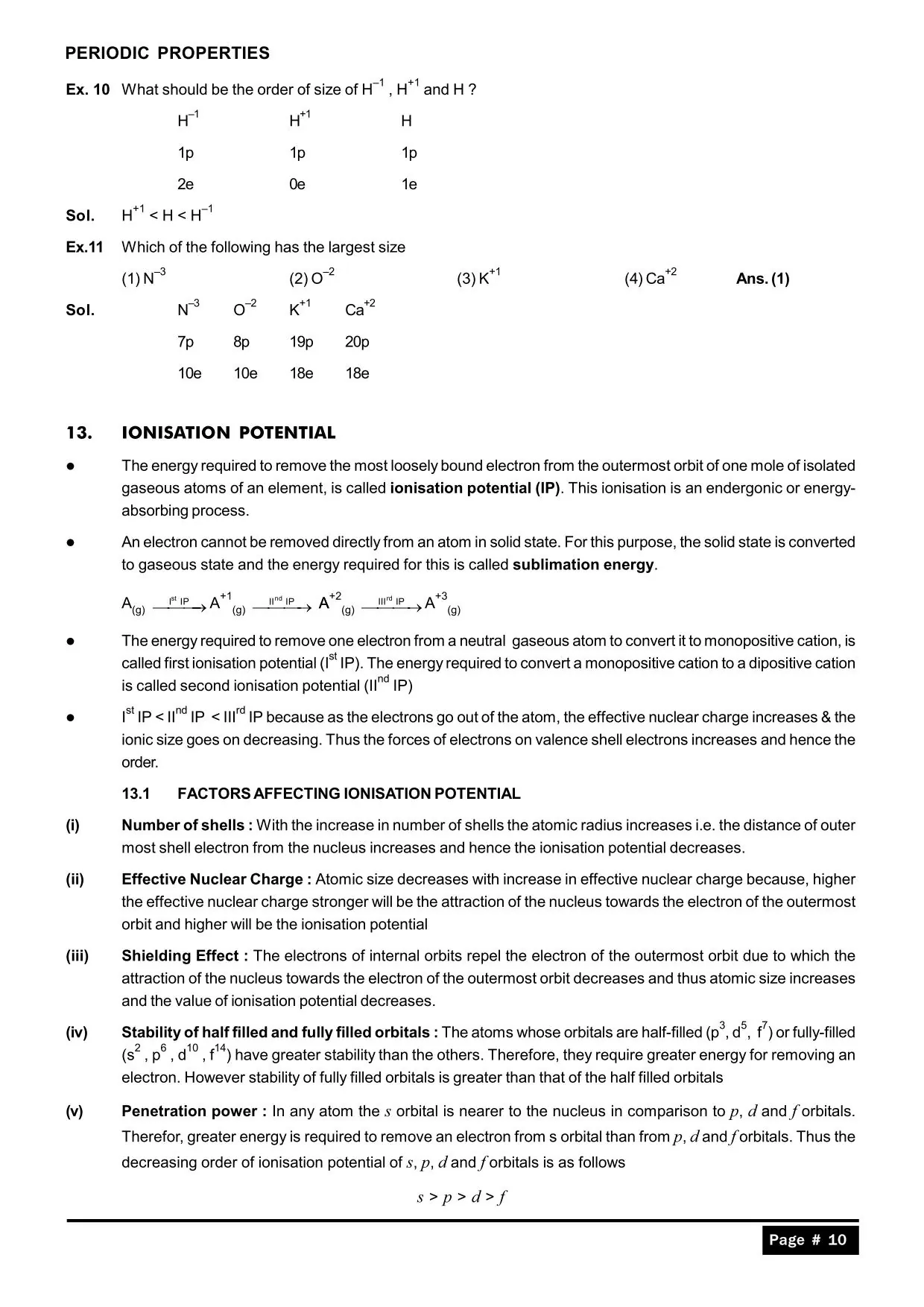
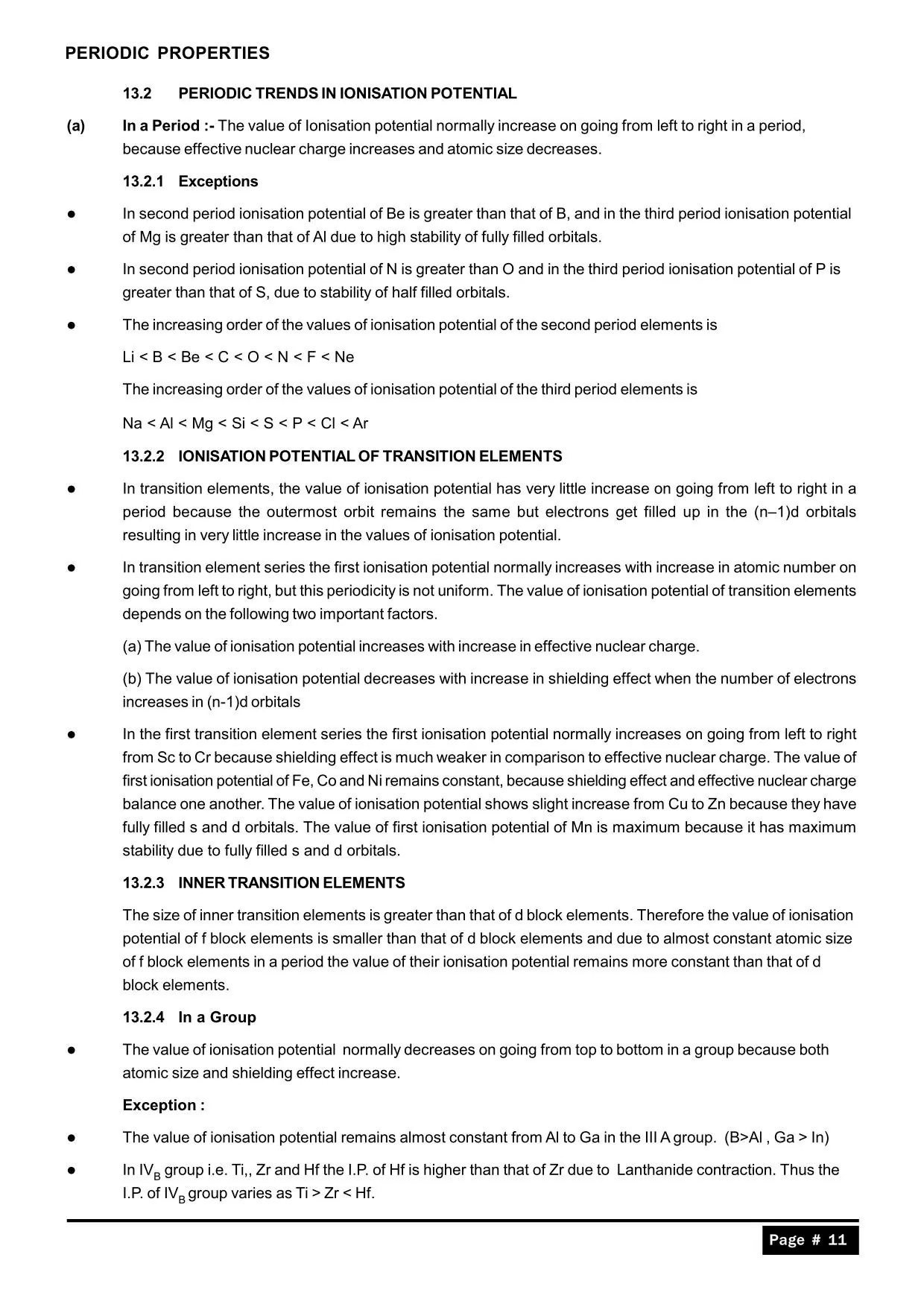
Ionisation Enthalpy (IE)
Ionisation enthalpy is the energy needed to remove the outermost electron from a gaseous atom.
- Across a period: Generally increases — smaller atomic radius means electrons are held more tightly.
- Down a group: Decreases — outermost electrons are further from the nucleus and more shielded.
Important exceptions for JEE:
- IE₁ of B < BE₁ of Be (B has a 2p¹ electron, easier to remove than Be's 2s²)
- IE₁ of O < IE₁ of N (N has half-filled 2p³ — extra stability; O's paired 2p electron is easier to remove)
💡 Expert Tip by Prateek Gupta, IIT Bombay: "The exceptions in ionisation enthalpy — B vs Be and O vs N — appear in JEE Main almost every year. Don't just memorise the exception; understand why. Half-filled and fully filled subshells have extra stability. That one concept explains both exceptions."
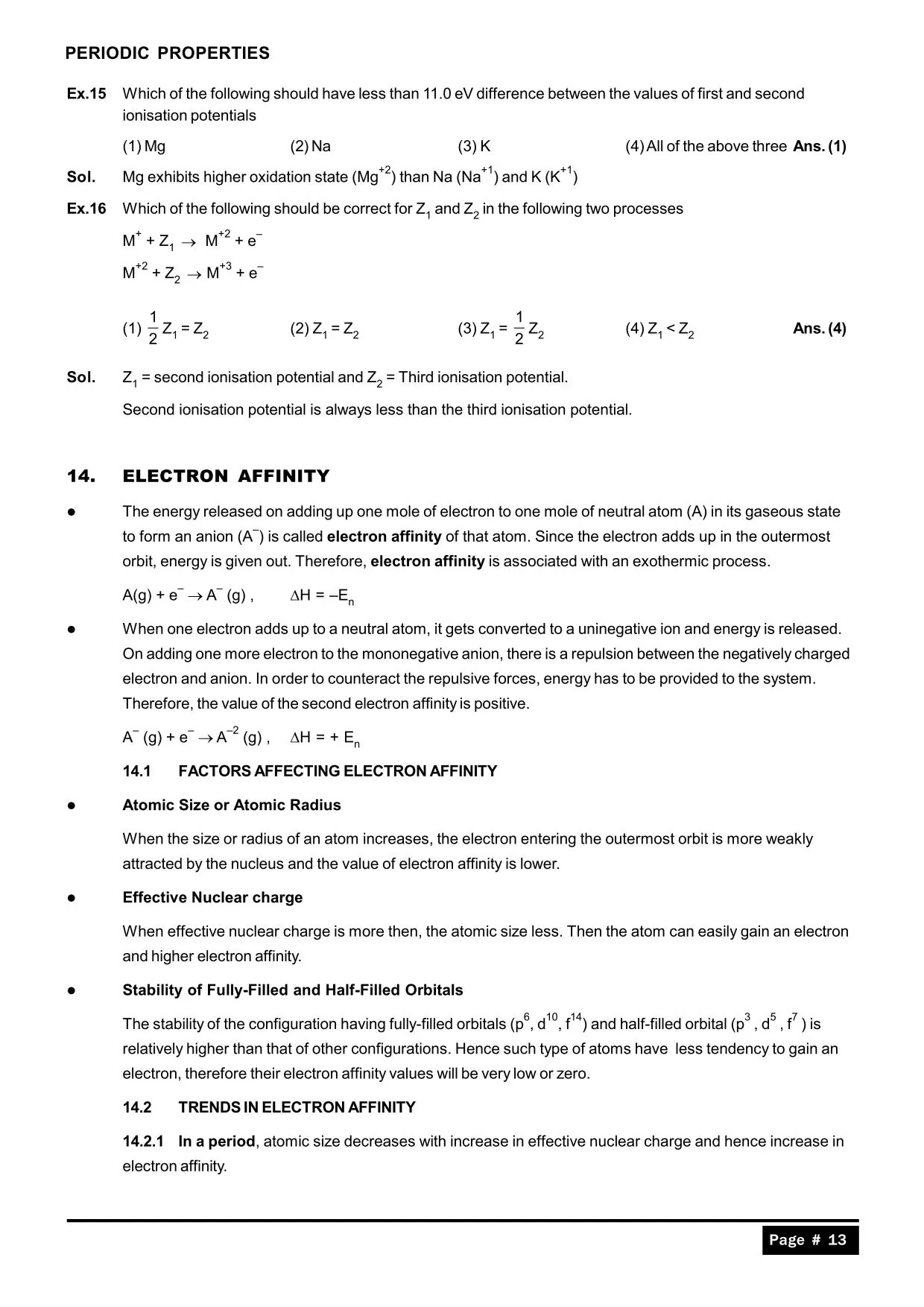
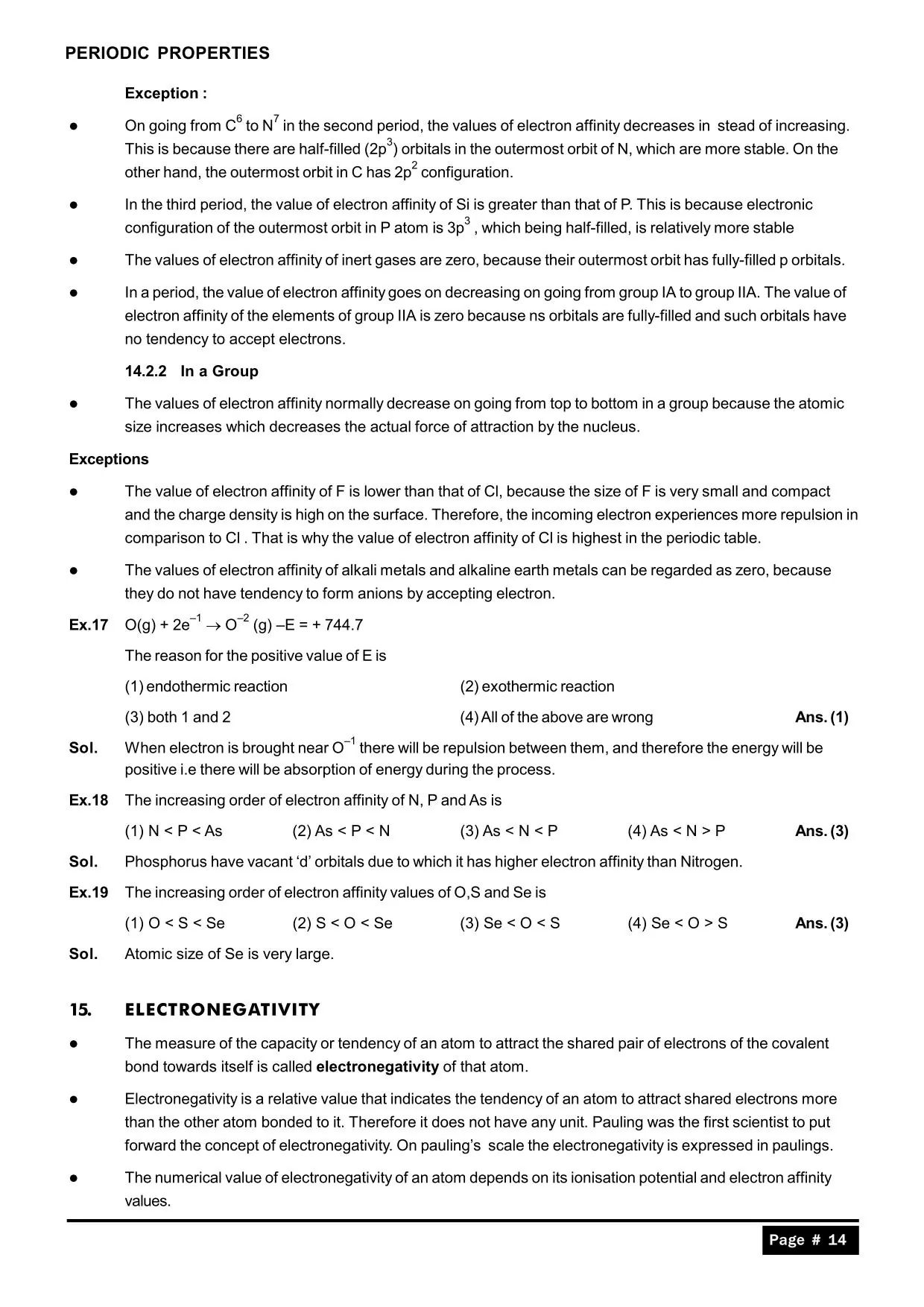
Electron Gain Enthalpy (Electron Affinity)
Electron gain enthalpy is the energy change when a neutral gaseous atom gains an electron.
- Across a period: Becomes more negative (more energy released) — smaller atoms hold additional electrons more strongly.
- Down a group: Becomes less negative — larger atoms attract additional electrons less effectively.
Exception: Fluorine has a less negative electron gain enthalpy than chlorine, despite being more electronegative. Fluorine's small size causes high electron-electron repulsion in its compact 2p subshell, making electron gain slightly less favourable.
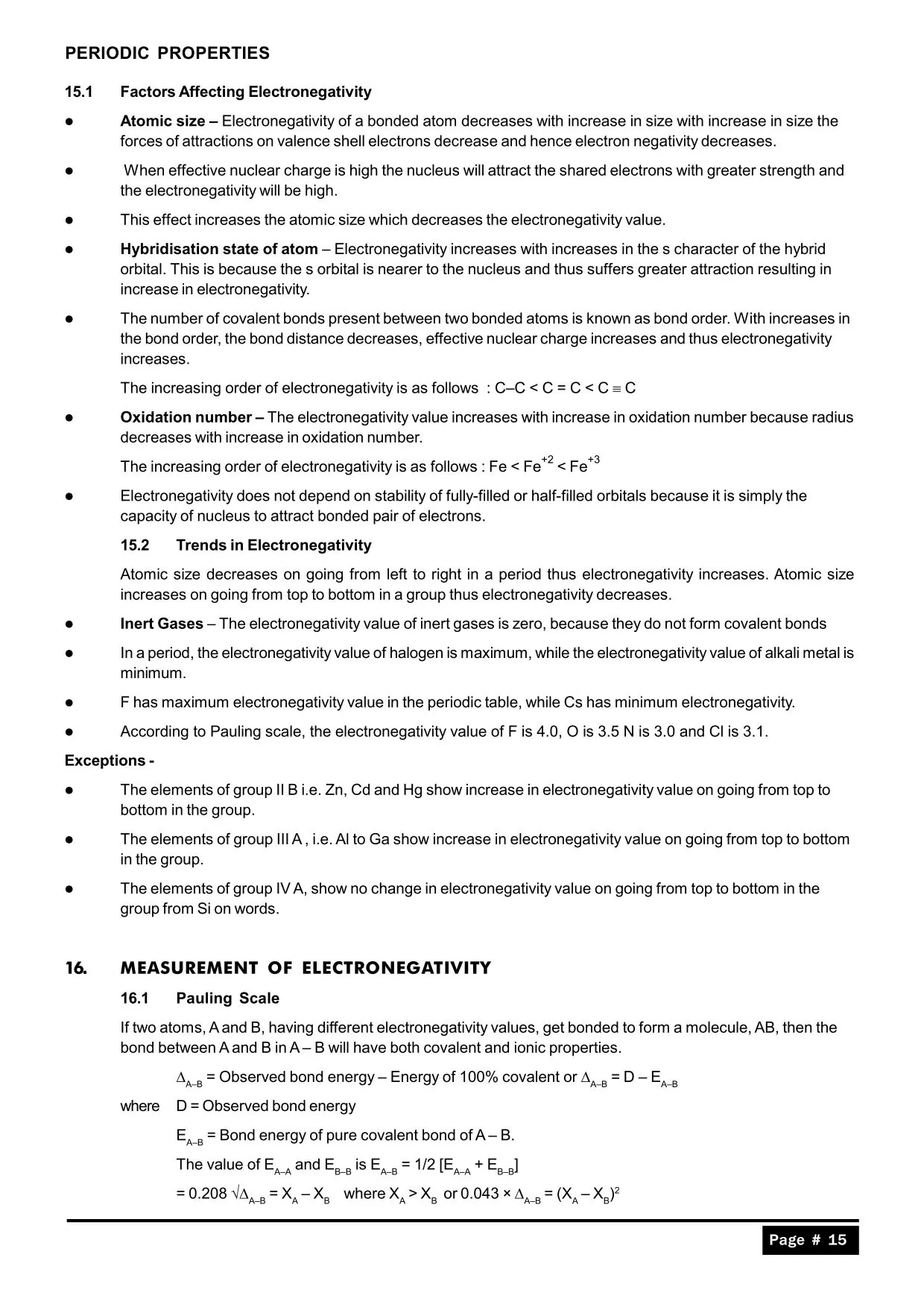
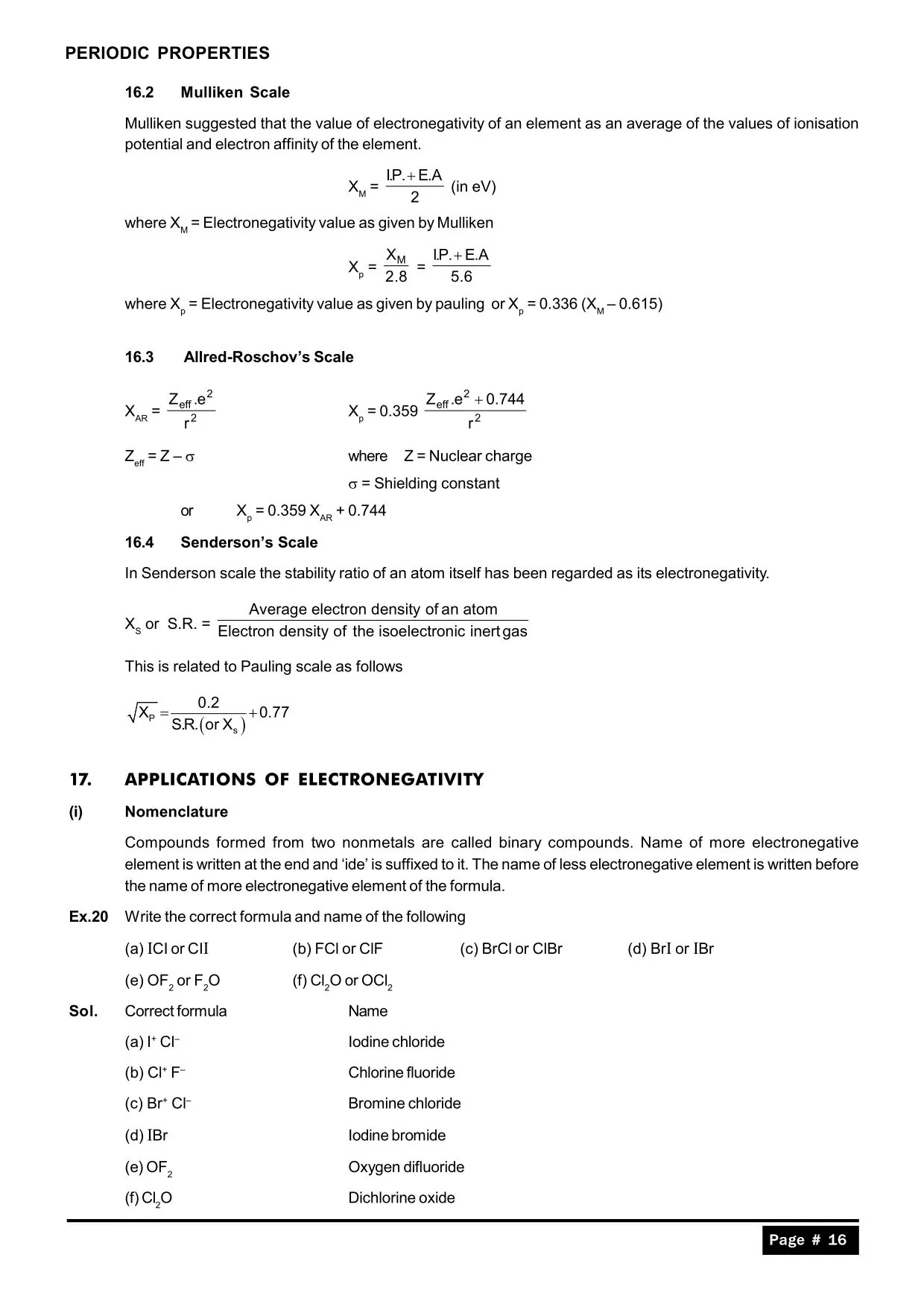
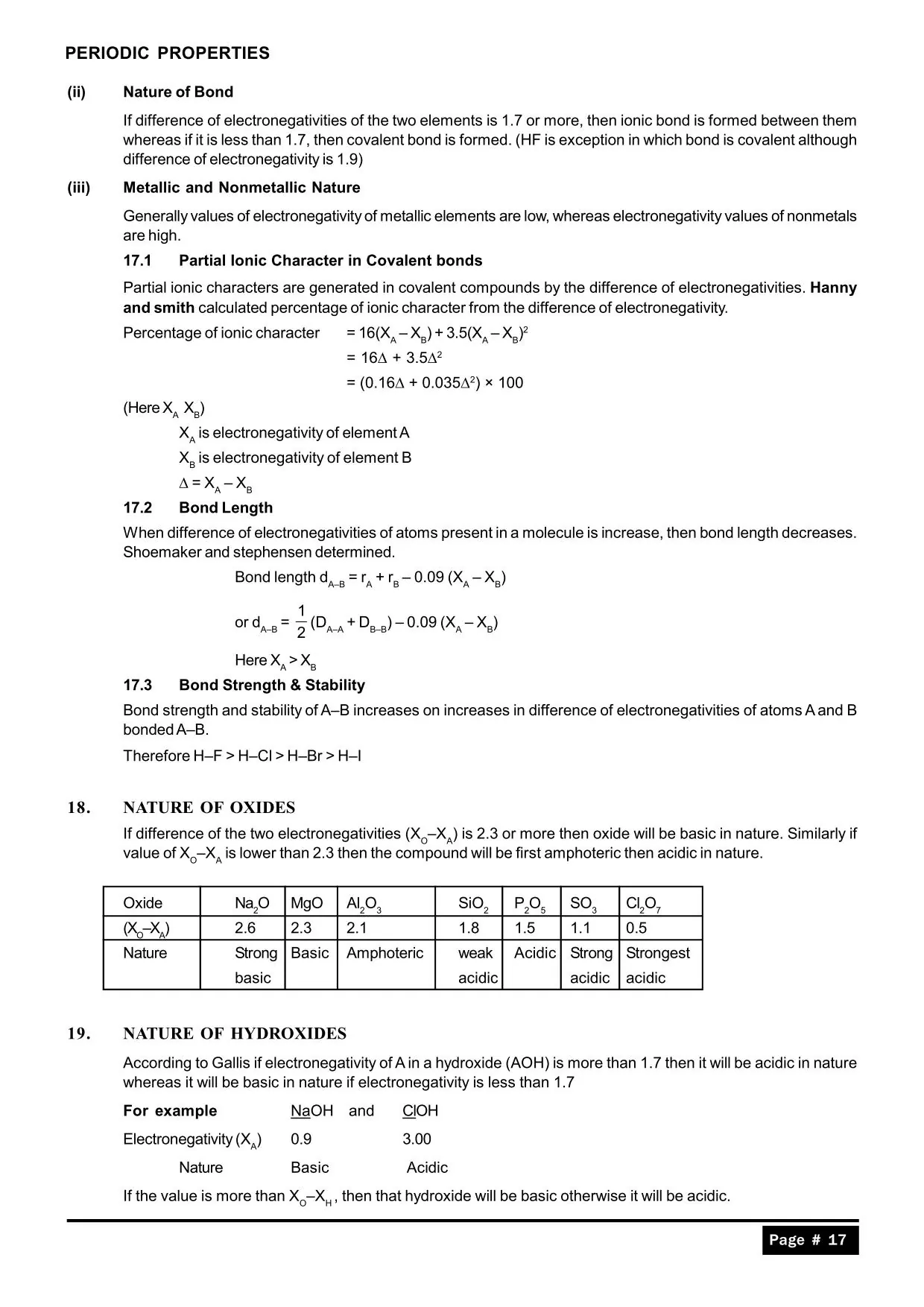
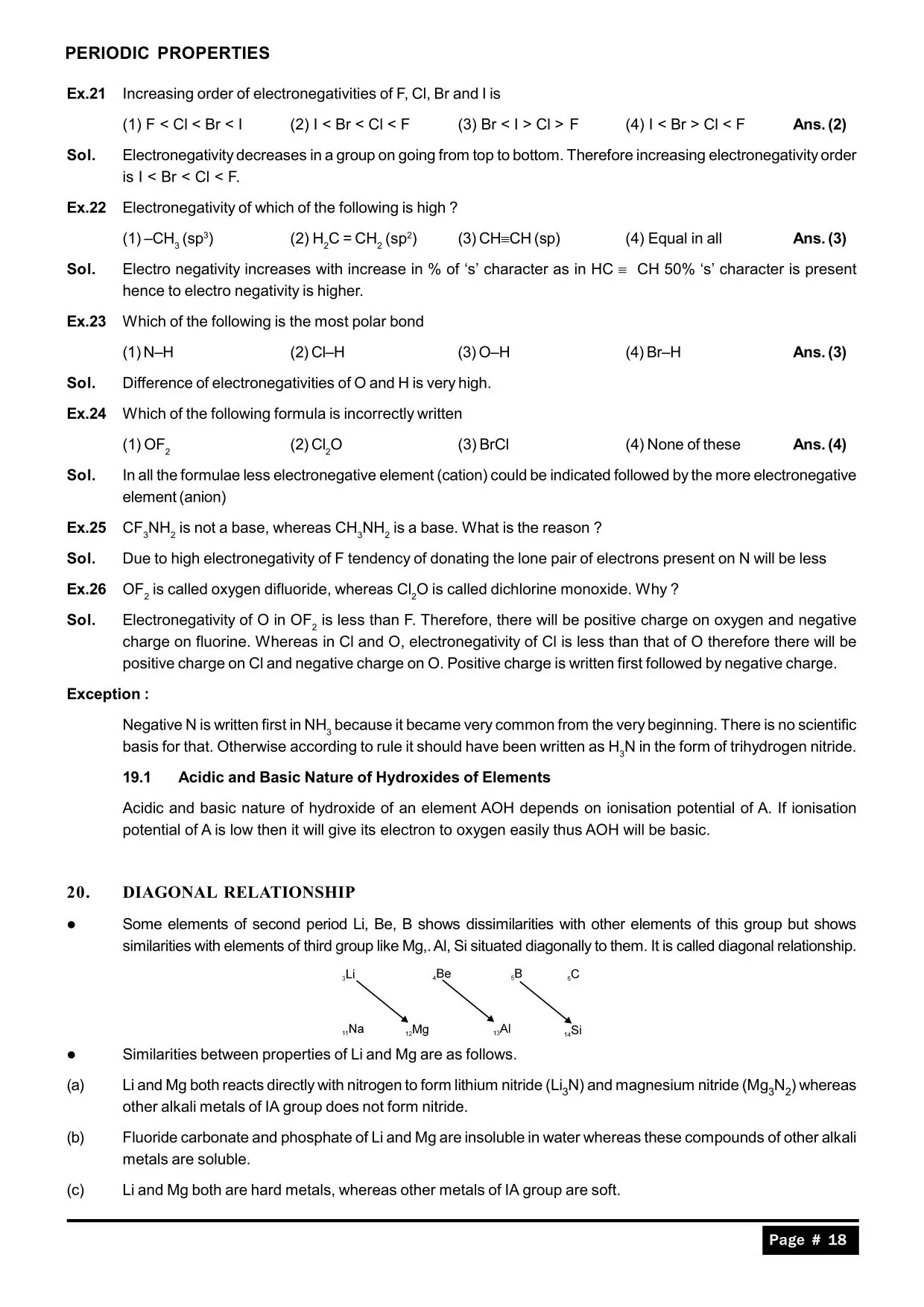
Electronegativity
Electronegativity is the ability of a bonded atom to attract the shared electron pair toward itself.
- Across a period: Increases (left to right)
- Down a group: Decreases
- Most electronegative element: Fluorine (F)
- Least electronegative among metals: Caesium (Cs)
Valency
Valency is the combining capacity of an element.
- Across a period: Valency first increases from 1 to 4, then decreases from 4 to 0 (for noble gases).
- Down a group: Valency remains constant — all elements in the same group have the same number of valence electrons.
Summary Table — Periodic Trends
| Property | Across Period (→) | Down Group (↓) |
|---|---|---|
| Atomic radius | Decreases | Increases |
| Ionisation enthalpy | Increases (with exceptions) | Decreases |
| Electron gain enthalpy | More negative | Less negative |
| Electronegativity | Increases | Decreases |
| Metallic character | Decreases | Increases |
| Non-metallic character | Increases | Decreases |
Most Important Topics for JEE Main and NEET From This Chapter
Based on previous year question papers from JEE Main and NEET, the highest-yield topics from this chapter are:
- Ionisation enthalpy exceptions — especially N vs O and Be vs B
- Electron gain enthalpy of F vs Cl — counterintuitive and frequently tested
- Identification of s, p, d, f block from electronic configuration
- Atomic radius trends — with noble gas exception
- Electronegativity order and its application to bond polarity
- Mendeleev's predictions — at least one factual question per NEET paper
- Number of elements in each period — especially Period 4 and 6
For JEE Advanced, expect application-level questions that combine periodic trends with bonding and structure. For NEET, factual and assertion-reasoning questions dominate.
How to Study Classification of Elements for JEE and NEET
Step 1: Build the Conceptual Framework First (2 days)
Read the NCERT chapter once end-to-end without stopping to memorise. Understand the logic of why properties trend the way they do — nuclear charge, shielding, effective nuclear charge. Concepts learned with logic are retained permanently; memorised facts fade before the exam.
Step 2: Master the Exceptions (1 day)
Write out every exception — IE exceptions (B, O), electron gain enthalpy of F vs Cl, noble gas exclusion from radius trends. For each, write the reason next to it, not just the fact. Create a one-page exceptions sheet.
Step 3: Solve Module Problems in Order (3–4 days)
Do not skip directly to JEE PYQs. Work through eSaral's chapter module from Exercise 1 (basic) to Exercise 2A (JEE Main level). The progressive difficulty ensures each concept is reinforced before the next is introduced.
Step 4: Attempt Chapter-Wise JEE Main and NEET Tests
After completing the module, take eSaral's chapter-wise JEE Main test and chapter-wise NEET test for this chapter. Review every wrong answer against your exceptions sheet. Identify whether your error was conceptual or careless.
Step 5: Revise With Short Notes Before Exams
eSaral provides chapter-specific short revision notes. Use these in the final revision phase — not as a substitute for step 1–4, but as a memory trigger before mocks and the actual exam.
Frequently Asked Questions
Find answers to common questions.
What is the Modern Periodic Law for Class 11 Chemistry?
The Modern Periodic Law states that the physical and chemical properties of elements are a periodic function of their atomic numbers. Proposed by Henry Moseley in 1913, it replaced Mendeleev's atomic weight-based law and resolved all the anomalies in the original periodic table, including the reversed order of Ar/K and Co/Ni.
How does atomic radius change across a period and down a group?
Atomic radius decreases across a period from left to right because increasing nuclear charge pulls electrons closer without adding new shells. Down a group, atomic radius increases because each successive element gains a new electron shell, increasing the distance of valence electrons from the nucleus.
Why is the ionisation enthalpy of nitrogen higher than oxygen in Class 11?
Nitrogen has a half-filled 2p³ configuration, which is extra-stable due to symmetric electron distribution. Oxygen's 2p⁴ configuration has one paired electron that experiences extra electron-electron repulsion, making it easier to remove. This makes nitrogen's ionisation enthalpy higher despite its larger nuclear charge.
What are periodic properties and why are they important for JEE?
Periodic properties are characteristics — atomic radius, ionisation enthalpy, electron gain enthalpy, electronegativity, and valency — that show regular trends across the periodic table. They are important for JEE because they directly explain the reactivity and behaviour of all elements, forming the basis of inorganic chemistry questions in JEE Main and JEE Advanced.
What is the difference between electron affinity and electron gain enthalpy?
Electron affinity (older term) is the energy released when a neutral atom gains an electron. Electron gain enthalpy (IUPAC preferred term) is the enthalpy change for the same process — it can be negative (energy released, exothermic) or positive (energy absorbed, endothermic). NCERT uses electron gain enthalpy; both terms appear in JEE papers.