Coordination Compounds- NEET Previous Year Questions with Complete Solutions
Coordination Compounds is an important and high-scoring NEET Chemistry chapter focused on concepts like ligands, IUPAC nomenclature, Crystal Field Theory (CFT), isomerism, magnetic properties, and EAN rule, with most NEET questions repeatedly coming from these predictable topics.
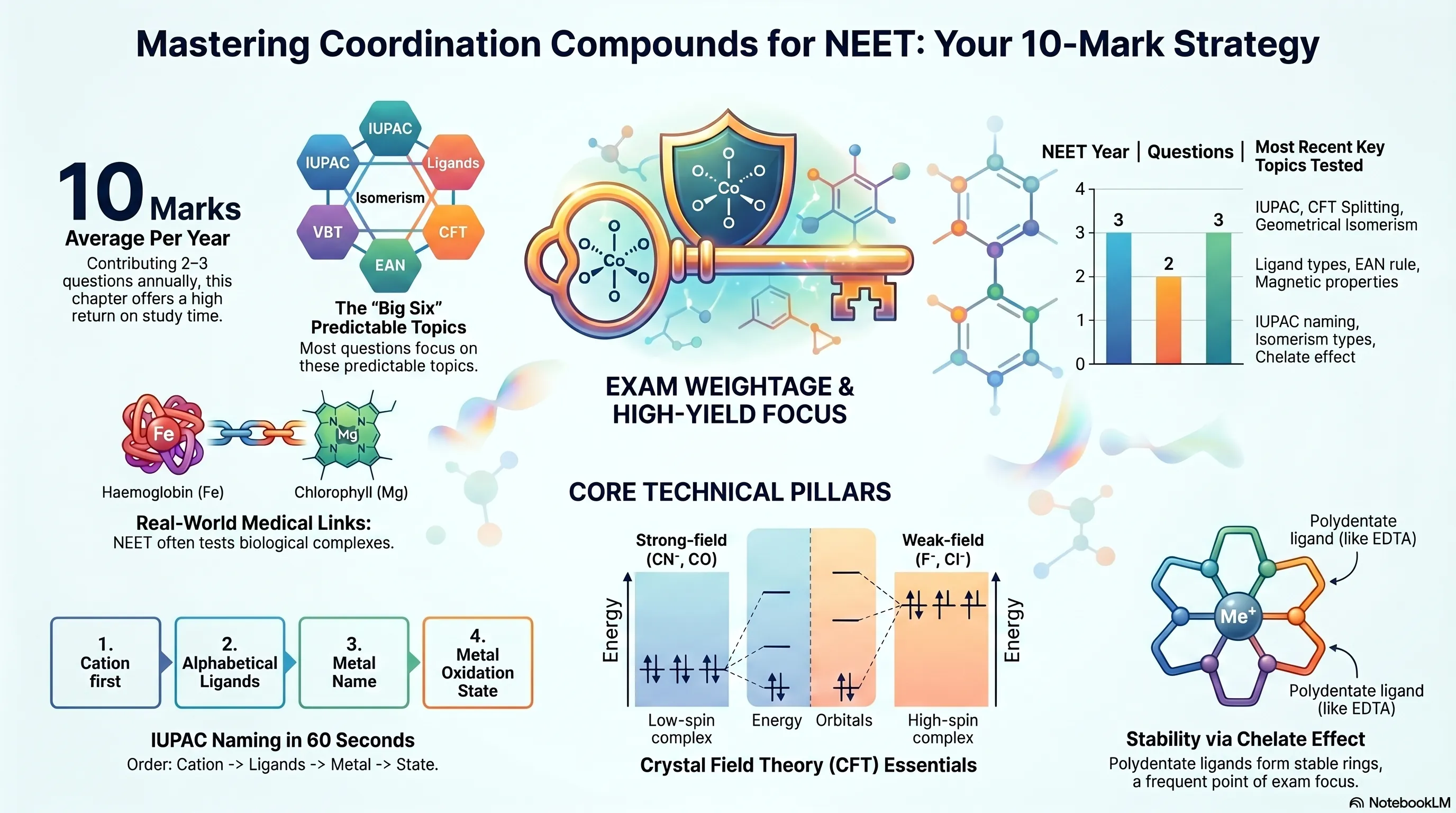
Table of Contents
- Why Coordination Compounds Is a Must-Master Chapter for NEET
- NEET Previous Year Questions — Coordination Compounds with Solutions
- Chapter Overview: Topics and Subtopics
- NEET Weightage Analysis: Year-Wise Question Count
- Key Concepts You Must Know Before Solving PYQs
- How to Study Coordination Compounds for Maximum NEET Marks {#how-to-study}

eSaral › NEET › Coordination Compounds- NEET Previous Year Questions with Complete Solutions

Why Coordination Compounds Is a Must-Master Chapter for NEET
Coordination Compounds (Class 12, Chapter 9) is one of the most concept-dense chapters in Inorganic Chemistry — and one of the most rewarding when prepared systematically. It contributes 2–3 questions every year in NEET UG, worth approximately 8–12 marks, across a predictable and finite set of question types.
What makes this chapter particularly valuable is its specificity. Unlike some chapters where question types are broad and unpredictable, Coordination Compounds questions in NEET almost always come from these exact areas: IUPAC nomenclature, ligand classification, coordination number, geometrical and optical isomerism, Crystal Field Theory (CFT) splitting, and effective atomic number (EAN). Master these six areas and the chapter yields near-perfect marks.
The chapter also has direct relevance to the medical world — haemoglobin (an iron coordination complex) and chlorophyll (a magnesium coordination complex) are examples that NEET uses to anchor conceptual questions.
💡 Expert Tip by eSaral Chemistry Faculty: "Coordination Compounds is the chapter where students either score 3-for-3 or 0-for-3 — there is rarely a middle ground. Students who lose marks here almost always lose them on IUPAC naming (wrong charge on metal) or on CFT (confusing high-spin and low-spin). These are fixable errors. Practise naming 10 complexes and drawing 5 CFT splitting diagrams and this chapter becomes a reliable source of free marks."
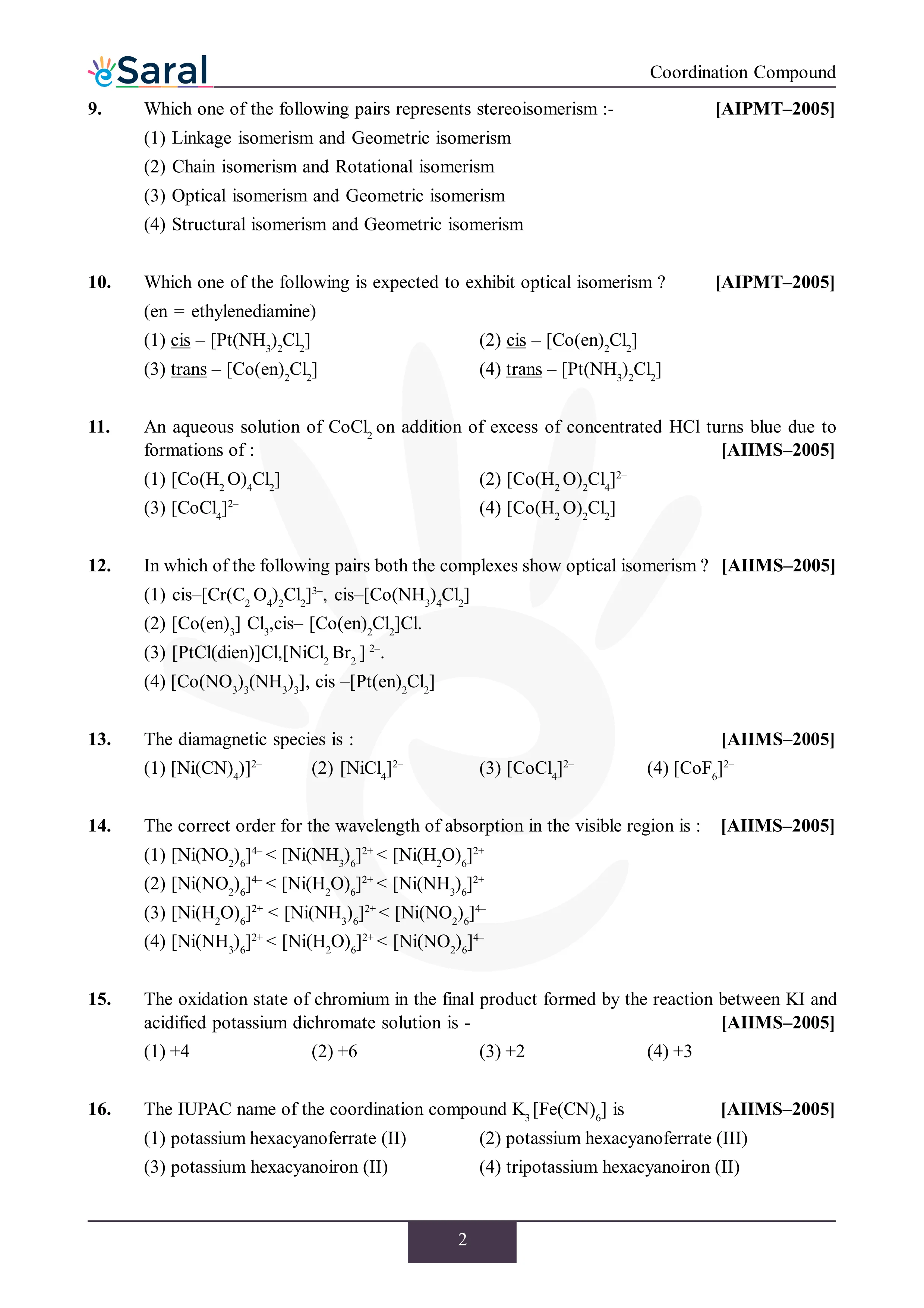
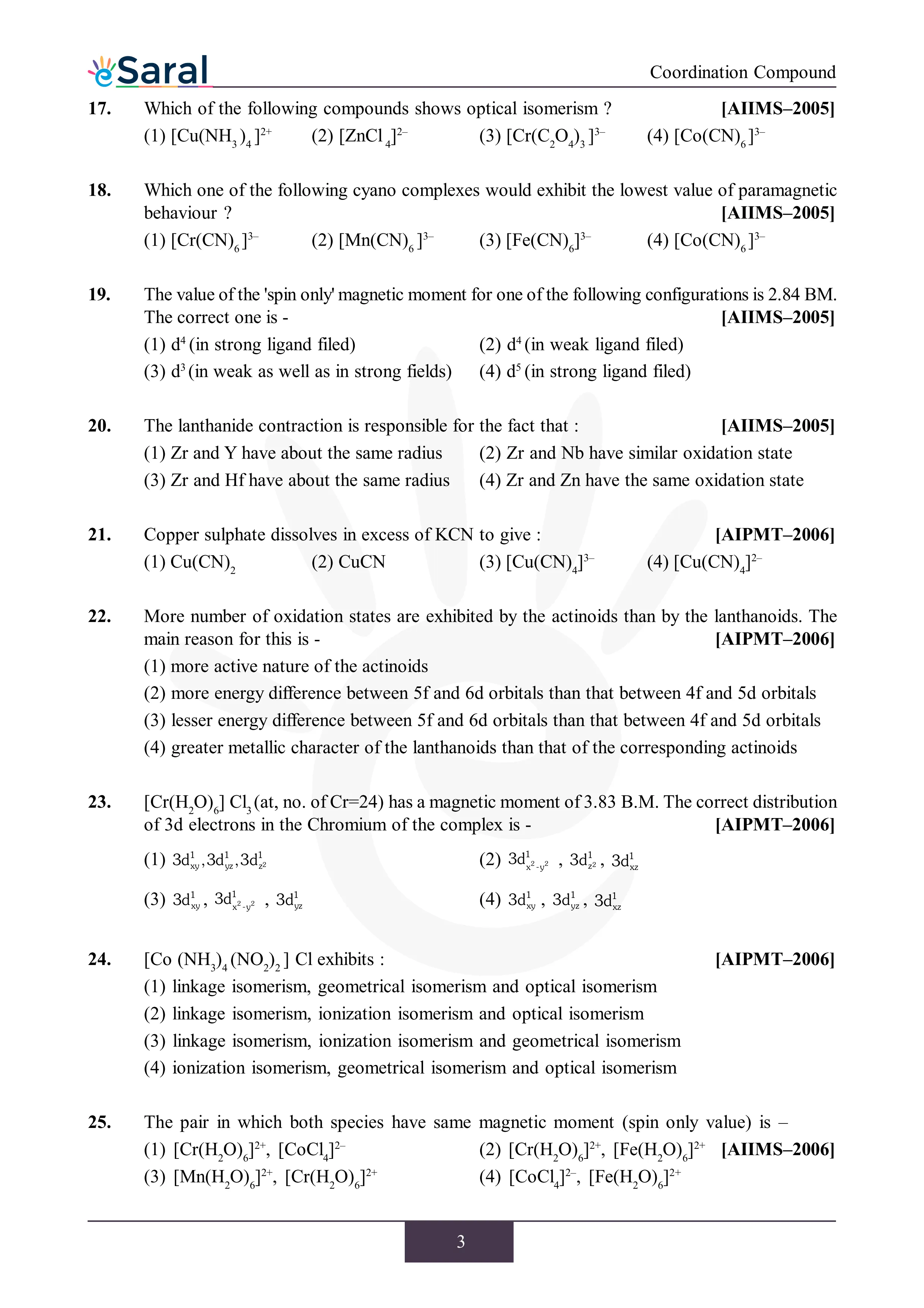
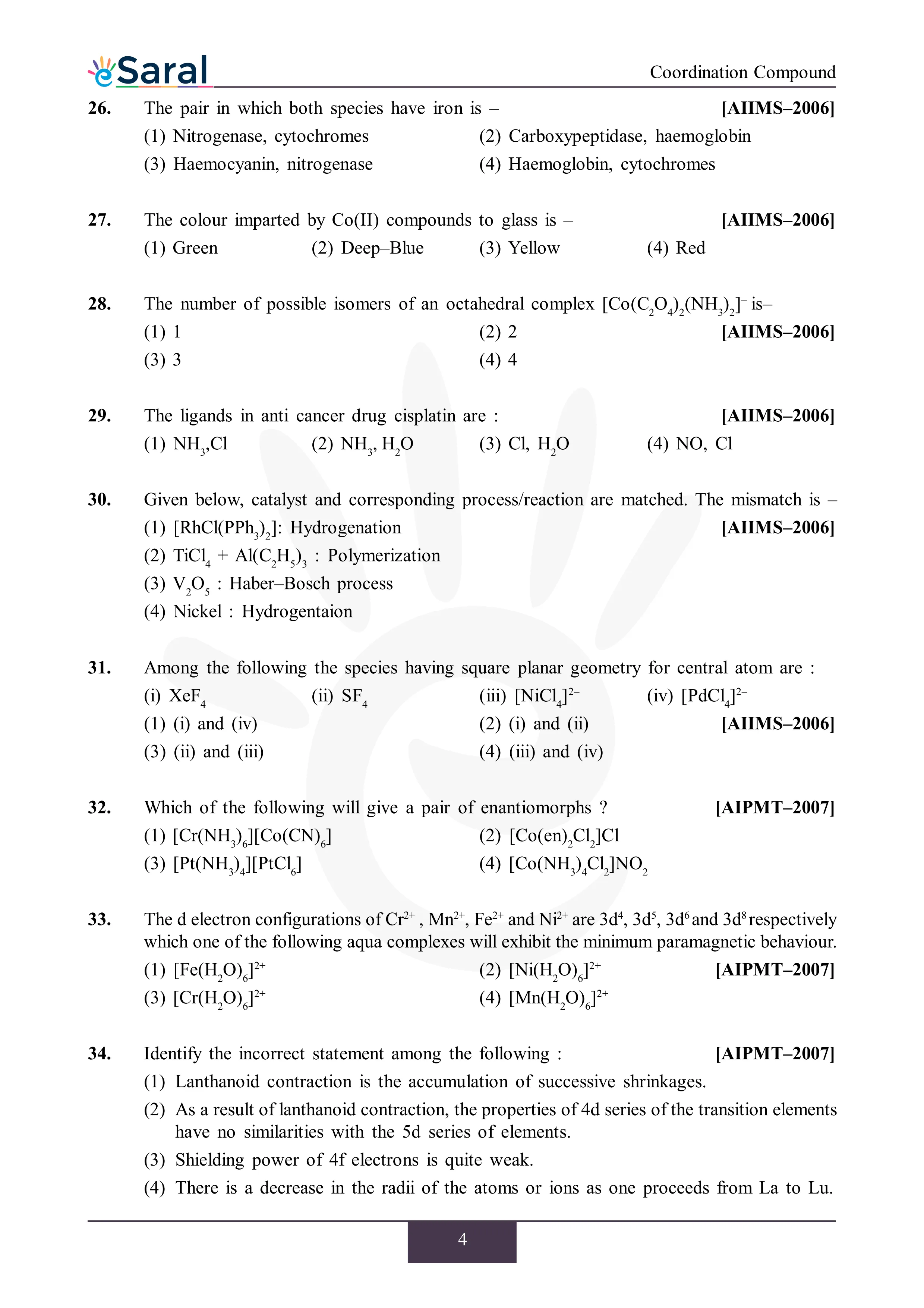
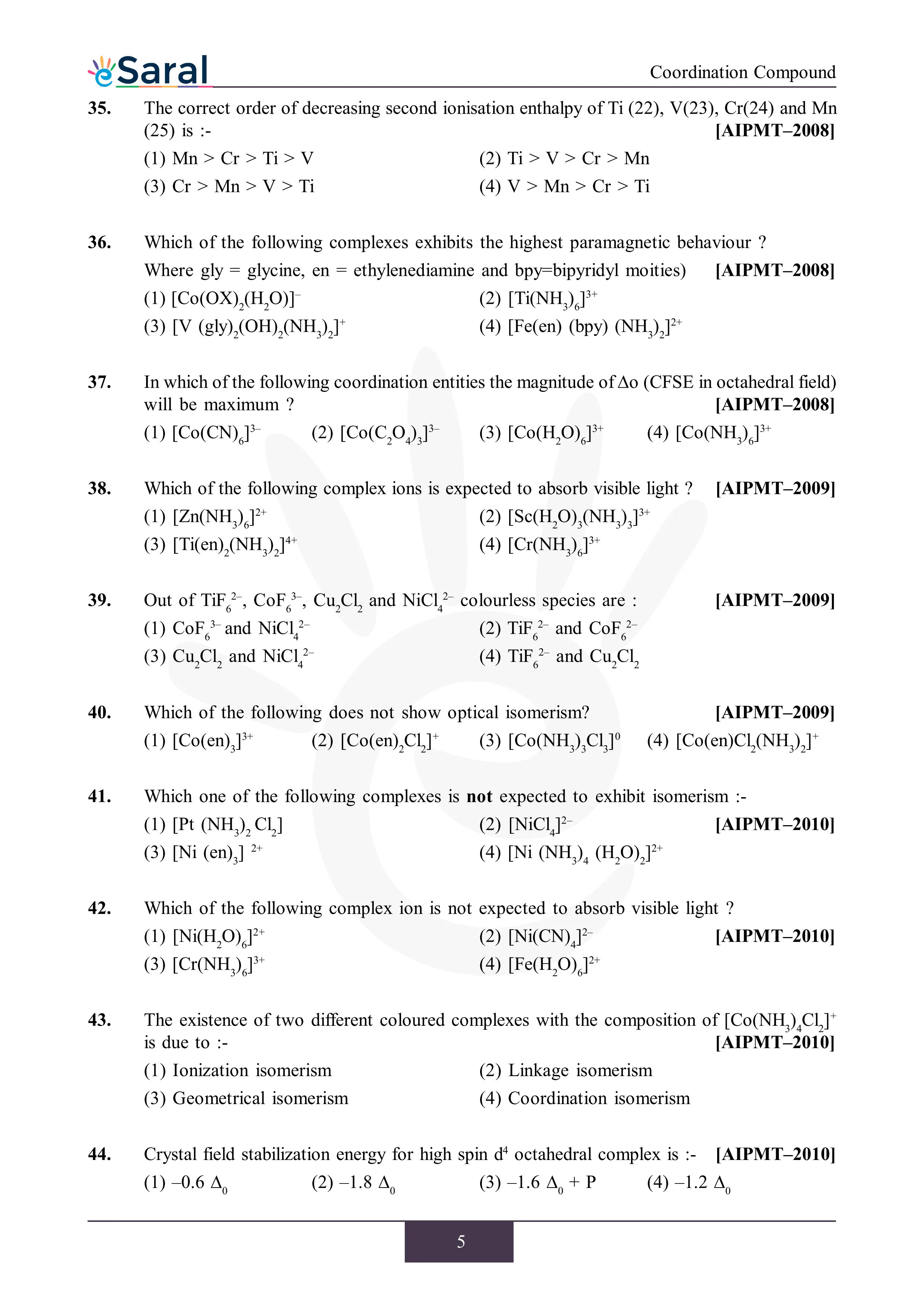
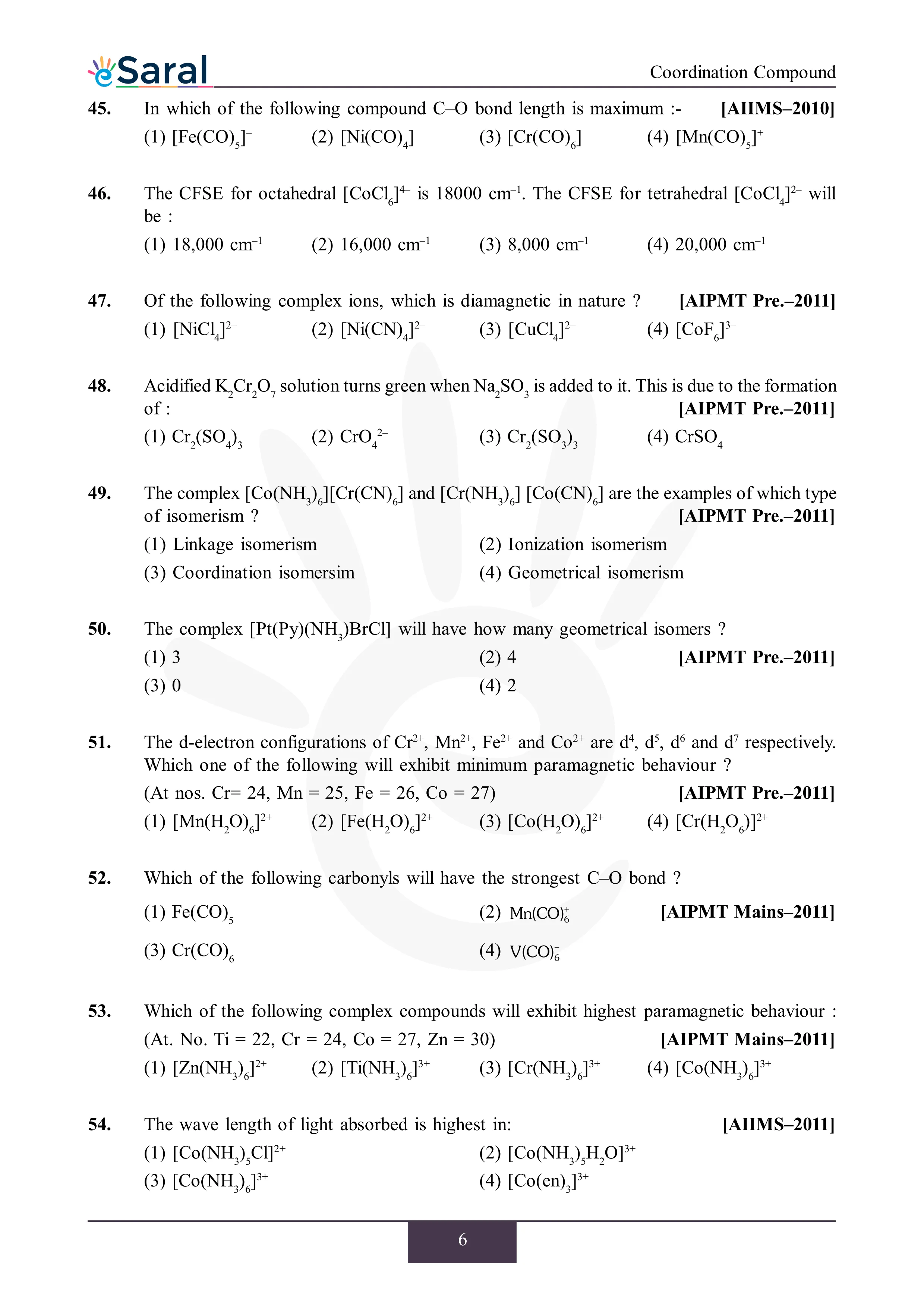
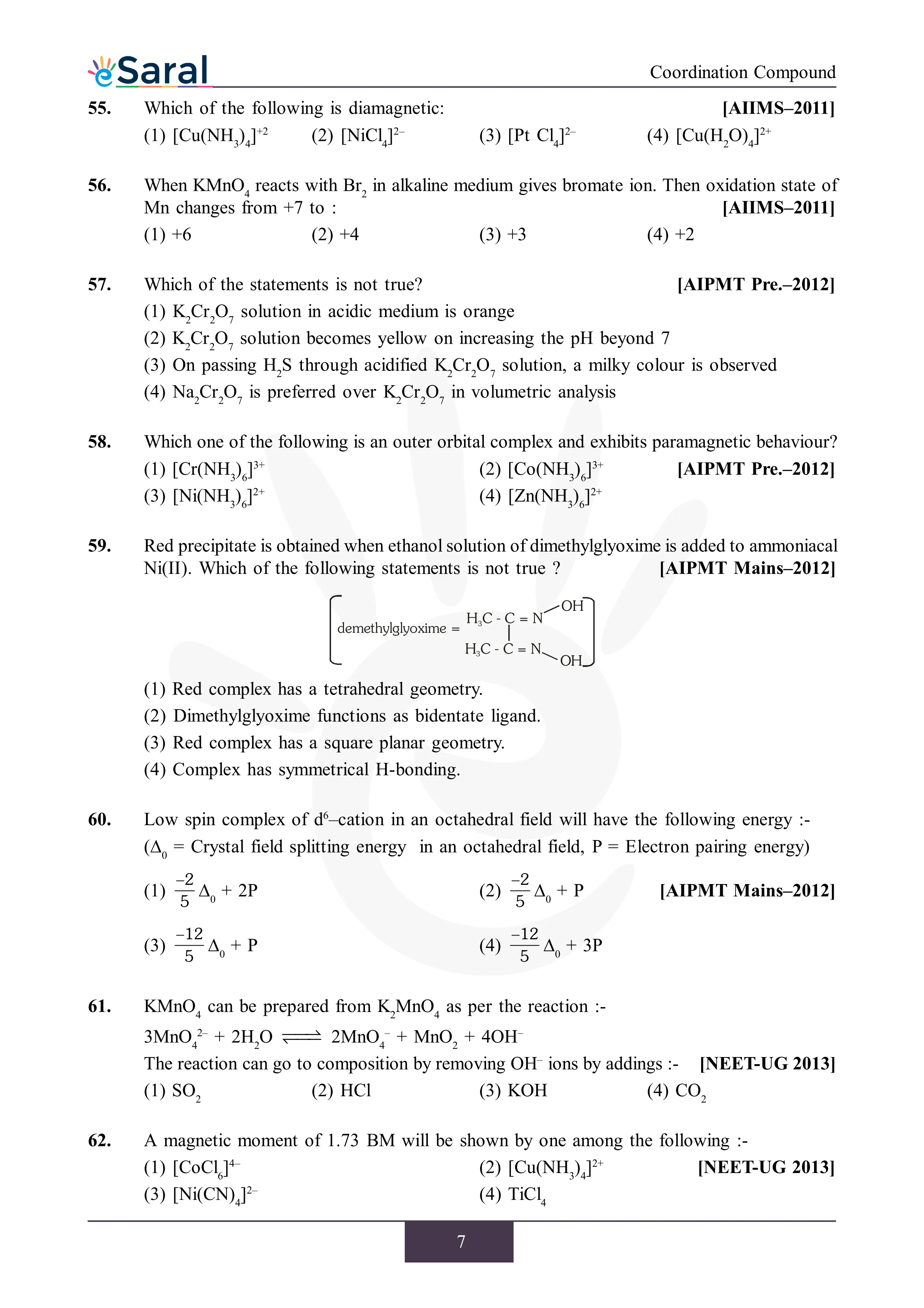
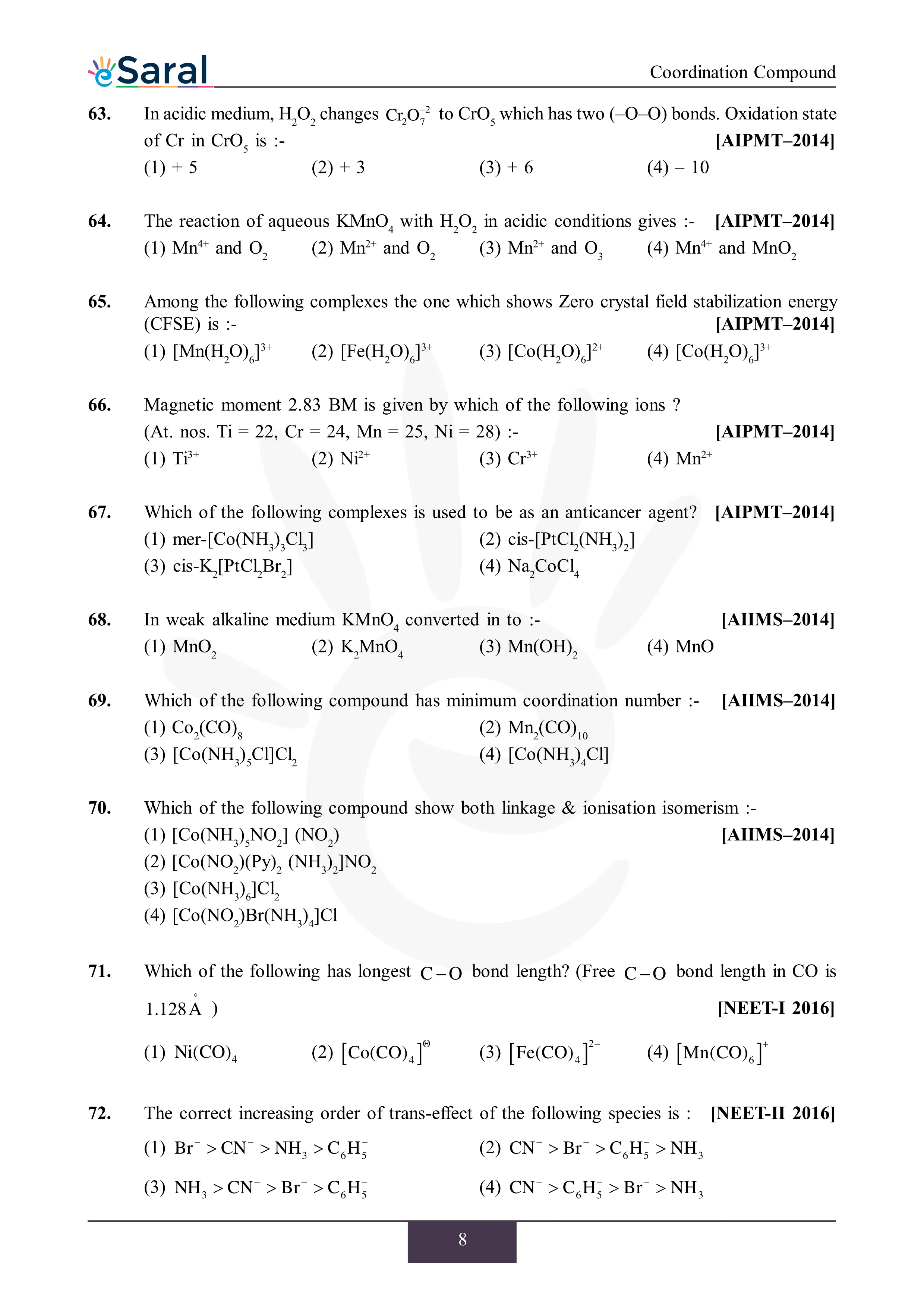
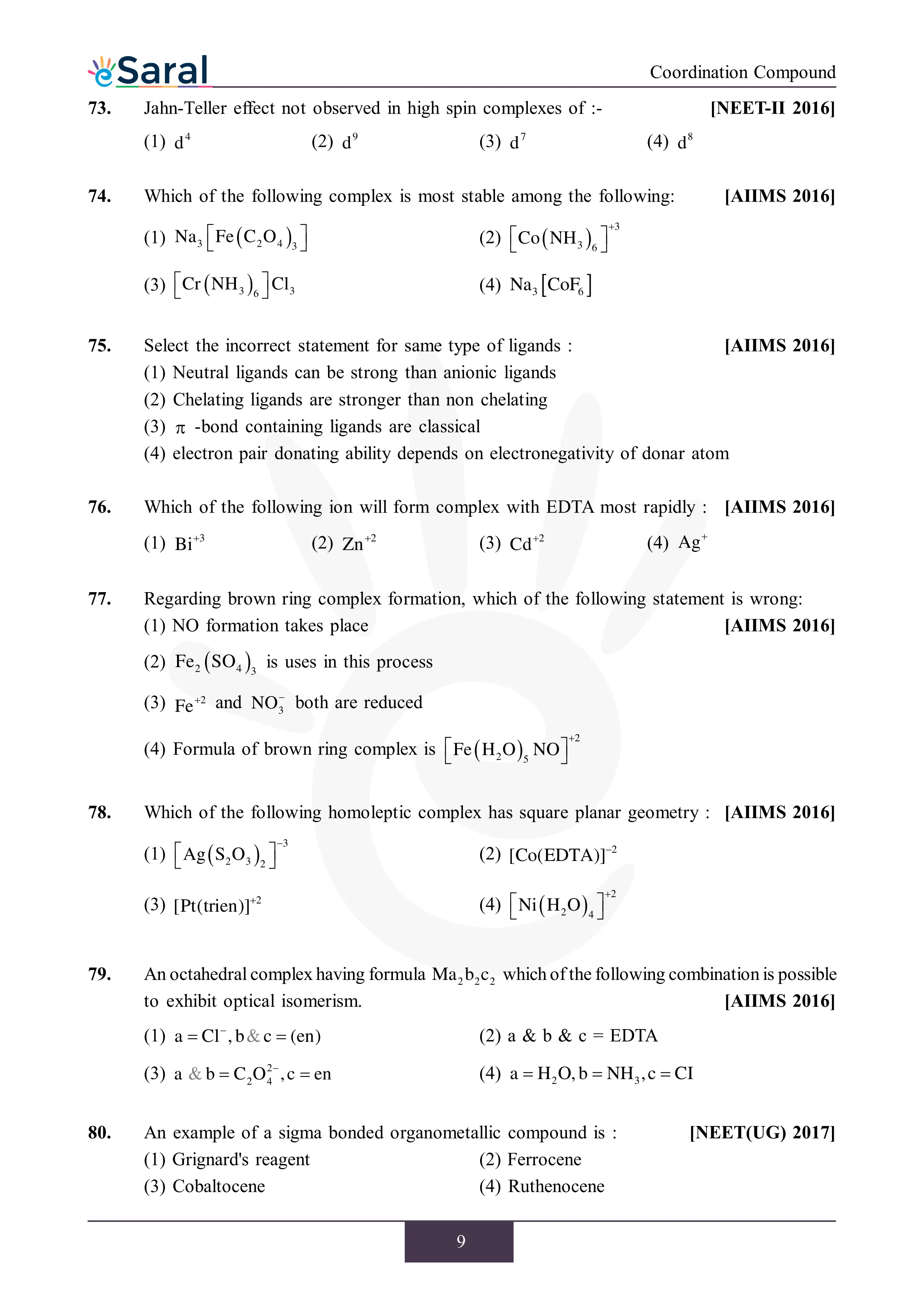
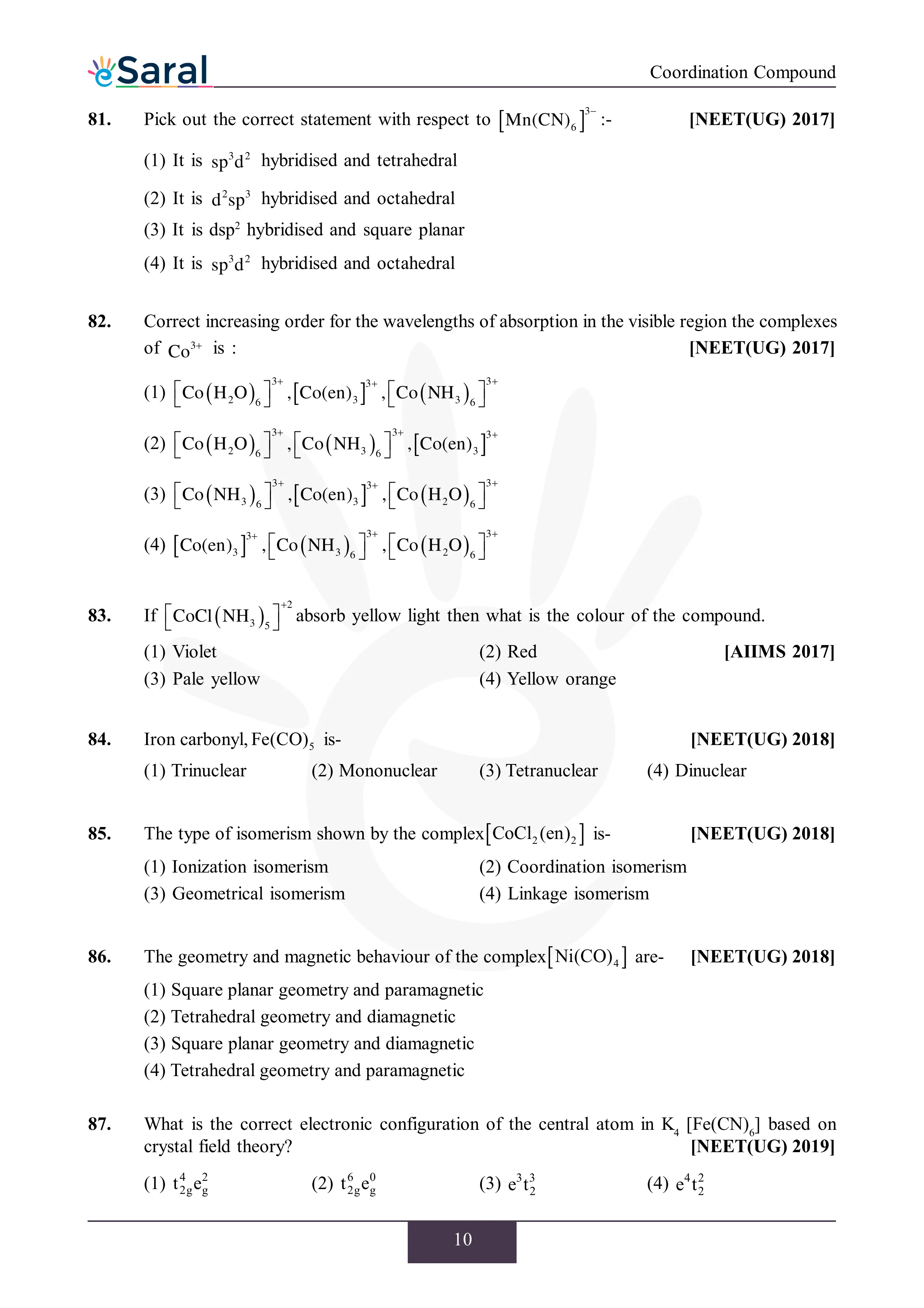
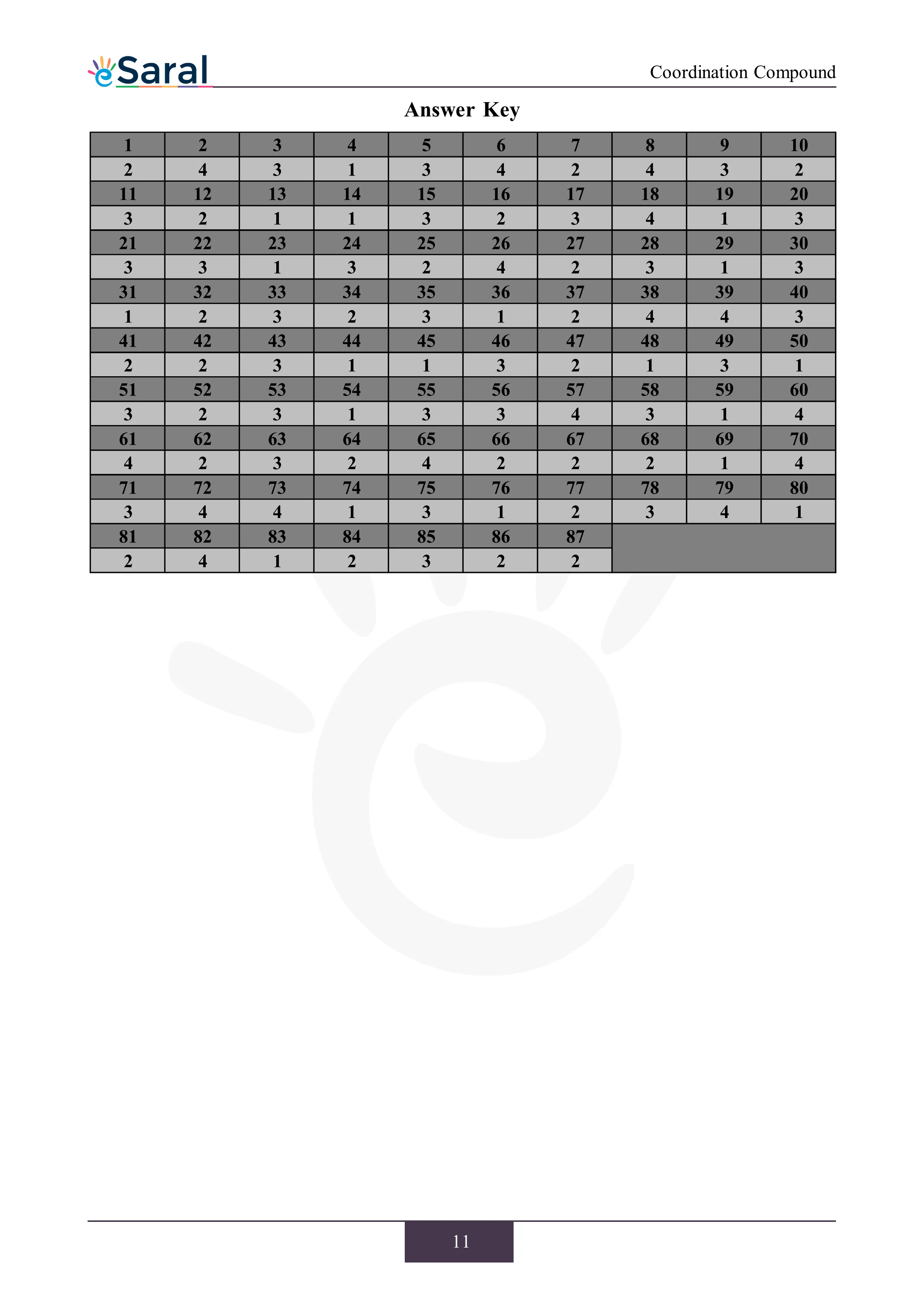
NEET Previous Year Questions — Coordination Compounds with Solutions 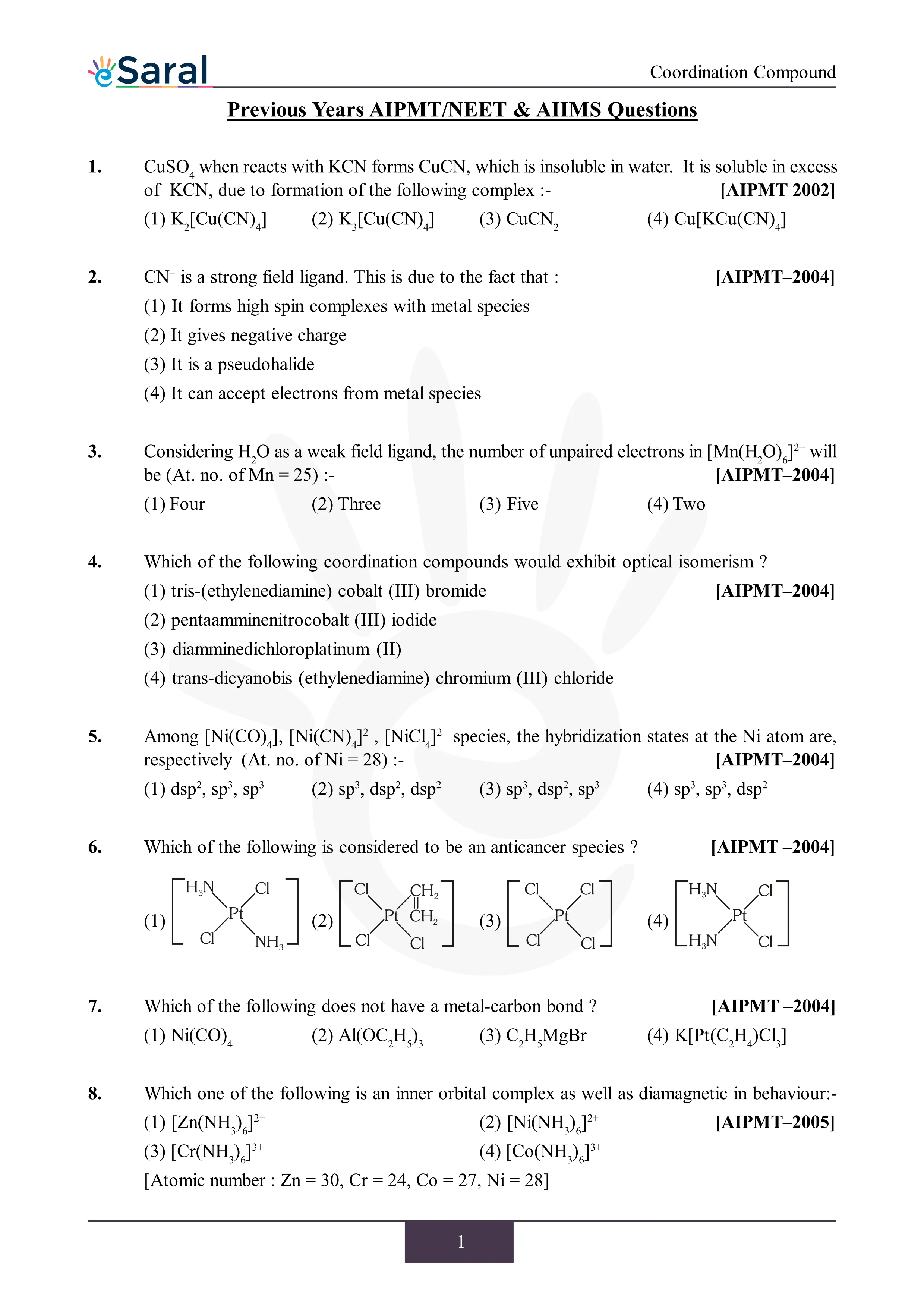
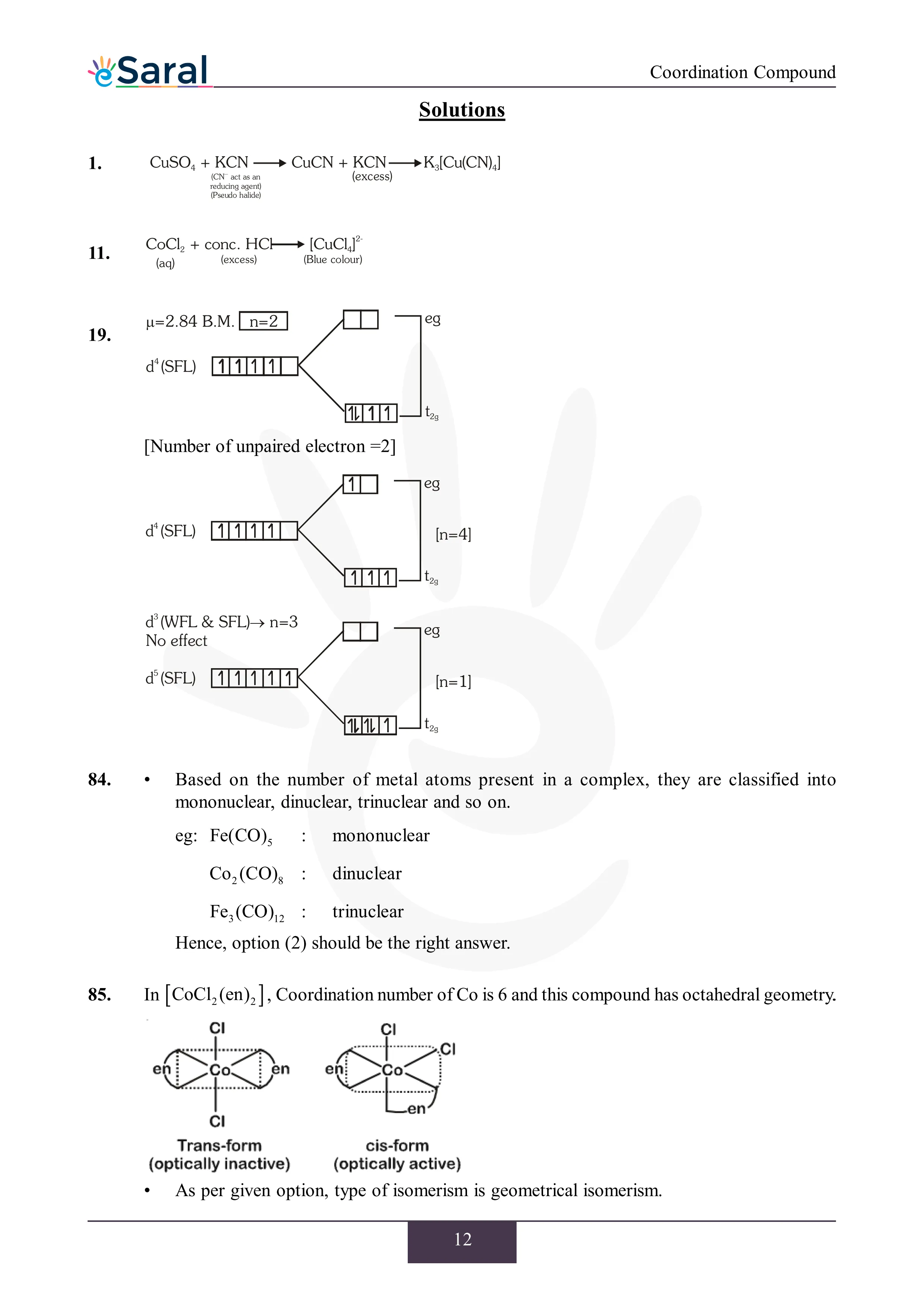
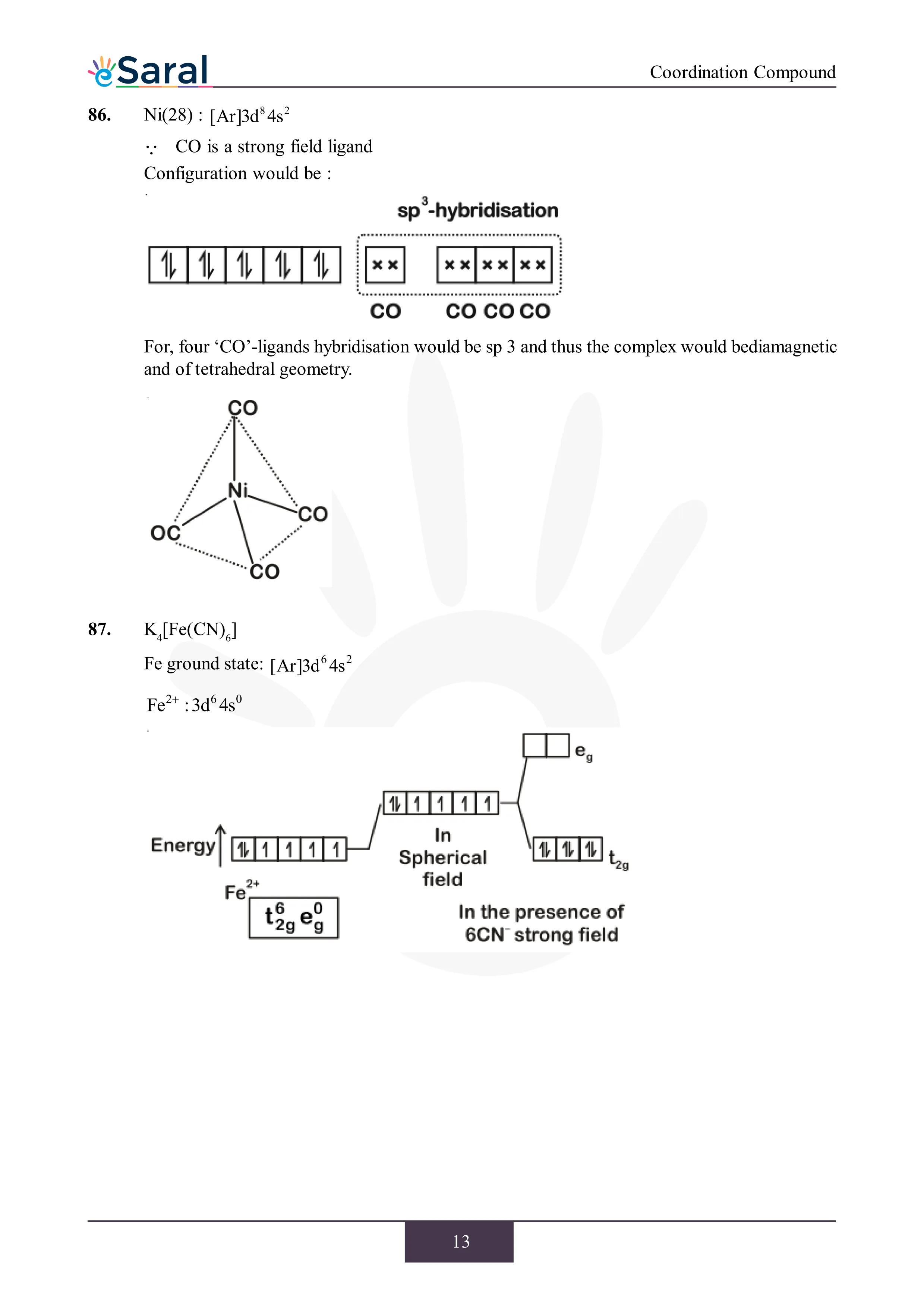
Chapter Overview: Topics and Subtopics
What This Chapter Covers
| Topic | Key Subtopics | NEET Frequency |
|---|---|---|
| Basic Terminology | Central metal ion, ligand, coordination sphere, counter ion, coordination number | High |
| Types of Ligands | Monodentate, bidentate, polydentate, ambidentate, bridging (μ) | Very High |
| IUPAC Nomenclature | Naming cationic, anionic, neutral complexes; oxidation state of metal | Very High |
| Werner's Theory | Primary and secondary valency, the coordination sphere concept | Medium |
| Effective Atomic Number (EAN) | EAN = Z − oxidation state + 2 × (number of ligands) | High |
| Valence Bond Theory (VBT) | sp³, dsp², d²sp³ hybridisation; inner and outer orbital complexes | High |
| Crystal Field Theory (CFT) | Δ splitting (octahedral, tetrahedral), high-spin vs low-spin, CFSE | Very High |
| Isomerism | Structural (ionisation, hydrate, linkage, coordination) and stereo (geometrical, optical) | Very High |
| Stability of Complexes | Chelate effect, stability constants | Medium |
| Colour in Coordination Compounds | d-d transition, complementary colours | High |
| Magnetic Properties | Paramagnetic vs diamagnetic, number of unpaired electrons | High |
| Biological Importance | Haemoglobin (Fe), chlorophyll (Mg), Vitamin B₁₂ (Co), cisplatin | Medium |
NEET Weightage Analysis: Year-Wise Question Count
How Many Questions Come From Coordination Compounds in NEET?
| NEET Year | Questions | Key Topics Tested |
|---|---|---|
| NEET 2024 | 3 | IUPAC nomenclature, CFT splitting, geometrical isomerism |
| NEET 2023 | 2 | Ligand types, EAN rule, magnetic properties |
| NEET 2022 | 3 | IUPAC naming, isomerism types, chelate effect |
| NEET 2021 | 2 | Hybridisation (VBT), colour and d-d transition, coordination number |
| NEET 2020 | 3 | CFT high-spin/low-spin, optical isomerism, IUPAC nomenclature |
| NEET 2019 | 2 | Ambidentate ligands, Werner's theory, EAN |
| NEET 2018 | 3 | Geometrical isomerism (square planar), IUPAC naming, CFT |
| NEET 2017 | 2 | Structural isomerism types, bidentate ligands, and magnetic behaviour |
Average: 2.5 questions per year — approximately 10 marks. The high repeatability of question types makes this one of the most efficiently learnable chapters in NEET Chemistry.
💡 Expert Tip by eSaral Chemistry Faculty: "CFT and IUPAC nomenclature together account for nearly half of all Coordination Compounds questions in NEET. For CFT — know the splitting diagram for both octahedral (d_z², d_x²-y² higher; t₂g lower) and tetrahedral complexes, and which ligands are strong-field vs weak-field. For IUPAC — practise until you can name any given complex and determine the oxidation state of the metal in under 60 seconds."
Key Concepts You Must Know Before Solving PYQs
1. Types of Ligands — Complete Reference
| Ligand Type | Definition | Examples |
|---|---|---|
| Monodentate | Donates one lone pair; one donor atom | Cl⁻, NH₃, H₂O, CN⁻, CO, F⁻ |
| Bidentate | Donates two lone pairs; two donor atoms | en (ethylenediamine), ox²⁻ (oxalate), acac |
| Polydentate | Donates multiple lone pairs | EDTA (hexadentate — 6 donor atoms) |
| Ambidentate | Can donate from two different atoms | NO₂⁻ (via N or O), SCN⁻ (via S or N), CN⁻ (via C or N) |
| Bridging (μ) | Connects two metal centres simultaneously | μ-Cl, μ-OH |
| Chelate | Bi or polydentate ligand forming a ring with the metal | en, EDTA — chelate complexes are extra stable |
2. IUPAC Nomenclature — Rules in Order
Step 1: Name the cation first, then the anion (just like ionic compounds).
Step 2: Within the complex ion, name ligands in alphabetical order before the metal.
Step 3: Ligand name prefixes:
- Anionic ligands: add suffix -o (Cl⁻ = chlorido, CN⁻ = cyanido, NO₂⁻ = nitrito)
- Neutral ligands: use special names — NH₃ = ammine, H₂O = aqua, CO = carbonyl, NO = nitrosyl
- Cationic ligands: add suffix -ium (rare)
Step 4: Number of ligands: di, tri, tetra, penta, hexa (or bis, tris, tetrakis if ligand name contains a number).
Step 5: Metal name:
- In cationic/neutral complex: use English name of metal + oxidation state in Roman numerals in parentheses
- In anionic complex: use Latin name + suffix -ate (Fe → ferrate, Cu → cuprate, Au → aurate, Pb → plumbate, Sn → stannate, Ag → argentate)
Step 6: Oxidation state of metal = charge of complex − sum of charges of all ligands.
Quick IUPAC Practice Examples
| Formula | IUPAC Name |
|---|---|
| [Co(NH₃)₆]Cl₃ | Hexaamminecobalt(III) chloride |
| [CoCl₃(NH₃)₃] | Triamminetrichloridocobalt(III) |
| K₄[Fe(CN)₆] | Potassium hexacyanidoferrate(II) |
| [Pt(en)₂]Cl₂ | Bis(ethylenediamine)platinum(II) chloride |
| [CrCl₂(NH₃)₄]⁺ | Tetraamminedichloridochromium(III) ion |
3. Crystal Field Theory (CFT) — Splitting Diagrams
Octahedral complex (most common in NEET):
- d orbitals split into two sets:
- e_g (higher energy): d_z², d_x²-y² — 2 orbitals
- t₂g (lower energy): d_xy, d_xz, d_yz — 3 orbitals
- Energy gap = Δ_o (octahedral splitting energy)
Tetrahedral complex:
- Split into t₂ (higher) and e (lower) — reverse of octahedral
- Δ_t = 4/9 × Δ_o (much smaller than octahedral — most tetrahedral complexes are high-spin)
Strong-field vs Weak-field Ligands (Spectrochemical Series)
Weak-field (small Δ) → High-spin → more unpaired electrons → paramagnetic
Strong-field (large Δ) → Low-spin → fewer unpaired electrons → less paramagnetic (may be diamagnetic)
Spectrochemical series (partial — weakest to strongest field): I⁻ < Br⁻ < SCN⁻ < Cl⁻ < F⁻ < OH⁻ < ox²⁻ < H₂O < NH₃ < en < CN⁻ < CO
4. Isomerism in Coordination Compounds
Structural Isomerism:
| Type | Description | Example |
|---|---|---|
| Ionisation isomerism | Counterion and ligand exchange roles | [Co(NH₃)₅Br]SO₄ vs [Co(NH₃)₅SO₄]Br |
| Hydrate isomerism | Water inside vs outside coordination sphere | [Cr(H₂O)₆]Cl₃ vs [Cr(H₂O)₅Cl]Cl₂·H₂O |
| Linkage isomerism | An ambidentate ligand binds through different atoms | [Co(NH₃)₅(NO₂)]²⁺ (via N) vs [Co(NH₃)₅(ONO)]²⁺ (via O) |
| Coordination isomerism | Exchange of ligands between two complex ions | [Co(NH₃)₆][Cr(CN)₆] vs [Cr(NH₃)₆][Co(CN)₆] |
Stereoisomerism:
| Type | Condition | Example |
|---|---|---|
| Geometrical (cis-trans) | Square planar MA₂B₂ or octahedral MA₄B₂ | [Pt(NH₃)₂Cl₂]: cis-platin and trans-platin |
| Optical isomerism | Non-superimposable mirror images (chiral complex) | [Co(en)₃]³⁺ — three bidentate ligands create chirality |
5. EAN Rule
EAN (Effective Atomic Number) = Atomic number of metal − Electrons lost (oxidation state) + Electrons gained from ligands (2 × number of ligands for monodentate)
EAN = Z − oxidation state + 2 × (coordination number)
A complex is stable when its EAN equals the atomic number of the nearest noble gas.
Example: [Fe(CO)₅] → Fe: Z = 26, oxidation state = 0, coordination number = 5 EAN = 26 − 0 + 2 × 5 = 36 = Kr ✓ (stable)
How to Study Coordination Compounds for Maximum NEET Marks {#how-to-study}
Step-by-Step Study Plan
Step 1 — Learn the basic terminology with examples (Day 1) Central metal ion, ligand, coordination sphere, counter ion, coordination number — write a definition and one example for each. For ligand types (mono/bi/poly/ambidentate), make a table with 2–3 examples per type. This is the vocabulary of the chapter — without it, no question is solvable.
Step 2 — Master IUPAC nomenclature with 10 practice complexes (Day 1–2) IUPAC naming is the single most tested skill in this chapter. Follow the five-step naming sequence:
- Name the cation first
- Ligands in alphabetical order
- Metal name with oxidation state in Roman numerals
- Anionic complex: Latin metal name + -ate suffix
- Determine oxidation state: metal charge = complex charge − sum of ligand charges
Practise naming the 5 examples in this article from scratch, then try 5 more from NCERT. Target: any complex named correctly in under 90 seconds.
Step 3 — Draw and understand the CFT splitting diagram (Day 2–3) Draw the octahedral splitting diagram (t₂g lower, e_g higher) and the tetrahedral diagram (e lower, t₂ higher) from memory. Know the spectrochemical series from CN⁻/CO (strongest) to I⁻/Br⁻ (weakest). Practice: given a d-electron count and a ligand, determine high-spin vs low-spin and count unpaired electrons.
Step 4 — Classify all isomerism types (Day 3) Make a table with all isomerism types — structural (ionisation, hydrate, linkage, coordination) and stereo (geometrical, optical). For each type, know one example complex and the diagnostic condition. Geometrical isomerism in square planar (MA₂B₂) and optical isomerism in [M(en)₃]ⁿ⁺ complexes are the two most tested stereo-isomerism scenarios.
Step 5 — Solve PYQs year-wise from 2024 to 2017 (Day 4–5) Work through all NEET Coordination Compounds PYQs year by year. Each question maps to one of the six key areas identified in this article. After 5 years of PYQs, you will have seen every important question template — and the chapter will feel completely predictable.
Access the complete NEET chapter-wise PYQ collection on eSaral for all years in one place. Timed practice under exam conditions is available on the eSaral NEET Test Series.
Frequently Asked Questions
Find answers to common questions.
How many questions come from Coordination Compounds in NEET?
Coordination Compounds contributes 2–3 questions in almost every NEET UG Chemistry paper. The average over the last 8 years is approximately 2.5 questions per year — around 10 marks. Given the chapter's finite and predictable question types, it is one of the highest return-on-investment chapters in NEET Chemistry.
What are the most important topics of Coordination Compounds for NEET?
The six highest-frequency topics are: IUPAC nomenclature (including finding oxidation state of metal), types of ligands (especially ambidentate and polydentate), Crystal Field Theory splitting (octahedral, high-spin vs low-spin), geometrical and optical isomerism, EAN rule, and biological importance (chlorophyll, haemoglobin, Vitamin B₁₂). These six areas account for over 90% of all Coordination Compounds questions in NEET.
Which Coordination Compounds concepts are most repeated in NEET?
IUPAC nomenclature appears in almost every NEET paper from this chapter. CFT (particularly the contrast between high-spin and low-spin complexes, and which ligands produce large vs small Δ) is the second most repeated concept. Geometric isomerism of square planar complexes (especially cisplatin) is tested directly at least once every two years.
What is the difference between inner orbital and outer orbital complexes?
In inner orbital (low-spin) complexes, strong-field ligands cause large Δ splitting — electrons pair up in the (n−1)d orbitals, which are then used for hybridisation (e.g., d²sp³ in [Co(CN)₆]³⁻). In outer orbital (high-spin) complexes, weak-field ligands cause small Δ — electrons remain unpaired in (n−1)d orbitals and the (n)d orbitals are used for hybridisation (e.g., sp³d² in [CoF₆]³⁻). Inner orbital complexes are generally more stable and may be diamagnetic.
Why is cisplatin (cis-[Pt(NH₃)₂Cl₂]) used as an anticancer drug but transplatin is not?
Cisplatin is effective because its geometry allows it to form intrastrand cross-links with DNA — the two Cl⁻ ligands on the same side can be replaced by N atoms of adjacent guanine bases on the same DNA strand, distorting the helix and triggering apoptosis. Transplatin's geometry (Cl ligands on opposite sides) prevents the formation of this specific intrastrand cross-link — making it biologically ineffective as an anticancer agent.