D and F Block Elements Class 12 Notes, IIT JEE & NEET
Master D & F Block Elements for JEE and NEET with concise notes on electronic configuration, oxidation states, magnetic properties, coloured compounds, lanthanides, actinides, and important reactions like KMnO₄ and K₂Cr₂O₇.
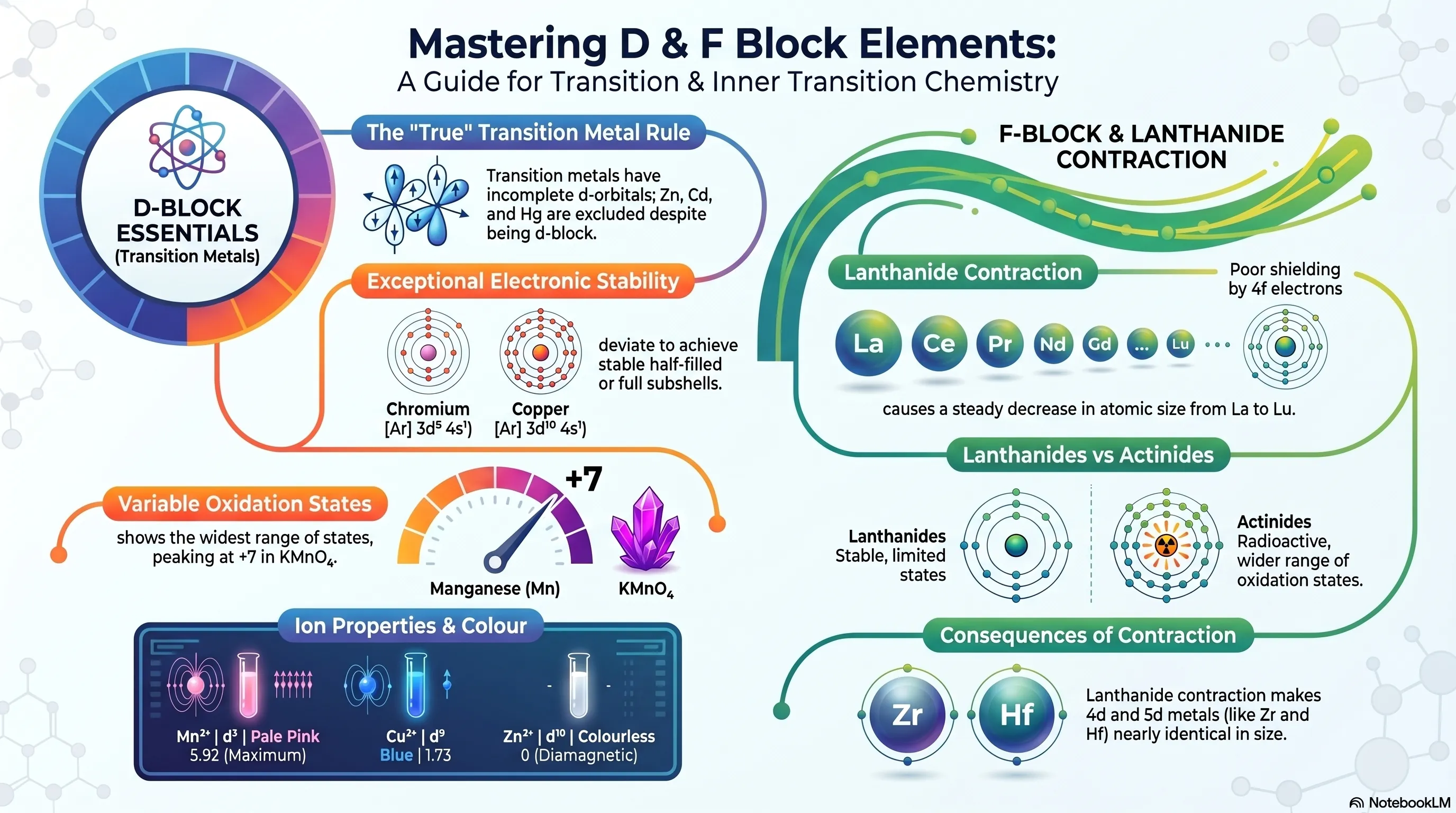
Table of Contents
- What Are D Block and F Block Elements?
- D and F Block Elements Class 12 Notes
- Electronic Configuration of Transition Metals
- General Properties of D Block Elements
- Why Do Transition Metals Show Variable Oxidation States?
- Magnetic Properties and Colour of Transition Metal Compounds
- Important Compounds of Transition Metals
- F Block Elements: Lanthanides and Actinides
- Key Differences: D Block vs F Block Elements

eSaral ›D and F Block Elements Class 12 Notes, IIT JEE & NEET

🚀 Checkout eSaral Courses
What Are D Block and F Block Elements?
D Block Elements (Transition Metals)
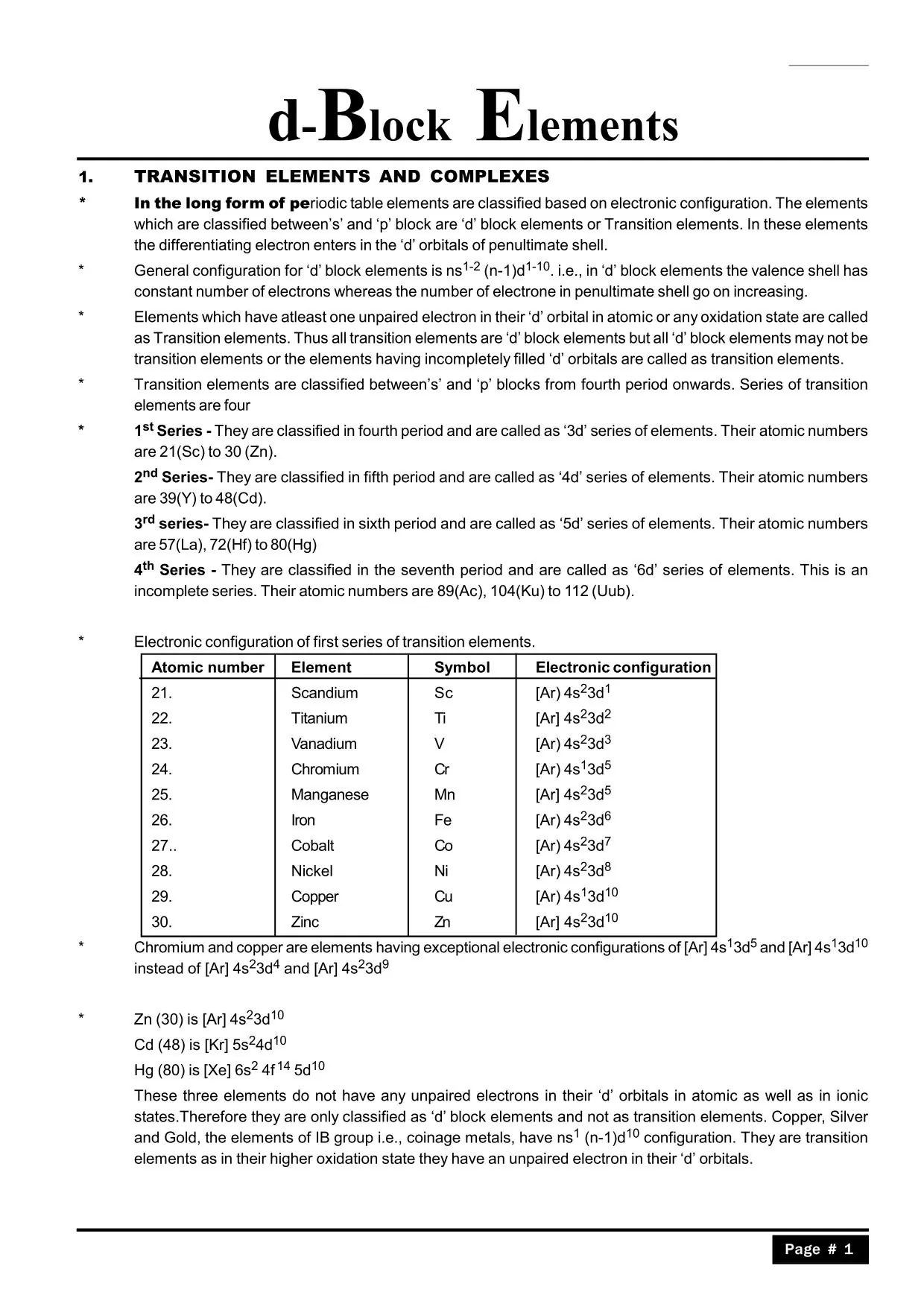
D block elements are those in which the last electron enters the d orbital of the penultimate shell. They occupy Groups 3 to 12 in the periodic table and are called transition metals because they bridge s block (reactive metals) and p block (non-metals) elements.
The four series of d block elements are:
| Series | Elements | Orbitals Filled |
|---|---|---|
| 1st transition series | Sc (21) to Zn (30) | 3d |
| 2nd transition series | Y (39) to Cd (48) | 4d |
| 3rd transition series | La (57) / Hf (72) to Hg (80) | 5d |
| 4th transition series | Ac (89) / Rf (104) to Cn (112) | 6d |
Note for JEE/NEET: Zinc (Zn), Cadmium (Cd), and Mercury (Hg) are d block elements but are NOT transition metals because their d orbitals are completely filled (d¹⁰) in both elemental and common ionic forms. They do not show typical transition metal properties.
F Block Elements (Inner Transition Metals)
F block elements are those in which the last electron enters the f orbital of the pre-penultimate shell. They are placed separately at the bottom of the periodic table and are divided into:
- Lanthanides: Elements 58 (Ce) to 71 (Lu) — 4f series
- Actinides: Elements 90 (Th) to 103 (Lr) — 5f series
💡 Expert Tip by eSaral IIT Faculty: A very common JEE/NEET trap question asks whether Zn is a transition metal. The answer is NO — Zn has a completely filled d¹⁰ configuration in both the atom and its ion (Zn²⁺), so it does not show variable oxidation states, colour, or paramagnetism. Always check ionic configuration, not just atomic configuration.
D and F Block Elements Class 12 Notes
India's Best Exam Preparation for Class 12th - Download Now
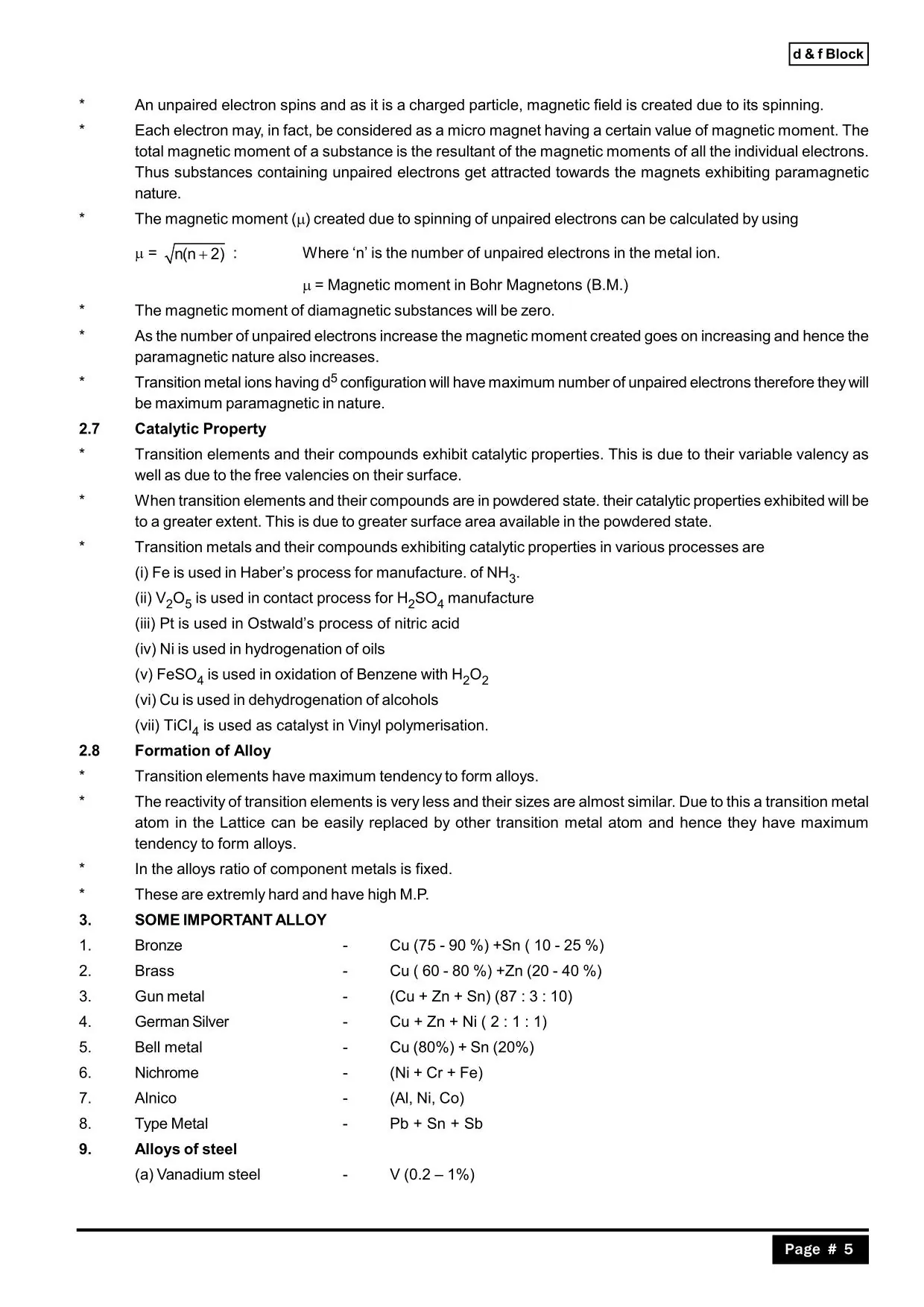
India's Best Exam Preparation for Class 12th - Download Now
India's Best Exam Preparation for Class 12th - Download Now
Electronic Configuration of Transition Metals
General Configuration
The general electronic configuration of d block elements is:
(n–1)d¹⁻¹⁰ ns⁰⁻²
where n is the outermost shell (principal quantum number).
For the first transition series (Sc to Zn): [Ar] 3d¹⁻¹⁰ 4s⁰⁻²
Important Exceptions to Know for JEE
Two elements in the first transition series deviate from the expected configuration due to the extra stability of half-filled (d⁵) and completely filled (d¹⁰) d orbitals:
| Element | Expected Config | Actual Config | Reason |
|---|---|---|---|
| Cr (24) | [Ar] 3d⁴ 4s² | [Ar] 3d⁵ 4s¹ | Half-filled d⁵ is more stable |
| Cu (29) | [Ar] 3d⁹ 4s² | [Ar] 3d¹⁰ 4s¹ | Completely filled d¹⁰ is more stable |
💡 Expert Tip by eSaral IIT Faculty: The configurations of Cr and Cu are asked directly in JEE Main and NEET almost every year. Memorise both. The reasoning — extra stability of half-filled and completely-filled d orbitals — must be stated clearly in board exam answers for full marks.
Electronic Configuration of Common Ions
For ionic configurations, always remove ns electrons first, then (n–1)d electrons:
| Ion | Configuration |
|---|---|
| Fe²⁺ | [Ar] 3d⁶ |
| Fe³⁺ | [Ar] 3d⁵ |
| Cu⁺ | [Ar] 3d¹⁰ |
| Cu²⁺ | [Ar] 3d⁹ |
| Mn²⁺ | [Ar] 3d⁵ |
General Properties of D Block Elements
Physical Properties
Transition metals generally have:
- High melting and boiling points (due to strong metallic bonding involving d electrons)
- High density and hardness
- Good electrical and thermal conductivity
Exception: Mercury (Hg) is a liquid at room temperature. Manganese (Mn) has an unusually low melting point among the first series.
Atomic and Ionic Radii Trends
Moving across the first transition series (Sc → Zn):
- Atomic radius decreases initially, then becomes nearly constant from about Cr to Cu
- This is because added d electrons shield the increased nuclear charge effectively — unlike s and p blocks where size decreases steadily
- From Cu to Zn, slight increase due to d¹⁰ repulsion
| Property | Trend Across 1st Transition Series | Exception |
|---|---|---|
| Atomic radius | Slight decrease then nearly constant | Slight increase at Zn |
| Melting point | Generally high; peaks at Cr/W | Mn and Zn are low |
| Density | Generally increases | — |
| Ionisation enthalpy | Increases slowly across series | Irregularities due to d stability |
| Electronegativity | Increases slowly | — |
Ionisation Enthalpy
Ionisation enthalpies of transition metals are higher than s block metals but lower than p block non-metals. The slow increase across the period is due to increasing nuclear charge being partially offset by d electron shielding.
Why Do Transition Metals Show Variable Oxidation States?
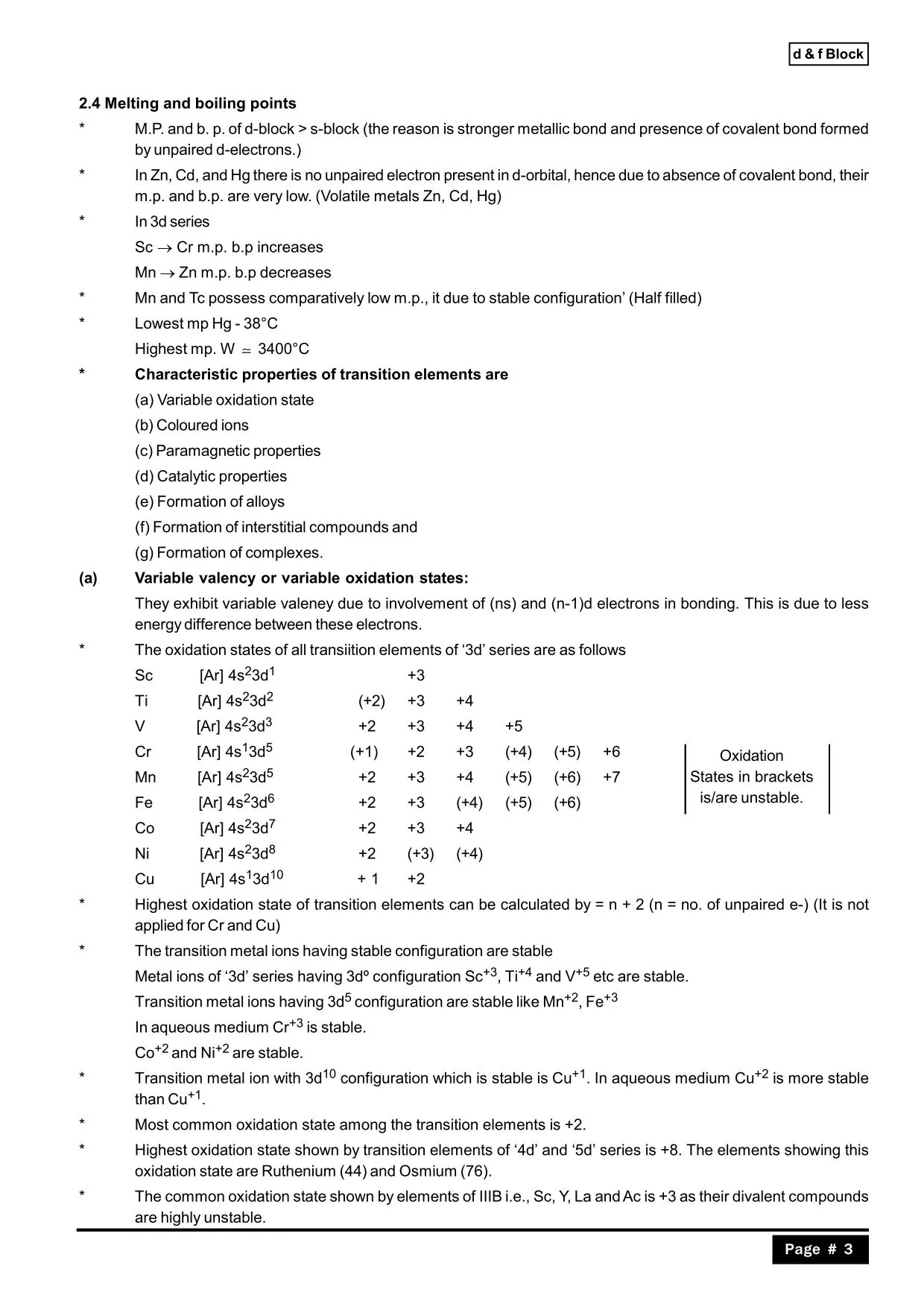
Transition metals show variable oxidation states because both ns and (n–1)d electrons can participate in bonding. The energy difference between ns and (n–1)d orbitals is small, making it easy to use different numbers of electrons.
Oxidation State Ranges for Common Transition Metals
| Element | Common Oxidation States | Highest Oxidation State |
|---|---|---|
| Sc | +3 | +3 |
| Ti | +2, +3, +4 | +4 |
| V | +2, +3, +4, +5 | +5 |
| Cr | +2, +3, +6 | +6 |
| Mn | +2, +3, +4, +6, +7 | +7 (in KMnO₄) |
| Fe | +2, +3 | +6 (rare) |
| Co | +2, +3 | +3 |
| Ni | +2 | +4 (rare) |
| Cu | +1, +2 | +2 |
| Zn | +2 only | +2 |
Key trends:
- The +2 oxidation state is common across the series (loss of both 4s electrons)
- Mn shows the maximum number of oxidation states (+2 to +7)
- The highest oxidation state increases from Sc (+3) to Mn (+7), then decreases
- Higher oxidation states are stabilised by oxygen and fluorine (electronegative ligands)
Magnetic Properties and Colour of Transition Metal Compounds
Magnetic Properties
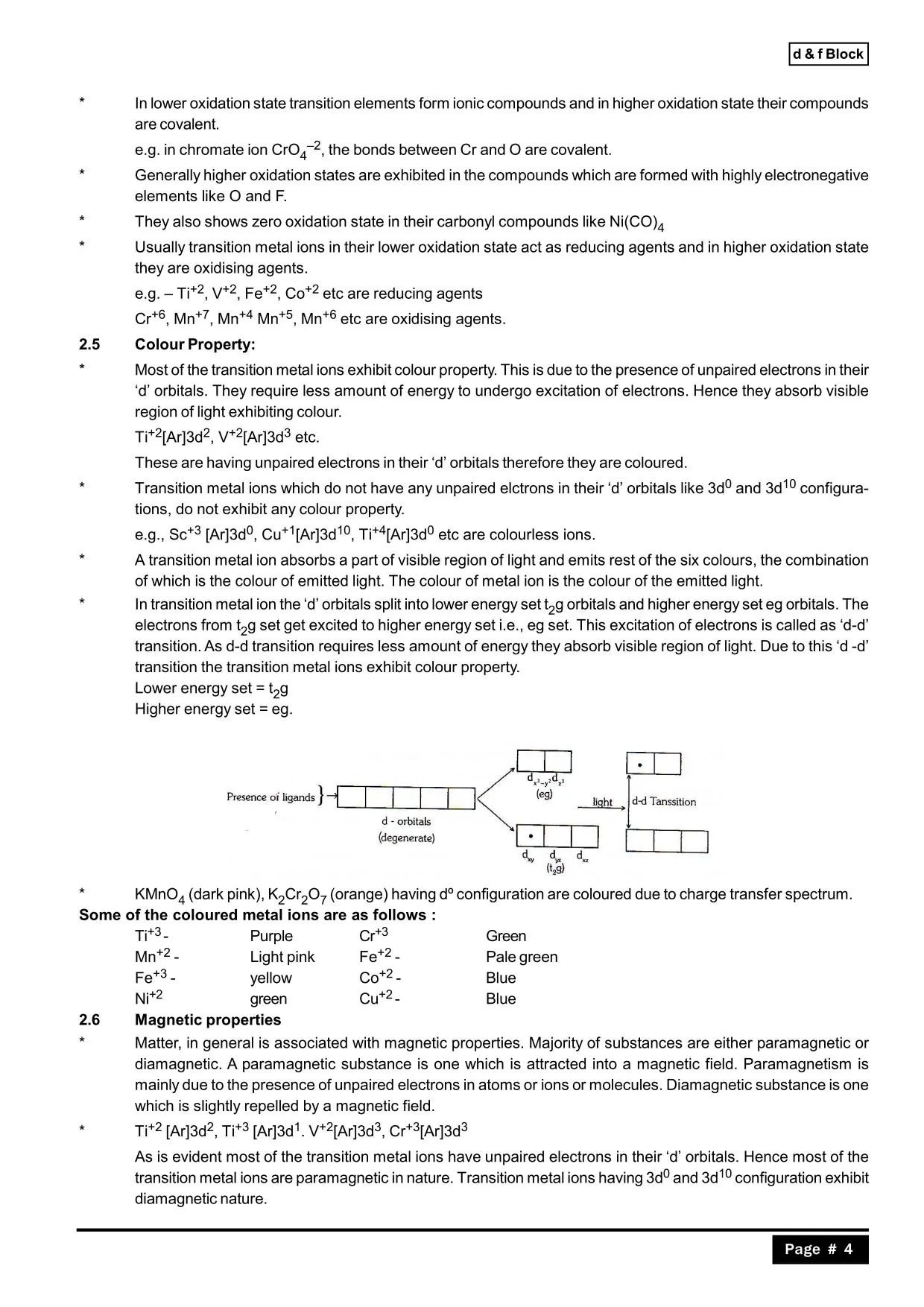
Transition metal compounds are often paramagnetic because of unpaired d electrons.
- Paramagnetism: Substance is attracted to a magnetic field — caused by unpaired electrons
- Diamagnetism: Substance is repelled — all electrons are paired
Magnetic moment (μ) = √n(n+2) BM, where n = number of unpaired electrons
| Ion | d configuration | Unpaired electrons | Magnetic moment (BM) |
|---|---|---|---|
| Sc³⁺ | d⁰ | 0 | 0 (diamagnetic) |
| Ti³⁺ | d¹ | 1 | 1.73 |
| V³⁺ | d² | 2 | 2.83 |
| Cr³⁺ | d³ | 3 | 3.87 |
| Mn²⁺ / Fe³⁺ | d⁵ | 5 | 5.92 (maximum) |
| Fe²⁺ | d⁶ | 4 | 4.90 |
| Co²⁺ | d⁷ | 3 | 3.87 |
| Ni²⁺ | d⁸ | 2 | 2.83 |
| Cu²⁺ | d⁹ | 1 | 1.73 |
| Zn²⁺ | d¹⁰ | 0 | 0 (diamagnetic) |
JEE/NEET fact: Mn²⁺ and Fe³⁺ both have d⁵ configuration with 5 unpaired electrons — giving the highest magnetic moment of 5.92 BM among common ions.
Colour of Transition Metal Compounds
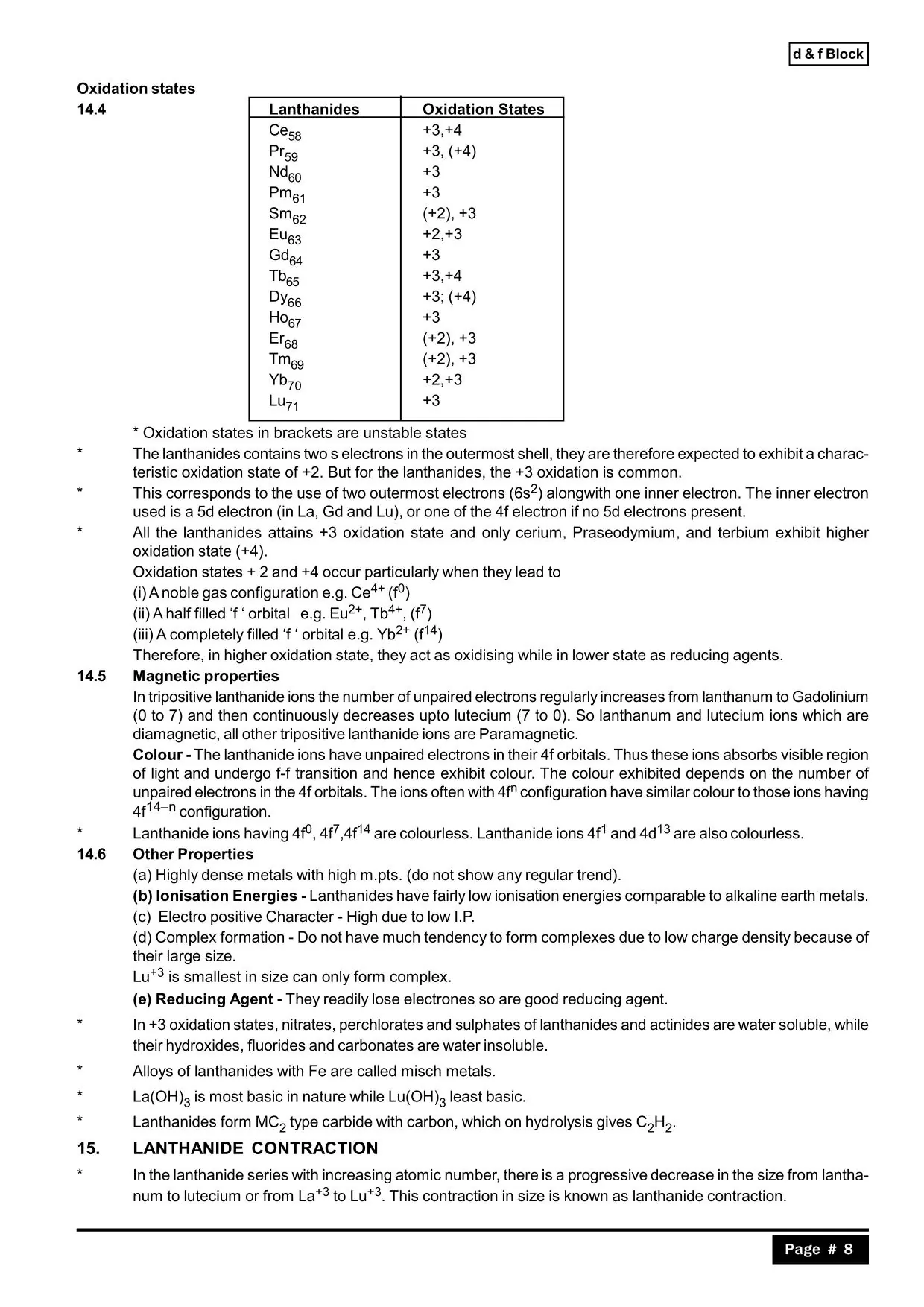
Most transition metal compounds are coloured because d electrons can absorb visible light and undergo d-d transitions (electrons jump from lower to higher d energy levels, absorbing part of the visible spectrum — the complementary colour is observed).
| Ion | Colour | d configuration |
|---|---|---|
| Ti³⁺ | Purple | d¹ |
| V³⁺ | Green | d² |
| Cr³⁺ | Violet | d³ |
| Mn²⁺ | Pale pink | d⁵ |
| Fe³⁺ | Yellow/Brown | d⁵ |
| Co²⁺ | Pink | d⁷ |
| Ni²⁺ | Green | d⁸ |
| Cu²⁺ | Blue | d⁹ |
| Zn²⁺ | Colourless | d¹⁰ |
| Sc³⁺ | Colourless | d⁰ |
Why are Zn²⁺ and Sc³⁺ colourless? Because d⁰ and d¹⁰ configurations have no possibility of d-d transitions — no visible light is absorbed, so the compound appears colourless.
Important Compounds of Transition Metals
These compounds appear directly in JEE Main, NEET, and board exams every year.
Potassium Permanganate (KMnO₄)
- Mn is in +7 oxidation state
- Strong oxidising agent in both acidic and basic media
- In acidic medium: MnO₄⁻ → Mn²⁺ (colourless) — gain of 5 electrons
- In neutral/alkaline medium: MnO₄⁻ → MnO₂ (brown ppt) — gain of 3 electrons
- Prepared by fusing MnO₂ with KOH in presence of oxidising agent → K₂MnO₄, then electrolytic oxidation → KMnO₄
Potassium Dichromate (K₂Cr₂O₇)
- Cr is in +6 oxidation state
- Strong oxidising agent in acidic medium
- Structure contains two CrO₄ tetrahedra sharing one oxygen
- In acidic solution: Cr₂O₇²⁻ + 14H⁺ + 6e⁻ → 2Cr³⁺ + 7H₂O
- Orange in acidic solution, yellow (CrO₄²⁻) in alkaline solution
- Used in volumetric analysis — orange to green colour change indicates end point
| Compound | Oxidation State of Metal | Colour | Key Use |
|---|---|---|---|
| KMnO₄ | Mn = +7 | Purple/Violet | Oxidising agent, volumetric analysis |
| K₂Cr₂O₇ | Cr = +6 | Orange | Oxidising agent, chrome tanning |
| K₂MnO₄ | Mn = +6 | Green | Intermediate in KMnO₄ preparation |
| CrO₄²⁻ | Cr = +6 | Yellow | In alkaline solution |
| CuSO₄·5H₂O | Cu = +2 | Blue | Fungicide, electroplating |
F Block Elements: Lanthanides and Actinides
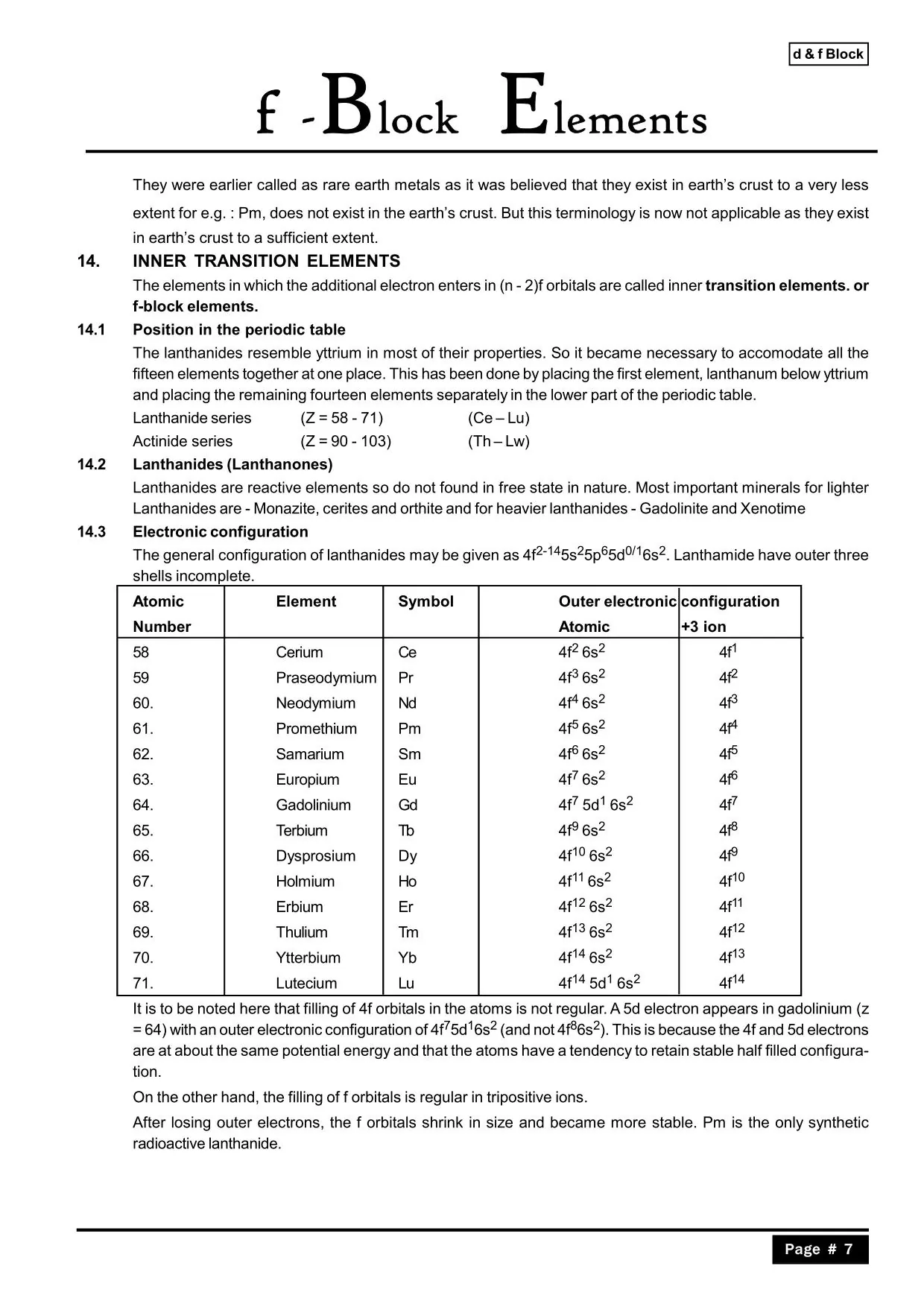
Lanthanides (4f Series: Ce to Lu, Z = 58–71)
General electronic configuration: [Xe] 4f¹⁻¹⁴ 5d⁰⁻¹ 6s²
Key properties:
- All show +3 as the most common oxidation state
- Also show +2 (Eu, Yb) and +4 (Ce, Tb) in some compounds
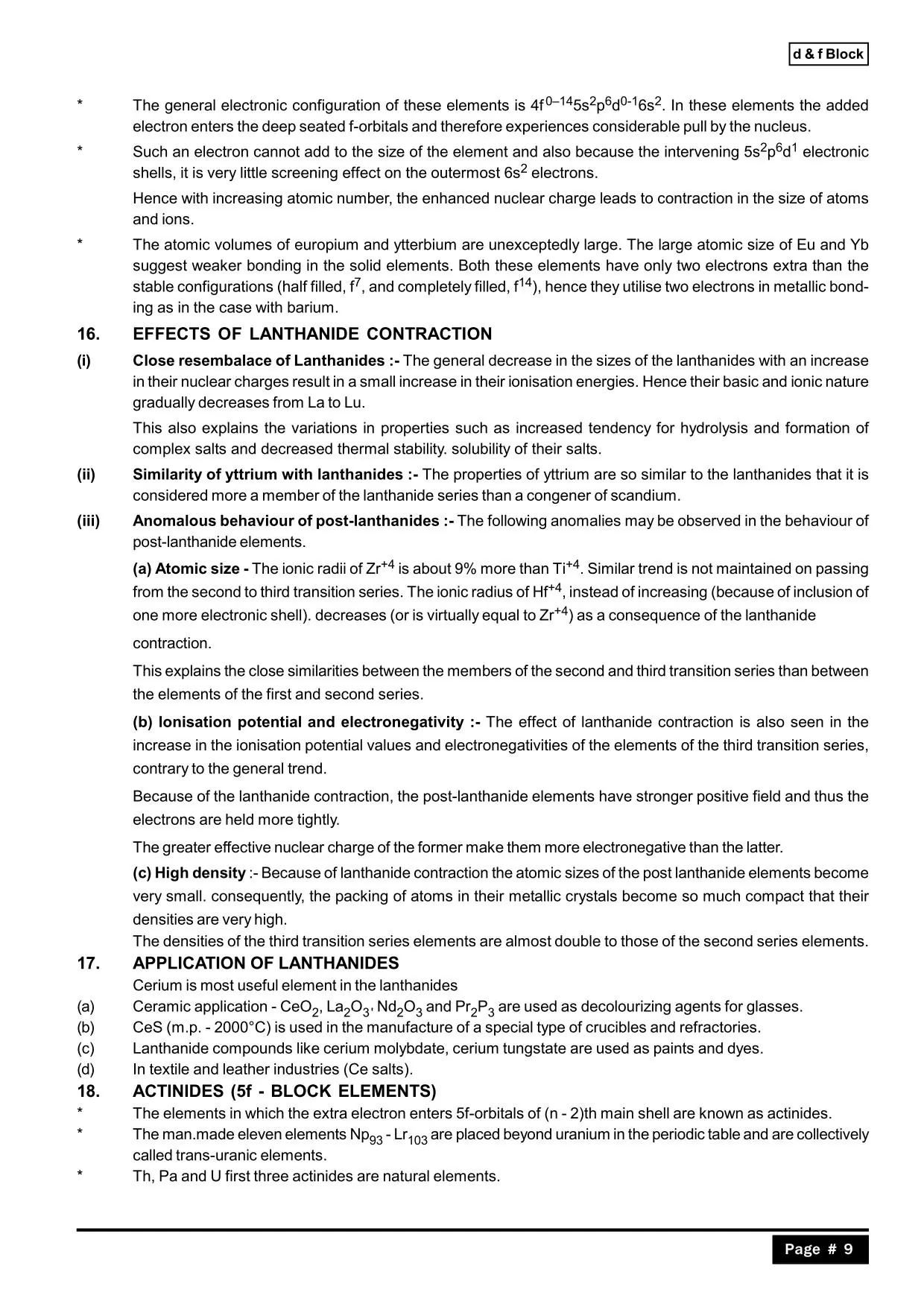
- Lanthanide contraction: Steady decrease in atomic/ionic radii from La to Lu due to poor shielding by 4f electrons — each added 4f electron shields nuclear charge poorly, causing a net pull on outer electrons
What Is Lanthanide Contraction and Why Does It Matter?
Lanthanide contraction is the gradual decrease in atomic and ionic radii of lanthanides from La (Z=57) to Lu (Z=71). It occurs because 4f electrons have poor shielding ability — each new 4f electron does not fully shield the increased nuclear charge, causing electrons to be pulled inward.
Consequences of lanthanide contraction:
- Similar sizes of 4d and 5d transition metals (e.g., Zr and Hf are almost identical in size)
- Similar properties of Zr/Hf, Nb/Ta, Mo/W — making them difficult to separate
- Higher density and harder character of 5d metals
Actinides (5f Series: Th to Lr, Z = 90–103)
General electronic configuration: [Rn] 5f¹⁻¹⁴ 6d⁰⁻¹ 7s²
Key differences from Lanthanides:
| Property | Lanthanides | Actinides |
|---|---|---|
| f orbital filled | 4f | 5f |
| Common oxidation state | +3 | +3, but also +4, +5, +6 (more variable) |
| Radioactivity | Most are non-radioactive | All are radioactive |
| Shielding by f electrons | Poor (4f) | Even poorer (5f) |
| Availability | Naturally occurring | Most are synthetic (beyond U) |
| Actinide contraction | Less pronounced | More pronounced |
💡 Expert Tip by eSaral IIT Faculty: The key difference examiners love to test: all actinides are radioactive; only a few lanthanides are. Also, actinides show a wider range of oxidation states than lanthanides because 5f, 6d, and 7s electrons all have similar energies and can all participate in bonding.
Key Differences: D Block vs F Block Elements
| Property | D Block (Transition Metals) | F Block (Inner Transition Metals) |
|---|---|---|
| Position in periodic table | Groups 3–12 | Bottom two rows (separate block) |
| Orbital filling | (n–1)d | (n–2)f |
| Series | 4 series (3d, 4d, 5d, 6d) | Lanthanides (4f) and Actinides (5f) |
| Variable oxidation states | Yes — due to ns and (n–1)d electrons | Lanthanides mainly +3; Actinides more variable |
| Colour of compounds | Most are coloured (d-d transitions) | Lanthanide compounds — some coloured |
| Radioactivity | Most are stable | All actinides are radioactive |
| Catalytic activity | High (Fe, Ni, Pt, V₂O₅) | Low |
| Complex formation | Strong tendency | Moderate |
| Magnetic properties | Often paramagnetic | Lanthanides show paramagnetism |
Frequently Asked Questions
Find answers to common questions.
What are d block and f block elements in Class 12 Chemistry?
D block elements are those in which the last electron enters the d orbital — they occupy Groups 3–12 of the periodic table and are called transition metals. F block elements are those in which the last electron enters the f orbital — they include lanthanides (4f series, elements 58–71) and actinides (5f series, elements 90–103), placed separately at the bottom of the periodic table.
Why do transition metals show variable oxidation states?
Transition metals show variable oxidation states because both ns electrons and (n–1)d electrons can participate in bonding. The energy gap between these orbitals is small, so different numbers of electrons can be used in bond formation. For example, Mn shows oxidation states from +2 to +7, the widest range in the first transition series.
Why is Zinc not considered a transition metal?
Zinc (Zn) has the electronic configuration [Ar] 3d¹⁰ 4s². Its d orbital is completely filled in both the elemental form and its common ion Zn²⁺ ([Ar] 3d¹⁰). Since transition metals are defined as elements with partially filled d orbitals in the elemental or ionic state, Zn does not qualify. It shows no variable oxidation states, no colour, and no paramagnetism.
What is lanthanide contraction and what are its consequences?
Lanthanide contraction is the steady decrease in atomic and ionic radii from La to Lu due to the poor shielding ability of 4f electrons. Its main consequences are: 5d transition metals have almost the same size as their 4d counterparts (e.g., Zr ≈ Hf in radius), making pairs like Zr/Hf, Nb/Ta, and Mo/W difficult to separate chemically.
What is the oxidation state of Mn in KMnO₄ and Cr in K₂Cr₂O₇?
In KMnO₄, manganese is in the +7 oxidation state — the highest for Mn. In K₂Cr₂O₇, chromium is in the +6 oxidation state. Both compounds are strong oxidising agents used in volumetric analysis. KMnO₄ is purple; K₂Cr₂O₇ is orange in acidic solution and yellow (as CrO₄²⁻) in alkaline solution.