d & f-Block - NEET Previous Year Questions with Complete Solutions
d and f Block Elements is a high-scoring NEET Chemistry chapter covering electronic configurations, oxidation states, magnetic properties, coloured ions, lanthanoid contraction, and oxidising agents like KMnO₄ and K₂Cr₂O₇, with 2–3 questions appearing consistently every year.
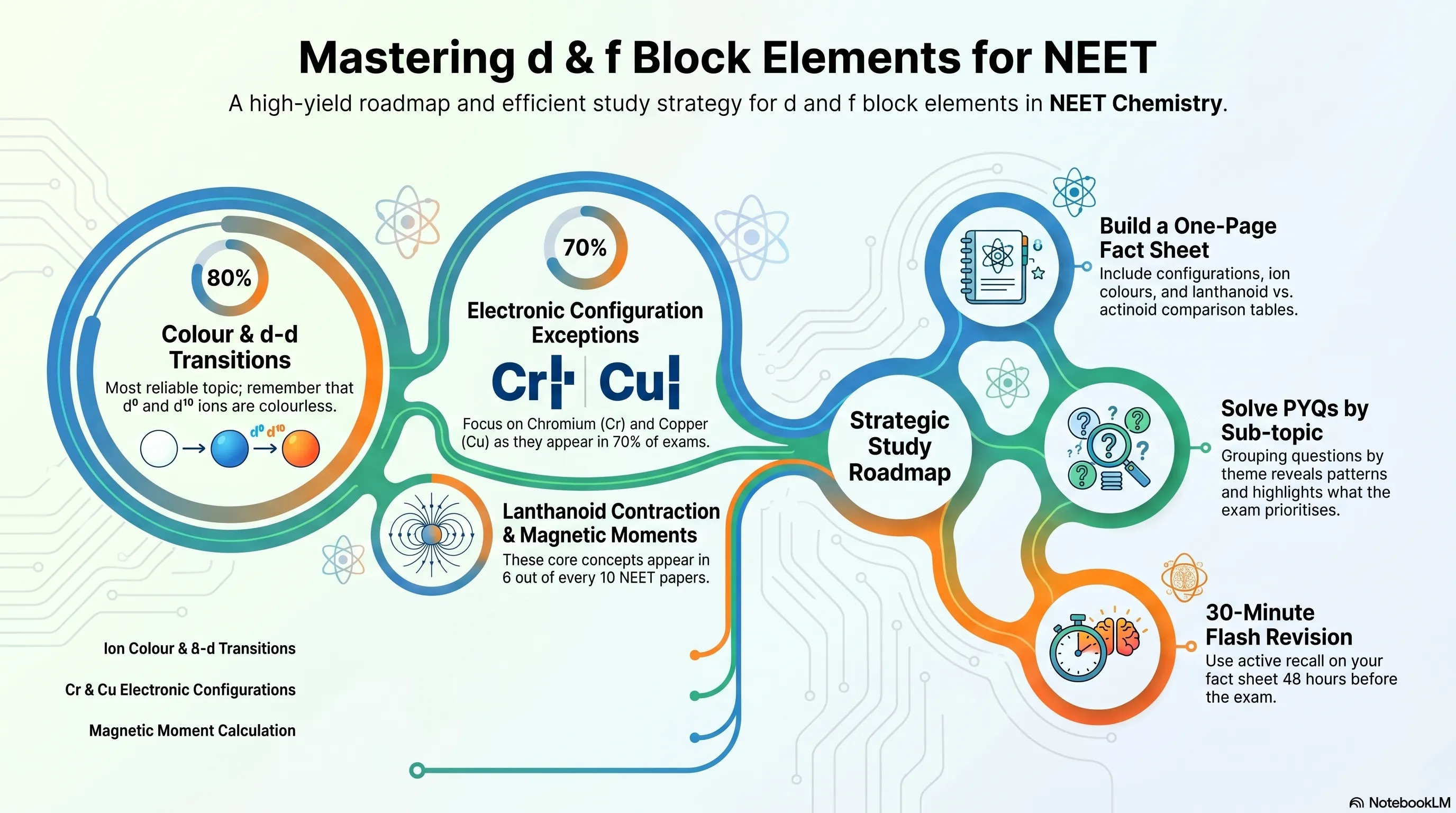
Table of Contents

eSaral › NEET ›d & f-Block - NEET Previous Year Questions with Complete Solutions

d and f Block Elements in NEET: Weightage and Exam Pattern
d and f block elements is one of the most consistently high-scoring chapters in NEET Class 12 Chemistry. Unlike chapters where the question count varies year to year, this chapter reliably delivers 2–3 questions per paper — making it a chapter no serious NEET aspirant can afford to treat lightly.
The questions split almost evenly between factual recall (which element shows the highest oxidation state, which compound is coloured) and concept application (why Mn²⁺ is more stable than Fe²⁺, why lanthanoids show similar properties). Both types are fully predictable from PYQ analysis.
| Exam Year | Questions from d & f Block | Key Sub-topics Tested |
|---|---|---|
| 2024 | 2 | Lanthanoid contraction, KMnO₄ oxidising properties |
| 2023 | 3 | Variable oxidation states, colour of ions, magnetic moment |
| 2022 | 2 | Catalytic behaviour, interstitial compounds |
| 2021 | 3 | Electronic configuration exceptions (Cr, Cu), oxidation states |
| 2020 | 2 | f block — lanthanoids vs actinoids, oxidation states |
| 2019 | 3 | Colour of transition metal ions, d-d transitions |
| 2018 | 2 | KMnO₄ and K₂Cr₂O₇ as oxidising agents |
| 2017 | 2 | Magnetic properties, unpaired electrons |
| 2016 | 3 | Lanthanoid contraction consequences, actinoids |
| 2015 | 2 | Interstitial compounds, alloy formation |
💡 Expert Tip by Prateek Gupta, IIT Bombay: "d and f block feels like a memorisation chapter, but NEET questions are cleverer than that. They test why copper and chromium have exceptional electronic configurations, why higher oxidation states are more stable in early transition metals, and why lanthanoid contraction affects the properties of Period 6 elements. Understand the reasoning and the facts become easy to retain."
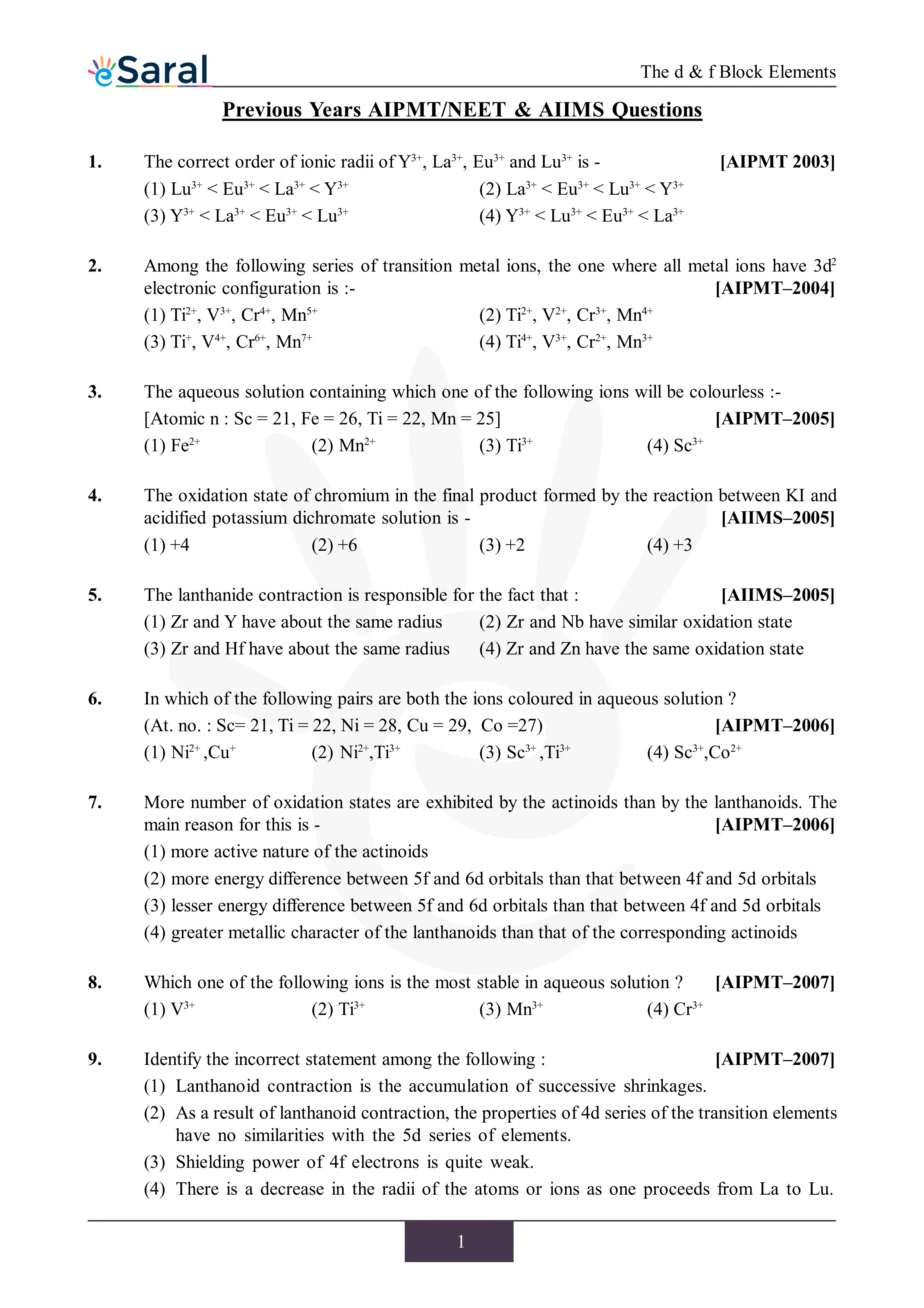
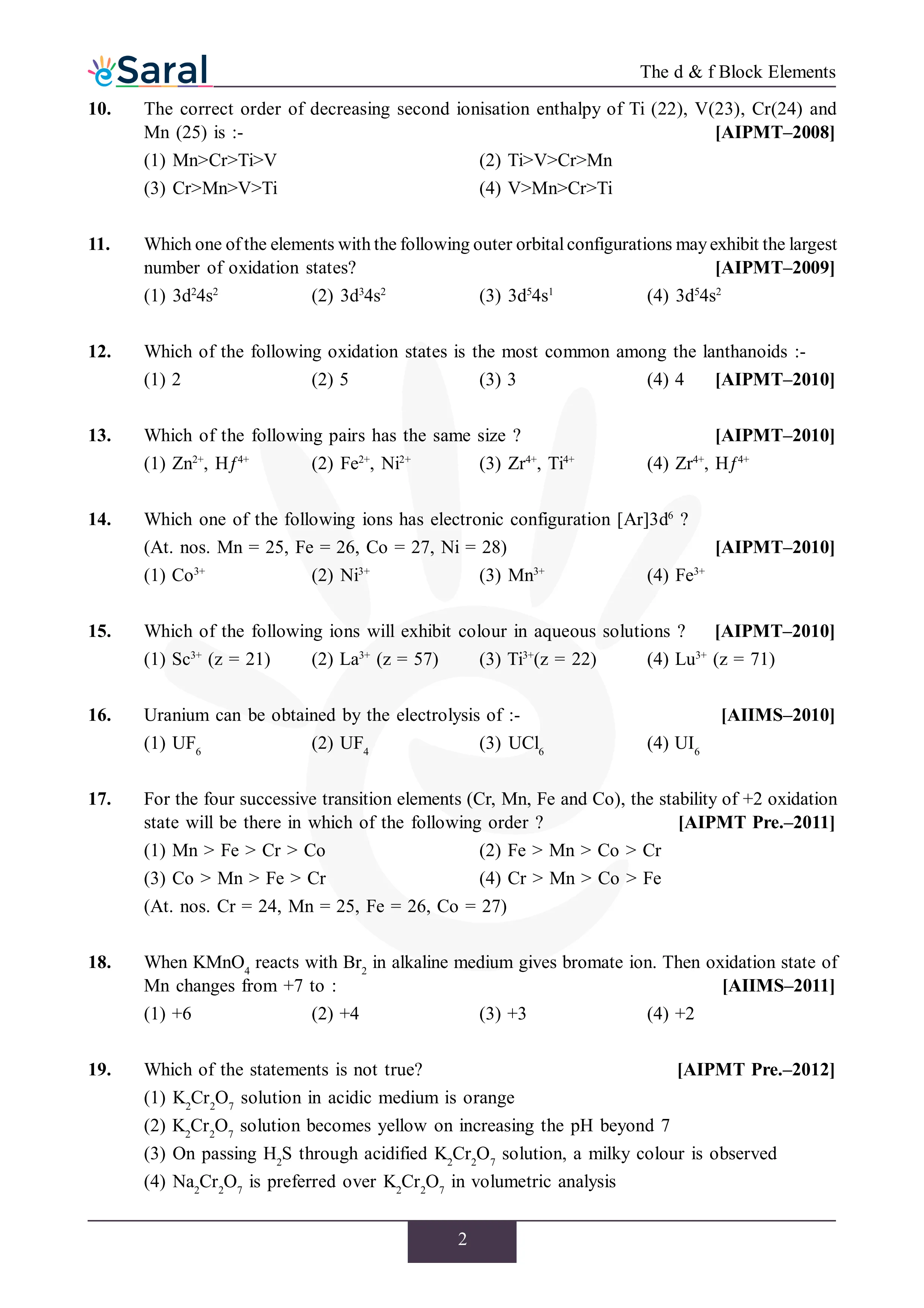
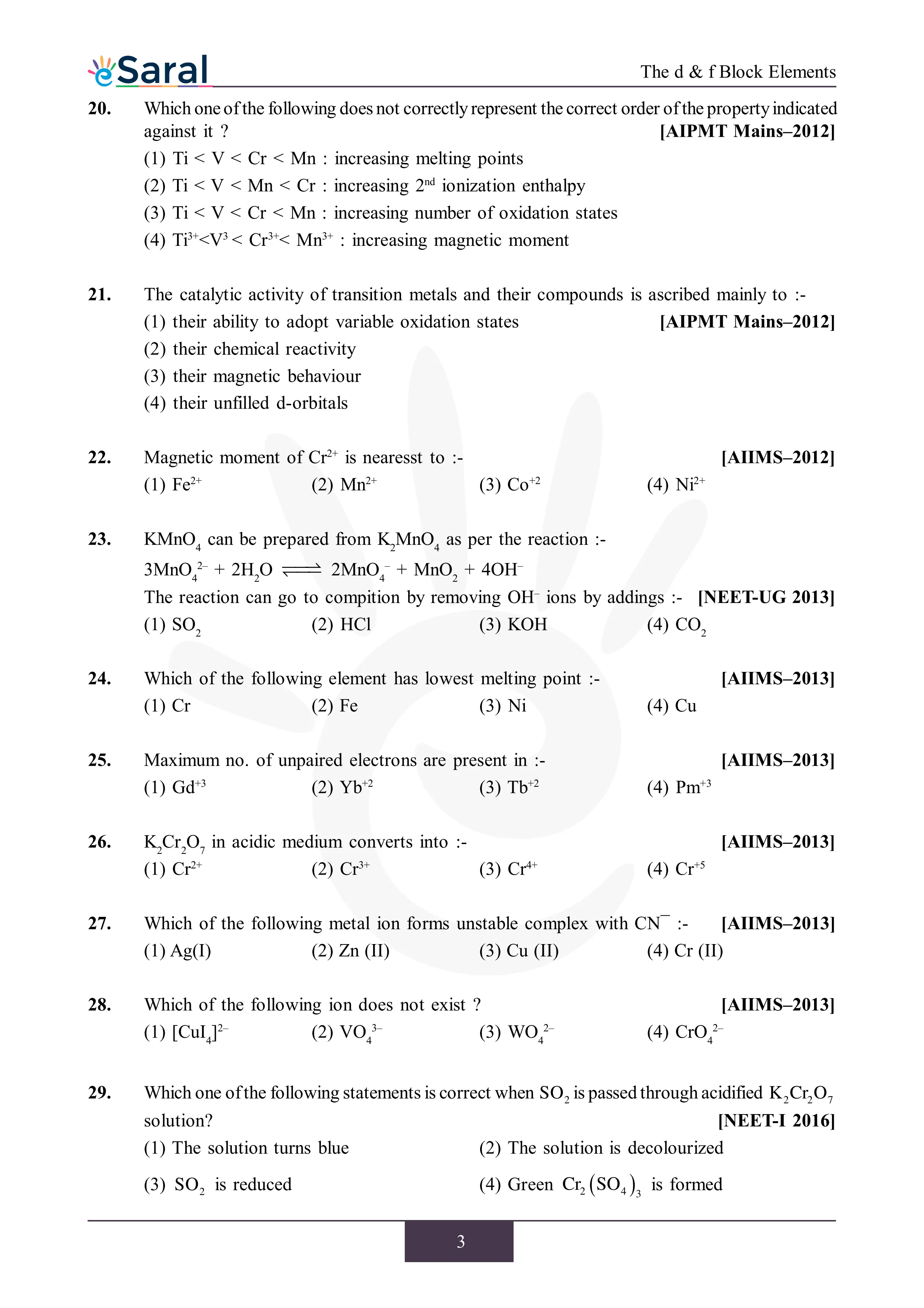
NEET PYQs with Solutions: Variable Oxidation States and Electronic Configuration
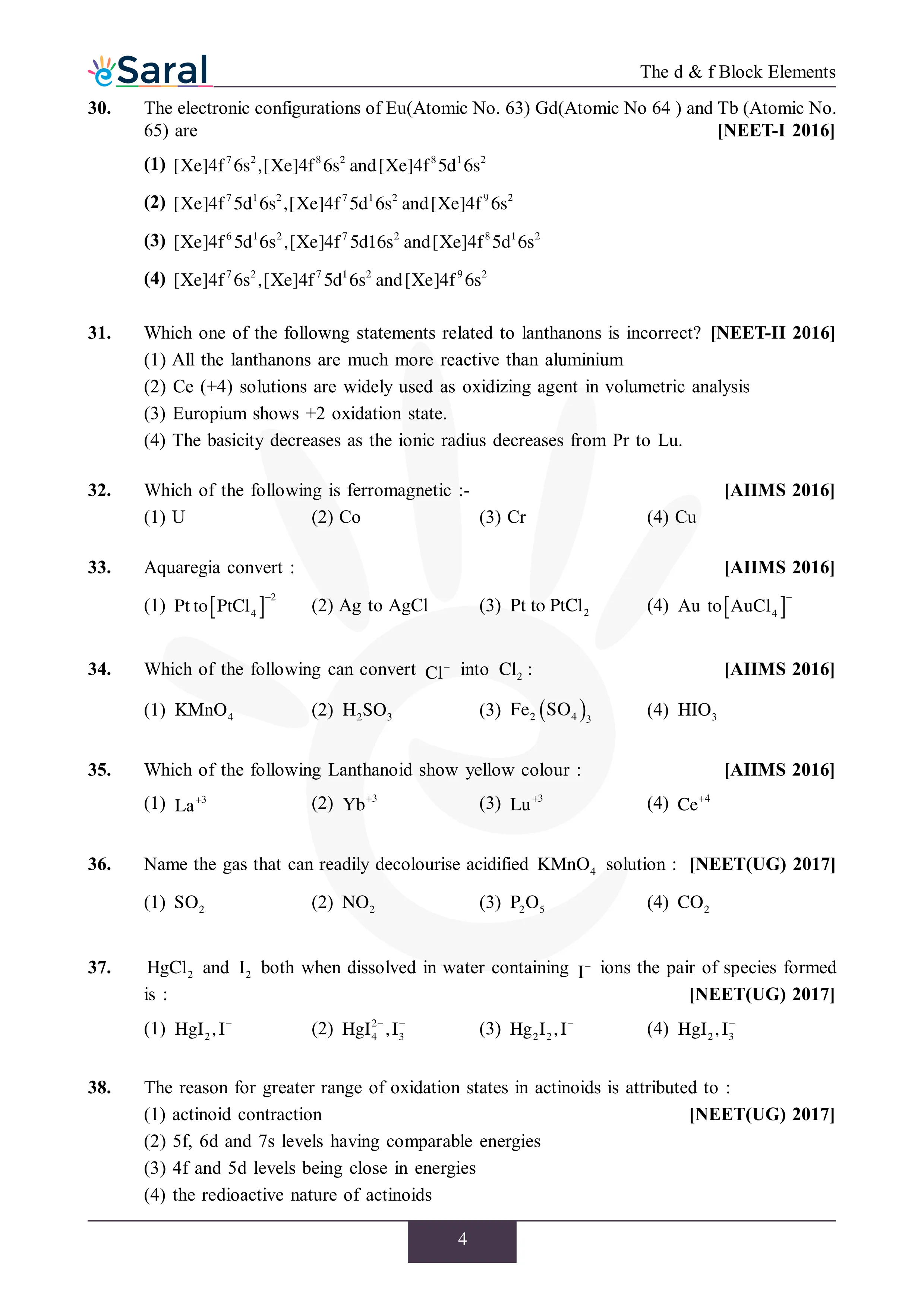
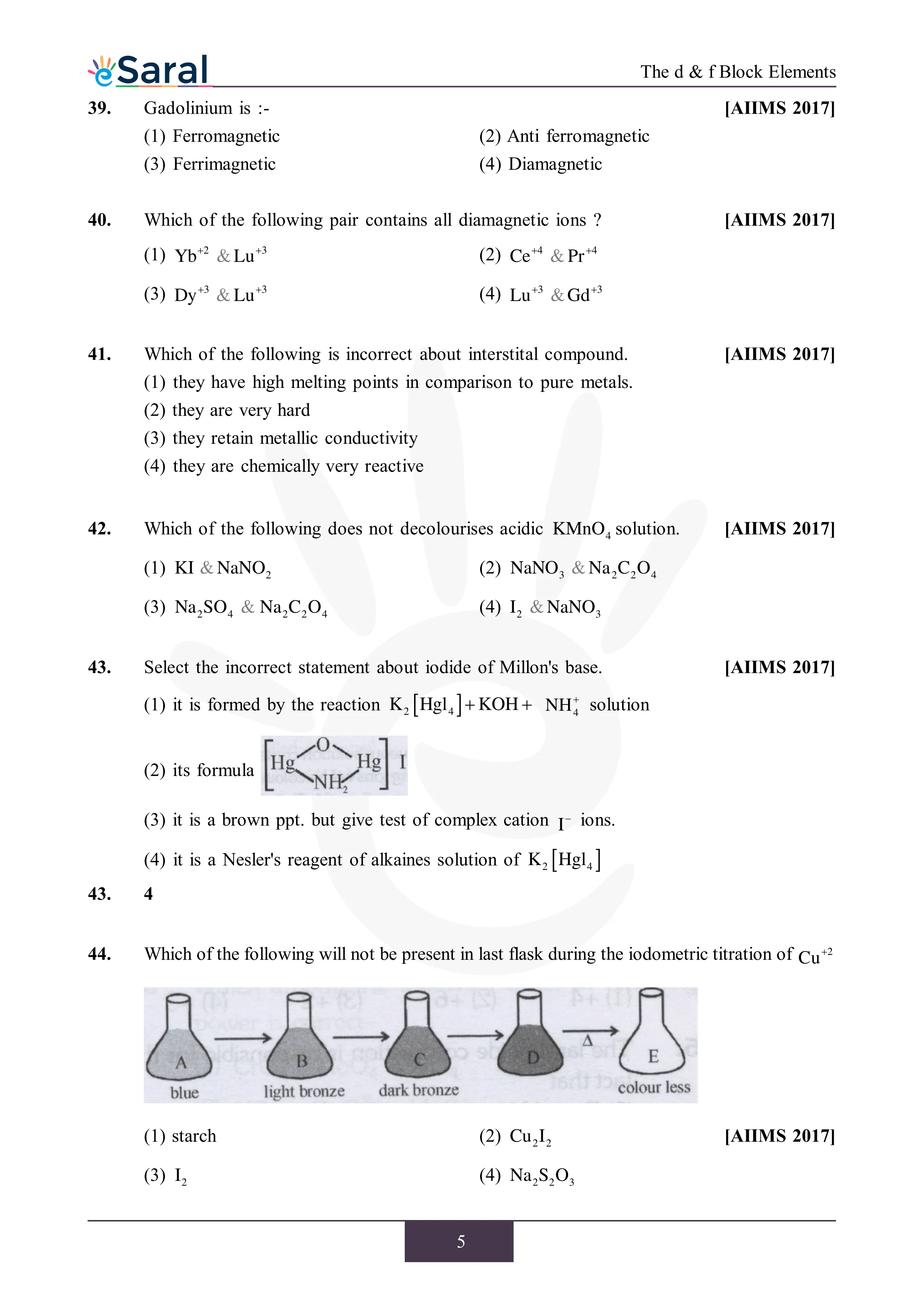
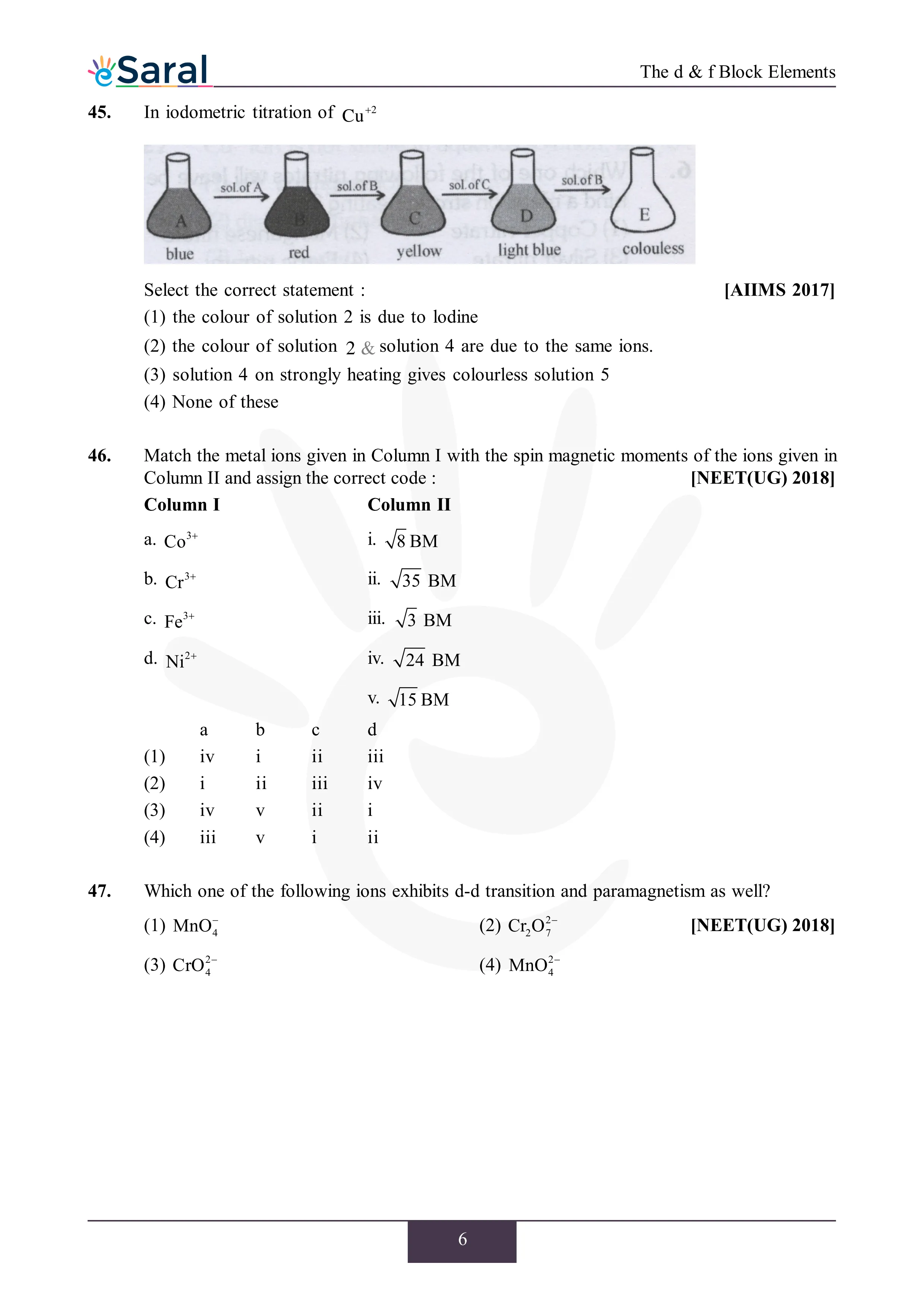
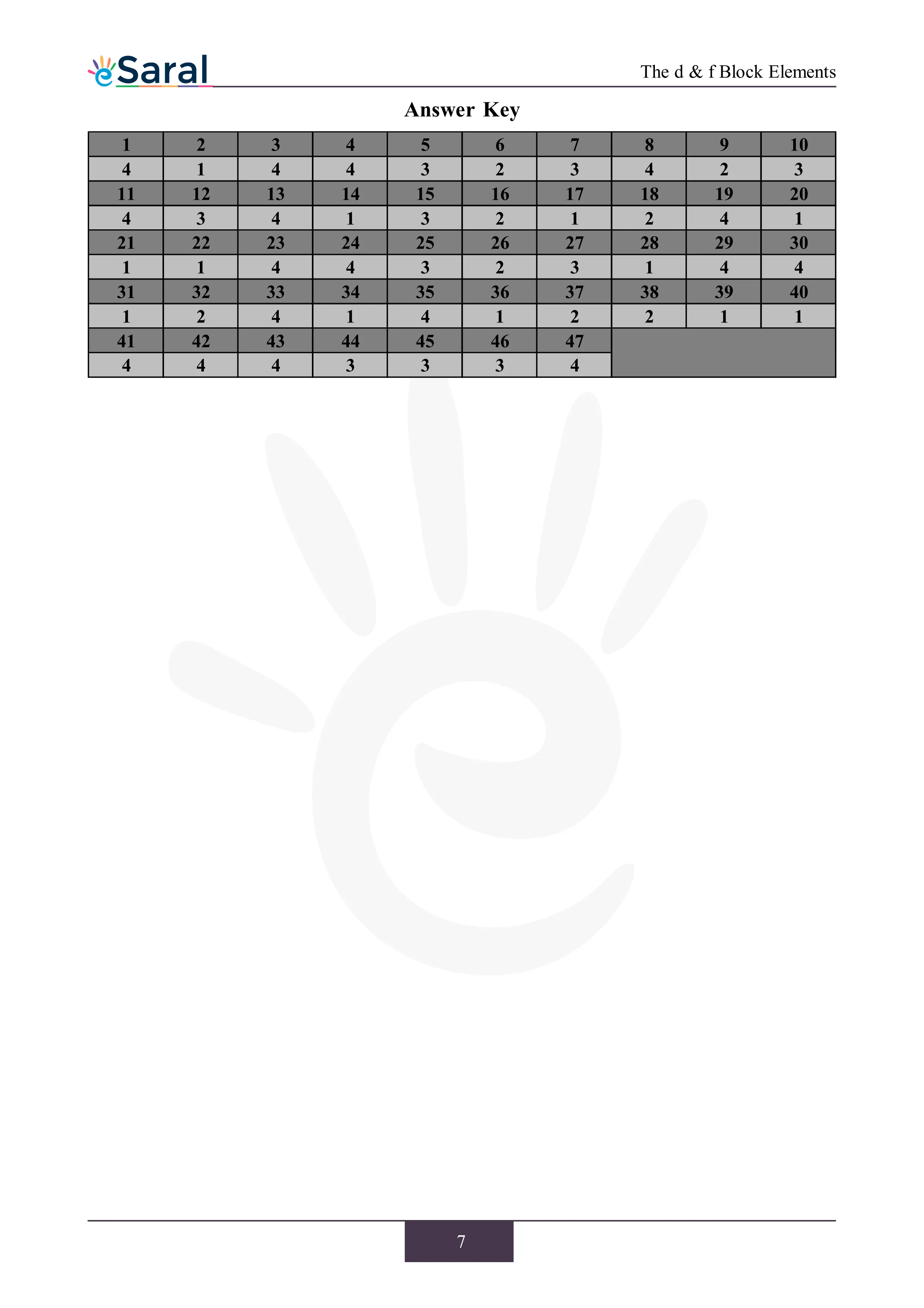
Most Repeated Topics in d and f Block for NEET
Based on analysis of NEET UG papers from 2015 to 2024, ranked by frequency of appearance:
- Electronic configuration exceptions — Cr and Cu — appeared in 7 of 10 years
- Colour of transition metal ions and d-d transitions — appeared in 8 of 10 years
- Magnetic moment calculation — appeared in 6 of 10 years
- KMnO₄ reactions in acidic, neutral, and alkaline media — appeared in 6 of 10 years
- Lanthanoid contraction — cause and consequences — appeared in 6 of 10 years
- Variable oxidation states — highest and most stable — appeared in 5 of 10 years
- Lanthanoids vs actinoids comparison — appeared in 5 of 10 years
- Interstitial compounds — properties and examples — appeared in 4 of 10 years
- K₂Cr₂O₇ as an oxidising agent — appeared in 3 of 10 years
- Catalytic behaviour of transition metals — appeared in 3 of 10 years
The single most reliable fact in d and f block NEET preparation: Colour and d-d transitions has appeared in 8 of the last 10 NEET papers. If you know which ions are coloured, which are colourless (d⁰ and d¹⁰), and why — you are guaranteed marks from this chapter every year.
How to Study d and f Block for NEET Efficiently
Step 1: Build Your Fact Sheet First (1 day)
Before solving any questions, create a one-page fact sheet covering:
- Electronic configurations of Cr and Cu (exceptions)
- Coloured vs colourless ions table (d⁰ and d¹⁰ are colourless)
- KMnO₄ reduction products in all three media
- Lanthanoid contraction: cause (poor 4f shielding) + three consequences
- Lanthanoids vs actinoids comparison table (oxidation states, radioactivity, complex formation)
This sheet becomes your revision anchor. Every PYQ you get wrong will point back to one row on this sheet.
Step 2: Learn the Magnetic Moment Formula by Doing, Not Memorising (1 day)
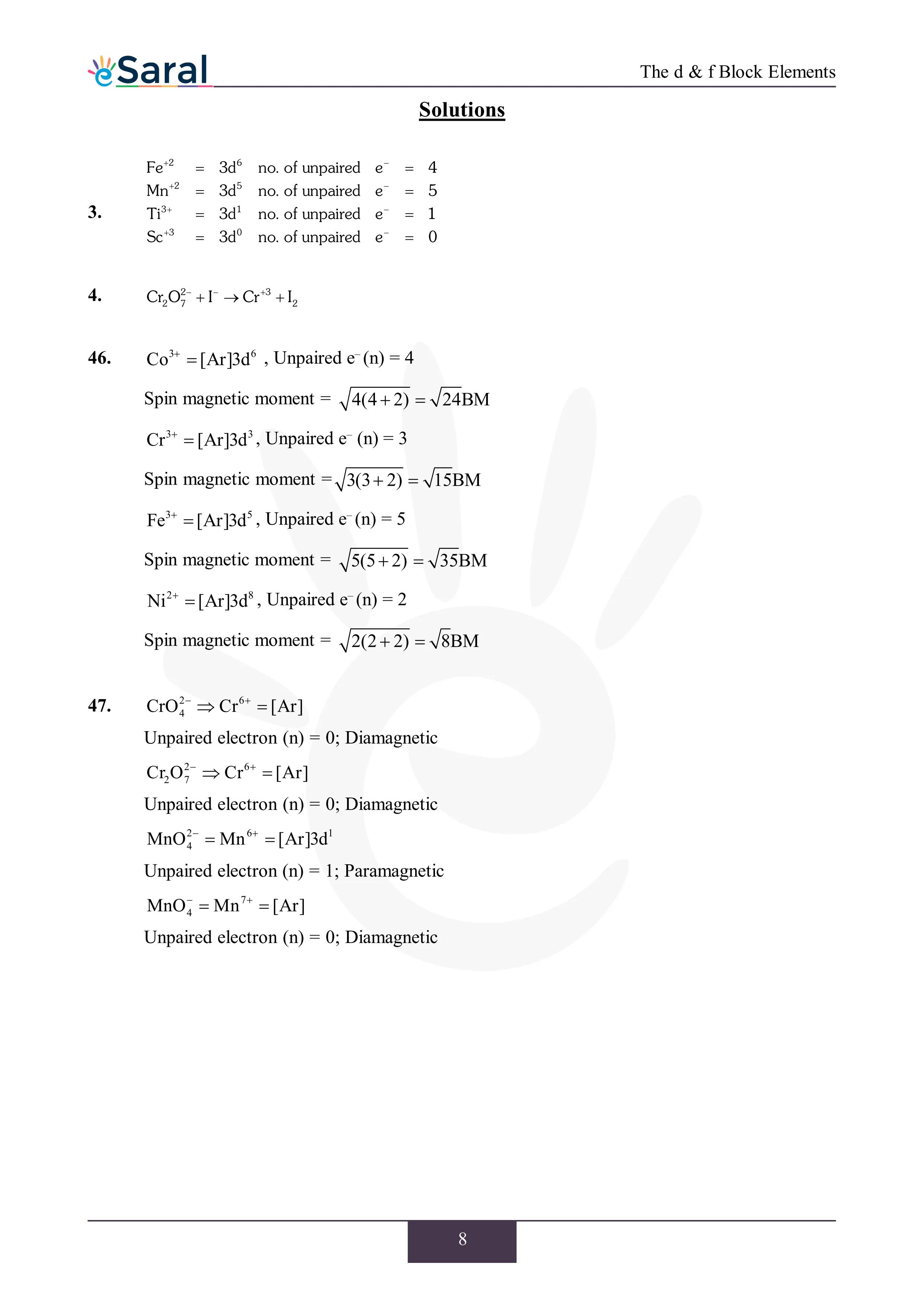
Write out μ = √n(n+2) BM ten times for different ions — Ti³⁺, V³⁺, Cr³⁺, Mn²⁺, Fe²⁺, Fe³⁺, Co²⁺, Ni²⁺. Do not memorise the final values. Practice deriving them from electron count every time. Under exam pressure, derivation is more reliable than memorised numbers.
Step 3: Solve PYQs Grouped by Sub-topic, Not by Year (2–3 days)
Solve all colour questions together, all magnetic moment questions together, all lanthanoid questions together. This pattern-grouping reveals exactly what NEET keeps testing within each sub-topic — and what it never tests (which tells you what to deprioritise).
Step 4: Revisit the KMnO₄ and K₂Cr₂O₇ Reactions Table
These two compounds are tested almost every alternate year. Make a dedicated table showing:
- Preparation of each compound
- Reactions in acidic, neutral, alkaline media
- Colour of the compound and its reduction products
- Use in volumetric analysis
Step 5: Do a 30-Minute Flash Revision 48 Hours Before NEET
Use your fact sheet from Step 1. Read each row, close the sheet, and write it from memory. Any row you cannot recall goes on a sticky note for the morning of the exam.
Frequently Asked Questions
Find answers to common questions.
How many questions come from d and f block elements in NEET every year?
d and f block elements contributes 2–3 questions per NEET UG paper consistently. The chapter appeared in every NEET paper from 2015 to 2024 without exception. Questions cover variable oxidation states, colour and magnetic properties, KMnO₄ reactions, lanthanoid contraction, and the lanthanoid vs actinoid comparison.
Why is the electronic configuration of Cr [Ar] 3d⁵ 4s¹ and not [Ar] 3d⁴ 4s²?
Chromium adopts [Ar] 3d⁵ 4s¹ because a half-filled d subshell (3d⁵) is extra stable due to symmetrical electron distribution and maximum exchange energy. One electron moves from 4s to 3d to achieve this stable half-filled configuration. The same principle gives copper its [Ar] 3d¹⁰ 4s¹ configuration — a completely filled d subshell is also extra stable.
Which transition metal ions are colourless and why?
Transition metal ions with d⁰ configuration (Sc³⁺, Ti⁴⁺) and d¹⁰ configuration (Cu⁺, Zn²⁺) are colourless. Colour in transition metal ions arises from d-d transitions — electrons absorbing visible light and jumping between d orbitals. Ions with no d electrons (d⁰) or fully filled d orbitals (d¹⁰) cannot undergo d-d transitions and therefore appear colourless.
What is lanthanoid contraction and what are its consequences for NEET?
Lanthanoid contraction is the steady decrease in atomic and ionic radii across the lanthanoid series, caused by poor shielding of outer electrons by 4f electrons. Its consequences — tested in NEET — include: near-identical atomic radii of 4d and 5d transition metals (e.g., Zr and Hf), difficulty in separating lanthanoids chemically, and decreasing basicity across the series.
What are the products of KMnO₄ reduction in acidic, neutral, and alkaline media?
In acidic medium, KMnO₄ is reduced to Mn²⁺ (colourless, Mn oxidation state +2). In neutral or faintly alkaline medium, the product is MnO₂ (brown precipitate, +4). In strongly alkaline medium, the product is MnO₄²⁻ (manganate ion, green, +6). These three products appear in NEET questions almost every other year.