Electrochemistry - JEE Main Previous Year Questions with Solutions


Home > JEE Main Previous Year Questions > Electrochemistry JEE Main Previous Year Questions

JEE Main Previous Year Papers Questions of Chemistry with Solutions are available at eSaral. Practicing JEE Main chapter wise questions of Chemistry will help the JEE aspirants in realizing the question pattern as well as help in analyzing weak & strong areas. Simulator Previous Years AIEEE/JEE Mains Questions 
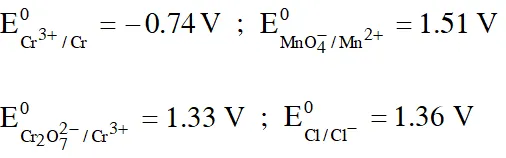 Based on the data given above, strongest oxidising agent will be : (1) Cl– (2) $\mathrm{Cr}^{3+}$ (3) $\mathrm{Mn}^{2+}$ (4) $\mathrm{MnO}_{4}^{-}$ JEE-Mains 2013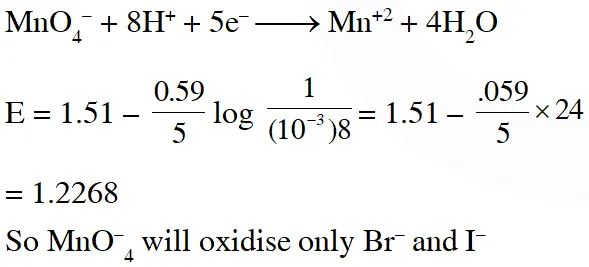
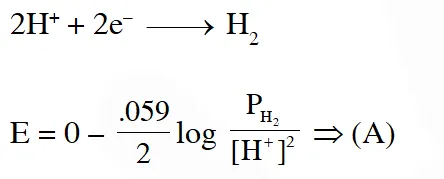
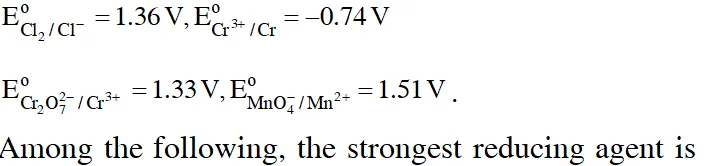 (1)Cr (2) $\mathrm{Mn}^{2+}$ (3) $\mathrm{Cr}^{3+}$ (4) $\mathrm{Cl}^{-}$ JEE-Mains 2017
 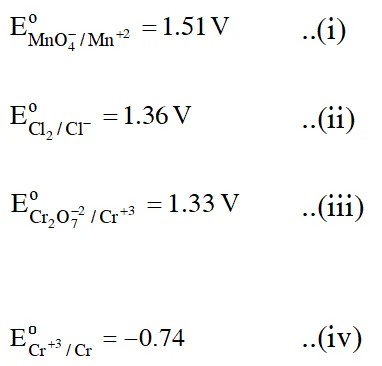 Since $\mathrm{Cr}^{+3}$ is having least reducing potential, so Cr is the best Reducing agent.
The Electrochemistry questions can be followed by more chapter-specific practice through the JEE Mains PYQ chapter wise index.
Curious how often Electrochemistry gets tested? Browse our JEE Main last year paper archive and count the questions yourself, session by session.
Frequently Asked Questions
Find answers to common questions.
Is the Nernst equation directly asked in JEE Main?
Yes. The Nernst equation appears both directly — asking you to calculate E at non-standard conditions — and indirectly, such as determining when a hydrogen half-cell has negative reduction potential. Knowing E = E° – (0.0592/n) log Q at 298 K is sufficient for most JEE Main problems.
Which topic within Electrochemistry has the highest weightage in JEE Main?
Standard electrode potential and related Gibbs energy calculations account for roughly 40% of all Electrochemistry questions in JEE Main history. Questions on Faraday's laws of electrolysis and molar conductivity each contribute around 20–25%. Galvanic cell operation, Kohlrausch's law, and corrosion make up the remainder.
How many questions from Electrochemistry appear in JEE Main each year?
EE Main typically features 1 to 2 questions from Electrochemistry per session. With two sessions per year, you can expect 2–4 questions annually, worth 8–16 marks. The chapter has appeared in every JEE Main / AIEEE paper since 2009 without exception, making it one of the most reliable scoring topics in Physical Chemistry
What is the difference between molar conductivity and specific conductance?
Specific conductance (κ, units S m⁻¹) measures the conductance of a 1 m³ cube of solution. Molar conductivity (λ_m, units S m² mol⁻¹) is defined as λ_m = κ/C, where C is concentration in mol m⁻³. Molar conductivity increases as the solution is diluted because more ions become mobile. Specific conductance decreases on dilution because fewer ions are present per unit volume.
How do I identify the strongest oxidising agent from a table of SRP values?
The strongest oxidising agent is the species with the highest (most positive) standard reduction potential. It has the greatest tendency to accept electrons. In JEE Main 2013, MnO₄⁻ (E° = +1.51 V) was the correct answer for this exact reason. Conversely, the best reducing agent is the metal with the most negative SRP.
What is the formula to find the minimum voltage needed for electrolysis?
Use ΔG = nFE, where ΔG is the Gibbs energy of the reaction (in joules), n is the number of electrons transferred per formula unit, and F = 96,500 C mol⁻¹. Rearranging: E (minimum) = ΔG / (nF). This was directly tested in AIEEE 2010 for the electrolytic reduction of Al₂O₃.