Electrochemistry Notes for Class 12, IIT JEE & NEET

Table of Contents

eSaral › Class 12 Chemistry › Electrochemistry Notes for IIT JEE and NEET

Get detailed Class 12th Chemistry Notes to prepare for Boards as well as competitive exams like IIT JEE, NEET, etc. Here are the Electrochemistry Notes for Class 12, JEE & NEET Exam Preparation. eSaral helps the students in clearing and understanding each topic in a better way. eSaral is providing complete chapter notes of Class 11th and 12th, both of Physics Chemistry & Mathematics. Besides this, eSaral also offers NCERT Solutions, Previous year questions for JEE Main and Advanced, Practice questions, Test Series for JEE Main, JEE Advanced, and NEET, Important questions of Physics, Chemistry, Math, and Biology, and many more. Download the eSaral app for free study material and video tutorials.
India's Best Exam Preparation for Class 12th - Download Now
Electrochemistry Notes for Class 12
India's Best Exam Preparation for Class 12th - Download Now


India's Best Exam Preparation for Class 12th - Download Now


India's Best Exam Preparation for Class 12th - Download Now


India's Best Exam Preparation for Class 12th - Download Now
eSaral helps the students by providing you an easy way to understand concepts and attractive study material for IIT JEE, which includes the chemistry video lectures by top expert IITian Faculties of KOTA. We are also providing Quick revision for Chemistry to help the students in revising the chapter quickly. eSaral brings complete notes for Class 12 Chemistry. eSaral provides a series of detailed chapter-wise notes for all the Subjects of class 11th and 12th. These notes will also help you in your IIT JEE & NEET preparations. We hope these Chemistry Notes for Class 12 will be helpful for you to understand the important topics and help in remembering the key points from an exam point of view. Get Complete Class 12 Chemistry Notes for easy learning and understanding. For free video lectures and complete study material, download the eSaral APP. About eSaral: At eSaral, we are offering a complete platform for IIT-JEE & NEET preparation. The main mission behind eSaral is to provide education to every student in India by eliminating the Geographic and Economic factors, as a nation’s progress and development depend on the availability of quality education to everyone. With the blend of education & technology, the eSaral team made the learning personalized & adaptive for everyone.
Frequently Asked Questions
Find answers to common questions.
What is the Nernst equation and when is it used?
The Nernst equation — E = E° − (0.0592/n) log Q at 298 K — calculates cell EMF when ion concentrations differ from standard conditions (1 M). It is used whenever the question specifies non-standard concentrations or asks for EMF at equilibrium. If Q = K, the EMF becomes zero, indicating the cell has reached equilibrium.
Is electrochemistry important for NEET?
Yes. Electrochemistry appears in NEET every year, typically as 1–2 questions from Physical Chemistry. NEET focuses more on conceptual understanding — definitions of galvanic and electrolytic cells, Faraday's laws, and Kohlrausch's law — rather than heavy numerical calculations. Clearing NCERT thoroughly is sufficient for NEET-level electrochemistry.
What are the most important topics in electrochemistry for JEE Main?
The highest-weightage topics for JEE Main are the Nernst equation, standard electrode potential, ΔG–EMF relationship, and Faraday's laws of electrolysis. These four areas account for the majority of electrochemistry questions in JEE Main papers from 2019 to 2024. Always master these before moving to secondary topics like fuel cells or corrosion.
How do you calculate mass deposited using Faraday's law?
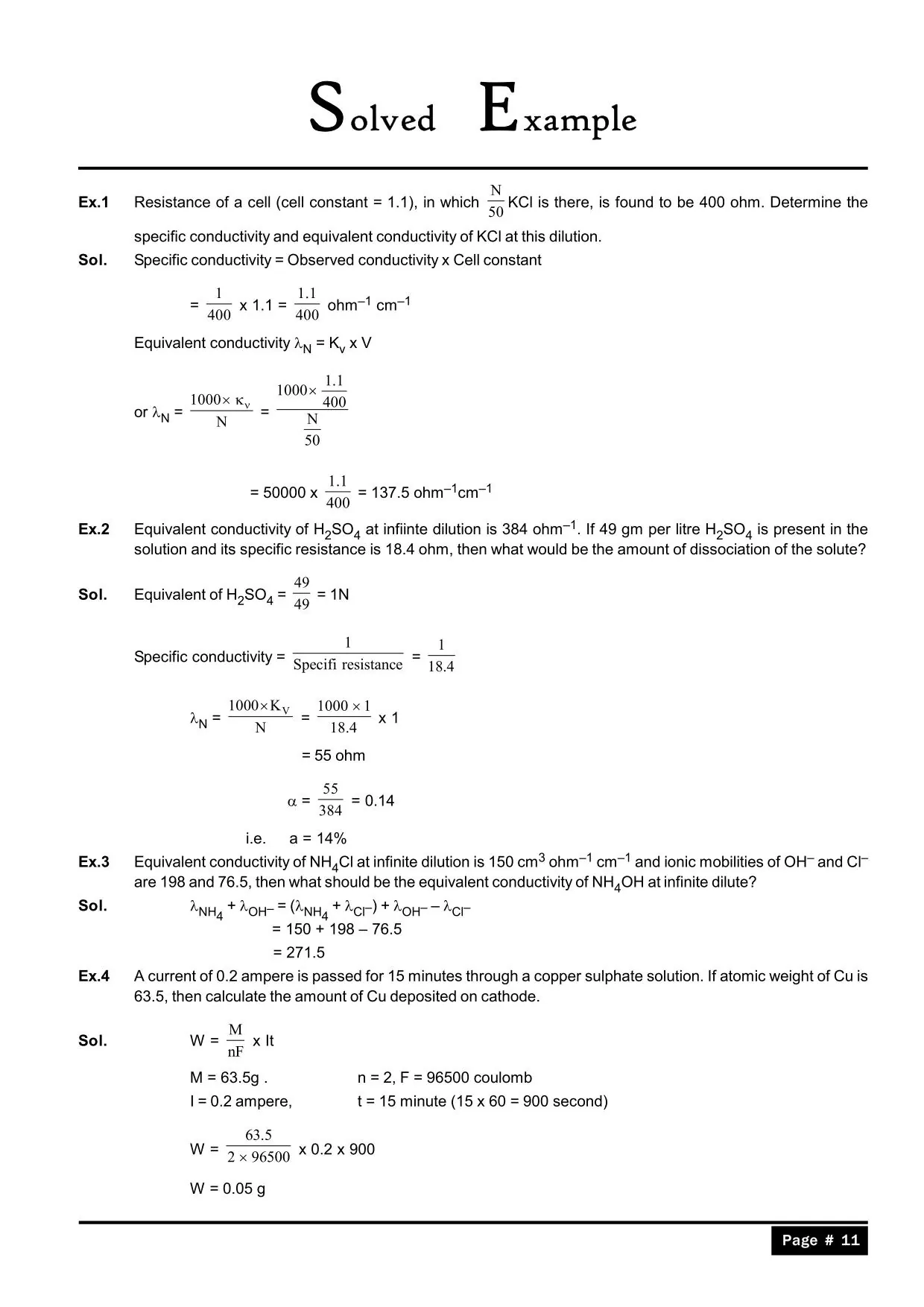
Use the formula: m = (M × I × t) / (n × F), where M is molar mass in g/mol, I is current in Amperes, t is time in seconds, n is the number of electrons transferred per ion, and F is 96,500 C/mol. For example, depositing copper (M = 64, n = 2): passing 2 A for 965 s deposits (64 × 2 × 965)/(2 × 96500) = 0.64 g
What is the difference between molar conductivity and equivalent conductivity?
Molar conductivity (Λₘ) is conductance per unit molar concentration: Λₘ = κ × 1000/M (in S·cm²·mol⁻¹). Equivalent conductivity uses the equivalent concentration instead of molarity. For modern JEE and NEET syllabi, molar conductivity is the standard term. Both increase with dilution because interionic interactions decrease, allowing ions to move more freely
What is Kohlrausch's law and what is its main application?
Kohlrausch's law states that at infinite dilution, each ion contributes a fixed, independent value to the molar conductivity regardless of the counter-ion present. Its most important application is calculating the limiting molar conductivity (Λ°ₘ) of weak electrolytes — like acetic acid — that cannot be obtained by direct extrapolation because their conductivity vs √c graph is not linear
Why does molar conductivity increase with dilution?
As a solution is diluted, the interionic attractions between positive and negative ions decrease. This allows each ion to move more independently toward the electrode, increasing ionic mobility. For strong electrolytes, the increase follows Debye–Hückel–Onsager equation: Λₘ = Λ°ₘ − A√c. For weak electrolytes, dilution also increases the degree of dissociation, producing more charge carriers.