Essay On Importance Of Education
Education is the process of acquiring knowledge, skills, values, and critical thinking abilities that empower individuals, reduce poverty, promote equality, improve career opportunities, and drive the social, economic, and democratic development of a nation.
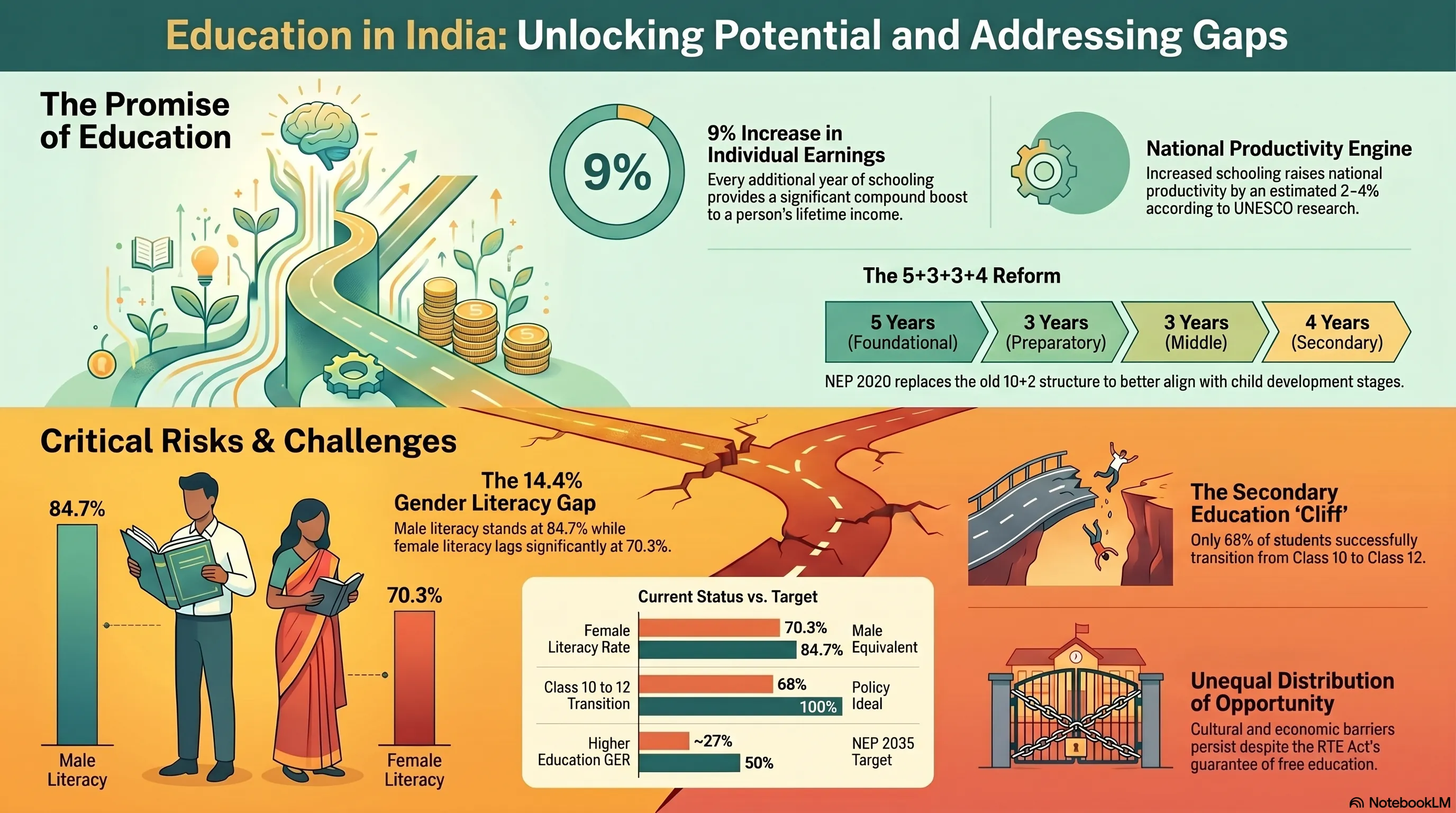
Table of Contents
- Key Points — Importance of Education Quick Reference
- 10 Lines on Importance of Education
- Essay on Importance of Education — 100 Words (Class 3 & 4)
- Essay on Importance of Education — 150 Words (Class 5)
- Essay on Importance of Education — 200 Words (Class 6)
- Essay on Importance of Education — 300 Words (Class 7 & 8)
- Essay on Importance of Education — 400 Words (Class 9)
- Essay on Importance of Education — 500 Words (Class 10–12)
- Types of Education
- India's Education Landscape — Key Facts for Essays
- How to Write an Essay on Importance of Education

eSaral ›Foundation courses ›Essay On Importance Of Education

Key Points — Importance of Education Quick Reference
Use these as the backbone of any essay on education, regardless of word count.
| Point | Detail |
|---|---|
| Definition | Process of acquiring knowledge, skills, values, and attitudes |
| Famous quote | "Education is the most powerful weapon to change the world." — Nelson Mandela |
| India literacy rate | 77.7% (UNESCO, 2023); male 84.7%, female 70.3% |
| RTE Act | Right to Education Act (2009) — free, compulsory education for ages 6–14 |
| NEP 2020 | New Education Policy — replaced 10+2 with 5+3+3+4 structure |
| Key initiative | Beti Bachao Beti Padhao — promotes girls' education |
| Mid-Day Meal Scheme | Improves school attendance in government schools |
| GER (elementary) | Gross Enrolment Ratio exceeded 95% (UDISE+, 2022) |
| Class 10–12 dropout | Only 68% of students transition from Class 10 to 12 (UDISE+, 2022) |
| Types of education | Formal, Informal, Non-formal |
| Role in economy | Education raises human capital, productivity, and national income |
| Impact on gender equality | Education is the single strongest factor in closing the gender gap |
10 Lines on Importance of Education
- Education is the process of learning knowledge, skills, and values that shape our personality and future.
- Nelson Mandela said, "Education is the most powerful weapon to change the world."
- Education helps us get good jobs and lead a financially secure life.
- It develops our ability to think critically, solve problems, and make better decisions.
- Educated citizens are essential for the progress and development of any nation.
- In India, the Right to Education Act (2009) guarantees free education to all children between 6 and 14 years.
- Education reduces poverty by opening doors to better employment opportunities.
- It promotes gender equality by empowering girls and women to participate equally in society.
- Education makes us aware of our rights, responsibilities, and the world around us.
- No matter who we are or where we come from, education gives everyone a chance to improve their life.
Essay on Importance of Education — 100 Words (Class 3 & 4)
Education is one of the most important things in a person's life. It helps us learn to read, write, and think. With education, we can get good jobs and live a better life. Education also teaches us good values like honesty, kindness, and respect for others.
As Nelson Mandela said, "Education is the most powerful weapon to change the world." In India, every child between 6 and 14 years has the right to free education under the Right to Education Act. A country where every child goes to school becomes a stronger and more peaceful nation. Education is truly the key to a bright future.
Essay on Importance of Education — 150 Words (Class 5)
Education is the foundation of a successful and meaningful life. It gives us the knowledge and skills we need to understand the world, earn a living, and contribute to society. Without education, it is very difficult to achieve our goals or help others.
In India, the government has taken many steps to make education available to everyone. The Right to Education Act (2009) ensures that children between 6 and 14 years of age receive free and compulsory education. Schemes like the Mid-Day Meal Programme have increased school attendance, especially in rural areas.
Education is not only about getting a degree. It also teaches us discipline, responsibility, and the ability to tell right from wrong. It empowers girls and women to stand on their own feet and participate equally in society.
Every child deserves a good education. When we educate one child, we change not just that child's life, but the future of an entire family and community.
Essay on Importance of Education — 200 Words (Class 6)
Education is the most powerful tool available to individuals and societies to build a better future. It is not simply the act of going to school — it is the lifelong process of gaining knowledge, developing skills, forming values, and learning how to think clearly and independently.
Why Education Matters
Education matters for several interconnected reasons:
- Employment: Education opens the door to better career opportunities. In today's competitive world, most high-skill jobs require formal education and specialised knowledge.
- Personal development: Education builds confidence, improves communication, and develops the ability to think critically and solve complex problems.
- Social progress: An educated society is more aware of its rights and responsibilities, leading to a more just and democratic community.
- Economic growth: Countries with higher literacy rates consistently show stronger economic growth. According to UNESCO, each additional year of schooling increases an individual's earnings by approximately 9%.
- Gender equality: Education is the single most effective way to close the gender gap. Educated girls marry later, have fewer children, earn more, and invest more in their own children's education.
India has made significant progress — with the Gross Enrolment Ratio in elementary education crossing 95% — but challenges remain, particularly in keeping students in school through secondary level.
Essay on Importance of Education — 300 Words (Class 7 & 8)
Education is described in many ways — as a right, a privilege, a weapon, and a light. But at its core, education is the process through which human beings acquire the knowledge, values, and skills necessary to participate fully in society. Its importance cannot be measured only in individual terms; education shapes entire communities, economies, and nations.
Education and Individual Development
At the individual level, education transforms lives in measurable ways. It expands career options, improves earning potential, builds self-confidence, and develops the ability to think critically. An educated person is better equipped to navigate health decisions, financial planning, civic participation, and personal relationships. According to UNESCO, each additional year of schooling can increase an individual's income by approximately 9% — a figure that compounds dramatically across a lifetime.
Beyond income, education cultivates values: the ability to distinguish right from wrong, to empathise with others, to engage respectfully with different perspectives. These are not soft outcomes — they are the foundations of a functioning democratic society.
Education and National Development
A nation's human capital — the collective knowledge, skills, and capabilities of its people — is its most valuable resource. Countries that invest heavily in education consistently demonstrate higher economic productivity, lower poverty rates, better public health outcomes, and stronger democratic institutions.
India's Right to Education Act (2009) was a landmark step — guaranteeing free, compulsory education for all children between 6 and 14 years. The New Education Policy (NEP) 2020 goes further, introducing a 5+3+3+4 structure, emphasis on critical thinking, regional language instruction, and integration of vocational skills from early age.
The Unfinished Agenda
Despite significant progress, challenges remain. India's literacy rate stands at 77.7% (UNESCO, 2023), with a notable gender gap — 84.7% for men vs 70.3% for women. Data from UDISE+ (2022) shows that only 68% of students who complete Class 10 transition to Class 12, highlighting a serious dropout problem at the secondary level.
Addressing these gaps requires not only policy but a cultural shift — a collective recognition that every child's education is every citizen's responsibility.
Essay on Importance of Education — 400 Words (Class 9)
Education is the single most transformative force available to individuals, communities, and nations. From ancient gurukuls to modern digital classrooms, the forms of education have evolved dramatically — but its core purpose has remained constant: to develop human potential, transmit cultural values, and prepare people to contribute meaningfully to society.
Education as a Fundamental Right
The recognition of education as a fundamental right marks one of the most important milestones in India's social history. The Right to Education (RTE) Act, enacted in 2009, guarantees free and compulsory education for all children between 6 and 14 years of age. In the 15 years since its enactment, school enrolment rates have risen sharply — the Gross Enrolment Ratio in elementary education now exceeds 95%. However, enrolment and learning are not the same thing. Ensuring that children who enter school actually learn — and stay in school through secondary level — remains an urgent challenge.
The Role of Education in Reducing Inequality
India's greatest challenge is not the absence of talent but the unequal distribution of opportunity. Education is the most reliable mechanism for breaking inter-generational poverty cycles. A child from a rural, low-income family who receives quality schooling gains access to opportunities that would otherwise be structurally unavailable.
The gender dimension of this inequality is particularly significant. According to UNESCO 2023 data, India's female literacy rate stands at 70.3% compared to 84.7% for males — a gap of 14.4 percentage points. Government initiatives like Beti Bachao Beti Padhao and Kasturba Gandhi Balika Vidyalayas have worked to narrow this gap, but cultural and economic barriers persist in many states.
Education and Economic Development
The link between education and economic prosperity is well established. Countries in which education is a national priority — Finland, Japan, South Korea — consistently achieve high levels of innovation, productivity, and per capita income. UNESCO research estimates that each additional year of schooling increases individual earnings by approximately 9% and national productivity by 2–4%.
India's New Education Policy (NEP 2020) reflects this understanding. By shifting from rote learning to critical thinking, by integrating vocational training from Class 6, and by recognising regional languages as legitimate mediums of instruction, NEP 2020 aims to produce graduates who are genuinely skilled — not merely certificated.
Education and Citizenship
Perhaps the deepest purpose of education is civic. An educated citizen understands their rights, fulfils their responsibilities, participates in democratic processes, and holds institutions accountable. A country of educated citizens is, by definition, harder to deceive and easier to govern fairly.
This is why education is not simply an investment in individual futures — it is the foundation on which a just, democratic, and prosperous society is built.
Essay on Importance of Education — 500 Words (Class 10–12)
Introduction
"Education is the most powerful weapon which you can use to change the world." Nelson Mandela's words, spoken in the context of post-apartheid South Africa, carry equal force for India today — a nation of extraordinary human potential navigating deep structural inequalities. Education is not merely the accumulation of information or the acquisition of a degree. It is a transformative process that shapes how people think, what they value, and how they engage with the world around them.
Education and Human Development
At its most fundamental level, education is the development of human capability. Nobel laureate Amartya Sen's capability approach argues that development must be measured not by GDP alone, but by the real freedoms people enjoy — including the freedom to live a long, healthy, educated life. Education expands these freedoms. It enables people to make informed choices, to resist exploitation, to participate in civic life, and to access economic opportunity.
The data supports this clearly. According to UNESCO, each additional year of schooling increases an individual's earnings by approximately 9%. For women, this effect is even stronger — girls who complete secondary education earn, on average, 25% more than those who do not. These are not abstract figures; they represent real differences in the quality of millions of lives.
India's Progress and Remaining Gaps
India has made substantial progress in expanding access to education since Independence. The RTE Act (2009) guarantees free schooling for children aged 6–14. The Gross Enrolment Ratio in elementary education has crossed 95%. The Mid-Day Meal Scheme has significantly increased school attendance by addressing food insecurity as a barrier. Sarva Shiksha Abhiyan and its successor PM POSHAN have reached tens of millions of children.
Yet the picture remains uneven. India's overall literacy rate stands at 77.7% (UNESCO, 2023), with women at 70.3% and men at 84.7%. Dropout rates at the secondary level are alarming — UDISE+ data (2022) shows that only 68% of Class 10 students continue to Class 12. In many states, infrastructure, teacher quality, and learning outcomes remain significantly below what children need and deserve.
The New Education Policy 2020 — A Paradigm Shift
The New Education Policy (NEP) 2020 represents the most ambitious reform of India's education system since 1986. It replaces the 10+2 school structure with a 5+3+3+4 framework aligned with child developmental stages. It mandates mother-tongue instruction up to Grade 5, emphasises critical thinking over rote learning, introduces vocational education from Class 6, and sets a target of 50% Gross Enrolment Ratio in higher education by 2035.
If implemented effectively, NEP 2020 has the potential to produce graduates who are not merely qualified but genuinely capable — creative thinkers, adaptable problem-solvers, and engaged citizens.
Education and Gender Equality
The relationship between education and gender equality is among the most well-documented in development economics. Educated women marry later, have fewer children, earn higher incomes, invest more in their children's health and education, and participate more actively in civic life. Educating girls, therefore, does not benefit only the individual — it triggers a cascade of positive effects across generations.
India's Beti Bachao Beti Padhao campaign, launched in 2015, reflects governmental recognition of this connection. But policy alone is insufficient. Cultural attitudes — particularly in states where girls' education is seen as less valuable — must change through community engagement, female role models, and economic incentives for families who keep their daughters in school.
Conclusion
Education is simultaneously a personal journey and a public good. For the individual, it opens doors that would otherwise remain permanently closed. For society, it is the infrastructure on which democracy, economic growth, and social justice are built.
The question is not whether education is important — that has been settled beyond reasonable doubt. The question is whether we are willing, as individuals, communities, and as a nation, to do what is necessary to ensure that every child — regardless of gender, caste, class, or geography — has access to a quality education. The answer to that question will determine what kind of country India becomes.
Types of Education
Understanding the three types of education is important for Class 9–12 essays and competitive exams.
| Type | Definition | Examples | Key Feature |
|---|---|---|---|
| Formal Education | Structured learning in institutions following a fixed curriculum | School, college, university | Leads to recognised degrees and certificates |
| Informal Education | Learning from life experiences and daily interactions | Family values, street knowledge, cultural practices | No fixed structure or certification |
| Non-formal Education | Organised learning outside formal institutions | Adult literacy programmes, skill training, online courses | Flexible structure; may or may not lead to certification |
India's Education Landscape — Key Facts for Essays
Include these data points in your essay to demonstrate depth and earn higher marks:
| Fact | Source | Year |
|---|---|---|
| India literacy rate: 77.7% | UNESCO | 2023 |
| Male literacy: 84.7% | UNESCO | 2023 |
| Female literacy: 70.3% | UNESCO | 2023 |
| GER in elementary education: 95%+ | UDISE+ | 2022 |
| Class 10–12 transition rate: 68% | UDISE+ | 2022 |
| RTE Act age group: 6–14 years | Government of India | 2009 |
| NEP 2020 higher education GER target | NEP 2020 document | 50% by 2035 |
| UNESCO — each year of schooling raises earnings by | UNESCO | ~9% |
| Secondary education earnings gain (women) | World Bank / UNESCO | ~25% vs dropouts |
How to Write an Essay on Importance of Education
Structure Guide by Class
| Class | Word Count | Focus Areas |
|---|---|---|
| Class 3–4 | 100 words | Definition + 2 benefits + one positive closing line |
| Class 5 | 150 words | Benefits + one India fact + individual/social importance |
| Class 6 | 200 words | Multiple benefits with sub-headings + data point |
| Class 7–8 | 300 words | Individual + national importance + India context + challenge |
| Class 9 | 400 words | Analysis: rights, inequality, economy, citizenship |
| Class 10–12 | 500+ words | Full essay: data, policy (NEP, RTE), gender, conclusion with vision |
Strong Opening Lines (Avoid "In this essay, I will...")
- "Nelson Mandela once said, 'Education is the most powerful weapon to change the world' — and India's journey since Independence proves him right."
- "Every time a child learns to read, the world becomes slightly fairer."
- "Education is not preparation for life — it is life itself." (John Dewey)
- "India's greatest resource is not coal, steel, or software — it is the 250 million students sitting in its classrooms."
Common Mistakes to Avoid
| Mistake | Correct Approach |
|---|---|
| Writing only about school/college | Include informal + non-formal education too |
| No India-specific content | Always include RTE Act, NEP 2020, or literacy data |
| Vague statements ("Education is very good") | Support every claim with a reason or fact |
| Repeating the same point | Each paragraph must make a new, distinct point |
| No conclusion | Always summarise + add a forward-looking closing thought |
Frequently Asked Questions
Find answers to common questions.
What is the importance of education in our life?
Education improves employment opportunities, develops critical thinking, builds self-confidence, and shapes moral values. It enables individuals to make informed decisions about health, finance, and civic life. For societies, education reduces poverty, narrows inequality, strengthens democracy, and drives economic growth. UNESCO research shows each year of schooling increases earnings by approximately 9%, making education the highest-return investment most individuals can make.
How do you write an essay on the importance of education for Class 10?
For Class 10, write 400–500 words in 5–6 paragraphs. Begin with a powerful quote or fact (Nelson Mandela's quote or India's literacy rate). Cover education's role in individual development, national progress, gender equality, and economic growth. Include India-specific data — RTE Act, NEP 2020, dropout rates. End with a forward-looking conclusion about what education can achieve for India. Use formal language and varied sentence structure throughout.
What are the main types of education?
The three main types are: formal education (structured learning in schools and universities, leading to recognised degrees), informal education (learning from daily life experiences, family, and culture — no fixed structure), and non-formal education (organised learning outside institutions, such as adult literacy programmes and online courses — flexible and not always certified). All three types contribute to a person's total development and are recognised in NEP 2020.
What are 10 lines on importance of education?
Education is the process of learning knowledge, skills, and values. Nelson Mandela called it the most powerful weapon to change the world. It improves employment opportunities and earning potential. Education develops critical thinking and problem-solving abilities. It promotes gender equality and social justice. In India, the Right to Education Act (2009) guarantees free schooling for ages 6–14. India's literacy rate is 77.7% as of 2023 (UNESCO). Educated citizens strengthen democracy. Education reduces poverty across generations. Every child deserves access to quality education regardless of background.
What is the role of education in national development?
Education builds a nation's human capital — the collective skills, knowledge, and capabilities of its people. Countries with high literacy and educational attainment consistently show stronger GDP growth, lower poverty rates, better public health outcomes, and more stable democratic governance. In India, the New Education Policy 2020 targets a 50% Gross Enrolment Ratio in higher education by 2035, recognising education as central to India's ambition to become a developed nation.