Friction - JEE Main Previous Year Questions with Solutions


eSaral > JEE Main Physics PYQs > Friction

JEE Main Previous Year Question of Physics with Solutions is available here. Practicing JEE Main Previous Year Papers Questions of Physics will help all the JEE aspirants in realizing the question pattern, as well as help in analyzing their weak & strong areas. Get detailed Class 11th &12th Physics Notes to prepare for Boards as well as competitive exams like IIT JEE, NEET, etc. eSaral helps the students in clearing and understanding each topic in a better way. eSaral is providing complete chapter-wise notes of Class 11th and 12th for all subjects.
Besides this, eSaral also offers NCERT Solutions, Previous year questions for JEE Main and Advanced, Practice questions, Test Series for JEE Main, JEE Advanced, and NEET, Important questions of Physics, Chemistry, Math, and Biology, and many more. Download the eSaral app for free study material and video tutorials.
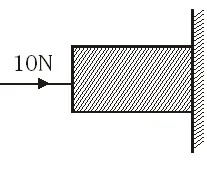 (1) 20 N (2) 50 N (3) 100 N (4) 2 N [AIEEE - 2003]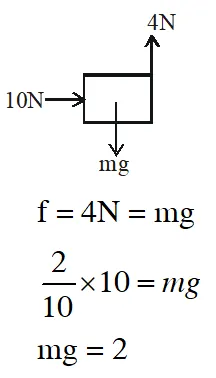
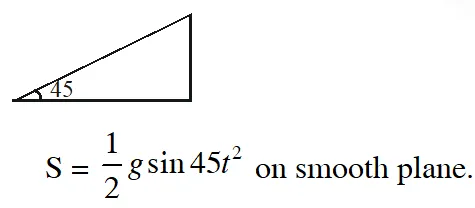
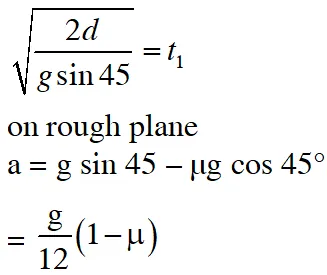
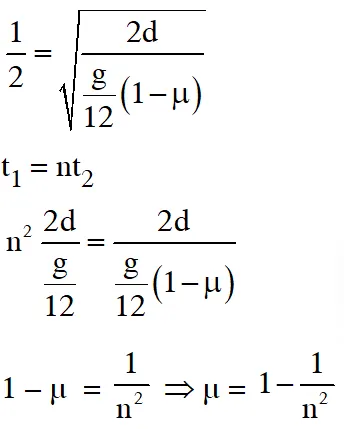
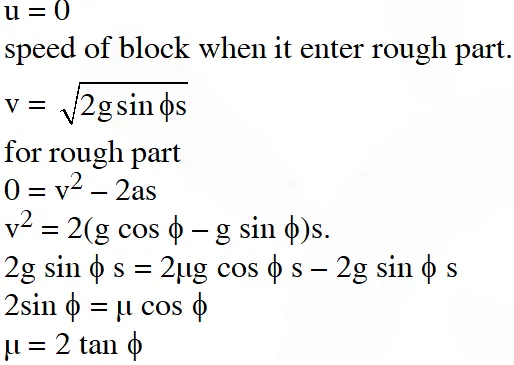
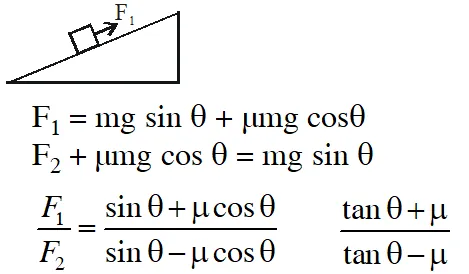 $=\frac{2 \mu+\mu}{2 \mu-\mu}=\frac{3 \mu}{\mu}=3$
 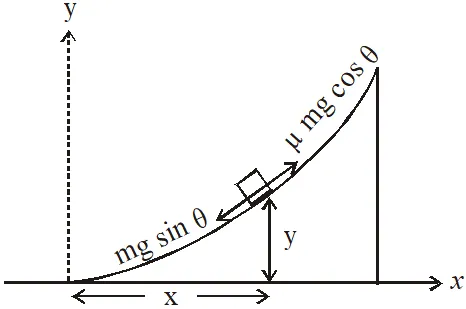 For equilibrium under limiting friction $\operatorname{mg} \sin \theta=\mu \operatorname{mg} \cos \theta$ $\Rightarrow \tan \theta=\mu$ From the equation of surface $y=\frac{x^{3}}{6}$ slope $=\frac{d y}{d x}=\frac{3 x^{2}}{6}=\tan \theta$ $\Rightarrow \frac{\mathrm{x}^{2}}{2}=\mu=0.5 \Rightarrow \mathrm{x}=1$ So $\mathrm{y}=\frac{1}{6}$
 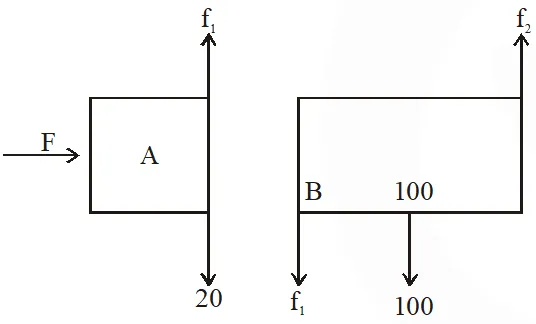 for equllibrrium of A $\mathrm{f}_{1}=20$ for equllibrrium of B $\mathrm{f}_{2}=\mathrm{f}_{1}+100$ $\mathrm{f}_{2}=120 \mathrm{N}$
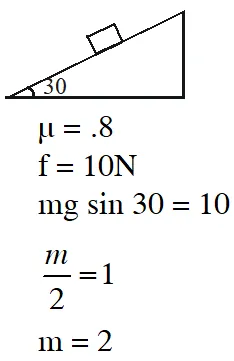
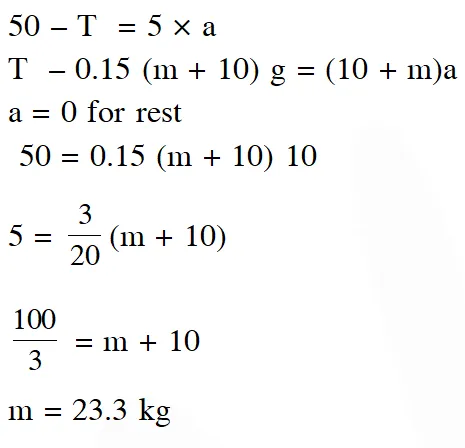
 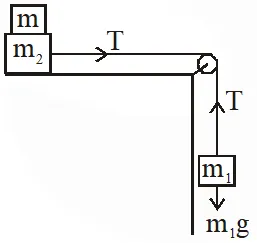 (1) 27.3 kg (2) 43.3 kg (3) 10.3 kg (4) 18.3 kg [JEE-(Mains) - 2018]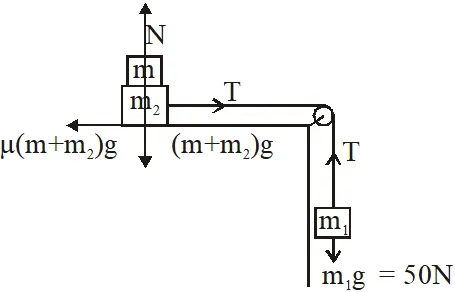
After completing Friction, continue your topic-wise preparation with the JEE Mains PYQ chapter wise collection to keep track of the remaining chapters.
If full mock-exam conditions suit you better than isolated Friction questions, our JEE Main last year question paper is the natural next step.
Frequently Asked Questions
Find answers to common questions.
How do I find the coefficient of friction from a stopping distance problem?
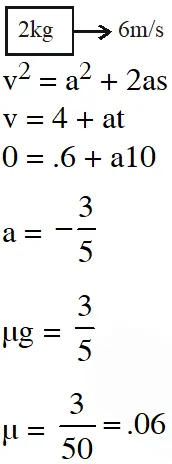
Use the equation v² = u² – 2μgs, where u is initial speed, v is final speed (zero for stopping), μ is the kinetic friction coefficient, g is gravitational acceleration, and s is the stopping distance. Rearranging gives μ = u²/(2gs). This is directly applicable to Q2 and Q6 in this set.
What is the difference between static and kinetic friction in JEE Main problems?
Static friction acts when a body is at rest and resists the tendency to move — it can take any value from zero up to μₛN. Kinetic friction acts when a body is already sliding and equals μₖN (a fixed value). In JEE Main problems, static friction appears in equilibrium questions and kinetic friction appears in acceleration or stopping-distance problems.
How many questions from friction appear in JEE Main each year?
Friction typically contributes 1 to 2 questions per JEE Main paper. These questions are usually drawn from the Laws of Motion chapter (Class 11 Physics) as tested by NTA. The sub-topics most commonly tested are inclined plane problems, two-body friction, and minimum force calculations. Building strong fundamentals here can reliably secure marks.
Is friction an important topic for JEE Advanced as well?
Yes. While this page focuses on JEE Main previous year questions, friction also appears in JEE Advanced — typically in multi-concept problems involving rotational motion, string tensions, or pseudo forces. Mastering JEE Main-level friction questions is essential before attempting JEE Advanced problems. You can supplement your preparation with the NCERT Solutions for Class 11 Physics and eSaral's topic-wise test series.
How do I solve two-block friction problems in JEE Main?
Solve two-block friction problems by drawing a separate FBD for each block, writing equilibrium or Newton's second law equations for each, and identifying whether friction is at its maximum (limiting) value or not. For blocks pressed against walls (like Q9), check if the given friction coefficient is sufficient — often the problem is simpler than it appears because the system is in static equilibrium.
Why is the coefficient of friction independent of the area of contact?
According to the classical friction model (as per the NCERT Class 11 Physics syllabus and tested by NTA in JEE Main), friction depends only on the normal force and the nature of surfaces — not the contact area. This is because the true microscopic contact area depends on normal force, not geometric area. JEE Main expects you to apply this as a given principle