Ionic Equilibrium- JEE Advanced Previous Year Questions with Solutions
Ionic Equilibrium – JEE Advanced PYQs: These JEE Advanced previous-year questions cover key ionic equilibrium concepts including pH calculations, buffer solutions, hydrolysis, solubility product (Ksp), common ion effect, weak acid-base equilibria, and dilution effects, helping students strengthen problem-solving skills for competitive exams.

eSaral › JEE › JEE Main ›Ionic Equilibrium- JEE Advanced Previous Year Questions with Solutions

🚀 Checkout eSaral Courses
Simulator Previous Years JEE Advance Questions 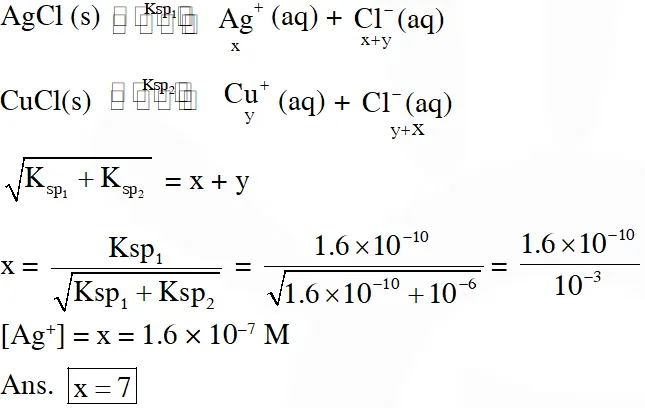
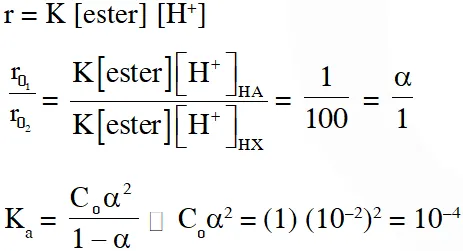
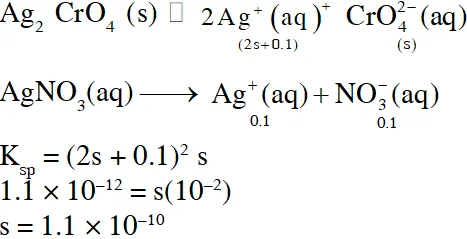
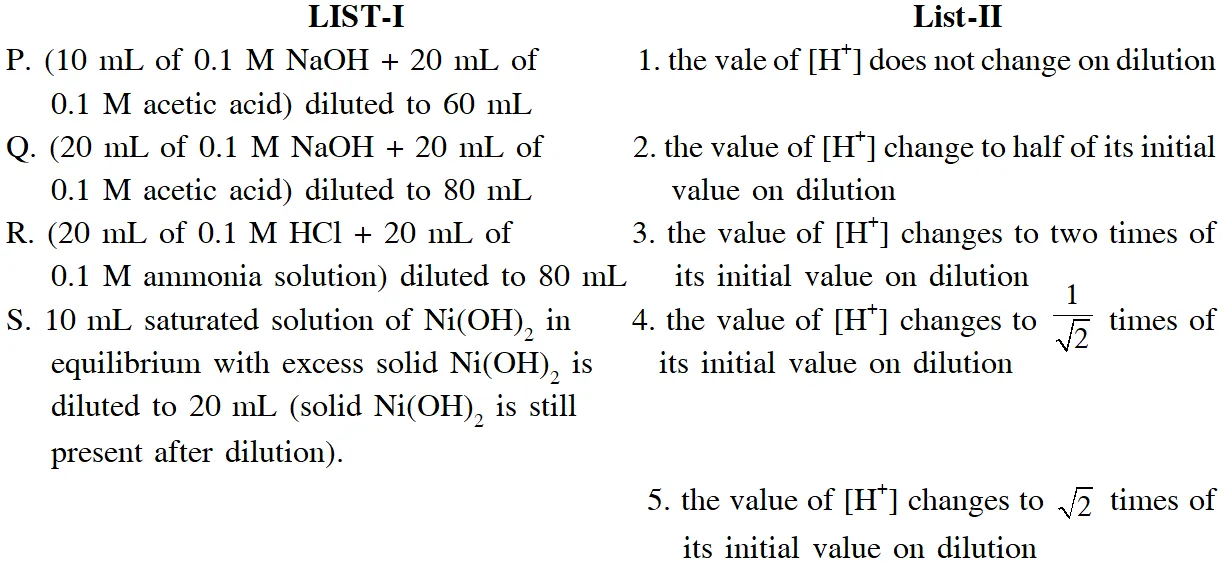 Match each process given in LIST-I with one or more effect(s) in LIST-II. The correct option is $(\mathrm{A}) \mathrm{P} \rightarrow 4 ; \mathrm{Q} \rightarrow 2 ; \mathrm{R} \rightarrow 3 ; \mathrm{S} \rightarrow 1$ (B) $\mathrm{P} \rightarrow 4 ; \mathrm{Q} \rightarrow 3 ; \mathrm{R} \rightarrow 2 ; \mathrm{S} \rightarrow 3$ (C) $\mathrm{P} \rightarrow 1 ; \mathrm{Q} \rightarrow 4 ; \mathrm{R} \rightarrow 5 ; \mathrm{S} \rightarrow 3$ $(\mathrm{D}) \mathrm{P} \rightarrow 1 ; \mathrm{Q} \rightarrow 5 ; \mathrm{R} \rightarrow 4 ; \mathrm{S} \rightarrow 1$ [JEE- Adv. - 2018]
 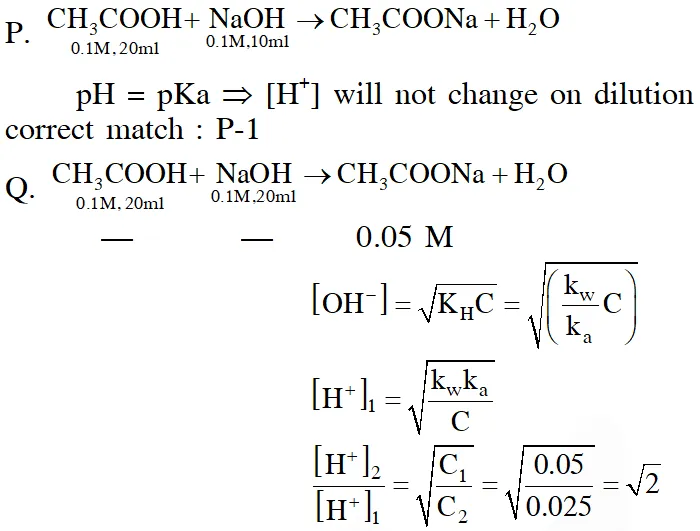 correct match : Q-5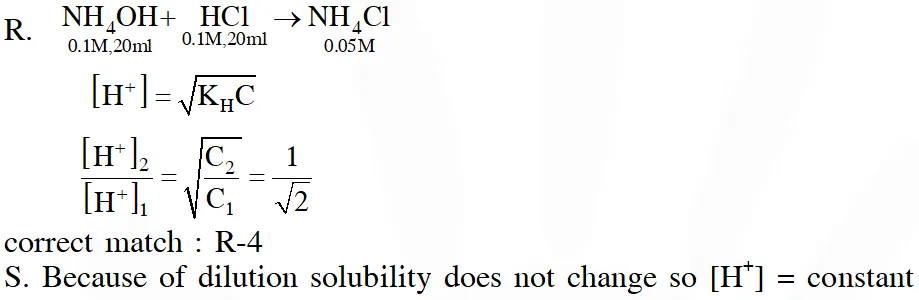
After solving Ionic Equilibrium - JEE Advanced PYQs (Chemistry), check how the topic appears alongside others in the JEE Advanced exam paper.
Frequently Asked Questions
Find answers to common questions.
How many questions from Ionic Equilibrium appear in JEE Advanced each year?
Typically 1–2 questions appear from Ionic Equilibrium in JEE Advanced per year, contributing 3–8 marks depending on the question type. The topic is part of the broader Physical Chemistry section, which accounts for approximately 35% of the Chemistry paper according to the official JEE Advanced syllabus published by IIT.
What is the best way to prepare Ionic Equilibrium for JEE Advanced?
Start with NCERT Class 11 Chapter 7 (Equilibrium) to build your base, then move to JEE-level problems on pH, Ksp, and buffers. Solve previous year questions topic-by-topic before attempting full-length mocks. The NCERT Solutions for Class 12 Chemistry provide a solid conceptual bridge between board-level and JEE Advanced difficulty.
Is the Henderson–Hasselbalch equation directly applicable in JEE Advanced?
Yes. The Henderson–Hasselbalch equation (pH = pKa + log [A⁻]/[HA]) is directly used in buffer pH questions. However, JEE Advanced sometimes tests whether a buffer is even formed first — as in Q2 above — before you can apply the formula. Always verify the buffer condition before plugging in numbers.
What is the difference between Kh (hydrolysis constant) and Ka?
Kh is the equilibrium constant for the hydrolysis of a salt ion in water. For the anion of a weak acid: Kh = Kw / Ka. A smaller Ka (weaker acid) means a larger Kh, meaning the salt undergoes more hydrolysis and the solution is more basic. This relationship appears directly in Q1 of this set.
How does dilution affect the pH of a buffer solution?
Diluting a buffer solution causes a very small change in pH because the ratio [salt]/[acid] remains nearly constant. The Henderson–Hasselbalch equation shows that pH depends on the logarithm of this ratio, not on absolute concentrations. This is why buffers resist pH change on dilution — a key concept tested in the 2018 JEE Advanced match question.