Isomerism Notes for Class 11, IIT JEE & NEET
Isomerism is a core Organic Chemistry topic for JEE & NEET that explains how compounds with the same molecular formula can differ in structure or spatial arrangement, covering structural, geometrical, optical, and tautomeric isomerism with major applications in stereochemistry and reaction mechanisms.
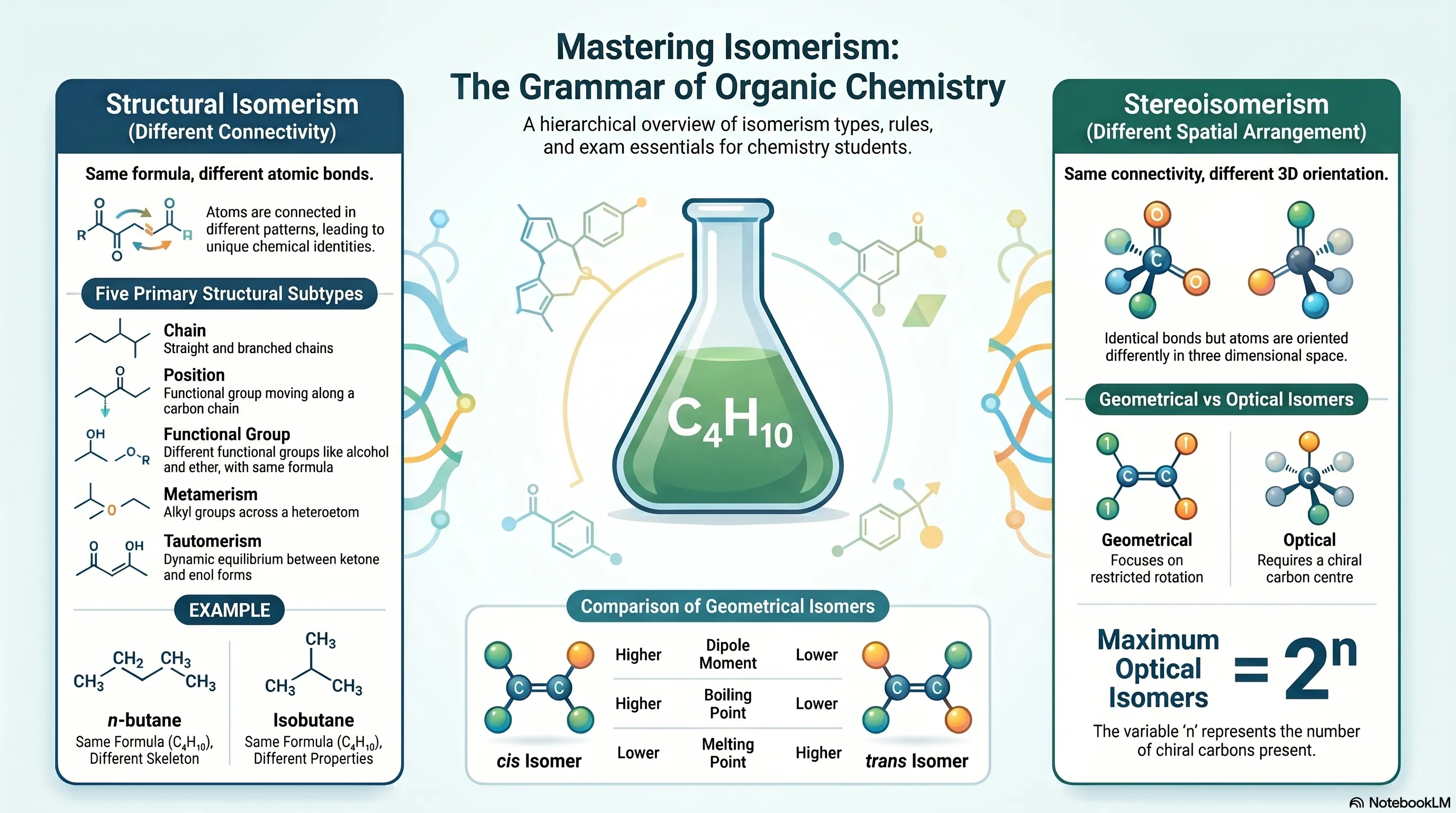
Table of Contents
- What Is Isomerism and Why It Matters for JEE and NEET
- Isomerism Notes
- Classification of Isomerism — Complete Overview
- Structural Isomerism: All Types with Examples
- Stereoisomerism: Geometrical and Optical Isomerism
- Tautomerism: The Special Case
- Isomerism Weightage in JEE Main and NEET
- Key Points and Quick Revision Table
- How to Study Isomerism for Maximum Exam Marks

eSaral › Class 11th ›Vectors Physics Class 11 - IIT JEE | NEET

What Is Isomerism and Why It Matters for JEE and NEET
Isomerism is the phenomenon in which two or more chemical compounds share the same molecular formula but differ in the arrangement of atoms — either in how they are connected (structural) or in how they are oriented in space (stereo).
The compounds that exhibit isomerism are called isomers.
Simple Example
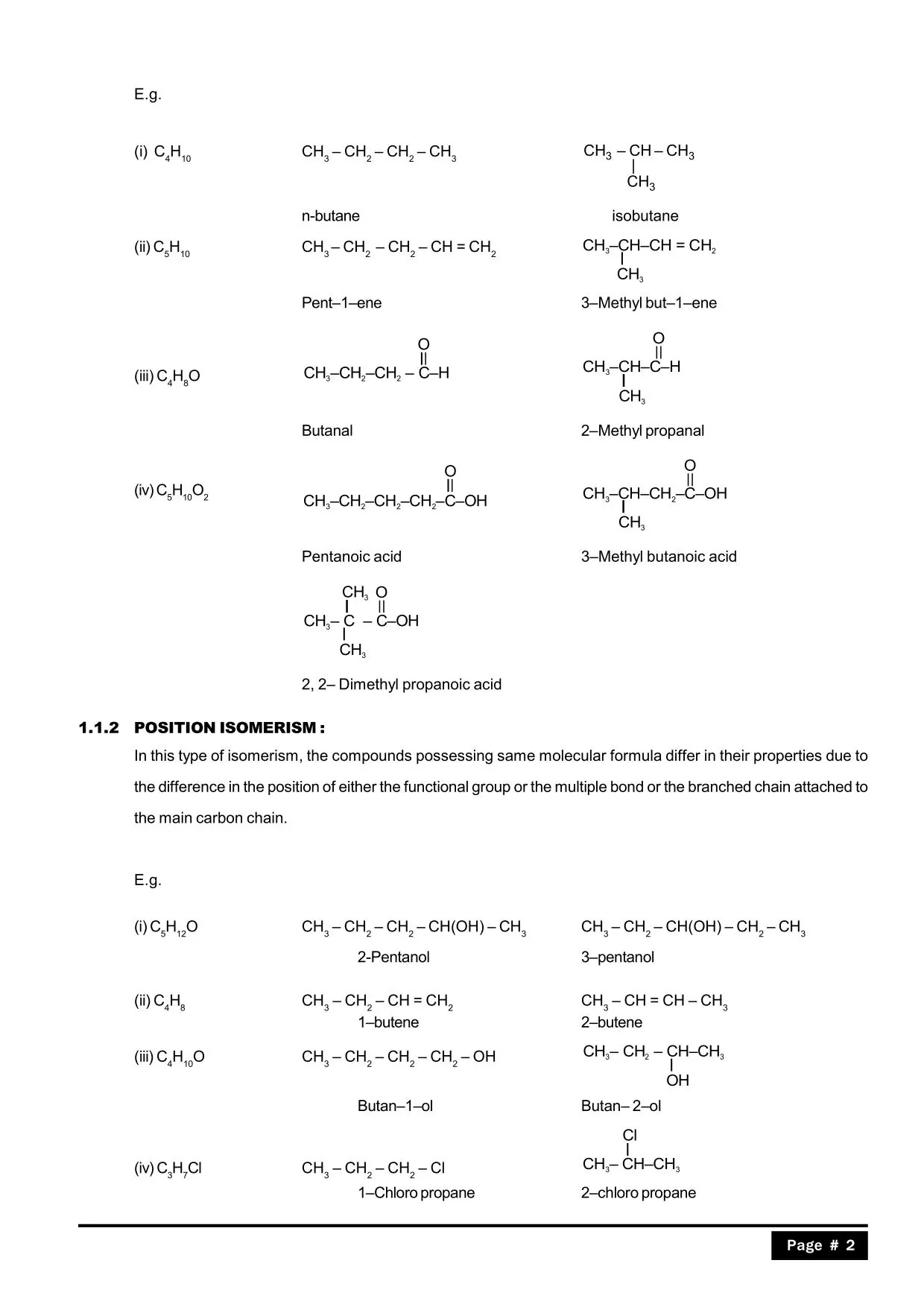
Both n-butane (CH₃-CH₂-CH₂-CH₃) and isobutane (2-methylpropane) have the molecular formula C₄H₁₀ — but they are structurally different compounds with different physical and chemical properties.
This is the core idea. Same formula. Different compound. Different properties.
Why This Topic Is Critical for Exams
Isomerism sits at the heart of Organic Chemistry. A student who does not understand isomerism will struggle to:
- Name organic compounds correctly (IUPAC naming)
- Predict reaction mechanisms and products
- Answer questions on optical activity, geometrical isomers, and stereochemistry
- Solve "how many isomers are possible for X" type JEE questions
In JEE Advanced, isomerism-based questions often combine with GOC (General Organic Chemistry), reaction mechanisms, and stereochemistry in multi-concept problems. In NEET, 2–3 questions per year come directly from this topic.
💡 Expert Tip by eSaral Chemistry Faculty: "Isomerism is not a standalone topic — it is the grammar of Organic Chemistry. Once you understand why isomers are different compounds despite the same formula, every subsequent organic chapter becomes easier to navigate. Invest proper time here in Class 11 and it pays back through all of Class 12 Organic."
India's Best Exam Preparation for Class 11th - Download Now
Isomerism Notes
India's Best Exam Preparation for Class 11th - Download Now
India's Best Exam Preparation for Class 11th - Download Now
India's Best Exam Preparation for Class 11th - Download Now
India's Best Exam Preparation for Class 11th - Download Now
India's Best Exam Preparation for Class 11th - Download Now
Classification of Isomerism — Complete Overview
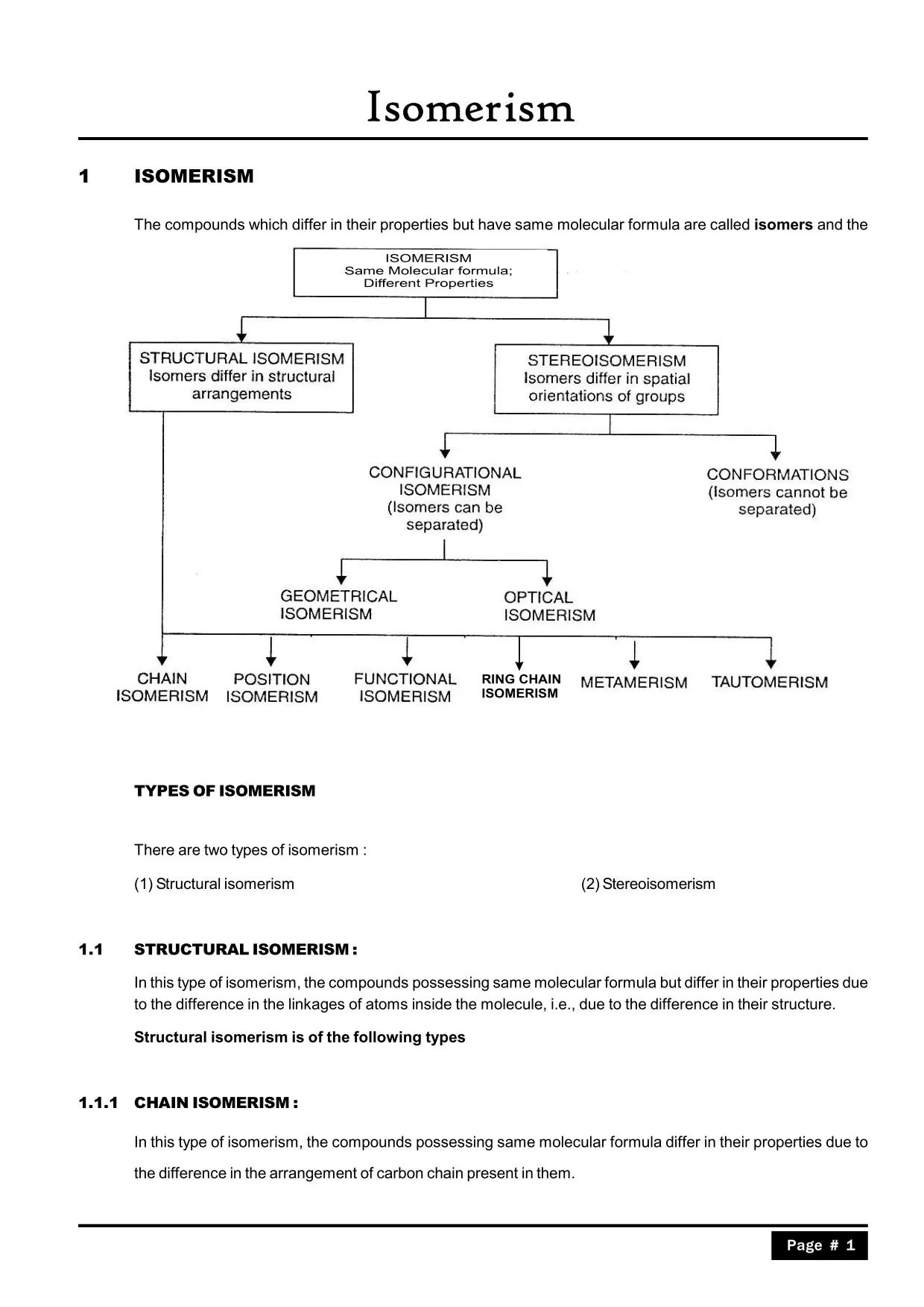
The Two-Branch Structure
ISOMERISM
│
├── STRUCTURAL ISOMERISM
│   (same molecular formula, different connectivity of atoms)
│   ├── Chain Isomerism
│   ├── Position Isomerism
│   ├── Functional Group Isomerism
│   ├── Metamerism
│   └── Tautomerism
│
└── STEREOISOMERISM
    (same connectivity, different spatial arrangement)
    ├── Geometrical Isomerism (cis-trans)
    └── Optical Isomerism (enantiomers, diastereomers)
Keep this tree diagram in your notes. Every isomerism question in JEE and NEET fits somewhere in this structure.
Structural Isomerism: All Types with Examples
Structural isomers have the same molecular formula but atoms are connected in a different order or pattern.
1. Chain Isomerism (Skeletal Isomerism)
Definition: Compounds with the same molecular formula but different carbon skeleton (branching pattern).
Example — C₅H₁₂ (three chain isomers):
| Compound | Structure | IUPAC Name |
|---|---|---|
| n-pentane | CH₃-CH₂-CH₂-CH₂-CH₃ | Pentane |
| Isopentane | CH₃-CH(CH₃)-CH₂-CH₃ | 2-methylbutane |
| Neopentane | C(CH₃)₄ | 2,2-dimethylpropane |
Key rule: The longer the carbon chain, the more possible chain isomers. This is why JEE questions ask "how many structural isomers exist for C₅H₁₂?" — answer: 3.
2. Position Isomerism
Definition: Same carbon skeleton and same functional group, but the functional group or substituent is at a different position on the chain.
Example — C₃H₇Cl:
- 1-chloropropane: CH₃-CH₂-CH₂Cl
- 2-chloropropane: CH₃-CHCl-CH₃
Example — C₃H₆ (with double bond):
- Prop-1-ene: CH₂=CH-CH₃
- Prop-2-ene does not exist (same as prop-1-ene from the other end)
Exam tip: Count positions carefully from both ends of the chain to avoid double-counting isomers.
3. Functional Group Isomerism
Definition: Same molecular formula but different functional groups — the compounds belong to different homologous series.
| Molecular Formula | Compound A | Compound B |
|---|---|---|
| C₂H₆O | Ethanol (alcohol) — CH₃CH₂OH | Dimethyl ether — CH₃OCH₃ |
| C₃H₆O | Propanal (aldehyde) — CH₃CH₂CHO | Acetone (ketone) — CH₃COCH₃ |
| C₂H₄O₂ | Acetic acid — CH₃COOH | Methyl formate — HCOOCH₃ |
Critical for JEE and NEET: Aldehyde vs ketone (same C and H count), alcohol vs ether, and carboxylic acid vs ester pairs are tested repeatedly.
4. Metamerism
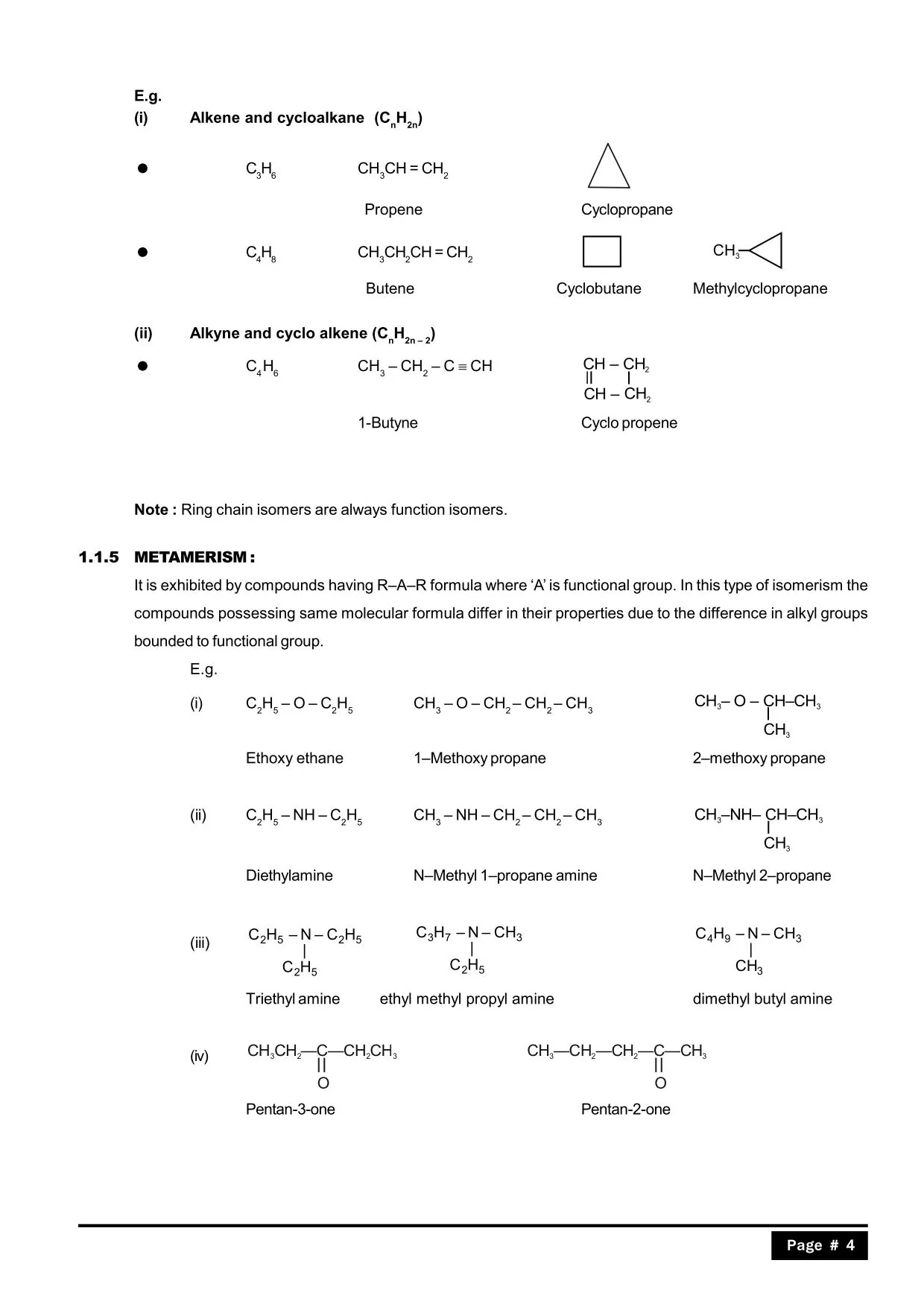
Definition: Isomers that have the same functional group but different alkyl groups on either side of the functional group. Occurs only in ethers, thioethers, secondary amines, and ketones.
Example — Diethyl ether vs Methyl propyl ether (both C₄H₁₀O):
- Diethyl ether: CH₃CH₂-O-CH₂CH₃
- Methyl propyl ether: CH₃-O-CH₂CH₂CH₃
Key fact for exams: Metamerism is a subtype of structural isomerism. Metamers always have the same functional group — this distinguishes metamerism from functional group isomerism.
5. Ring-Chain Isomerism
Definition: One isomer has a chain structure; the other has a ring structure, both with the same molecular formula.
Example — C₃H₆:
- Propene (open chain): CH₂=CH-CH₃
- Cyclopropane (ring): triangle of three CH₂ groups
This type appears more in Class 11 organic introduction and some JEE questions on cyclic vs acyclic isomers.
Stereoisomerism: Geometrical and Optical Isomerism
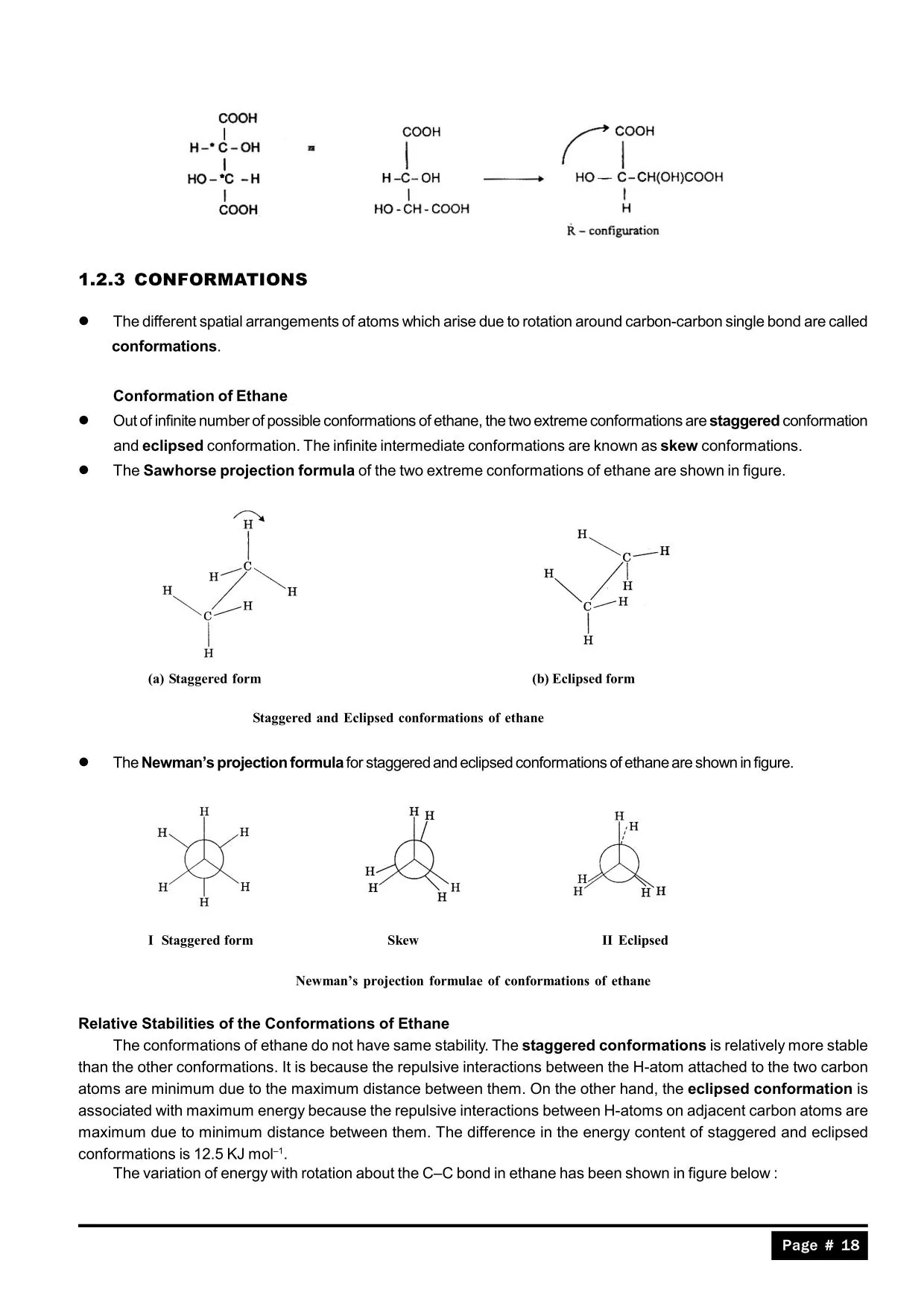
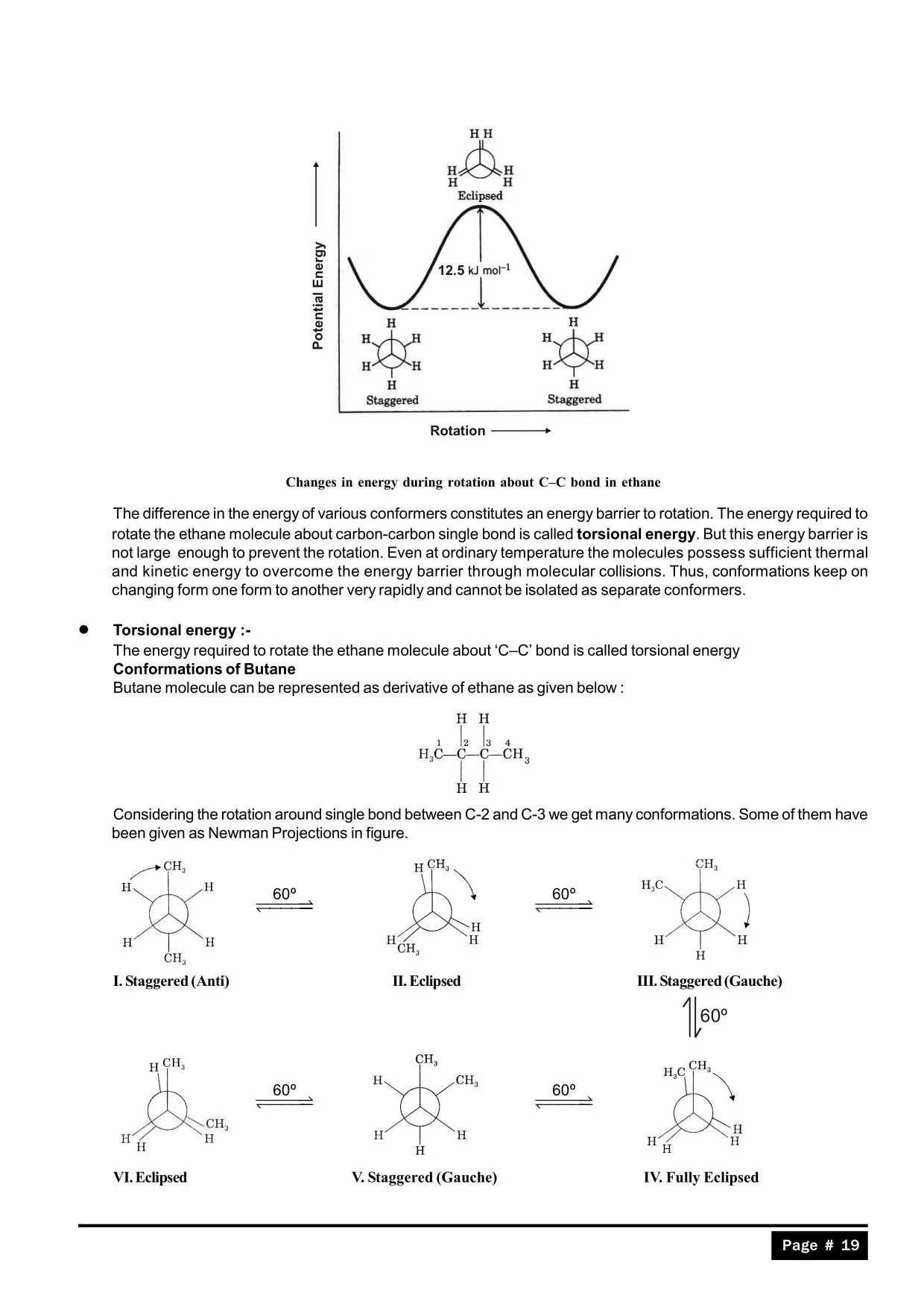
Stereoisomers have the same connectivity of atoms but differ in how atoms are arranged in three-dimensional space.
1. Geometrical Isomerism (cis-trans Isomerism)
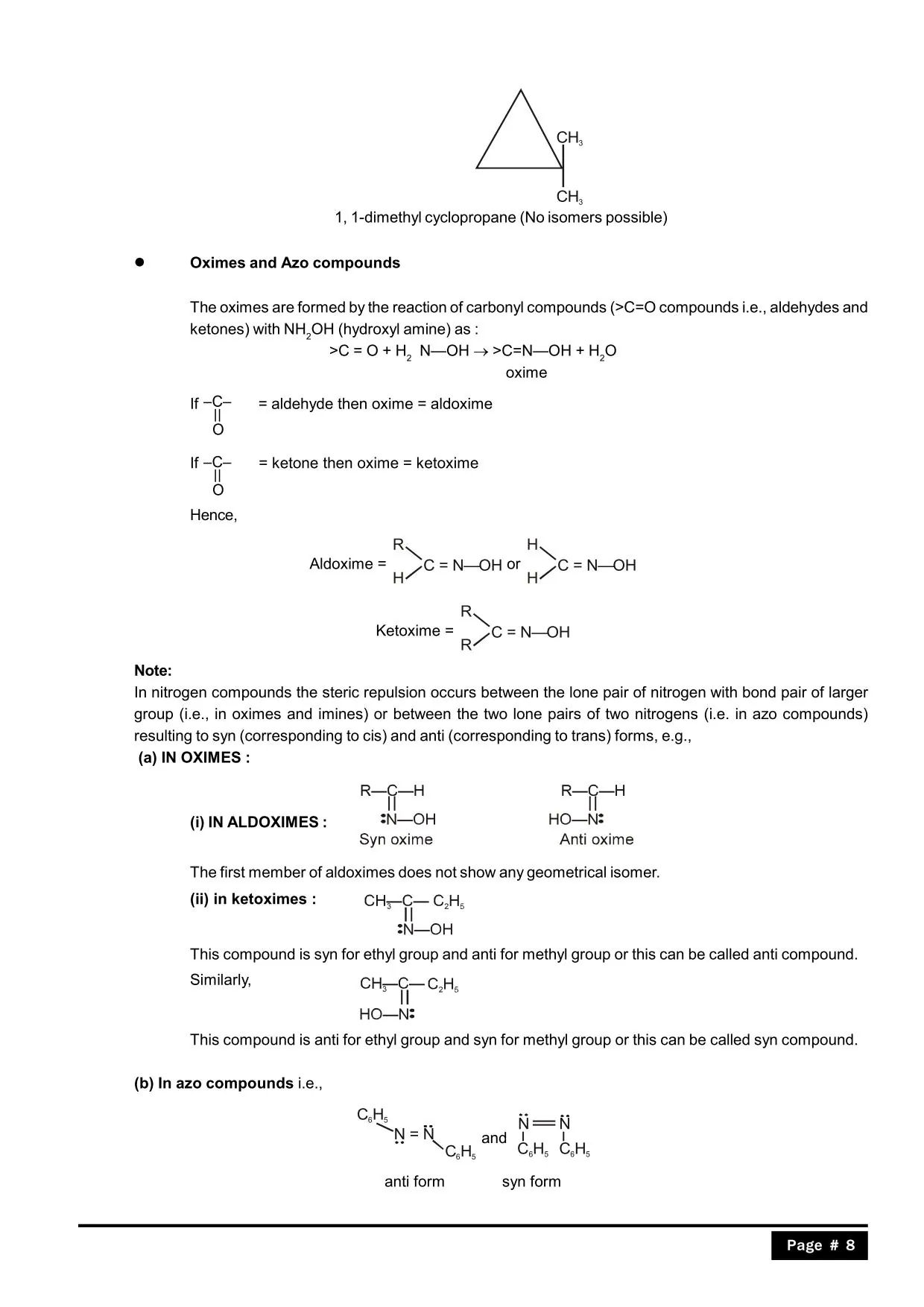
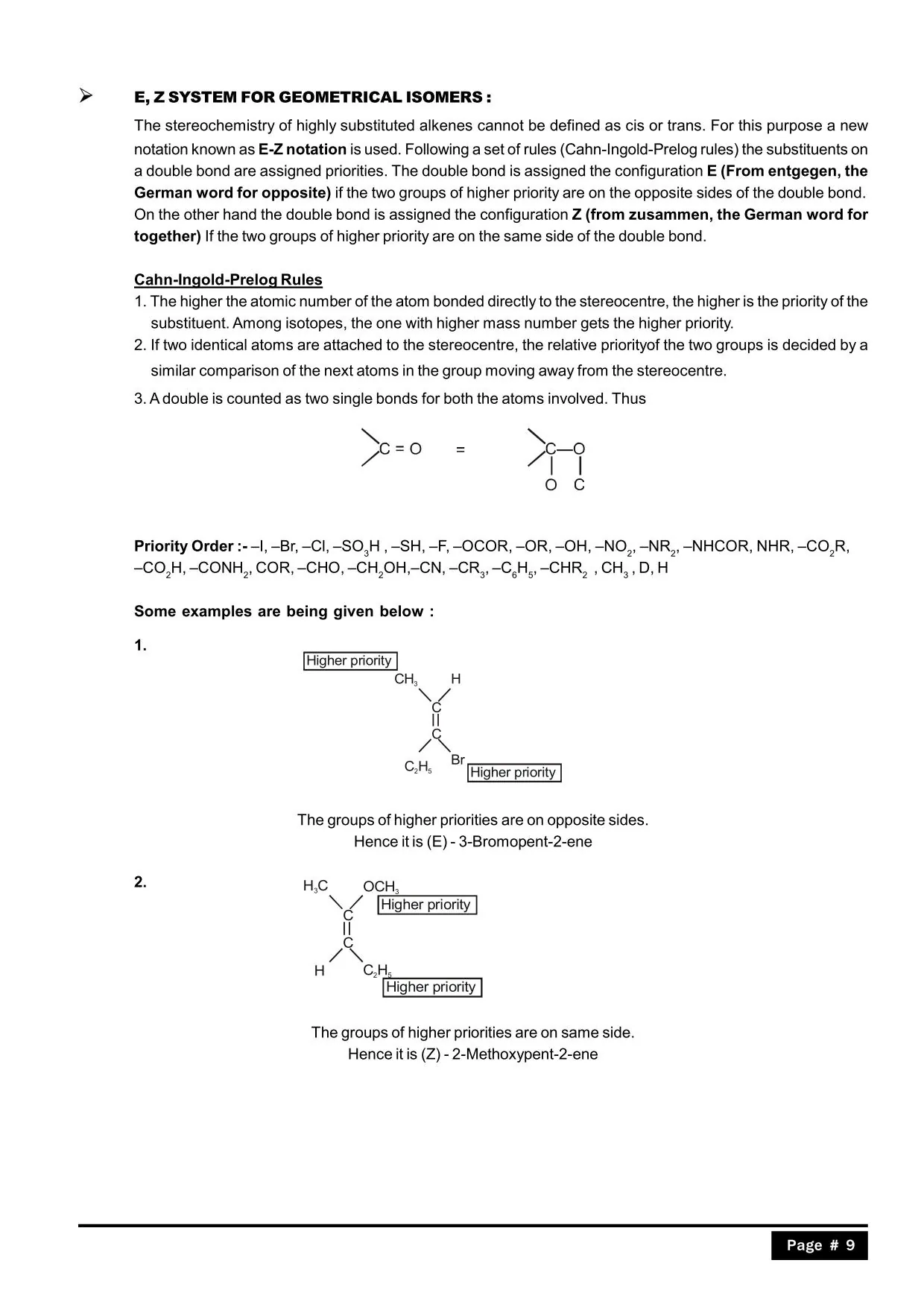
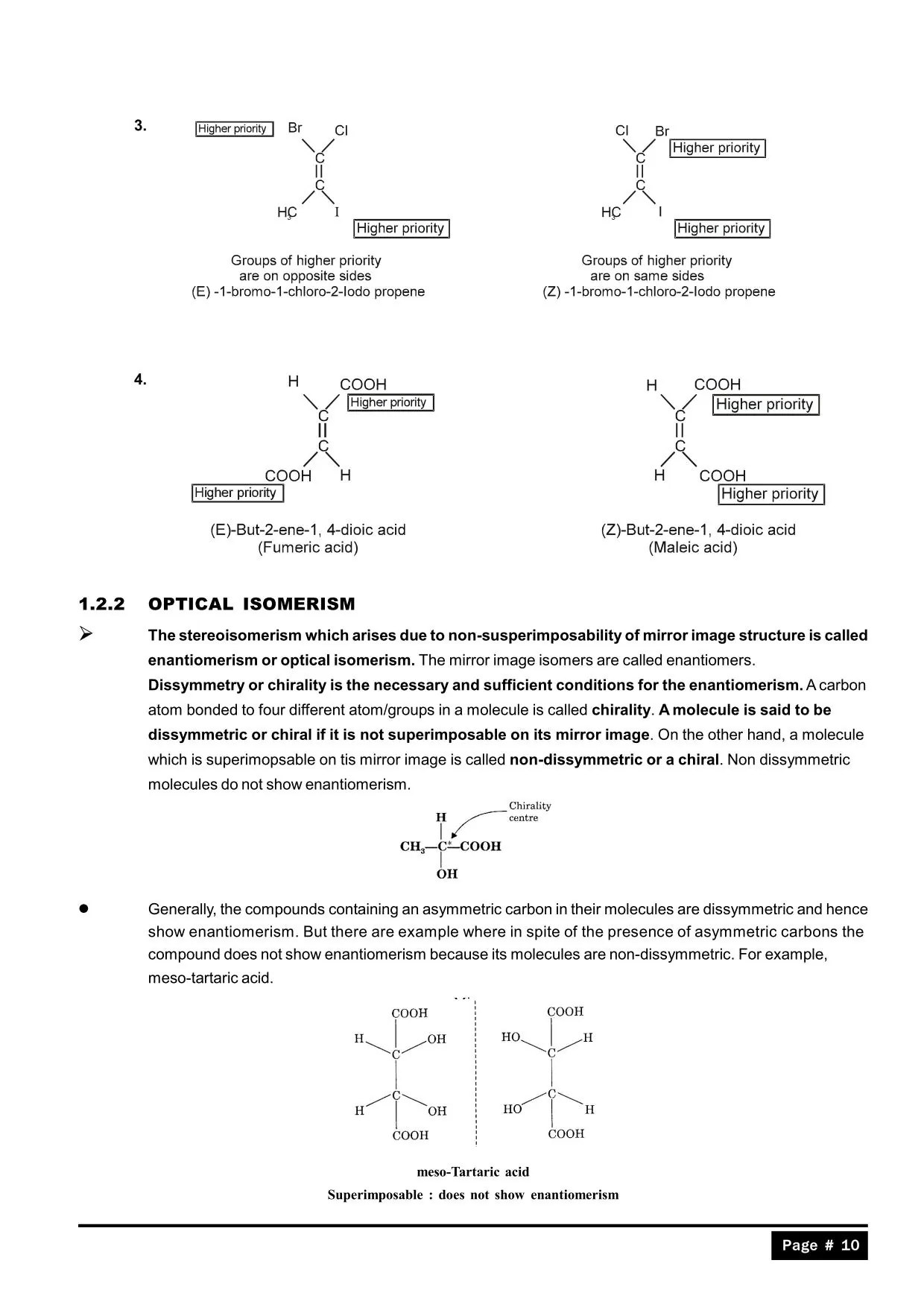
Condition for geometrical isomerism: Restricted rotation (usually due to a C=C double bond or ring) AND each carbon of the double bond must have two different groups attached.
Example — But-2-ene (C₄H₈):
| Isomer | Structure | Name |
|---|---|---|
| cis | CH₃ and CH₃ on the same side of the double bond | cis-but-2-ene |
| trans | CH₃ and CH₃ on opposite sides | trans-but-2-ene |
When does geometrical isomerism NOT exist? If either carbon of the double bond has two identical groups — for example, CH₂=CH₂ (both H's on the first carbon are identical) — no geometrical isomerism is possible.
Physical property differences between cis and trans isomers:
| Property | cis isomer | trans isomer |
|---|---|---|
| Dipole moment | Higher (bond dipoles add) | Lower (bond dipoles cancel) |
| Boiling point | Higher | Lower |
| Melting point | Lower (generally) | Higher (better packing) |
| Solubility in polar solvents | Higher | Lower |
2. Optical Isomerism
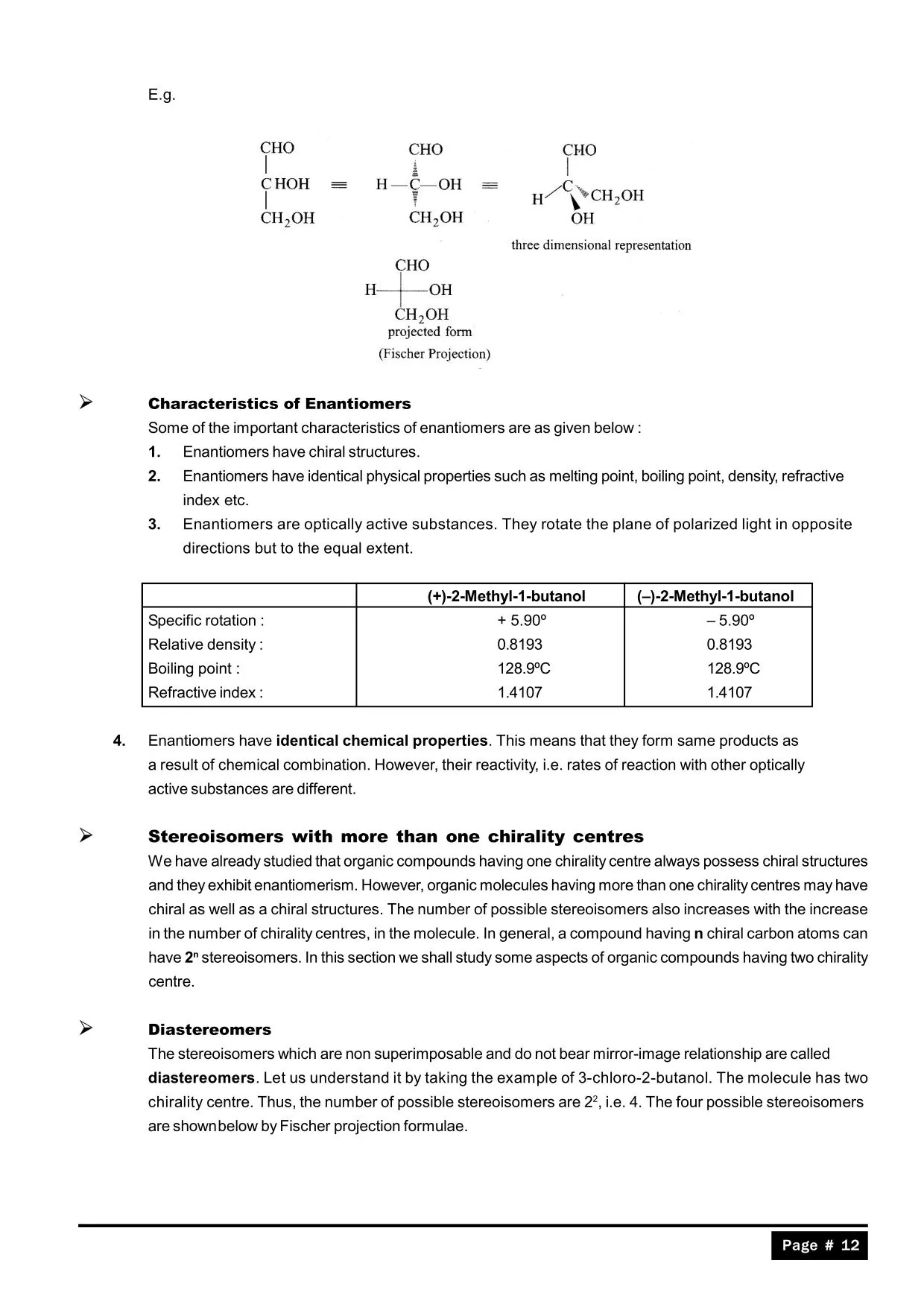
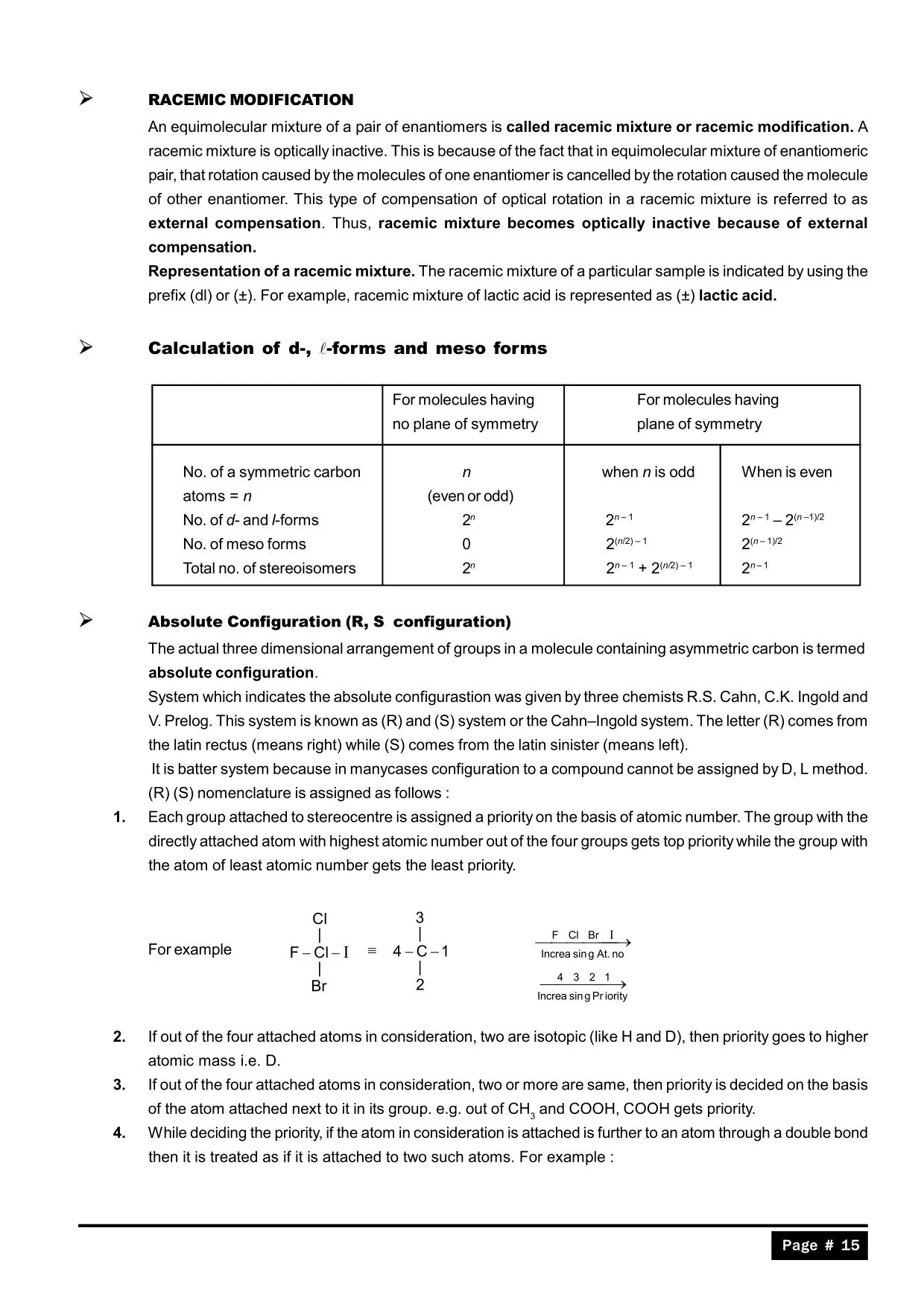
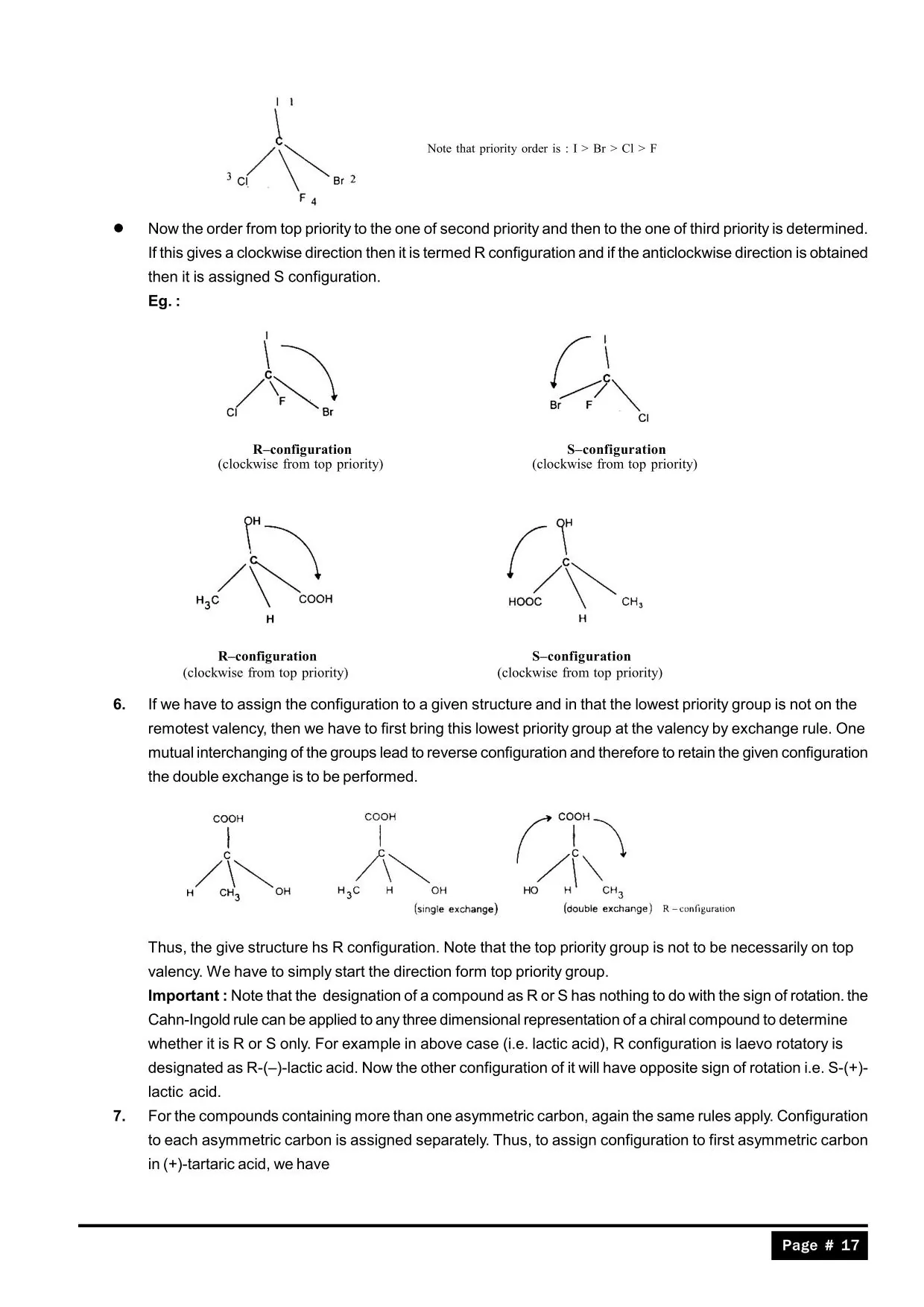
Condition: A molecule with a chiral carbon — a carbon bonded to four different atoms or groups (also called an asymmetric carbon or stereocentre).
Key terminology:
| Term | Definition |
|---|---|
| Chiral carbon | Carbon bonded to 4 different groups — denoted with * |
| Enantiomers | Mirror images of each other that are non-superimposable |
| Racemic mixture | 50:50 mixture of two enantiomers; optically inactive |
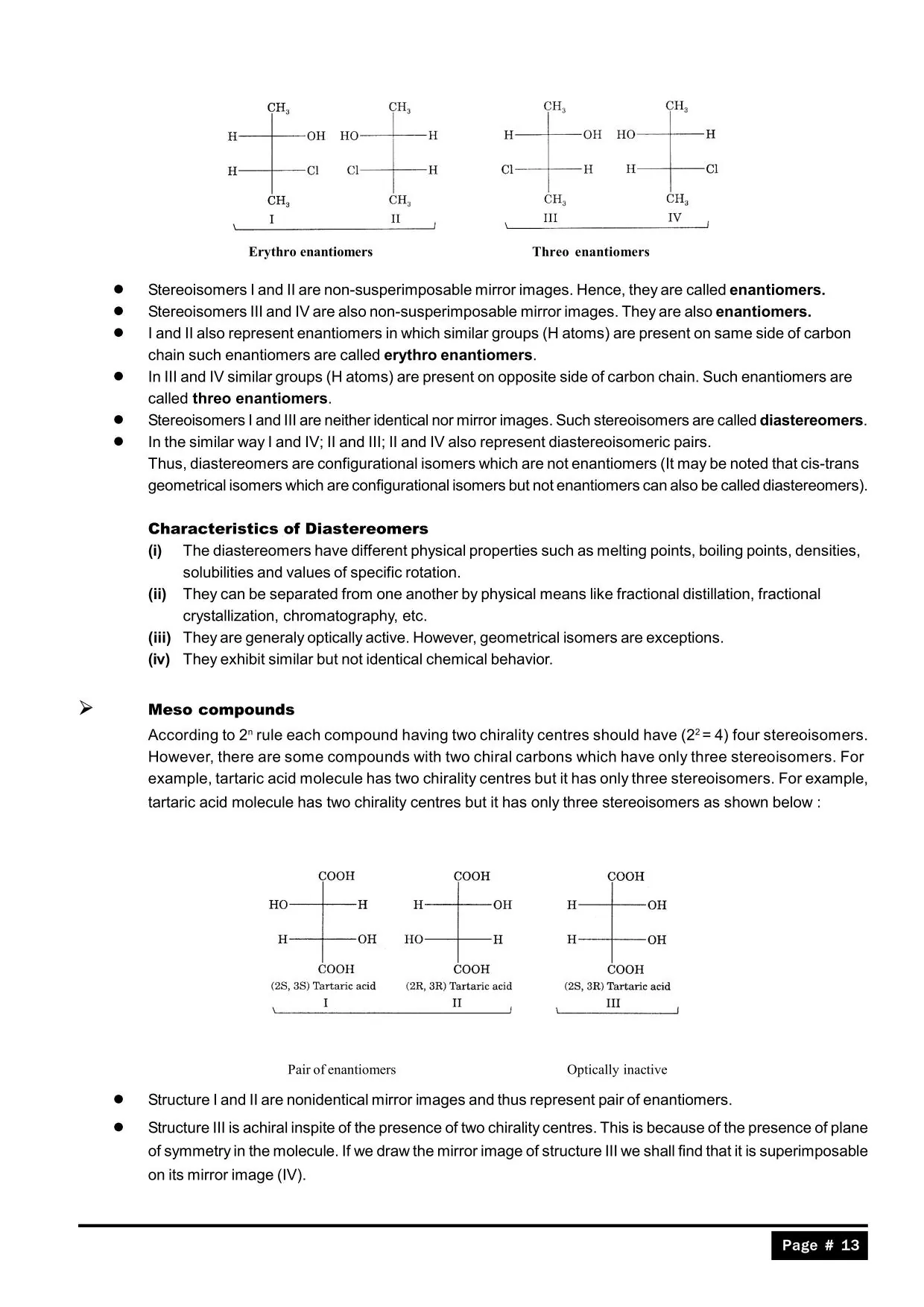
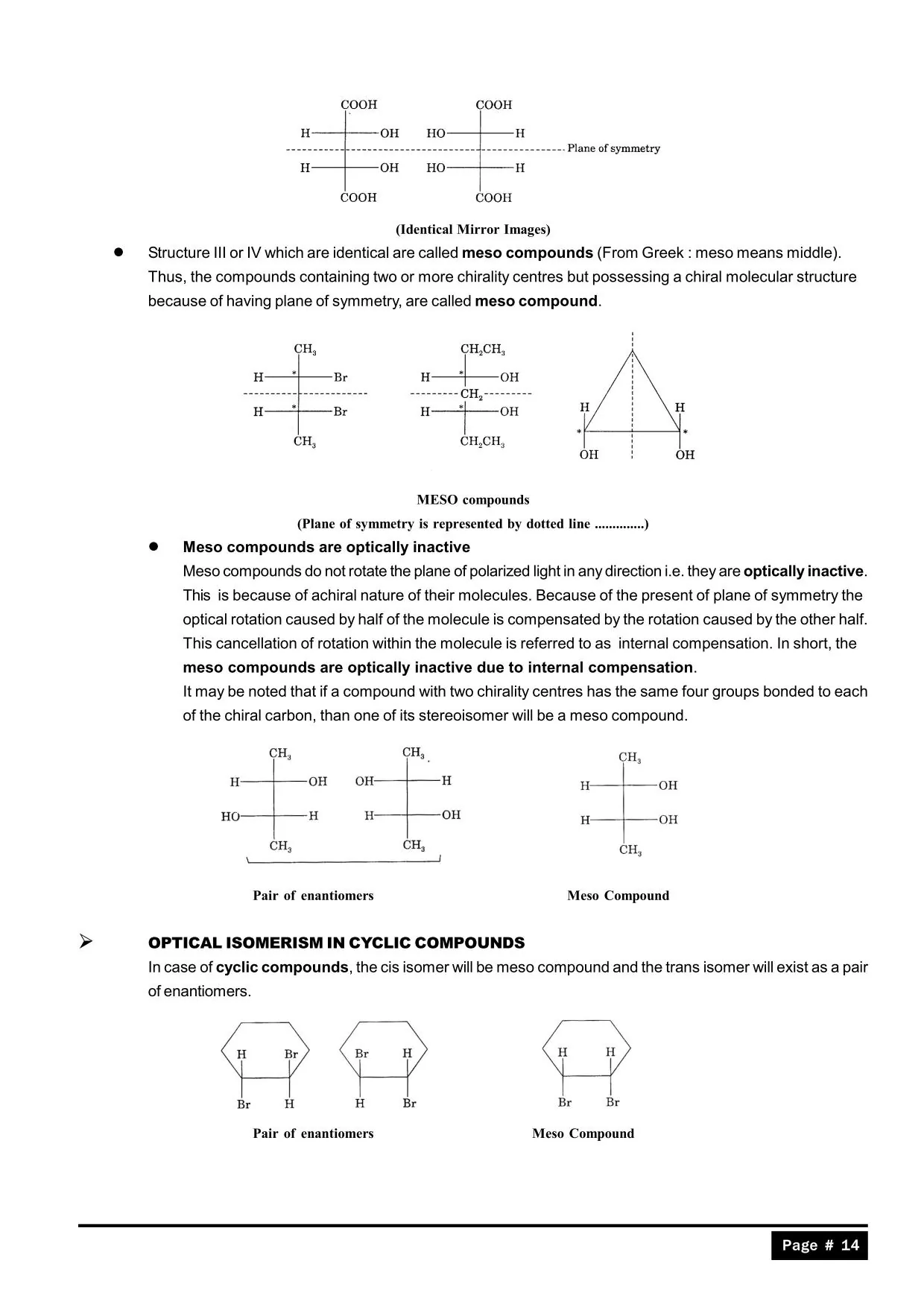
| Meso compound | Has chiral carbons but is internally symmetric; optically inactive overall |
| Dextrorotatory (+) | Rotates plane-polarised light to the right |
| Laevorotatory (−) | Rotates plane-polarised light to the left |
Example — Lactic acid (CH₃-CHOH-COOH): The central carbon is bonded to CH₃, OH, H, and COOH — four different groups. It is a chiral carbon. Lactic acid exists as two enantiomers: (+)-lactic acid and (−)-lactic acid.
Number of possible optical isomers formula:
- Maximum optical isomers = 2ⁿ (where n = number of chiral carbons)
- Exception: if the molecule has a plane of symmetry (meso form), actual isomers = less than 2ⁿ
💡 Expert Tip by eSaral Chemistry Faculty: "In JEE Advanced, optical isomerism questions often combine with mechanism questions: 'Which product is optically active?' or 'What is the configuration of the product?' This is why understanding why a carbon is chiral (not just that it is) is so important. Always check: are all four groups around that carbon genuinely different?"
Tautomerism: The Special Case
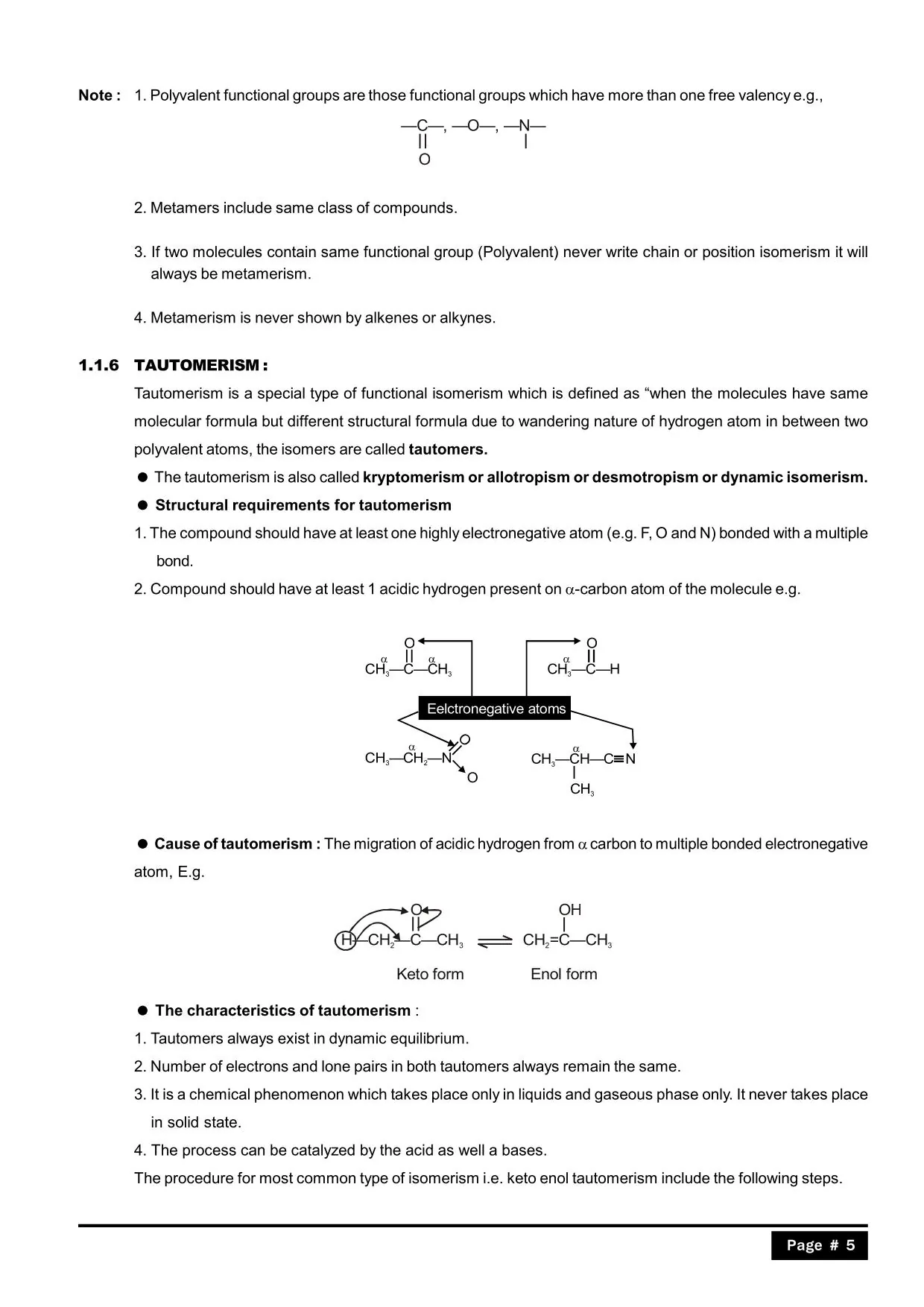
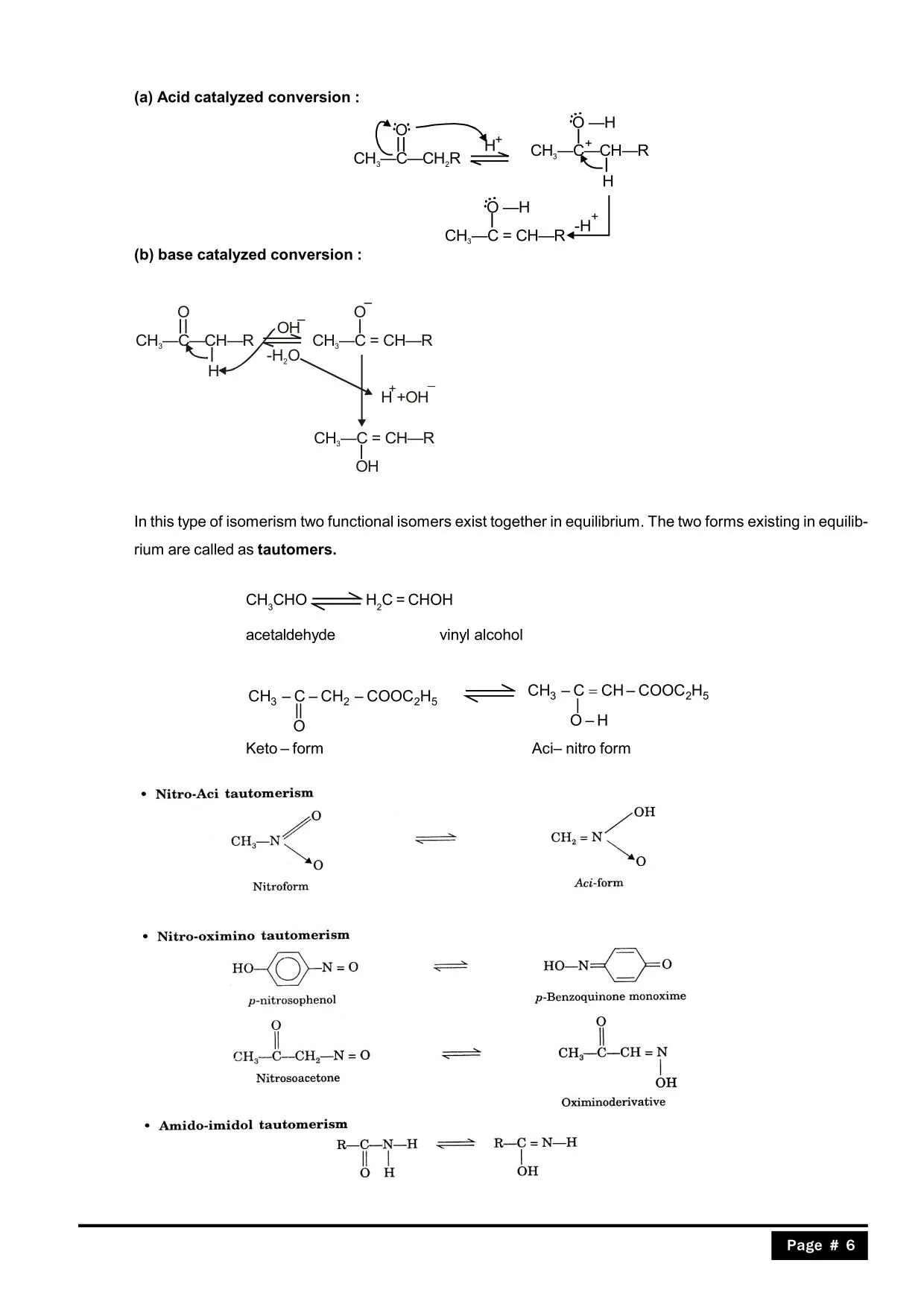
Tautomerism is a special type of isomerism where two isomers (called tautomers) interconvert rapidly and exist in dynamic equilibrium with each other.
The most important and most tested tautomeric pair in JEE and NEET is keto-enol tautomerism.
Keto-Enol Tautomerism
| Form | Structure | Characteristics |
|---|---|---|
| Keto form | Contains C=O (carbonyl) group | More stable in most cases |
| Enol form | Contains C=C and OH group | Less stable; more reactive |
Example — Acetaldehyde:
- Keto form: CH₃-CHO
- Enol form: CH₂=CH-OH
Key fact for NEET: Tautomerism requires the presence of an α-hydrogen (a hydrogen on the carbon adjacent to the carbonyl group). Without an α-hydrogen, keto-enol tautomerism is not possible.
Difference between tautomers and resonance structures:
| Tautomers | Resonance Structures |
|---|---|
| Different compounds in equilibrium | Same compound, different electron representations |
| Atoms change position (H moves) | Only electrons shift |
| Can be separated (in theory) | Cannot be separated — they are the same molecule |
Isomerism Weightage in JEE Main and NEET
| Exam | Questions Per Year | Topics Most Tested | Marks |
|---|---|---|---|
| JEE Main | 2–3 questions | Number of structural/optical isomers, geometrical isomerism conditions, optical activity | 8–12 marks |
| JEE Advanced | 1–2 questions (often multi-concept) | Chiral centres, meso compounds, stereochemistry of reaction products | 4–8 marks |
| NEET UG | 2–3 questions | Types of isomerism identification, cis-trans conditions, keto-enol tautomerism | 8–12 marks |
| CBSE Board | 3–5 marks | Definitions, examples, properties of cis vs trans | 3–5 marks |
Key Points and Quick Revision Table
Use this table the night before your exam or mock test for a rapid revision of everything in this chapter.
| Concept | Key Point to Remember |
|---|---|
| Chain isomerism | Same formula, different C skeleton (branching) |
| Position isomerism | Same skeleton + same functional group, different position |
| Functional group isomerism | Same formula, different functional groups (different series) |
| Metamerism | Same functional group, different alkyl groups on both sides |
| Geometrical isomerism condition | Restricted rotation + two different groups on each sp² carbon |
| cis isomer dipole moment | Always higher than trans (unless all groups cancel) |
| Optical isomerism condition | At least one chiral carbon (4 different groups) |
| Maximum optical isomers | 2ⁿ (n = number of chiral carbons) |
| Meso compound | Has chiral C but internal plane of symmetry → optically inactive |
| Tautomerism | Requires α-hydrogen; keto-enol is the most important pair |
| Tautomers vs resonance | Tautomers differ in atom positions; resonance differs only in electron arrangement |
| Racemic mixture | 50:50 enantiomers; optically inactive (internal cancellation) |
How to Study Isomerism for Maximum Exam Marks
Step-by-Step Study Plan
Step 1 — Learn the classification tree first (Day 1) Before reading any details, memorise the two-branch tree: Structural → (chain, position, functional group, metamerism, tautomerism) and Stereo → (geometrical, optical). Every question you will ever face fits into one of these branches. Knowing the tree tells you where to look when a question is asked.
Step 2 — Study each type with 2–3 examples (Day 1–2) For each type of isomerism, write 2–3 examples from scratch without looking at notes. If you can generate your own examples, you truly understand the concept — not just the definition.
Step 3 — Master the conditions for geometrical and optical isomerism (Day 2–3) These two types produce the most exam questions. Drill the conditions:
- Geometrical: restricted rotation + two different groups on each double-bond carbon
- Optical: chiral carbon (4 different groups) present
Practice identifying whether a given structure shows geometrical or optical isomerism — or neither.
Step 4 — Practice "how many isomers" questions (Day 3–4) JEE Main regularly asks: "How many structural isomers are possible for C₄H₈?" or "How many chiral carbons are present in this compound?" Practise these systematically. Use the eSaral app's question bank for chapter-wise practice on isomerism.
Step 5 — Solve NEET and JEE PYQs on isomerism Access the complete NEET chapter-wise PYQ collection on eSaral and filter for Organic Chemistry — isomerism questions. Solve year-by-year to see how questions are framed and which sub-topics repeat most.
Frequently Asked Questions
Find answers to common questions.
What are the types of isomerism in Class 11 Chemistry?
The two main types are structural isomerism and stereoisomerism. Structural isomerism includes chain isomerism, position isomerism, functional group isomerism, metamerism, and ring-chain isomerism. Stereoisomerism includes geometrical isomerism (cis-trans) and optical isomerism. Tautomerism is a special dynamic form of structural isomerism.
What is the difference between structural and stereo isomerism?
Structural isomers have the same molecular formula but atoms are connected in a different order — they have different connectivity. Stereoisomers have the same molecular formula and the same connectivity, but atoms are arranged differently in three-dimensional space. Enantiomers and cis-trans isomers are examples of stereoisomers.
What is the condition for geometrical isomerism in Class 11?
Two conditions must both be satisfied: first, there must be restricted rotation — usually due to a carbon-carbon double bond (C=C) or a ring structure. Second, each carbon involved in the double bond must carry two different atoms or groups. If either carbon has two identical groups, geometrical isomerism is not possible.
How many optical isomers are possible for a compound with 2 chiral carbons?
The maximum number of optical isomers is 2ⁿ where n is the number of chiral carbons. For 2 chiral carbons, the maximum is 2² = 4 optical isomers. However, if the molecule has an internal plane of symmetry (meso compound), the actual number of distinct isomers will be less than 4.
How many questions come from Isomerism in JEE Main and NEET?
Isomerism contributes 2–3 questions in JEE Main and 2–3 questions in NEET most years, making it worth 8–12 marks per exam. In JEE Advanced, it typically appears as part of multi-concept Organic Chemistry questions involving stereochemistry and reaction mechanisms.