

Syllabus Overview & Structure
Every year, millions of students appear for JEE Main, and physics is the subject that most often determines the rank gap between two equally prepared students. Knowing the exact syllabus structure is the first non-negotiable step.
The JEE Main Physics Syllabus 2026 is divided into two sections as defined by NTA
| Section | Content Type | Weightage | Units Covered |
|---|---|---|---|
| Section A | Theory & Concepts | 80% | Units 1–19 |
| Section B | Experimental Skills | 20% | Unit 20 |
Most students skip Section B, thinking it carries less weight. Don't. The 5 MCQs from experimental skills are among the most predictable questions in the paper — pattern recognition here is very high. A student who revises the 18 standard experiments in Unit 20 can virtually guarantee full marks from that section.
The syllabus spans Class 11 and Class 12 Physics equally and is closely aligned with the NCERT curriculum. Topics beyond NCERT require reference books, which we cover in the books section below.
Section A — Complete Theory Units (1–20)
Section A forms the backbone of JEE Main Physics. Below is the complete, NTA-official unit-by-unit breakdown.
Units 1–5: Mechanics Foundation
| Unit | Key Topics | Priority | |
|---|---|---|---|
| 1 | Units & Measurements | SI units, dimensional analysis, errors, significant figures | Medium |
| 2 | Kinematics | 1D & 2D motion, projectile, circular motion, relative velocity | Medium |
| 3 | Laws of Motion | Newton's laws, friction (static, kinetic, rolling), centripetal force | Medium |
| 4 | Work, Energy & Power | Work-energy theorem, elastic/inelastic collisions, spring PE | Medium |
| 5 | Rotational Motion | Torque, moment of inertia, and angular momentum conservation | Medium |
Units 6–10: Gravitation, Fluids, Thermodynamics & Waves
| Unit | Key Topics | Priority | |
|---|---|---|---|
| 6 | Gravitation | Kepler's laws, escape velocity, orbital velocity, satellites | Standard |
| 7 | Properties of Solids & Liquids | Stress-strain, Bernoulli's principle, surface tension, viscosity | Standard |
| 8 | Thermodynamics | Zeroth, first, second law; Carnot engine; reversible processes | High |
| 9 | Kinetic Theory of Gases | Ideal gas equation, RMS speed, degrees of freedom, equipartition | High |
| 10 | Oscillations & Waves | SHM, damped/forced oscillations, standing waves, Doppler effect | Standard |
Units 11–20: Electromagnetism, Optics & Modern Physics
| Unit | Key Topics | Priority | |
|---|---|---|---|
| 11 | Electrostatics | Coulomb's law, Gauss's law, capacitors, and electric potential | High |
| 12 | Current Electricity | Ohm's law, Kirchhoff's laws, Wheatstone bridge, potentiometer | High |
| 13 | Magnetic Effects & Magnetism | Biot-Savart, Ampere's law, cyclotron, galvanometer | Medium |
| 14 | EM Induction & AC | Faraday's law, LCR circuits, transformer, AC generator | Medium |
| 15 | Electromagnetic Waves | EM spectrum, displacement current, characteristics of EM waves | Standard |
| 16 | Optics | Reflection, refraction, lenses, YDSE, diffraction, polarisation | High |
| 17 | Dual Nature of Matter | Photoelectric effect, de Broglie relation, Einstein's equation | High |
| 18 | Atoms & Nuclei | Bohr model, radioactivity, mass defect, nuclear fission/fusion | High |
| 19 | Electronic Devices | Semiconductors, diodes, transistors, logic gates, Zener | High |
| 20 | Experimental Skills | 18 standard lab experiments (Section B) | High |
Section B — Experimental Skills (Unit 20)
Section B tests students on 18 standard experiments from the practical curriculum. Questions test conceptual understanding of the experiment, not memorised results. The key experiments are:
- Vernier callipers — measuring diameter and depth
- Screw gauge — thickness/diameter of thin sheet or wire
- Simple pendulum — dissipation of energy (amplitude² vs time graph)
- Metre scale — mass of object using the principle of moments
- Young's modulus of elasticity of a metallic wire
- Surface tension by capillary rise and the effect of detergents
- Coefficient of viscosity using terminal velocity
- Speed of sound using a resonance tube
- Specific heat capacity — solid and liquid by the mixture method
- Resistivity using a metre bridge
- Resistance using Ohm's law
- Figure of merit of a galvanometer (half-deflection method)
- Focal length of concave mirror, convex mirror, convex lens
- Angle of deviation vs. angle of incidence for a triangular prism
- Refractive index of a glass slab using a travelling microscope
- Characteristic curves of a p-n junction diode (forward & reverse)
- Characteristic curves of the Zener diode — reverse breakdown voltage
- Identification of a diode, an LED, a resistor, and a capacitor from a mixed set
For experiments 16–18 (semiconductor devices), understand the shape of the I-V curve rather than just theory. NTA has repeatedly tested "which curve corresponds to which device" type questions. Sketching each graph from memory three times is the most efficient preparation strategy.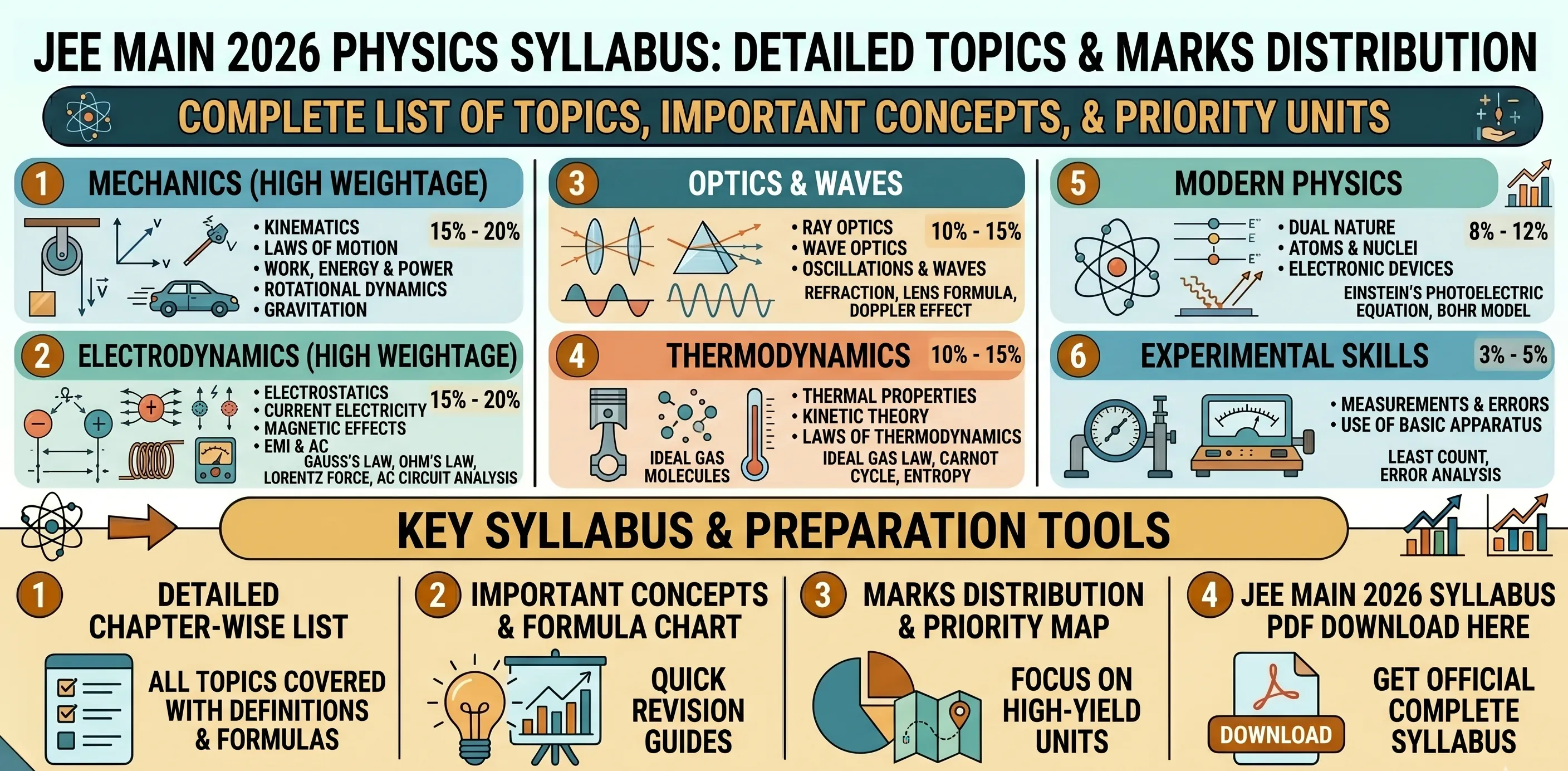
Chapter-Wise Weightage Table
Based on NTA's historical question distribution, here is the JEE Main Physics chapter-wise weightage — the single most important planning tool for any serious aspirant.
| Chapter / Topic | Questions | Total Marks | Priority |
|---|---|---|---|
| Modern Physics (Atoms, Nuclei, Dual Nature) | 5 | 20 | Highest |
| Heat & Thermodynamics | 3 | 12 | High |
| Optics | 3 | 12 | High |
| Current Electricity | 3 | 12 | High |
| Electrostatics | 3 | 12 | High |
| Magnetics | 2 | 8 | Medium |
| Units, Dimensions & Vectors | 1 | 4 | Standard |
| Kinematics | 1 | 4 | Standard |
| Laws of Motion | 1 | 4 | Standard |
| Work, Power & Energy | 1 | 4 | Standard |
| Centre of Mass, Impulse & Momentum | 1 | 4 | Standard |
| Rotation | 1 | 4 | Standard |
| Gravitation | 1 | 4 | Standard |
| Simple Harmonic Motion | 1 | 4 | Standard |
| Solids & Fluids | 1 | 4 | Standard |
| Waves | 1 | 4 | Standard |
| Electromagnetic Induction | 1 | 4 | Standard |
| Total | 30 | 120 | — |
Source: NTA official JEE Main paper analysis, compiled across sessions 2019–2026.
Which Chapters Should You Prioritise?
Not all chapters deserve equal time. Prioritisation is what separates toppers from average scorers. Here is the three-tier classification every eSaral student follows:
Tier 1 — Score Maximisers (Prepare First)
These chapters collectively account for over 55% of the Physics paper. Master them before anything else.
- Modern Physics — 20 marks. Bohr model, radioactive decay, and photoelectric effect. Very formula-dense but highly predictable.
- Electrostatics & Current Electricity — 24 marks combined. Gauss's law, Kirchhoff's laws, and potentiometer questions repeat yearly.
- Optics — 12 marks. Young's Double Slit, lens formula, and Brewster's law are annual fixtures.
- Thermodynamics + Kinetic Theory — 12 marks. Carnot engine efficiency and equipartition law questions are extremely common.
Tier 2 — Consolidators (Prepare After Tier 1)
These chapters each carry 4–8 marks. Solid preparation here pushes scores from the 85th to the 95th percentile.
- Magnetics (Biot-Savart, Ampere's law)
- EM Induction & Alternating Currents (LCR resonance, transformers)
- Rotational Motion (moment of inertia, rolling motion)
- Waves & SHM
Tier 3 — Foundational Chapters (Quick Revision)
These chapters typically contribute 1 question (4 marks) each. Revise them after Tier 1 and Tier 2 are solid — don't let them consume disproportionate time.
- Kinematics, Laws of Motion, Gravitation, Fluids, EM Waves
How to Study JEE Main Physics Effectively?
The question every student in Class 11 or 12 asks: mere paas time kaha hai — and the answer is always the same: time is not the constraint; strategy is.
Step 1: Cover the NCERT Thoroughly First
Every JEE Main Physics concept is rooted in the NCERT. Read each chapter once for understanding, then once for derivations. Do all in-text examples. This alone builds 60–65% of your physics foundation.
Step 2: Follow a Chapter Sequence Based on Weightage
Don't follow the textbook order. Follow Mark's order. Start with Modern Physics, Electrostatics, Current Electricity, and Optics — then move to the rest.
Step 3: Solve Previous Year Questions Chapter-Wise
JEE Main repeats concepts (not questions) with striking regularity. Solving the last 7 years of JEE Main previous year papers chapter-wise is the single highest-ROI activity in your preparation.
| Week | Focus Area | Target |
|---|---|---|
| Weeks 1–4 | Modern Physics + Thermodynamics | Complete theory + 200 PYQs |
| Weeks 5–8 | Electrostatics + Current Electricity | Complete theory + 250 PYQs |
| Weeks 9–12 | Optics + EM Induction + Magnetics | Complete theory + 200 PYQs |
| Weeks 13–16 | Mechanics (All Tier 2 & 3 chapters) | Complete theory + 300 PYQs |
| Weeks 17–20 | Full mock tests + Revision | 3 mocks/week + weak chapter revision |
Step 4: Use Formula Sheets and Mind Maps for Revision
The last 30 days before the exam should be pure revision, not fresh learning. eSaral's JEE Main revision notes and mind maps are built specifically for this phase. Each chapter's key formulas, exceptions, and common question types are on a single sheet.
Step 5: Attempt Full-Length Mocks Under Exam Conditions
JEE Main tests speed and accuracy together. Attempting at least 20 full-length mocks before the exam is non-negotiable. Analyse every mock for error type — silly mistakes vs. concept gaps — and attack the root cause, not the symptom.
Best Books for JEE Main Physics 2026
The right books for JEE Physics are the ones you actually finish — not the most popular ones on YouTube. Here is a faculty-curated list:
| Book | Author | Best For | Level |
|---|---|---|---|
| Concepts of Physics Vol. I & II | H.C. Verma | Concept clarity + problem practice | Core |
| Fundamentals of Physics | Halliday, Resnick & Walker | Deep understanding of theory | Core |
| Understanding Physics Series | D.C. Pandey (Arihant) | Chapter-wise solved + unsolved problems | Core |
| Problems in General Physics | I.E. Irodov | Advanced problem-solving (JEE Advanced level) | Advanced |
| IIT JEE Physics | D.C. Pandey | Conceptual cclarityis highly used by toppers | Core |
For most students, H.C. Verma + D.C. Pandey + Previous Year Questions is the ideal combination. Irodov is excellent, but use it only after the other two are ccompletee and you're targeting JEE Advanced alongside JEE Main.
Prepare with IIT Bombay Faculty
If you want structured JEE preparation taught by faculty who have cracked JEE from the inside — AIR-41 — eSaral's JEE Online Course is built exactly for you.
Explore JEE Courses →Students aiming beyond JEE Main can extend this preparation with our Irodov questions for JEE, which covers the same topics at a tougher, JEE Advanced level.
Explore the complete JEE Main syllabus and chapter-wise previous year questions on eSaral to continue your preparation.