Start Prep From 0 & Get IIT Bombay with Most Powerful JEE Dropper Course

Limit - JEE Advanced Previous Year Questions with Solutions


Limit questions in JEE Advanced appear almost every year, typically 1–2 questions per paper, testing techniques like L'Hôpital's Rule, Taylor/Maclaurin expansion, Squeeze Theorem, and standard algebraic manipulation. This page covers all JEE Advanced Previous Year Questions on Limits, with complete step-by-step solutions.
Limit - JEE Advanced Previous Year Questions with Solutions

eSaral > JEE Advanced PYQ > Limits

🚀 Checkout eSaral Courses

JEE Advanced Previous Year Questions of Math with Solutions are available at eSaral. Practicing JEE Advanced Previous Year Papers Questions of mathematics will help the JEE aspirants in realizing the question pattern as well as help in analyzing weak & strong areas. eSaral helps the students in clearing and understanding each topic in a better way. eSaral also provides complete chapter-wise notes of Class 11th and 12th both for all subjects. Besides this, eSaral also offers NCERT Solutions, Previous year questions for JEE Main and Advance, Practice questions, Test Series for JEE Main, JEE Advanced and NEET, Important questions of Physics, Chemistry, Math, and Biology and many more. Download eSaral app for free study material and video tutorials.

Q. Let $\mathrm{L}=\lim _{x \rightarrow 0} \frac{\mathrm{a}-\sqrt{\mathrm{a}^{2}-\mathrm{x}^{2}}-\frac{\mathrm{x}^{2}}{4}}{\mathrm{x}^{4}}, \mathrm{a}>0 .$ If $\mathrm{L}$ is finite, then $:-$ (A) a = 2 (B) a = 1 (C) $\mathrm{L}=\frac{1}{64}$ (D) $\mathrm{L}=\frac{1}{32}$ [JEE 2009, 4]
Ans. (A,C) $\mathrm{a}-\mathrm{a}\left(1-\frac{\mathrm{x}^{2}}{\mathrm{a}^{2}}\right)^{\frac{1}{2}}-\frac{\mathrm{x}^{2}}{4} \quad \mathrm{a}-\mathrm{a}\left(1-\frac{\mathrm{x}^{2}}{2 \mathrm{a}^{2}}-\frac{1}{8} \frac{\mathrm{x}^{4}}{\mathrm{a}^{4}}\right)-\frac{\mathrm{x}^{2}}{4}$ $\mathrm{a}=2,\left(\mathrm{coefficient} \text { of } \mathrm{x}^{2}=0\right)$ $\therefore \mathrm{L}=\frac{1}{64}$
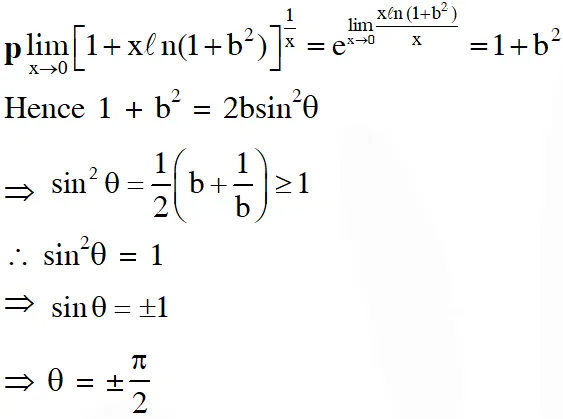
Q. If $\lim _{x \rightarrow 0}\left[1+x \ell n\left(1+b^{2}\right)\right]^{\frac{1}{x}}=2 b \sin ^{2} \theta, b>0$ and $\theta \in(-\pi, \pi],$ then the value of $\theta$ is- [JEE 2011, 3M, –1M]
Ans. (D)
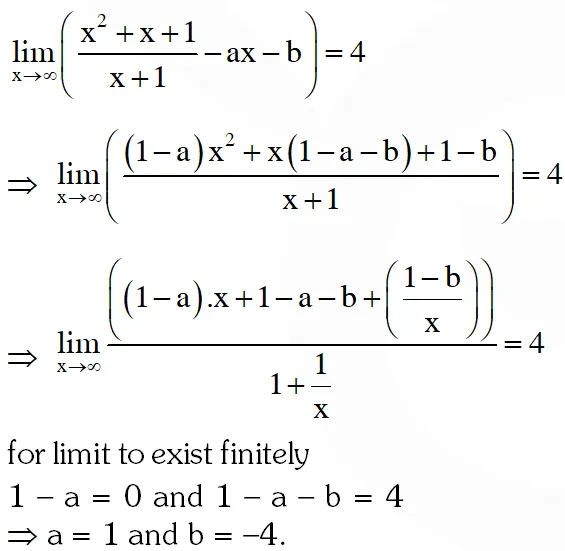
Q. If $\lim _{x \rightarrow \infty}\left(\frac{x^{2}+x+1}{x+1}-a x-b\right)=4,$ then $-$ (A) a = 1, b = 4 (B) a = 1, b = –4] (C) a = 2, b = –3 (D) a = 2, b = 3 [JEE 2012, 3M, –1M]
Ans. (B)
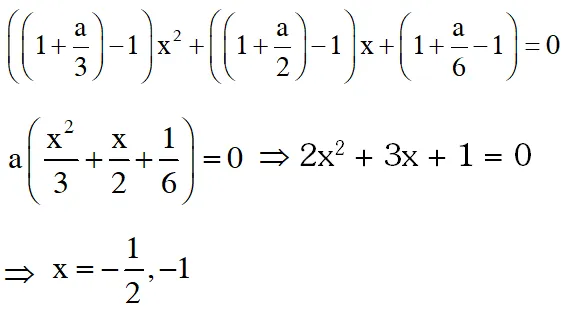
Q. Let $\alpha(\mathrm{a})$ and $\beta(\mathrm{a})$ be the roots of the equation $(\sqrt[3]{1+a}-1) x^{2}+(\sqrt{1+a}-1) x+(\sqrt[6]{1+a}-1)=0$ where $a>-1 .$ Then $\lim _{a \rightarrow 0^{+}} \alpha(a)$ and $\lim _{a \rightarrow 0^{+}} \beta(a)$ are (A) $-\frac{5}{2}$ and 1 (B) $-\frac{1}{2}$ and $-1$ (C) $-\frac{7}{2}$ and 2 (D) $-\frac{9}{2}$ and 3 [JEE 2012, 3M, –1M]
Ans. (B)
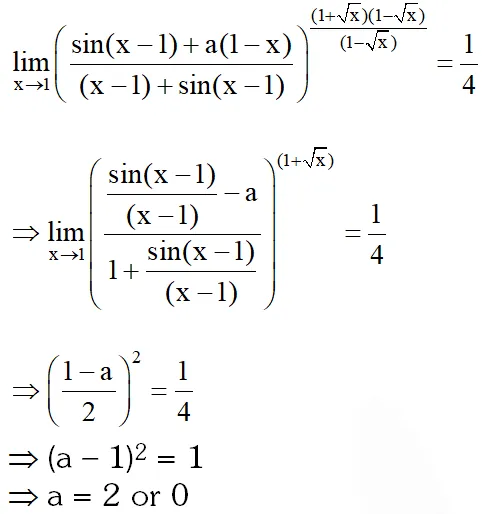
Q. The largest value of the non-negative integer a for which $\lim _{x \rightarrow 1}\left\{\frac{-a x+\sin (x-1)+a}{x+\sin (x-1)-1}\right\}^{\frac{1-x}{1-\sqrt{x}}}=\frac{1}{4}$ is [JEE(Advanced)-2014, 3]
Ans. 0
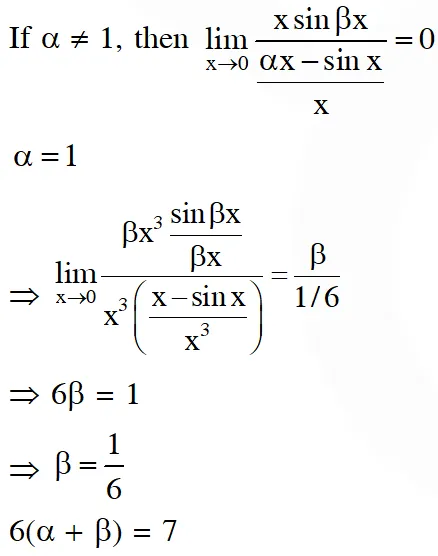
Q. Let $\alpha, \beta \in \mathrm{R}$ be such that $\lim _{x \rightarrow 0} \frac{x^{2} \sin (\beta x)}{\alpha x-\sin x}=1 .$ Then $6(\alpha+\beta)$ equals [JEE(Advanced)-2016]
Ans. 7
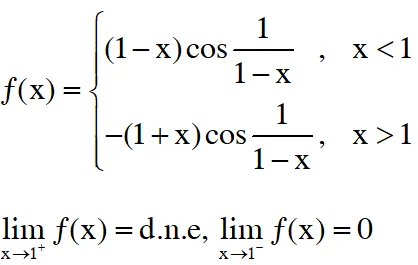
Q. Let $\mathrm{f}(\mathrm{x})=\frac{1-\mathrm{x}(1+|1-\mathrm{x}|)}{|1-\mathrm{x}|} \cos \left(\frac{1}{1-\mathrm{x}}\right)$ for $\mathrm{x} \neq 1 .$ Then [JEE(Advanced)-2017]
Ans. (A,C)
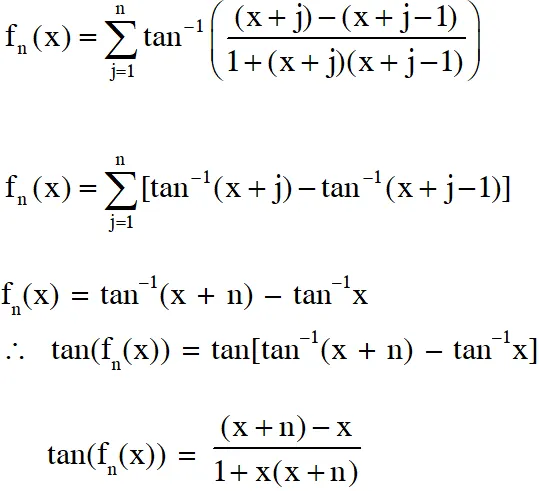
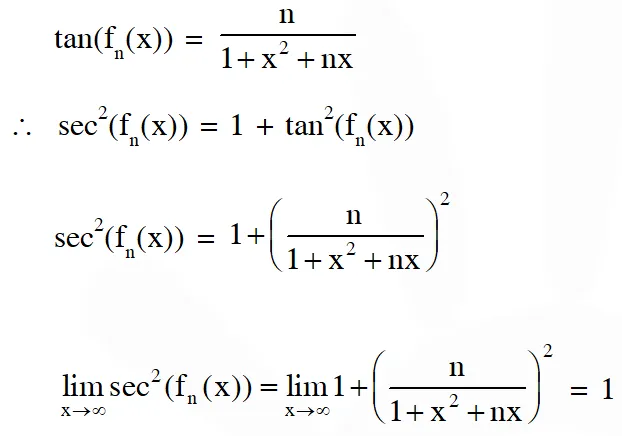
Q. For any positive integer n, define $f_{\mathrm{n}}:(0, \infty) \rightarrow \square$ as $f_{\mathrm{n}}(\mathrm{x})=\sum_{\mathrm{j}=1}^{\mathrm{n}} \tan ^{-1}\left(\frac{1}{1+(\mathrm{x}+\mathrm{j})(\mathrm{x}+\mathrm{j}-1)}\right)$ for all $\mathrm{x} \in(0, \infty)$ (Here, the inverse trigonometric function $\tan ^{-1} \mathrm{x}$ assume values in $\left(-\frac{\pi}{2}, \frac{\pi}{2}\right) .$ ) Then, which of the following statement(s) is (are) TRUE? (A) $\sum_{j=1}^{5} \tan ^{2}\left(f_{j}(0)\right)=55$ (B) $\sum_{j=1}^{10}\left(1+f_{j}^{\prime}(0)\right) \sec ^{2}\left(f_{j}(0)\right)=10$ (C) For any fixed positive integer $n, \lim _{x \rightarrow \infty} \tan \left(f_{\mathrm{n}}(x)\right)=\frac{1}{n}$ (D) For any fixed positive integer $n, \operatorname{limsec}_{x \rightarrow \infty} \operatorname{ec}^{2}\left(f_{\mathrm{n}}(x)\right)=1$ [JEE(Advanced)-2018]
Ans. (D)
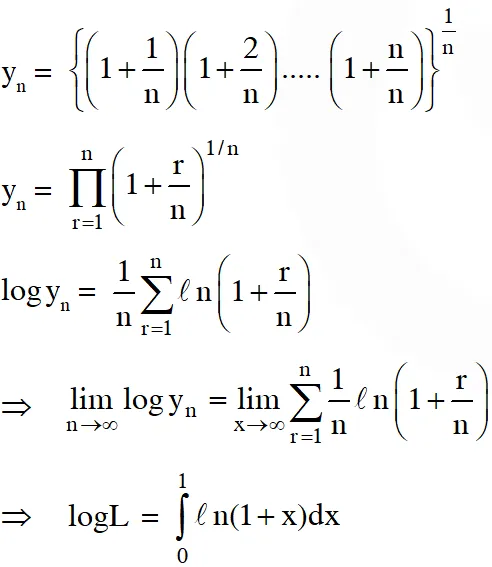
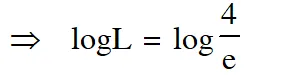
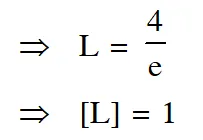
Q. For each positive integer $n,$ let $y_{n}=\frac{1}{n}(n+1)(n+2) \ldots(n+n)^{1 / n}$ For $x \in \square,$ let $[x]$ be the greatest integer less than or equal to $x$. If $\lim _{n \rightarrow \infty} y_{n}=L,$ then the value of $[L]$ is [JEE(Advanced)-2018]
Ans. 1

Frequently Asked Questions

Find answers to common questions.

Is L'Hôpital's Rule enough for JEE Advanced, or do I need Taylor series?

L'Hôpital's Rule alone is not enough. While it solves $\frac{0}{0}$ and $\frac{\infty}{\infty}$ forms, many JEE Advanced problems require Taylor series to identify the exact order at which cancellation occurs (like Q1). L'Hôpital can also be circular in some forms. Use Taylor series as your primary tool and L'Hôpital as a backup.

Which technique is most important for JEE Advanced Limits?

Taylor/Maclaurin series expansion is the most frequently rewarded technique in JEE Advanced Limits problems. It handles $\frac{0}{0}$ forms faster than L'Hôpital and is essential for multi-order cancellation problems like Q1 (2009). Prioritise memorising expansions up to the 4th order for $\sin x$, $\cos x$, $e^x$, and $\ln(1+x)$.

How many questions on Limits appear in JEE Advanced each year?

Typically 1–2 questions per paper (Paper 1 and Paper 2 combined), carrying 3–4 marks each. Some years include a Limits question within a paragraph-based set. Over the 2009–2023 window, Limits questions appeared in at least 12 out of 15 years, making it one of the most consistent calculus topics.

Where can I find more JEE Advanced Maths PYQs with solutions?

All JEE Advanced Mathematics PYQs with solutions are available on eSaral, organised chapter-wise. You can also access the NCERT Solutions for Class 12 Maths for foundation building, and the NCERT Solutions for Class 11 Maths for introductory limit theorems. The official JEE Advanced question papers are published by the organising IIT on jeeadv.ac.in.

How should I use JEE Advanced PYQs effectively for Limits revision?

Attempt each question with a strict 5-minute timer before reading the solution. After solving, identify which technique you used and whether a faster route existed. Group questions by technique (Taylor, L'Hôpital, Squeeze, Infinity) and revisit each group in the week before the exam. eSaral's structured topic-wise tests use this exact methodology in the Advanced batch.

What is the Squeeze Theorem, and when does it appear in JEE Advanced?

The Squeeze Theorem states: if $g(x) \leq f(x) \leq h(x)$ and $\lim g(x) = \lim h(x) = L$, then $\lim f(x) = L$. It appears in JEE Advanced when oscillating functions like $\sin(1/(1-x))$ or $\cos(1/x)$ are bounded by factors approaching zero. JEE Advanced 2017 Q7 is the clearest example from recent papers.

Leave a comment

Comments

Sangram keshari rout
Aug. 5, 2024, 6:35 a.m.
Halei ki muha re pakeidebi Tara banda Kati phopadidebi
Sangram keshari rout
Aug. 5, 2024, 6:35 a.m.
To bou bia
Sangram keshari rout
Aug. 5, 2024, 6:35 a.m.
Gandi Mara bokachoda......
Suyash singh
Aug. 3, 2022, 9:19 p.m.
Sir ek 2015 wala ques bhi upload kr do , m/n wala
Aniket Sadgir
Oct. 5, 2023, 11:55 a.m.
Ok
Pratyaksha881
Jan. 28, 2022, 6:03 p.m.
Thank you for the Content!!
renu
Aug. 16, 2021, 5:47 p.m.
for last 4th question the best approach is to use expansions ... it will make it very simple .
Anonymous
Feb. 11, 2021, 7:24 p.m.
Preferably....make some appropriation in the website and thank you for the questions despite of those problems.. keep it it up buddy
Sushanth
Oct. 22, 2020, 9:52 p.m.
In last problem if we apply sandwich rule that will be more easy
Vivek
Aug. 16, 2020, 10:13 p.m.
For anyone having problems seeing the questions, right-click on the equation part, click “Show Math as”, then click “MathML code”. Copy all the text in the new window that opens with Ctrl+A. Now open a new tab and type in this URL: http://www.wiris.com/editor/demo/en/developers. And paste whatever you copied! Woila! Thank me later!
Manmath
Aug. 10, 2020, 1:51 p.m.
questions are not clear
None